


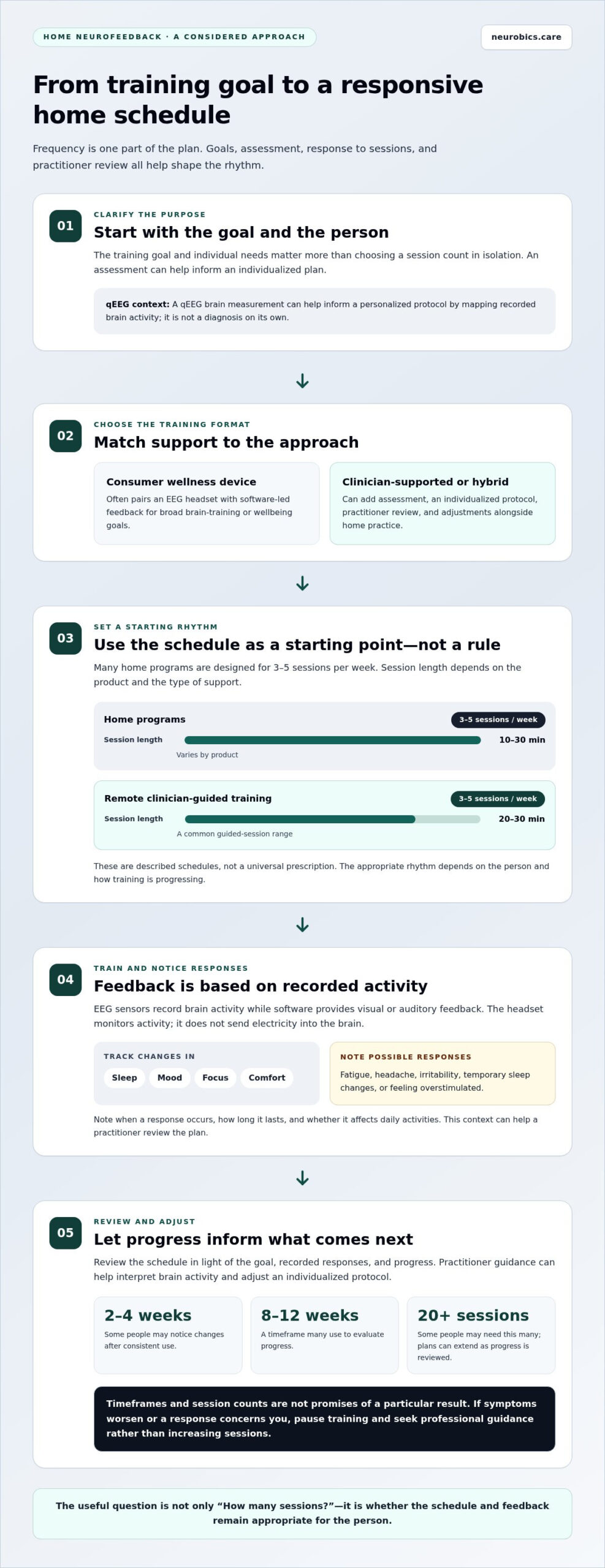
More sessions aren’t automatically better. Guided home neurofeedback is commonly scheduled 3-5 times per week, with sessions often lasting 20-30 minutes, but the right rhythm depends on the person’s needs and how training is progressing. An individualized plan can help shape the schedule rather than relying on a one-size-fits-all routine.
It makes sense to want a clear answer before committing to regular training. Frequency matters, but so do your goals, an appropriate assessment, and practitioner guidance that keeps the process considered and responsive.
This article explains how often home neurofeedback is typically used, why session needs vary, and what to expect when tracking progress. It also covers how assessment and ongoing guidance can support a personalized approach, including when remote professional support may be useful.
Key Takeaways
- Choose training frequency based on the purpose, assessment, and your response, rather than assuming one schedule fits everyone.
- Consumer wellness devices and clinician-supported training differ in how feedback is interpreted and protocols are tailored.
- Notice and track changes in sleep, mood, focus, or comfort during training so they can inform adjustments.
- Practitioner guidance can help interpret brain activity, plan an individualized protocol, and respond to difficulties.
- Self-guided tools may suit some beginners, while structured support can add assessment and ongoing oversight.
How many sessions of neurofeedback training are needed?
Home options include consumer wellness devices, clinician-supported programs, and hybrid training that combines home practice with professional sessions. Consumer systems often pair an EEG headset with software. Clinician-supported plans can also include assessment, an individualized protocol, and practitioner review.
There isn’t one session count for everyone. Many home programs are designed for 3-5 sessions per week, with sessions lasting 10-30 minutes depending on the product. Remote clinician-guided training typically uses 3-5 sessions per week, often lasting 20-30 minutes each.
In a typical session, EEG sensors record brain activity while software provides visual or auditory feedback. For example, a display may respond to changes in the measured brainwave signal during an activity such as watching an animation. The headset monitors activity; it does not send electricity into the brain.
Session frequency is only one part of the plan. The training goal, response to sessions, and how progress is reviewed can all shape the schedule. Some people may notice changes after 2-4 weeks of consistent use, while many evaluate progress over 8-12 weeks. These timeframes are not a promise of a particular result.
Consumer wellness devices generally provide software-led feedback for broad brain-training or wellbeing goals. Clinician-supported home training can add professional interpretation and adjustments based on individual needs. A qEEG brain measurement can help inform a personalized protocol by mapping recorded brain activity, but it is not a diagnosis on its own.
Hybrid neurofeedback combines at-home exercises with professional sessions. This gives a practitioner opportunities to review training and adjust the plan while the person practises at home. For example, someone working on focus might train at home between professional reviews, with progress considered across both settings.
Some people may need 20 or more training sessions, and plans can extend beyond an initial period as progress is reviewed. The useful question is not simply how many sessions to complete, but whether the schedule and feedback remain appropriate for the person. A personalized plan connects session frequency, assessment, and practitioner support without treating a general device schedule as a clinical protocol.
Is it Safe to Do Neurofeedback Training at Home on Your Own?
Home training uses EEG sensors to monitor brain activity and provide feedback; it does not send electricity into the brain. Neurobics’ system is non-invasive and passive. Safe use also depends on following the equipment instructions and having support that can respond to your needs.
Potential Benefits and Limitations
Neurofeedback uses feedback to help people practise self-regulation, including attention and emotional regulation. It has been explored for concerns such as anxiety, depression, and stress, but evidence remains inconclusive and outcomes vary between people.
That distinction matters when choosing a goal. Someone experiencing stress, for example, might use training as a complementary approach, not a replacement for established care. Neurofeedback is not a cure, and a device’s feedback does not establish a diagnosis or show that symptoms will improve.
Possible Responses and Safety Considerations
Responses during or after training can include fatigue, headache, irritability, temporary sleep changes, or feeling overstimulated. Note when a response occurs, how long it lasts, and whether it affects daily activities. This gives a practitioner useful context.
Device instructions matter, but they do not replace individual oversight. People with neurological conditions should consult a professional before starting home training. Do not stop medical or mental health care while using neurofeedback without professional advice.
Self-guided use also has limits: inaccurate monitoring or interpretation can make feedback less useful. If symptoms worsen or a response concerns you, pause training and seek professional guidance rather than increasing sessions.
Safety Considerations for Children
Children need age-appropriate equipment, adult involvement, and training suited to their needs. Some programs may be suitable for children as young as 3 or 4 years old, depending on the provider; age alone doesn’t determine readiness.
For a child, a caregiver can observe changes in sleep, mood, attention, or comfort after sessions. Record fatigue, headache, irritability, or sleep changes and discuss them with a practitioner. A child’s training should not displace existing medical or mental health care.
Professional guidance can help families interpret responses and decide whether the training approach remains appropriate. For a conversation about remote support, use the neurofeedback contact page.
Professional equipment and practitioner guidance
Choose a provider who explains the equipment, protocol, and monitoring process in plain language. A useful discussion covers who interprets the EEG data, how responses are reviewed, and how comfort is considered during training.
Professional Equipment and EEG Monitoring
EEG sensors placed on the scalp record brain activity in real time. In remote neurofeedback, a cap can measure activity while the participant and coach connect by video. The sensors monitor signals; they do not send electricity into the brain. Knowing this helps clarify what the equipment does during a session.
Before training begins, clarify the equipment’s manufacturer, model, intended use, and recording method. For example, ask how the coach can tell whether the signal is being read clearly. Accurate recording matters because feedback depends on the measured signal, not simply on the screen or sound presented.
Supervision and Remote Monitoring
Remote supervision links home sessions with practitioner review, allowing training to take place outside a clinic. A video conversation can support setup and communication, while EEG equipment records activity during training. Ask how the practitioner monitors your responses and how you can raise concerns between reviews.
Monitoring should involve more than confirming that a device turns on. A practitioner can review whether sessions are comfortable, whether the equipment is positioned properly, and whether the training remains appropriate. If a session feels different from usual, describe what happened and when rather than changing the protocol on your own.
Guidance and Data Interpretation
Data interpretation means considering recorded brain activity alongside a person’s goals and experience. A single EEG measure should not confirm an ADHD diagnosis or replace a standard clinical evaluation. Brain data can inform training decisions, but cannot explain every mental health concern on its own.
Practitioner guidance connects the signal to the training plan. If someone’s goal involves attention, for example, a practitioner can review the protocol and the person’s experience over time. They can also consider whether a change in comfort or daily functioning calls for a review, rather than treating every software score as meaningful progress.
Getting Started With a Qualified Provider
At the outset, discuss your training goal, relevant health context, equipment, and oversight. A thoughtful provider can explain who selects and reviews the protocol, and how responses are monitored. Ask how the approach relates to existing mental health treatment: neurofeedback should not replace medical care without professional advice.
Use those answers to understand the plan before beginning. You should know how EEG data informs training, how to report discomfort, and what happens if the protocol needs review. Clear explanations make it easier to take part actively and describe your experience accurately.
If you’re considering professionally guided remote training, discuss your questions with a practitioner and learn how supervision can fit your needs.
Assessment and individualized protocol planning
A typical home program starts with an assessment. The findings and training goals inform a protocol, and progress reviews help determine whether the plan needs adjustment as you train at home.
Assessment Before Training
Assessment gathers information about a person’s goals, relevant history, and brain activity before a training protocol is selected. A qEEG brain measurement can map recorded electrical activity and help inform the plan. It is not a stand-alone test for diagnosing ADHD, anxiety, autism, depression, or other conditions.
Someone seeking support with focus, for example, can describe when attention feels difficult, such as during reading or work. The practitioner can consider that experience alongside assessment findings, rather than treating a scan as the whole picture. This connects the training goal to the person’s needs and daily context.
Before home sessions begin, the assessment also provides a reference point for later review. You might note sleep quality, concentration, or stress in everyday situations. Those observations help the practitioner compare lived experience with training data and decide what deserves closer attention.
Personalized Protocol Planning
A personalized protocol translates assessment findings and a person’s goals into a specific training approach. EEG activity informs the selected feedback, while the individual’s experience helps guide its use. Brain mapping supports planning, but does not establish a medical diagnosis or determine every aspect of someone’s mental health.
Consider someone whose main concern is staying focused while studying. The protocol should relate to that goal, rather than apply a generic brain-training setting without context. A practitioner interprets the available information and explains what the training is intended to practise, giving the participant a clearer sense of the plan.
Devices and software deliver feedback during home training, but a protocol is not simply the device’s default setting. Assessment, goals, and observed responses all contribute to planning. The same activity or setting may not suit every person or training objective.
From Assessment to Training
The process moves from gathering information to planning a protocol, then to home sessions and progress review. At each stage, you can describe how training feels and whether daily activities seem different. The practitioner considers those details alongside recorded information before deciding whether to adjust the protocol.
A participant may report that concentration feels different at work, while the training record shows how sessions have gone. Neither detail tells the whole story on its own. Reviewing them together supports a more grounded discussion about whether the current approach remains suitable.
Progress tracking works best when observations are consistent. Brief notes on focus during a familiar task, sleep patterns, or comfort after sessions can reveal changes worth discussing. A practitioner can use that information to continue the plan or consider an adjustment. Brain mapping informs the starting point; ongoing review connects training with your experience.
Is self-guided neurofeedback enough for beginners?
Self-guided devices can introduce EEG-based brain training, but they do not provide the same assessment and interpretation as clinician-guided programs. FDA clearance is specific to a device and its intended use; EEG recording alone does not establish clearance to treat ADHD or another condition. In the United States, insurance coverage depends on plan terms and service classification, not simply on whether training happens at home.
Home products generally fall into two groups: consumer EEG headsets paired with training software, and brain-tracking devices that display or interpret activity. Some headsets are designed for general wellness or attention practice. A device’s feedback is not, by itself, a clinical assessment or proof that a specific brain pattern has changed.
Cost can help compare product categories, but it does not show how much guidance a program provides. These ranges describe device categories, not clinician-guided services.
Before buying, identify the manufacturer and model, then review the stated intended use. Also establish who selects or reviews the protocol, how responses are monitored, and what support comes with the software. These details matter because a headset may record brain activity without providing expert interpretation.
For ADHD, be cautious about treating a consumer headset as therapy or a substitute for clinical care. A JAMA Psychiatry meta-analysis concluded that current forms of neurofeedback should not be viewed as a stand-alone ADHD treatment based on probably blinded outcomes. Neurofeedback may be considered as a complementary approach, not a replacement for established care.
For a beginner, the practical difference is the feedback loop. A self-guided program usually leaves the user to interpret progress and decide whether to continue. A clinician-guided approach can include assessment, individualized protocol planning, and review of responses. A hybrid arrangement may combine home practice with professional sessions, making guidance part of the training process.
Insurance benefits can distinguish between a device purchase and clinician-guided care. Coverage depends on plan terms, the service category, and billing arrangements; home use alone does not establish eligibility. Device subscriptions and professional programs may therefore be handled differently under a person’s benefits.
Use a simple comparison: consider what the headset measures, what the software teaches, and who interprets the results. If you want support that includes assessment and practitioner guidance, contact Neurobics about remote neurofeedback.
Neurobics: Remote Neurofeedback
Neurobics provides Remote Neurofeedback for people seeking structured home training with professional guidance. The process includes a personalized brain mapping assessment using qEEG to inform a protocol tailored to individual needs.
This approach may suit someone who wants more than a self-guided device offers: an assessment-informed plan, remote support, and a way to discuss training responses. Neurofeedback at home provides a practical setting for sessions, while practitioner guidance connects the training process with your goals and experience.
If you’re considering home-based training and want to understand whether remote support fits your needs, contact Neurobics to discuss remote neurofeedback.
Make your next step a considered one
Before beginning, decide what you want training to support in everyday life. A concrete focus, such as settling into work or feeling more present during routine tasks, gives you a useful starting point for discussing priorities and how to understand progress.
For guided home neurofeedback, the next step is to explore whether remote practitioner support fits your circumstances. Neurobics provides Remote Neurofeedback and Neurofeedback at home, bringing home-based training into a professionally guided setting. Start by discussing your needs and goals with Neurobics. The aim is to explore an approach that suits you, not to promise a particular outcome.
If you’re ready to discuss your options, contact Neurobics to discuss your options. A thoughtful beginning can help you approach brain training with clear intentions and a better understanding of the support available.
Frequently Asked Questions
How often do I need to use neurofeedback?
Follow the schedule in your training plan rather than adding sessions in hopes of faster progress. Choose a consistent time that fits your routine, then note whether interruptions or fatigue affect your ability to complete a session. If your routine changes, discuss the pattern with your practitioner before making a lasting change to the plan.
Are brain-tracking devices the same as neurofeedback?
Not necessarily. Compare what each system gives you after a session: some display activity or trends, while others connect brain activity to feedback during training. Before choosing, look for a plain explanation of what its reports represent and their limits. A chart or score can be useful information, but it shouldn’t be treated as a diagnosis or proof of a health change.
Can Parents or Siblings Use At-Home Neurofeedback Too?
Family members may each explore at-home training, but one person’s experience does not establish what another needs. Parents can support a child by keeping observations neutral and specific, such as describing a change during a familiar routine without prompting a particular response. For siblings, discuss each person’s goals separately so comparisons do not turn training into a competition.
Do I need a clinician, or can I do it alone?
The right approach depends partly on your purpose. Exploring a consumer tool for general wellbeing differs from using brain training to address persistent symptoms or a health concern. If you’re unsure how to interpret the information or relate it to your goals, professional input can provide context. Keep existing care in place, and do not use a device as a substitute for clinical advice.
How long does it take to see results?
There isn’t a reliable timeline that applies to everyone. To make your observations more useful, identify a daily activity that matters to you and describe how it is going before training. Review it consistently alongside factors such as workload or sleep routine. This can help distinguish a day-to-day pattern from a single unusually good or difficult day.
How often should I train?
Use the frequency set in your plan, and do not treat extra practice as a shortcut. If you miss a session, return to the established routine rather than doubling up without guidance. A simple note of completed sessions can help you and your practitioner spot practical barriers, such as a time that consistently conflicts with work or family responsibilities.
What Kind of Results Should I Expect from Neurofeedback?
Expect the process to focus on practising self-regulation, not on a guaranteed change in a diagnosis or a specific result. A useful measure is often whether a meaningful everyday task feels different over time. For example, reflect on how you return to a task after an interruption, and consider that alongside other influences on your wellbeing.
What is guided home neurofeedback and how does it work?
Guided home neurofeedback is EEG-based training completed at home with professional support. The home setting changes where sessions happen, not the need to understand their purpose. Before starting, clarify how you’ll receive instructions, discuss your experience, and connect the plan to your goals. This helps distinguish supported training from using a device alone.
