


When nearly 15% of the global population lives with chronic insomnia, it’s clear that common advice to just “relax” or “turn off the screens” often misses the mark. You’ve likely spent countless nights staring at the ceiling, feeling the weight of daytime brain fog and the mounting anxiety of another restless evening. It’s exhausting to feel dependent on sleep medication just to function. The truth is that your brain might simply be stuck in a state of high arousal, unable to shift into the restorative frequencies required for deep rest. This is where professional neurofeedback for insomnia offers a different path by focusing on the underlying neurological patterns rather than just masking the symptoms.
We believe that sleep isn’t just something that happens to you; it’s a skill your nervous system can relearn. By using qEEG-informed training, you can provide your brain with the real-time feedback it needs to regulate itself naturally. In this article, we’ll explore how Neurobics brings professional remote neurofeedback into your home, helping you move away from chemical aids and toward a life where you wake up feeling mentally clear and genuinely refreshed. You’ll learn how modern brain mapping identifies your unique sleep barriers and how targeted training can help you fall asleep quickly and stay asleep through the night.
Key Takeaways
- Understand why chronic insomnia is often a sign of neurological hyperarousal rather than a simple lack of fatigue, and how this state prevents your brain from shifting into deep rest.
- Learn how professional neurofeedback for insomnia acts as a mirror for your nervous system, rewarding the brain for naturally accessing the frequencies required for restorative sleep.
- Discover the critical role of qEEG brain mapping in identifying the specific brainwave imbalances, such as excessive High Beta activity, that lead to racing thoughts at night.
- Explore the benefits of remote neurofeedback, which allows you to follow a practitioner-guided program from the comfort of your own home using professional-grade equipment.
- Compare the long-term value of neurological self-regulation with the temporary symptom-masking effects of sleep medications, focusing on sustainable, drug-free results.
Beyond Sleep Hygiene: Understanding Neurofeedback for Insomnia
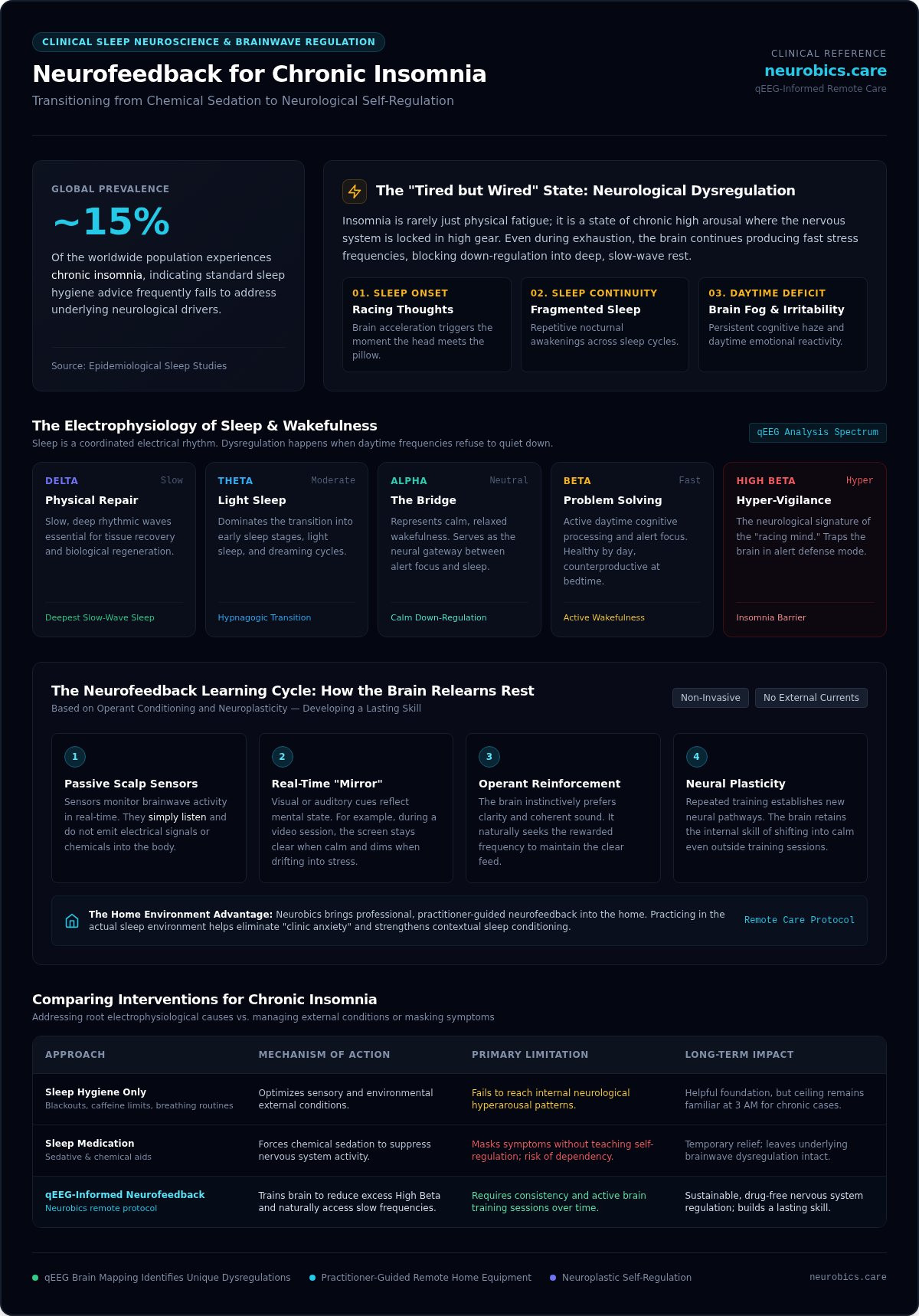
Most people struggling with sleep have tried every trick in the book. They’ve bought blackout curtains, cut out caffeine by noon, and practiced structured breathing, yet the ceiling remains their most familiar sight at 3 AM. While these “sleep hygiene” habits are helpful, they often fail because they don’t reach the underlying issue. Chronic sleep problems usually aren’t just about your environment; they’re about a brain that has forgotten how to switch off. When we look at neurofeedback for insomnia, we aren’t just treating a symptom. We’re addressing the neurological foundation of rest by using the brain’s own ability to reorganize itself.
Often described as a form of brain exercise, Neurofeedback uses the principles of operant conditioning to reward healthy brainwave patterns. It relies on neuroplasticity, which is the brain’s lifelong ability to form new neural connections. Instead of using external chemicals to force the brain into sedation, this method helps the nervous system relearn the path to natural, restorative sleep. It’s a shift from managing a condition to actively developing a skill.
The Problem with Chronic Hyperarousal
Many of our clients describe feeling “tired but wired.” This isn’t just a figure of speech; it’s a physiological state where the nervous system is stuck in high gear. Even when you’re physically exhausted, your brain continues to produce high-frequency waves associated with alertness and stress. This state of hyperarousal makes it nearly impossible to transition into the deep, slow-wave sleep your body needs to recover. Over time, this constant state of alert leads to common symptoms of neurological dysregulation, such as:
- Racing thoughts that accelerate the moment your head hits the pillow.
- Fragmented sleep, where you wake up multiple times throughout the night.
- A persistent sense of brain fog and irritability during the day.
Long-term stress and subtle environmental burdens can reinforce these patterns, making the brain “forget” how to enter a state of calm. For those interested in how ambient stressors like electromagnetic radiation disrupt nighttime recovery and vitality, you can read more on creating a healthier sleep space. Neurofeedback for insomnia works to interrupt this cycle, teaching the brain that it’s safe to down-regulate.
How Neurofeedback Provides a “Mirror” for the Brain
The brain can’t easily change what it can’t see. During a session with Neurobics, non-invasive sensors are placed on the scalp to monitor brainwave activity in real time. These sensors don’t put anything into the brain; they simply listen. The system then provides a “mirror” in the form of visual or auditory feedback. For example, if you’re watching a movie and your brain enters a state of calm, the screen stays bright. If your brain drifts back into a stressed or hyper-alert state, the screen dims.
Your brain naturally wants the reward of a clear screen and clear sound. Through this feedback loop, it learns to recognize the internal feeling of regulation and begins to return to that calm state more frequently. Because Neurobics offers professional training at home, you can practice this regulation in the very environment where you sleep, which often helps lower the “clinic anxiety” some people feel in medical settings. If you’re ready to see how this personalized approach can help your specific patterns, you can reach out to our team to discuss your needs.
The Neuroscience of Sleep: How Brainwave Patterns Affect Your Rest
Sleep isn’t a passive state of “off.” It’s a complex, rhythmic performance orchestrated by electrical patterns in the brain. To understand how neurofeedback for insomnia works, we first need to look at the brainwaves that govern these transitions. Your brain produces different frequencies depending on your state of arousal. Delta waves are the slow, deep rhythms of physical repair, while Theta waves dominate light sleep and dreaming. Alpha waves act as the bridge, representing relaxed wakefulness. Problems arise when Beta waves, usually reserved for active problem solving, refuse to quiet down at night.
High Beta activity is the neurological signature of the “racing mind.” When these fast frequencies persist after you’ve turned out the lights, the brain remains in a state of hyper-vigilance. It’s essentially trying to solve problems while it should be preparing for rest. According to the current state of neurofeedback research, training the brain to inhibit these high-frequency waves can significantly improve sleep quality and reduce the time it takes to fall asleep.
Beyond just falling asleep, staying asleep requires specific rhythms like the Sensory Motor Rhythm (SMR) and sleep spindles. These act as a protective “gate,” filtering out external sounds or internal shifts that might otherwise wake you up. If your brain lacks these protective rhythms, you’ll likely experience fragmented rest. We use qEEG (Quantitative EEG) to visualize these patterns, providing a clinical-grade map of your brain’s electrical activity to see exactly where your sleep cycle is being interrupted.
Identifying Your Specific Sleep Signature
No two cases of insomnia are neurologically identical. Some people struggle because their brains are stuck in high arousal, while others have a rhythm-based issue where the brain cannot maintain the deep sleep state. By mapping these patterns, we can see if your difficulty is rooted in an inability to “power down” or a lack of the protective waves that keep you asleep. This personalized data is why generic sleep apps often fail where professional brain training succeeds. If you’re curious about your own sleep signature, you can book an intake to begin the mapping process.
From High Beta to Deep Delta: The Transition to Rest
The goal of neurofeedback is to help your brain master the transition from active Beta waves to calming Alpha, and eventually into deep Delta. As you train, your brain learns to “quiet” the fast frequencies that keep you awake. You’ll start to notice a physical shift as this happens. The tension in your jaw might release, or the persistent “static” in your mind might finally quiet down. This isn’t a forced change; it’s your brain reclaiming its natural ability to down-regulate and enter a state of true, restorative rest.
Neurofeedback vs. Sleep Medication: A Comparison of Approaches
For many people, the journey toward better rest begins with a prescription bottle. It’s an understandable choice. When you’re facing chronic fatigue, the promise of immediate relief is incredibly tempting. However, it’s vital to understand the fundamental difference in how these two paths interact with your nervous system. Medication acts as a chemical override. It forces the brain into a sedated state by muting the signals of wakefulness. While this can help you lose consciousness, it doesn’t address the neurological hyperarousal we identified as the root of the problem. In contrast, neurofeedback for insomnia is a training process that helps the brain reclaim its own natural ability to regulate.
Sleep aids often come with a trade-off. Beyond the common side effects like morning grogginess or “brain fog,” there’s the significant risk of dependency. The brain can become accustomed to the chemical support, making it even harder to fall asleep naturally once the medication is stopped. Neurofeedback offers a different trajectory. By rewarding the brain for entering calm, regulated states, we’re helping it build new neural pathways. It’s a non-invasive approach that focuses on long-term skill acquisition rather than temporary symptom management. It’s also worth noting that many individuals use neurofeedback alongside their existing treatments, though you should always consult your doctor before making any changes to your medication regimen.
Short-term Relief vs. Long-term Regulation
The primary appeal of medication is speed; it works the very first night. Neurofeedback requires more patience, as it’s a learning process that typically unfolds over several weeks. However, the durability of the results is where the two methods diverge most sharply. One of the biggest challenges with sleep medication is “rebound insomnia,” where sleep problems return with increased intensity when you stop taking the pills. Because neurofeedback builds the brain’s own “muscles” for self-regulation, the improvements tend to be much more lasting. You aren’t just masking the noise in your head; you’re teaching your brain how to turn the volume down on its own.
Evaluating the Value of Neurofeedback
When looking at the value of brain training, it’s helpful to consider the long-term perspective. Years of recurring prescriptions and the hidden costs of daytime fatigue add up quickly. Investing in a professional remote program provides a structured path toward independence from sleep aids. For a deeper look at how this compares to other interventions, our guide on Neurofeedback Therapy Cost provides context on the outcomes you can expect. At Neurobics, we believe the ultimate value lies in the professional guidance included with our remote programs. Having an expert monitor your progress ensures that your training is always aligned with your unique neurological needs. If you’d like to learn more about how our practitioners can support your transition to natural sleep, feel free to contact us for more information.
Training Your Brain for Better Rest: The Remote Neurofeedback Process
Traditional neurofeedback once required patients to visit a clinic several times a week, a schedule that is often overwhelming for someone already struggling with chronic fatigue. The shift toward remote neurofeedback for insomnia has removed these barriers, allowing you to train in the comfort of your own home. This isn’t just about convenience; it’s about efficacy. By training in the environment where you actually sleep, you reduce the “clinic anxiety” that can sometimes mask your brain’s natural patterns. You’re teaching your nervous system to down-regulate in the very space where you need it most.
The process begins by shipping professional-grade equipment directly to your door. Our team then guides you through the setup process via a live video session, ensuring that the sensors are placed accurately. During a typical training session, you’ll simply watch a movie or listen to audio of your choice on a tablet or computer. The software monitors your brainwaves and subtly adjusts the brightness or volume as a reward when your brain hits the target frequencies. It’s a gentle, passive way to encourage the self-regulation we discussed in previous sections.
The 4-Step Journey to Better Sleep
We’ve streamlined the remote experience into a structured path that prioritizes precision and clinical oversight. Every step is designed to move you closer to natural rest:
- Step 1: At-Home qEEG Brain Mapping. You’ll use our specialized equipment to record your brain’s electrical activity. This identifies the specific areas of dysregulation causing your insomnia.
- Step 2: Personalized Protocol Design. Our practitioners analyze your qEEG data to create a custom training plan tailored to your unique “sleep signature.”
- Step 3: Regular Training Sessions. You’ll perform your sessions at home, with the software providing the necessary feedback to help your brain relearn how to quiet itself.
- Step 4: Continuous Monitoring. A Neurobics expert reviews your data remotely, ensuring your progress is on track and adjusting your protocol as your brainwaves begin to shift.
Professional Support in a Remote Setting
It’s important to clarify that remote training with Neurobics is not a “DIY” solution. While you’re performing the sessions at home, you’re never alone in the process. This is remote assisted neurofeedback, where professional expertise is integrated into every session. You’ll have regular live check-ins with your practitioner to discuss your progress and address any challenges. For a detailed look at how we manage the technical and clinical aspects of your care, you can explore The Ultimate Guide to At-Home Neurofeedback. If you’re ready to see how this technology fits into your life, you can book your initial brain measurement to get started.
Personalized Sleep Support: Why qEEG-Informed Remote Training Works
The market is flooded with consumer wellness wearables promising better sleep through generic tracking or basic meditation exercises. While these tools have their place in general relaxation, they lack the precision required for true neurological change. A one-size-fits-all headband cannot see whether your sleep issues stem from over-arousal in the frontal lobe or a lack of protective rhythms in the sensory-motor cortex. Effective neurofeedback for insomnia relies entirely on personalization, ensuring that your specific brain signature dictates the training parameters.
Data-Driven Rest: The Role of the Brain Map
The foundation of this personalized care is our At-Home QEEG Brain Mapping process. This initial assessment completely removes the guesswork from your training protocol, allowing us to see the precise electrical landscape of your brain. We use professional-grade hardware that rivals what you would find in an elite clinic, adapted for safe and easy use in your living room. As you progress through your sessions, we perform updated measurements to track how your brainwaves are changing. This data ensures your protocol evolves alongside your shifting nervous system, keeping your training optimal.
Taking the Next Step Toward Recovery
Living with chronic insomnia can feel incredibly isolating, making you feel as though your body is constantly working against you. Reclaiming your nights doesn’t happen overnight, but through structured, data-driven self-regulation, it’s entirely possible to guide your system back to its natural balance. A regulated nervous system doesn’t just mean faster sleep onset; it translates to deeper physical recovery, better emotional resilience, and waking up with genuine mental clarity. If you’re ready to move past temporary fixes and explore a personalized approach to your sleep health, we invite you to contact Neurobics today to speak with a practitioner and begin your journey.
Reclaiming Your Natural Rhythms for Restorative Sleep
The journey to better rest often requires moving beyond surface-level habits to address the neurological patterns that keep you awake. We’ve explored how neurofeedback for insomnia provides a sophisticated, non-invasive way to train your brain out of chronic hyperarousal and into a state of deep, natural regulation. By using clinical-grade qEEG mapping, you can target the specific brainwave imbalances that medication only masks, building lasting neural pathways for sleep.
With over 15 years of clinical expertise, Neurobics delivers these professional qEEG-informed protocols directly to your home. We handle global equipment shipping and provide continuous remote support, ensuring you have expert guidance every step of the way. You don’t have to navigate sleep struggles alone or rely indefinitely on chemical aids. Book an intake assessment or contact our team to start your journey to better sleep. Taking the first step toward a regulated nervous system is a powerful investment in your long-term well-being and daily mental clarity.
Frequently Asked Questions
How many sessions of neurofeedback are usually needed for insomnia?
Most individuals require between 20 and 40 sessions to see lasting changes in their sleep patterns. While some notice subtle shifts within the first few weeks, the brain needs repeated reinforcement to consolidate new habits. At Neurobics, we typically structure our initial training programs in 4-week or 12-week blocks. This timeframe allows enough space for the nervous system to adapt and for our practitioners to refine your personalized protocol based on real-time data.
Is neurofeedback for insomnia permanent, or will I need to train forever?
Results from neurofeedback for insomnia are generally long-lasting because the process involves genuine neurological learning. Once your brain masters the skill of self-regulation and shifting into restorative states, it doesn’t easily forget these patterns. Unlike medication that requires continuous use, brain training builds internal resilience. While some clients choose occasional tune-up sessions during periods of extreme life stress, the foundational improvements in sleep quality typically remain stable after the initial training course is complete.
Can I do neurofeedback at home if I have a very busy schedule?
Remote assisted neurofeedback is specifically designed for individuals with demanding professional or personal lives. Since the equipment is shipped directly to your home, you don’t need to spend time traveling to a clinic. Sessions typically last about 30 to 45 minutes and can be performed at a time that suits you best, such as early morning or before bed. This flexibility makes it much easier to maintain the consistency required for successful brain training.
Are there any side effects of neurofeedback for sleep issues?
Neurofeedback is a non-invasive, drug-free approach with very few reported side effects. Some individuals might experience mild brain fatigue or a slight headache after their first few sessions, similar to the feeling after learning a complex new skill. These sensations are usually temporary and indicate that the brain is working hard to adapt. Because our protocols are qEEG-informed and expert-guided, we can adjust the training intensity to ensure your comfort throughout the process.
Does neurofeedback help with sleep apnea or just insomnia?
Neurofeedback is primarily used to address the neurological roots of insomnia, such as hyperarousal and poor brainwave regulation. Sleep apnea is a physical respiratory condition that requires medical intervention, often involving a CPAP machine or specialized dental appliances. While brain training can help improve overall sleep architecture and the anxiety often associated with sleep disorders, it doesn’t fix the physical airway obstructions found in apnea. We always recommend consulting a medical professional if you suspect a respiratory issue.
What is the difference between professional remote neurofeedback and consumer headbands?
The main difference lies in clinical precision and professional oversight. Consumer headbands are generally wellness tools that provide basic relaxation feedback. In contrast, professional neurofeedback for insomnia uses high-fidelity sensors and a personalized brain map (qEEG) to target specific areas of dysregulation. With Neurobics, you aren’t just using an app; you’re working with a practitioner who monitors your data and adjusts your protocol weekly. This expert-led approach ensures the training is safe and accurate.
Can children or teenagers use neurofeedback for sleep problems?
Children and teenagers often respond very well to neurofeedback because their brains are highly neuroplastic. It’s a gentle, non-invasive way to help younger individuals who struggle with sleep onset or anxiety-related rest issues without resorting to medication. At Neurobics, we adapt our remote assisted neurofeedback protocols to be engaging and age-appropriate. Since the training involves watching a favorite show or listening to music, most children find the process enjoyable rather than clinical or stressful.
Will my insurance cover the cost of remote neurofeedback for insomnia?
Insurance coverage for neurofeedback is currently inconsistent and varies significantly by provider and region. Many international plans consider it an investigational service, though some clients successfully use Health Savings Accounts (HSA) or Flexible Spending Accounts (FSA) to cover the costs. We recommend contacting your insurance provider directly to inquire about CPT codes 90901 or 90875. While we don’t guarantee reimbursement, we provide the necessary documentation to help you explore your options for professional brain training.
