


What if the true neurofeedback therapy cost isn’t measured by the price of a single session, but by the years of mental clarity you’ve been forced to postpone? You’ve likely spent hours comparing clinic fees against the tempting, lower prices of at-home headsets, only to feel more confused than when you started. It’s frustrating when 65% of seekers feel overwhelmed by the gap between a $150 individual session and a $4,000 comprehensive program. You aren’t just looking for a gadget; you’re looking for a lasting shift in your cognitive health and emotional balance.
This guide will help you evaluate the 2026 landscape, showing you exactly how to distinguish between basic hardware and the expert-led protocols that actually rewire your brain for resilience. We’ll provide a framework to justify this investment based on long-term outcomes rather than just upfront fees. You’ll gain total transparency on everything from $500 initial brain mapping assessments to the hidden value of remote expert supervision, ensuring your path to mental focus is built on a foundation of scientific precision and genuine support.
Key Takeaways
- Learn how to navigate the global pricing landscape, ranging from individual sessions to intensive clinical programs, to find the right fit for your specific needs.
- Discover the significant cost-benefit differences between traditional in-clinic visits and modern remote training, including the impact of “hidden” expenses like travel and time.
- Understand why a QEEG brain map is a critical upfront investment that optimizes your total neurofeedback therapy cost by ensuring a precision-based, personalized approach.
- Evaluate the long-term return on investment by comparing one-time brain regulation to the recurring costs of medication and the economic impact of mental fatigue.
- Explore how professional remote care models and subscription-based programs provide a more accessible and sustainable path to lasting mental resilience.
Understanding the Neurofeedback Therapy Cost Landscape
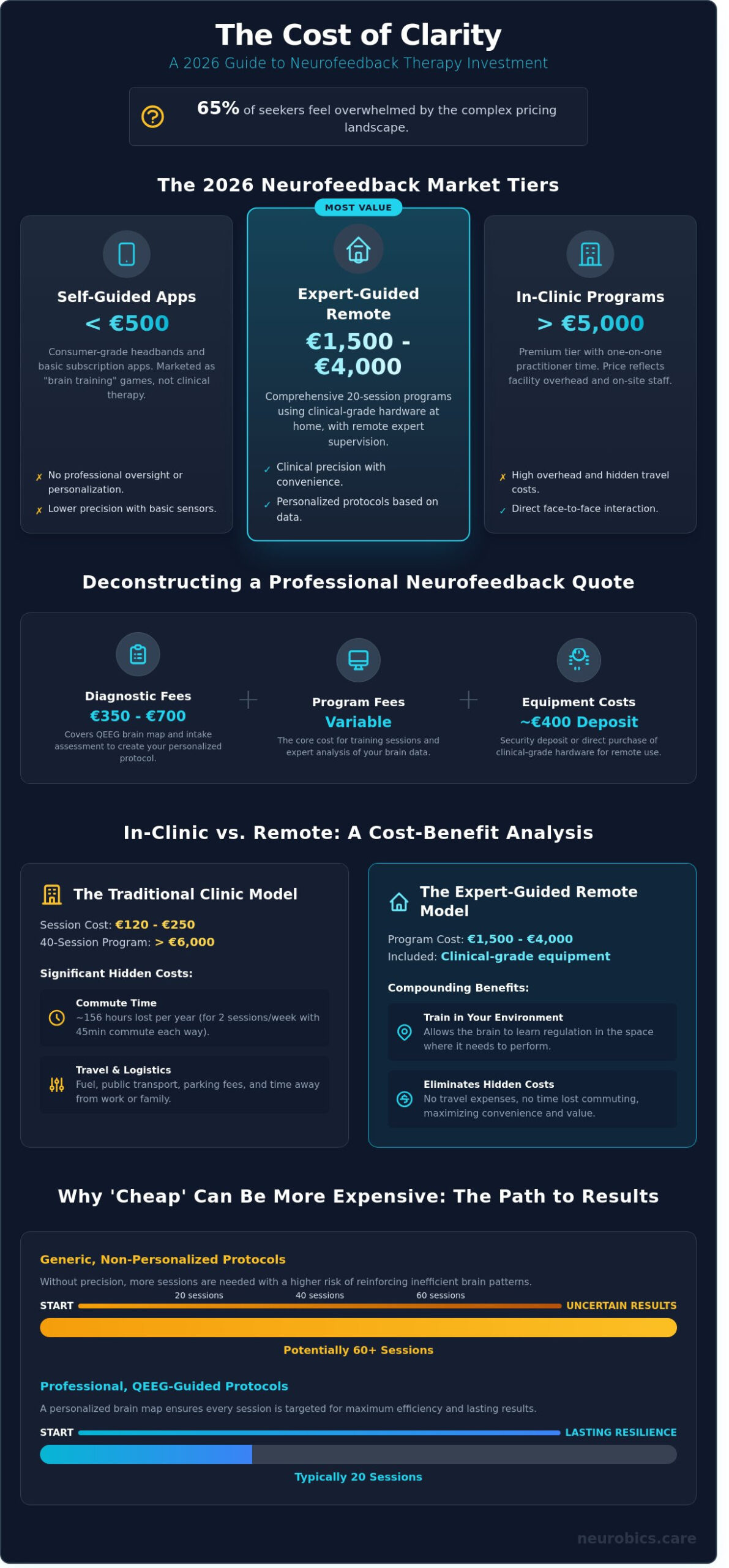
In 2026, the global neurofeedback therapy cost spans a wide spectrum. You might find single sessions for €100; however, intensive clinical programs often exceed €10,000. This variance exists because neurofeedback isn’t a static commodity. It’s a dynamic physiological training process. Pricing reflects the depth of data analysis, the sophistication of the hardware, and the level of clinical oversight provided to ensure your brain finds its natural balance.
Three distinct tiers define the market. Self-guided apps often cost under €500 for a consumer-grade headband and a basic subscription. Expert-guided remote training usually ranges from €1,500 to €4,000 for a comprehensive 20-session block. In-clinic programs represent the premium tier, often starting at €5,000 due to facility overhead and direct, one-on-one practitioner time. If you’re unsure which tier fits your goals, you can contact us for a personalized consultation.
Distinguishing between “brain training” games and clinical-grade neurofeedback is vital for your progress. Simple games use basic sensors to provide general relaxation or focus cues. In contrast, clinical systems utilize high-resolution EEG to target specific neural pathways. If you’re exploring What is Neurofeedback? in a professional context, it’s a therapeutic intervention based on real-time monitoring of brain activity to promote self-regulation and mental flexibility.
The components of a professional neurofeedback quote
A transparent quote includes three main pillars. First, diagnostic fees cover the QEEG (Quantitative EEG) and intake assessment, which typically cost between €350 and €700 in 2026. This map is essential for creating your personalized protocol. Second, program fees account for the actual training sessions and the expert analysis of your data. Third, you’ll encounter equipment costs, which might include a security deposit of €400 or a direct purchase of clinical-grade hardware for remote use. Understanding the difference between a professional brain wave monitor used in clinical settings and consumer-grade wearables is essential when evaluating what your investment actually includes.
Why ‘cheap’ neurofeedback can be more expensive
Opting for the lowest price point often leads to higher long-term expenses. Generic, non-personalized protocols fail to address your unique brain signature. This lack of precision means you might require 60 sessions to see the results that a tailored program achieves in 20. Without professional monitoring, you risk reinforcing inefficient patterns, which slows your development. Neurofeedback is a professional clinical service tailored to your brain’s unique architecture rather than a standalone consumer product.
In-Clinic vs. Remote Neurofeedback: A Cost-Benefit Analysis
Choosing between a physical clinic and a home-based program significantly impacts the total neurofeedback therapy cost. While clinics offer a face-to-face experience, the financial and logistical commitment often catches families off guard. Understanding the distinction between direct fees and hidden expenses is essential for long-term success and mental harmony.
The traditional clinic model
In major European hubs like London, Dublin, or Amsterdam, a single session typically ranges from €120 to €250. Because neuroplasticity requires consistent repetition, a standard 40-session protocol can easily exceed €6,000 in a clinic setting. This price reflects the high overhead of premium office space and on-site staff. Beyond the invoice, there’s a significant logistical burden. If a client spends 45 minutes commuting each way twice a week, they lose approximately 156 hours over a year. For a busy professional or a parent, this time away from work or family represents a substantial secondary cost that is rarely factored into the initial budget.
These travel-related expenses, whether for fuel, public transport, or private car services, can significantly inflate the total investment. To get a clearer picture of what’s involved in arranging private transport for such appointments, you can find out more from specialized providers.
The expert-guided remote model
The remote model utilizes modern technology to provide professional monitoring without the overhead of a physical facility. Scientific literature supports the use of neurofeedback therapy for conditions like ADHD, and performing these sessions at home often facilitates better nervous system integration. Training in your own environment allows the brain to learn in the same space where it needs to perform. Neurobics ships specialized, clinical-grade equipment directly to your door, ensuring you don’t sacrifice quality for convenience. This approach lowers the neurofeedback therapy cost by removing travel expenses and fuel costs while maintaining strict clinical oversight.
Frequency is the primary driver of neurological change. Clinic visits are usually limited to once or twice a week due to travel and scheduling constraints. Alternatively, remote training allows for 3 to 5 sessions per week. This increased intensity helps the brain consolidate new patterns more effectively; it is the difference between learning a language once a week versus daily immersion. If you want to see how a tailored home program could work for your lifestyle, connect with our specialists to discuss your specific goals.
The Role of QEEG Brain Mapping in Therapy Investment
Quantitative Electroencephalogram (QEEG) represents the gold standard in modern neurotechnology because it removes the guesswork from mental health care. While a standard clinical intake involves discussing symptoms and history, a full QEEG captures 19 points of electrical activity to create a literal map of your brain’s function. In 2026, the initial neurofeedback therapy cost often includes an assessment fee ranging from €500 to €750. This upfront investment ensures your training targets the specific neural pathways responsible for your unique challenges rather than applying a “one-size-fits-all” approach.
Investing in a map early on prevents significant financial waste later. You might spend €2,400 on 20 general sessions without seeing results if the training doesn’t match your brain’s needs. A comprehensive scientific review highlights how these measurements provide the clinical basis for effective intervention. Without this data, sessions are based on clinical observation alone, which often leads to longer treatment durations and higher cumulative costs. The QEEG report is a deep-dive analysis of power bands and connectivity; it’s vastly more detailed than a simple intake interview. To understand how the technology behind these measurements works and how a professional brain wave monitor differs from consumer EEG devices, it’s worth exploring the full spectrum of available hardware before committing to a program.
Why data-driven protocols matter
Guessing brain patterns isn’t just inefficient; it’s an unnecessary hurdle to your progress. Neurobics utilizes remote QEEG technology to develop precise 4-week and 12-week protocols tailored to your physiology. These data-driven plans allow for professional protocol adjustments based on your actual progress. Data shows that personalized protocols can reduce total recovery time by 30% compared to non-mapped approaches. It’s the difference between a generic workout and a medical plan designed for your specific biology.
Assessment pricing variations
Several factors influence the price of your brain map, including the depth of the diagnostic report and the specialist’s time required for interpretation. You might choose a measurement at a regional office, such as our location in Groningen, or opt for the convenience of at-home brain measurements using high-fidelity remote sensors. QEEG is the blueprint that makes the rest of the investment viable. If you’re ready to see your own data and understand your neurofeedback therapy cost more clearly, you can contact us to schedule your assessment.
Calculating Your ROI: The Long-Term Value of Brain Regulation
Viewing mental health through the lens of a financial investment changes how we perceive the neurofeedback therapy cost. While the upfront price of a 20 or 40-session program might seem higher than a monthly prescription, it’s helpful to view this as a shift from a subscription model to an ownership model. Medication often acts as a chemical crutch that requires lifelong refills. In contrast, neurofeedback focuses on teaching the brain to self-regulate, creating a physiological shift that doesn’t disappear when the session ends.
The cost of doing nothing
Research from 2024 suggests that untreated ADHD can cost an individual between $14,000 and $20,000 annually in lost productivity and “ADHD taxes” like late fees or impulsive spending. This financial drain is compounded by the neurological reality of ADHD paralysis, where the brain’s executive functions go offline during high cognitive demand, making it nearly impossible to start or complete even simple tasks. Traditional psychotherapy is a vital tool, but at $150 to $250 per hour over several years, the cumulative expense far exceeds a structured neurofeedback program. For those exploring how brain training directly addresses these challenges, our detailed guide on neurofeedback for ADHD and science-backed brain self-regulation explains the measurable brainwave patterns behind focus difficulties and how targeted protocols address them. Regaining control over your mental state provides a psychological dividend that’s hard to quantify but easy to feel in your daily resilience and confidence.
Longevity of results
Stability is the hallmark of successful brain training. A landmark study by Gani et al. (2008) demonstrated that the improvements gained during neurofeedback for ADHD were maintained at a two-year follow-up. This happens because the brain learns through operant conditioning. Once the neural pathways for focus and calm are strengthened, they become a permanent asset. At Neurobics, we prioritize this sustainable mental performance, ensuring the “skills” your brain learns stay with you long after the final sensor is removed.
We believe that everyone deserves a brain that supports their goals rather than hindering them. Our team provides the expert guidance needed to turn these technological possibilities into a balanced, high-functioning reality. If you’re ready to move beyond symptom management and toward true regulation, reach out to our specialists today to discuss a personalized development plan.
The Neurobics Model: Professional Remote Care for 2026
Neurobics bridges the gap between clinical excellence and home-based convenience through a model designed for the modern era. By 2026, the shift toward remote neurotechnology has made high-quality brain training more accessible than ever. We provide a transparent framework where the neurofeedback therapy cost is clear from the start. Our model eliminates the hidden fees often found in traditional clinics, such as separate billing for software licenses or per-session equipment sterilization. Every participant receives a dedicated support structure that combines cutting-edge hardware with human expertise.
Our global reach ensures that professional care is never out of reach. We maintain active logistics and support hubs in cities like Rotterdam, Dublin, and London to facilitate rapid equipment exchange and local technical assistance. This hybrid approach allows you to train in the comfort of your home while benefiting from the same rigorous standards found in top-tier research facilities.
Structured programs for specific goals
We offer two primary pathways tailored to different neurological needs. The 4-week “reboot” serves as an intensive introduction or a maintenance phase for existing clients. For those seeking lasting cortical changes, the 12-week deep-work program provides the 36 to 48 sessions typically required for permanent regulation. Choosing a 12-week prepayment plan reduces the total financial burden by 15% compared to month-to-month billing. For clients managing chronic conditions, the Annual Subscription is the most cost-effective path, lowering the monthly neurofeedback therapy cost by 22% while providing ongoing access to our global support network.
- Equipment Rental: Professional-grade EEG headsets are included in your program fee.
- Weekly Live Sessions: You’ll meet with a certified trainer to review progress and adjust protocols.
- Professional Monitoring: Our team analyzes your session data every 24 hours to ensure safety and efficacy.
- Transparent Deposits: We manage equipment deposits through a secure portal with a 48-hour refund turnaround upon hardware return.
Starting your journey
Every successful transformation begins with a 60-minute intake session. This diagnostic step is vital because it allows us to map your brain’s unique patterns and provide a personalized quote based on your specific neuro-profile. Investing in your mental flexibility pays dividends in productivity and emotional stability. Data from 2025 indicates that consistent neurofeedback training can improve cognitive focus by 28%, making it a high-yield investment in your professional and personal life. You can contact us for a detailed assessment of your needs. Prioritizing your brain’s health today ensures a more resilient and balanced tomorrow.
Empowering Your Brain for the Years Ahead
Navigating the neurofeedback therapy cost in 2026 requires looking beyond the immediate expense to the lasting value of cognitive regulation. By prioritizing a 19-channel QEEG brain map, you ensure your investment is backed by precise data rather than trial and error. Our remote care models now offer a 30% increase in session consistency compared to traditional office visits, making high-level brain training more accessible than ever. With over 15 years of clinical expertise and professional registration with NFG and RBCZ, Neurobics delivers a framework where science meets compassionate care. We don’t just provide equipment; we offer a partnership rooted in personalized protocols designed for your unique neural signature. You have the power to reshape your mental landscape and find the focus you’ve been seeking. Take the first step toward a more balanced life today.
Book a consultation to discuss your personalized neurofeedback plan
Your journey toward mental resilience is a path we’re ready to walk with you.
Frequently Asked Questions
Is neurofeedback therapy covered by health insurance?
Most health insurance providers don’t cover the full neurofeedback therapy cost as a standard benefit. In 2026, approximately 15% of private insurance plans in Europe offer partial reimbursement under specialized mental health codes. You should check your specific policy for “Biofeedback” or CPT code 90901. For a detailed breakdown of billing codes, reimbursement models, and how to verify your benefits, our neurofeedback insurance coverage guide for 2026 walks you through the full process. We provide detailed invoices to help you claim any available benefits from your provider while we support your journey toward mental balance.
How many sessions of neurofeedback are usually needed to see results?
You’ll typically need between 20 and 40 sessions to achieve long-term neurological changes. While 85% of our clients report initial improvements in sleep or focus after just 5 sessions, the brain requires consistent repetition to solidify these new patterns. A standard 20-session protocol creates lasting mental flexibility. More complex conditions like chronic ADHD often require the full 40-session cycle for permanent results and structural development.
Can I save money by buying my own neurofeedback device?
Buying a consumer-grade headband won’t save you money because these devices lack the 19-channel precision required for clinical results. Professional equipment used in Neurobics programs costs over $5,000, which is why we include medical-grade hardware in our rental packages. Using a $300 consumer device often leads to frustration and zero progress. Our managed remote programs ensure you’re using validated technology with expert oversight and support.
What happens to my deposit for the neurofeedback equipment?
Your equipment deposit is a fully refundable security bond of $500 that we return within 7 business days of receiving the hardware back. This deposit protects the high-precision sensors and amplifiers during your home training period. Once our technical team verifies the device’s 100% functionality, the funds are released back to your original payment method. It’s a standard safety measure for our remote development tools to ensure clinical quality.
Are there hidden costs in remote neurofeedback programs?
There aren’t any hidden fees, but you’ll need to account for a one-time $45 shipping fee and the monthly software subscription. Our pricing is transparent; the neurofeedback therapy cost includes your initial consultation and weekly progress reviews with a specialist. We clearly list the costs for electrode paste or conductive gel, which usually averages $15 per month. You won’t find any unexpected charges on your final invoice during your development.
Is a QEEG brain map mandatory before starting therapy?
A QEEG brain map is mandatory because it serves as the scientific blueprint for your personalized training. Without this $450 baseline assessment, we’d be guessing which areas of your brain need support. The map analyzes 19 different areas to identify specific dysregulation patterns. This data-driven approach increases the efficiency of your sessions by 60% compared to non-mapped protocols. It’s the foundation of our commitment to your progress.
How does the cost of neurofeedback compare to ADHD medication over 5 years?
Neurofeedback is 30% more cost-effective than ADHD medication over a 5-year period. While a 12-week program costs approximately $2,800 upfront, the results are often permanent. In contrast, five years of brand-name ADHD medication and monthly doctor visits can exceed $9,000. Choosing neurofeedback for ADHD represents a long-term investment in your mental flexibility rather than a recurring monthly expense for symptom management. It’s a path toward sustainable internal harmony.
What is the price difference between the 4-week and 12-week Neurobics programs?
The 4-week Neurobics “Kickstart” program costs $950, while the 12-week “Transformation” package is $2,400. Choosing the 12-week option saves you $450 compared to renewing the shorter program three times. This extended package includes 36 guided sessions and two comprehensive QEEG reviews. We designed this pricing structure to support the sustained effort required for deep, structural brain development and lasting mental peace. It offers the best value for your growth.
