


ADHD paralysis isn’t a failure of willpower; it’s a sophisticated biological defense mechanism where the brain’s executive functions essentially go offline. You’ve likely spent hours staring at a screen or a mounting pile of tasks, feeling the heavy weight of shame and perceived laziness, even though your mind is frantically trying to find an entry point. It’s a frustrating paradox that impacts productivity for the 2.5 percent of adults living with these neurological patterns. At Neurobics, we believe that understanding the “why” behind these moments is the first step toward lasting change.
In this article, you’ll discover the neurological roots of adhd paralysis and learn evidence-based strategies to regulate your nervous system. We’ll explore how the brain’s freeze response triggers during moments of high cognitive demand and how qEEG-informed insights can help you regain momentum. We’ll provide a clear path from feeling stuck to building the mental flexibility needed to move forward with confidence and ease.
Key Takeaways
- Understand why adhd paralysis is an involuntary neurological “freeze” response rather than a lack of willpower or simple procrastination.
- Learn how the amygdala can misinterpret a long to-do list as a physical threat, causing the prefrontal cortex to temporarily go offline.
- Identify the specific ways “analysis paralysis” and task-based shutdown manifest in your daily life to better address your unique triggers.
- Discover immediate “bottom-up” sensory techniques, such as movement and temperature changes, to gently reset your nervous system and regain momentum.
- Explore how qEEG-informed neurofeedback training can help build long-term resilience by teaching your brain to shift out of “freeze” states more efficiently.
Beyond Procrastination: Defining the Reality of ADHD Paralysis
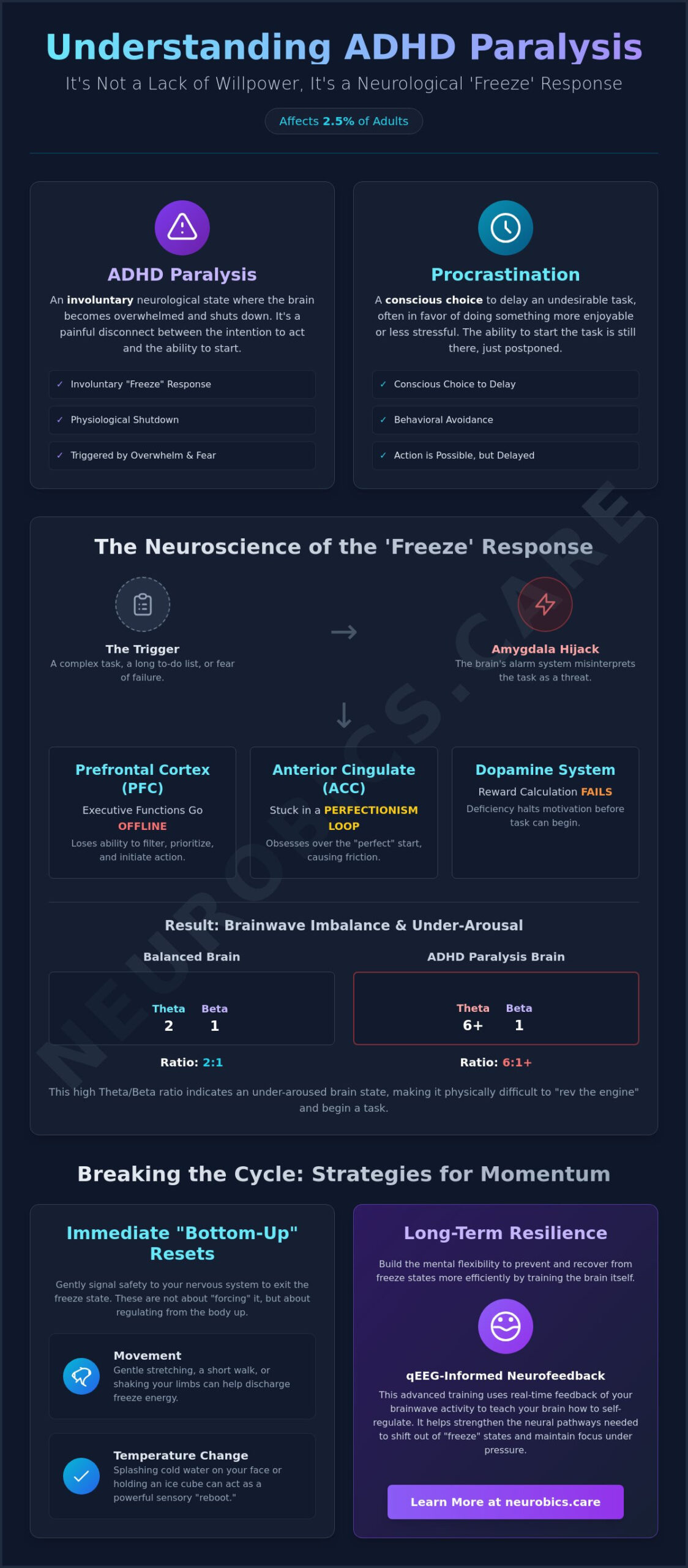
Many adults with ADHD describe a sensation where their body feels heavy and their mind feels like a browser with too many tabs open. This isn’t a lack of willpower or a character flaw. It’s adhd paralysis, a physiological state where the brain becomes so overwhelmed by information, choices, or emotion that it simply shuts down. While the DSM-5, updated in 2013, doesn’t list it as a standalone diagnosis, clinicians recognize it as a severe manifestation of executive dysfunction. Unlike procrastination, which is often a conscious choice to delay a task in favor of something more pleasant, paralysis is an involuntary “freeze” response. It’s a painful disconnect between the intention to act and the cognitive ability to begin. This state often triggers a destructive shame spiral; the person feels guilty for being “stuck,” and this guilt increases the emotional load, making it even harder to break the cycle.
The Emotional Weight of Being ‘Stuck’
The brain’s threat detection system, centered in the amygdala, can’t always distinguish between a physical predator and a daunting to-do list. When a task feels too complex or the fear of failure looms, the brain treats the situation as a danger, triggering a freeze response. For many, especially when exploring the symptoms of adhd in women, this experience is deeply internalized. Instead of outward hyperactivity, the struggle manifests as a quiet, crushing inability to move. When you try to “push through” or “try harder” without the right tools, you’re actually increasing the physiological pressure on your nervous system. This spike in stress hormones further impairs the prefrontal cortex, effectively locking the doors to your cognitive resources and deepening the adhd paralysis.
ADHD Paralysis vs. Executive Dysfunction
Think of executive function as the brain’s air traffic control system. It manages the flow of incoming data and decides which “plane” lands first. During a state of paralysis, the system crashes. Specific functions like working memory fail to hold the necessary steps of a task in mind, while task switching becomes impossible because the brain can’t find the “gear” to move from a state of rest to a state of action. This isn’t just a mental block but a neurobiological one. A deficiency in dopamine levels prevents the brain from accurately calculating the reward of finishing a task, which effectively halts the process of task initiation before it even begins. Understanding how the different types of adhd present with distinct neural regulation patterns can help clarify why paralysis looks and feels different from person to person. At Neurobics, we view these moments not as failures, but as signals that the nervous system requires better regulation and support to regain its natural flow.
The Neuroscience of ‘Freeze’: What Happens in the ADHD Brain
When you experience adhd paralysis, your brain’s executive command center, the Prefrontal Cortex (PFC), loses its ability to filter and rank priorities. Under normal conditions, the PFC helps you ignore distractions and focus on the task at hand. In the ADHD brain, however, this region becomes easily overwhelmed. When the PFC fails to regulate incoming stimuli, the Amygdala, the brain’s emotional alarm system, takes over. This “Amygdala Hijack” treats a mounting to-do list as a physiological threat, triggering a survival response rather than a productive one. A 2024 study on ADHD and decision paralysis explains how this executive dysfunction makes even minor choices feel like high-stakes risks, leading to a total cognitive stall.
The Anterior Cingulate Cortex (ACC) also plays a critical role in this process. The ACC acts as the brain’s error-monitoring station, helping you shift between different thoughts and tasks. In many people with ADHD, the ACC gets stuck in a loop, obsessing over the “perfect” way to start a project. This internal friction is often visible in brain wave dysregulation. Specifically, practitioners look at the ratio of slow Theta waves to fast Beta waves. While a balanced ratio might be 2:1, individuals struggling with chronic adhd paralysis often show ratios of 6:1 or higher. This indicates that the brain is in an under-aroused state, making it physically difficult to “rev the engine” and begin a task.
The Polyvagal Perspective: Is Paralysis a Survival Mechanism?
The nervous system doesn’t simply stop working; it shifts into a state of Dorsal Vagal shutdown. You might be familiar with the “Fight or Flight” response, which is a high-energy state driven by the sympathetic nervous system. In contrast, the “Freeze” state is a low-energy conservation mode. When your brain decides it can’t escape the demands of your environment, it triggers this shutdown to protect you from further stress. It’s not a lack of willpower, but a biological safety break that occurs when the perceived demand exceeds your current capacity to cope.
The Role of Intrusive Thoughts in Mental Shutdown
Cognitive overload is frequently exacerbated by intrusive thoughts that flood the mind with self-criticism or “what if” scenarios. This mental clutter prevents the brain from finding a single point of entry for a task. This happens because of overactivity in the Default Mode Network (DMN). In a neurotypical brain, the DMN shuts off when you start a goal-oriented task. In the ADHD brain, the DMN often stays active, creating a constant tug-of-war between your internal daydreams and the external world. This lack of “network switching” makes it feel like you’re trying to drive with the parking brake engaged. If you’re tired of feeling stuck in these loops, you can connect with our specialists to explore how neurofeedback can help retrain these neural pathways.
Recognizing the Three Faces of ADHD Paralysis
While the sensation of being stuck is universal, adhd paralysis manifests in three distinct ways. Each version stems from a specific breakdown in executive function, making it vital to identify which one you’re experiencing. Understanding these categories is a practical step toward regaining control through targeted nervous system regulation and self-awareness.
Choice Paralysis: The Burden of Too Many Options
Choosing a single priority becomes a source of intense stress when every task carries the same perceived weight. For instance, a project manager with five “urgent” deadlines might spend two hours staring at their screen because the brain cannot determine which one is truly the most important. This lack of hierarchy is a primary driver in defining ADHD paralysis as a clinical reality rather than a simple lack of willpower. Because the way paralysis presents can vary significantly across the different types of ADHD, recognizing your specific presentation is key to finding the most effective strategies.
Task Paralysis: The Wall of Awful
Task paralysis occurs when you know exactly what you need to do but find yourself physically unable to initiate the movement. Brendan Mahan, an ADHD coach and educator, describes this as the “Wall of Awful.” This wall is built from bricks of shame, failure, and past disappointments. Every time a task feels “boring” or overly complex, the ADHD brain experiences a genuine drop in stimulation. Low tonic dopamine levels mean the brain doesn’t register the future reward of finishing the task. Instead, it only feels the immediate discomfort of the effort required to start. This makes even simple chores feel physically painful to begin. It’s worth noting that this experience often overlaps with the types of hyperactivity that manifest internally, where racing thoughts and emotional restlessness make it even harder to settle into a task.
Mental Paralysis and the Daily Cycle
Mental paralysis is often the final stage of a difficult day. It’s a cognitive blackout where the mind feels like “static” on a television screen. This usually happens when sensory input or emotional demands exceed the brain’s processing capacity. These three faces often feed into one another in a predictable cycle. A morning spent in choice paralysis leads to afternoon task paralysis. By early evening, the brain enters a total mental shutdown to protect itself from further strain. It’s a protective mechanism, though an frustrating one.
At Neurobics, we focus on how qEEG-informed training can help stabilize these transitions. By improving the brain’s ability to shift between states and regulating the nervous system, we can reduce the frequency of these freezes. If you’re struggling to find your way out of these patterns, you can contact us to explore how personalized brain training supports long-term mental flexibility and focus.
Breaking the Cycle: Evidence-Based Strategies to Regain Momentum
Overcoming adhd paralysis isn’t a matter of willpower; it’s a matter of nervous system regulation. When the brain is stuck in a freeze response, the prefrontal cortex, responsible for “top-down” executive function, is effectively offline. Trying to think your way out of this state often leads to more shame and deeper stagnation. Instead, we must utilize “bottom-up” interventions that communicate safety to the brain through the body.
One of the most effective ways to break this physiological deadlock is through sudden sensory shifts. Research published in the European Journal of Applied Physiology indicates that cold water immersion or even splashing cold water on the face can increase plasma norepinephrine levels by 530% and dopamine by 250%. This creates a sharp “reset” for the nervous system, pulling the brain out of a ruminative loop and back into the present moment. Movement works similarly; a brief, vigorous two minute walk changes the internal chemistry enough to lower the barrier for the next task.
To prevent adhd paralysis from taking hold early in the day, many practitioners recommend a “Low-Dopamine Morning.” This involves avoiding high-stimulation activities, such as scrolling social media or checking emails, for the first 60 to 90 minutes after waking. By keeping dopamine levels stable, you avoid the premature “crash” that makes standard work tasks feel impossible by mid-morning. If a task still feels too heavy, apply the 5-Minute Rule. Commit to working for exactly 300 seconds. Lowering the entry barrier reduces the perceived threat of the task; for those who need a more structured approach to their professional workload, you can visit TrackMyBusiness to see how specialized software can help you manage your tasks efficiently. Once the initial friction of starting is gone, the brain often finds the momentum to continue.
The Power of Social Prosthetics: Body Doubling
For many, the presence of another person acts as a “social prosthetic” for a struggling nervous system. This is known as body doubling for ADHD, a technique where having someone else nearby provides a social anchor that stabilizes focus. The other person doesn’t need to help with the task or even speak. Their passive presence reduces the sense of isolation and lowers the perceived “threat” of the work, making it feel safer to begin. It’s the difference between an “active” interruption and a “passive” supportive environment that bridges the executive gap.
Sensory Grounding and Micro-Wins
When you feel the mental freeze approaching, the 3-2-1 grounding technique can pull you back. Identify three things you can see, two things you can touch, and one thing you can hear. This simple exercise shifts the brain’s focus from internal overwhelm to external reality. Once grounded, break your objective down into “stupidly small” steps. If writing a report feels impossible, your first step isn’t “write the intro,” it’s “just open the laptop.”
Celebrating these micro-wins is a physiological necessity because each small completion triggers a micro-dose of dopamine, which provides the chemical fuel needed for the next step. At Neurobics, we help individuals strengthen these self-regulation pathways through personalized brain training. If you’re ready to move beyond the freeze response, reach out to our team to explore how qEEG-informed care can support your mental rugalmasság.
Understanding your brain’s unique patterns is the first step toward lasting change. You can learn more about our approach to focus and regulation by visiting Neurobics.
Regulating the Nervous System: Long-Term Resilience with Neurofeedback
Neurofeedback serves as a sophisticated mirror for the brain, providing real-world data that allows the nervous system to learn how to exit a “freeze” state more efficiently. Instead of fighting against your biology, this process helps you retrain the underlying rhythms that govern focus and calm. By using at-home neurofeedback, you can engage in this training within your natural environment. This consistency is vital because the brain learns best through regular, low-stress repetition. At Neurobics, we don’t view this as a quick fix, but as a collaborative journey toward lasting nervous system regulation.
The process begins with a QEEG, or Quantitative Electroencephalogram. This brain map analyzes brainwave frequencies across 19 distinct locations to identify the specific neural signatures of your adhd paralysis. Whether it’s an overabundance of slow-wave activity in the frontal lobes or a hyper-aroused amygdala, the map provides a clear roadmap for development. It moves the conversation away from willpower and toward measurable physiological patterns. For those who find clinical visits difficult to manage, at-home qEEG brain mapping offers the same clinical precision without the added stress of travel, allowing you to capture high-resolution brainwave data from the comfort of your own home.
How QEEG-Informed Training Supports Self-Regulation
Seeing the physical reality of a “freeze” response on a brain map is often a profound emotional turning point. It helps remove the heavy burden of shame by showing that adhd paralysis isn’t a character flaw, but a visible pattern of dysregulation. When you visualize your brain activity in real-time, you start to understand the “why” behind the “stuck” feeling. This clarity is the first step in building a more compassionate and effective relationship with your mind.
Training the prefrontal cortex (PFC) improves what scientists call “top-down” control. A stronger PFC can more effectively signal the amygdala that a looming task isn’t a physical threat, lowering the intensity of the survival response. Our remote assisted sessions are designed to support this growth without adding to your mental load. You receive expert guidance and adjustments to your protocol from the comfort of your home, eliminating the stress of travel and clinical waiting rooms that often trigger avoidance.
Building a Resilient Brain for the Future
The core of this work is neuroplasticity, which is the brain’s natural ability to reorganize itself by forming new neural connections. Through consistent training, the brain creates more efficient pathways for task initiation and emotional regulation. Over time, this leads to more spontaneous focus. You’ll find yourself starting tasks because the “go” signal in your brain is functioning clearly, rather than waiting for a spike of emergency adrenaline to force you into action.
This structural change reduces the reliance on high-stress “crunch time” to get things done, which is a primary cause of long-term burnout. Choosing this path is a commitment to your future well-being. We invite you to explore the cost of neurofeedback as a strategic investment in your mental health and productivity. If you’re ready to move beyond the cycle of freezing and towards a more regulated life, please reach out to the Neurobics team to discuss how we can support your development.
Restoring Your Brain’s Natural Momentum
Breaking free from adhd paralysis isn’t a matter of willpower; it’s a process of shifting your nervous system from a survival state back into a state of functional safety. We’ve seen how the “freeze” response is a biological reality rooted in the communication between the amygdala and the prefrontal cortex. Recognizing these neural patterns is the first step toward replacing shame with effective, evidence-based regulation strategies.
Building long-term resilience requires a deep understanding of your unique neural signature. Neurobics brings 15+ years of clinical expertise to this journey, offering personalized QEEG-informed protocols designed to stabilize your brain’s arousal levels. Through our remote, expert-guided training, you can develop the mental flexibility needed to regain control from the comfort of home. This data-driven approach ensures your progress is grounded in your brain’s specific needs rather than guesswork.
Ready to understand your brain’s unique patterns? Book a QEEG-informed intake session with Neurobics today. You possess the capacity for growth and change, and we’re here to support every step of your progress toward a more balanced, focused life.
Frequently Asked Questions
Is ADHD paralysis the same as being lazy?
No, it’s a biological state where the brain’s executive functions are overwhelmed, distinct from laziness which is a choice to avoid effort. Research published in the Journal of Attention Disorders indicates that these episodes stem from dysfunction in the prefrontal cortex and anterior cingulate cortex. While a lazy person might feel relaxed, someone in a freeze state often experiences high levels of internal stress and a desire to act that they can’t physically initiate.
Can ADHD paralysis happen even with tasks I enjoy?
You can experience adhd paralysis even with hobbies or projects you love. This often occurs during choice paralysis when you have too many interests to pick from or when the steps to begin an enjoyable task feel disorganized. The brain’s reward system, particularly dopamine regulation, plays a role here; if the transition to the activity feels cognitively expensive, the nervous system may opt to freeze instead of engage.
How do I explain ADHD paralysis to my boss or partner?
Explain it as a temporary system overload where your brain’s ability to prioritize incoming data has stalled. You might say, “My brain is currently processing too many competing signals at once, which makes it difficult to initiate the next step.” Using the term executive dysfunction helps frame it as a documented cognitive challenge. Providing a clear timeline for when you’ll try a reset strategy can help maintain trust with your partner or manager.
What is the fastest way to get out of an ADHD freeze?
The most effective way to break a freeze is to change your sensory environment immediately. This might involve standing up, splashing cold water on your face, or moving to a different room. These actions provide a bottom-up stimulus to the nervous system that can bypass the top-down block in the prefrontal cortex. Breaking a large project into one tiny, 30 second micro-task can also help re-engage the brain’s motor pathways.
Does medication help with ADHD paralysis?
Stimulant and non-stimulant medications can reduce the frequency of these episodes by improving dopamine and norepinephrine levels in the brain. According to a 2022 clinical review, effective medication management helps the prefrontal cortex filter out distractions and lowers the activation energy required to start a task. However, medication works best when paired with nervous system regulation strategies to manage the underlying emotional freeze response.
Can neurofeedback actually change the way my brain ‘freezes’?
Neurofeedback training at Neurobics helps the brain move out of stuck patterns by teaching it to regulate its own electrical activity. By using qEEG data to identify where your brain is over-aroused, we can target the neural pathways responsible for the freeze response. Over a course of 20 to 40 sessions, individuals often report a significant increase in their ability to transition between tasks without feeling cognitively blocked.
Is ADHD paralysis a sign of burnout?
While adhd paralysis is a daily symptom of executive dysfunction, a sudden increase in its frequency often signals burnout. When the nervous system is chronically overtaxed, its threshold for freezing drops. A 2021 study on neurodivergent burnout found that cognitive fatigue makes it nearly impossible for the brain to utilize its usual coping mechanisms, leading to more frequent and longer periods of total task avoidance.
How long does an episode of ADHD paralysis usually last?
An episode can last anywhere from 15 minutes to several hours, depending on the level of sensory input and internal stress. If you’re unable to change your environment or reduce cognitive load, the state can persist until the brain reaches a point of total exhaustion. Implementing a structured reset protocol at the 10 minute mark can often prevent a short freeze from turning into a lost afternoon. To learn more about how brain training can help you regain control, feel free to contact our team.
