


A 2014 study involving researchers from 15 countries found that 94% of people experience unwanted, intrusive thoughts. Despite how common they are, these sudden, distressing images often leave you feeling like a “bad person” or trapped in a cycle of anxiety. You likely find it difficult to distinguish between a random neurological misfire and your actual desires. It’s frustrating to feel like your own mind is working against you, but understanding the clinical intrusive thoughts definition is the first step toward regaining your peace.
At Neurobics, we look at these experiences through the lens of brain function and nervous system regulation. This guide explains the science behind why these loops occur and how your brain’s “brakes” might be struggling to reset. You’ll learn the difference between a thought and an impulse, along with a practical checklist to stop the rumination cycle. We’ll show you how to move from confusion to mental clarity by focusing on how your brain processes information and how you can support its natural ability to self-regulate.
Key Takeaways
- Understand the clinical intrusive thoughts definition to distinguish between your core values and involuntary, ego-dystonic mental images.
- Explore the neurology of “sticky” thoughts and how specific brain wave patterns in the Anterior Cingulate Cortex contribute to repetitive rumination.
- Learn a practical 7-step framework to label distressing thoughts and create the cognitive distance necessary to regain mental clarity.
- Discover how Neurobics utilizes qEEG brain mapping and remote neurofeedback to help train your nervous system for improved self-regulation and resilience.
What is the Definition of Intrusive Thoughts?
An Intrusive thought is an involuntary, unbidden mental event that enters your consciousness without warning. These thoughts often take the form of vivid images, urges, or ideas that feel completely out of your control. Within a clinical framework, the intrusive thoughts definition centers on three specific characteristics: they are repetitive, they cause significant distress, and they are difficult to dismiss through standard willpower. At Neurobics, we view these not as character flaws, but as signatures of how the brain processes “noise” within its neural networks.
A vital concept in understanding these experiences is “ego-dystonic” thinking. This means the content of the thought is the polar opposite of your actual values, desires, and personality. If you are a deeply compassionate person, an intrusive thought might involve a horrific image of harm. Because the thought contradicts who you are, your brain flags it as a high-priority threat, which triggers a cycle of anxiety. It’s the very fact that you find the thought repulsive that proves it isn’t a reflection of your true intent.
Distinguishing between a fleeting mental “glitch” and clinical-level rumination is essential for mental clarity. A 2014 study published in the Journal of Obsessive-Compulsive and Related Disorders found that approximately 94% of people experience intrusive thoughts occasionally. For most, these thoughts are like background static that fades quickly. However, when the frequency increases or the distress level begins to interfere with daily functioning for more than one hour a day, it indicates that the nervous system may be struggling with self-regulation.
Common Themes of Intrusive Thinking
- Harm-based thoughts: Sudden fears of hurting yourself or others accidentally, such as while driving or handling kitchen tools.
- Sexual or moral intrusions: Images or doubts that contradict your sexual orientation, religious ethics, or fundamental sense of “goodness.”
- Doubt and “What If” scenarios: Chronic questioning of safety or past decisions, often leading to repetitive checking behaviors to find certainty.
Thought vs. Action: The Crucial Distinction
It’s vital to recognize that having a thought is not the same as having an impulse or a plan. Your brain’s “alarm system,” particularly the anterior cingulate cortex and the amygdala, can mistakenly flag a random neuron firing as a genuine danger. When this happens, the brain treats the thought as a physical threat in the room, demanding your full attention. This creates a physiological stress response even though no real danger exists.
Many people instinctively try to push these thoughts away, but this leads to the “paradox of suppression.” In psychological terms, trying to “not think” about something creates a rebound effect that makes the thought return with more intensity. Understanding the intrusive thoughts definition helps you realize that the goal isn’t to stop the thoughts from appearing, but to change how your brain reacts to them. If you feel overwhelmed by these patterns, you can reach out to us at Neurobics to explore how qEEG-informed training can help calm an overactive alarm system and restore mental balance.
The Neurology of “Sticky” Thoughts: Why Rumination Happens
The brain’s ability to transition from one idea to the next depends on a small but vital region known as the Anterior Cingulate Cortex (ACC). Think of the ACC as a mental gear shifter. When it functions optimally, you can acknowledge a bizarre image and move on. However, when the ACC is underactive or overwhelmed, thoughts become “sticky.” This biological friction is a core part of the intrusive thoughts definition, describing why some people can’t simply “let go” of a distressing mental image. It isn’t a lack of willpower; it’s a physiological delay in the brain’s switching mechanism.
A 2018 study published in Nature Communications highlighted how the Default Mode Network (DMN) plays a role here. The DMN is active when we aren’t focused on the outside world. In a balanced state, it fosters creativity and self-reflection. In a dysregulated state, it can over-index on negative or frightening imagery, replaying “worst-case scenarios” as if they were current threats. To understand What Are Intrusive Thoughts? from a clinical perspective, we must look at how the DMN interacts with the rest of the brain’s architecture.
EEG Patterns and Mental Flexibility
Mental flexibility correlates directly with specific brain wave frequencies. When we observe brain activity through a qEEG, we often see high-beta activity in individuals prone to rumination. High-beta waves, typically ranging from 20 to 38 Hz, represent a state of hyper-vigilance and over-arousal. This state makes it nearly impossible for the nervous system to settle. Chronic anxiety patterns often lock the brain into these frequencies, creating a rigid environment where intrusions thrive. Using at-home neurofeedback allows individuals to train their brains to exit these high-stress rhythms, fostering better self-regulation and mental fluidity.
The Feedback Loop of Anxiety
The amygdala serves as the brain’s smoke detector. When an unwanted thought appears, the amygdala may trigger a “false alarm,” signaling that the thought itself is a danger. This creates an immediate surge of shame or fear. This emotional reaction reinforces the neural pathway, making the thought more likely to return. It’s a self-perpetuating cycle where the brain interprets your distress as proof that the thought is important. Understanding the intrusive thoughts definition through this lens helps reduce their power. By viewing these events as “misfires” of a dysregulated nervous system rather than a reflection of your character, you begin to break the loop. If you’re struggling with these patterns, you can reach out to our team to discuss how targeted brain training can help restore balance.
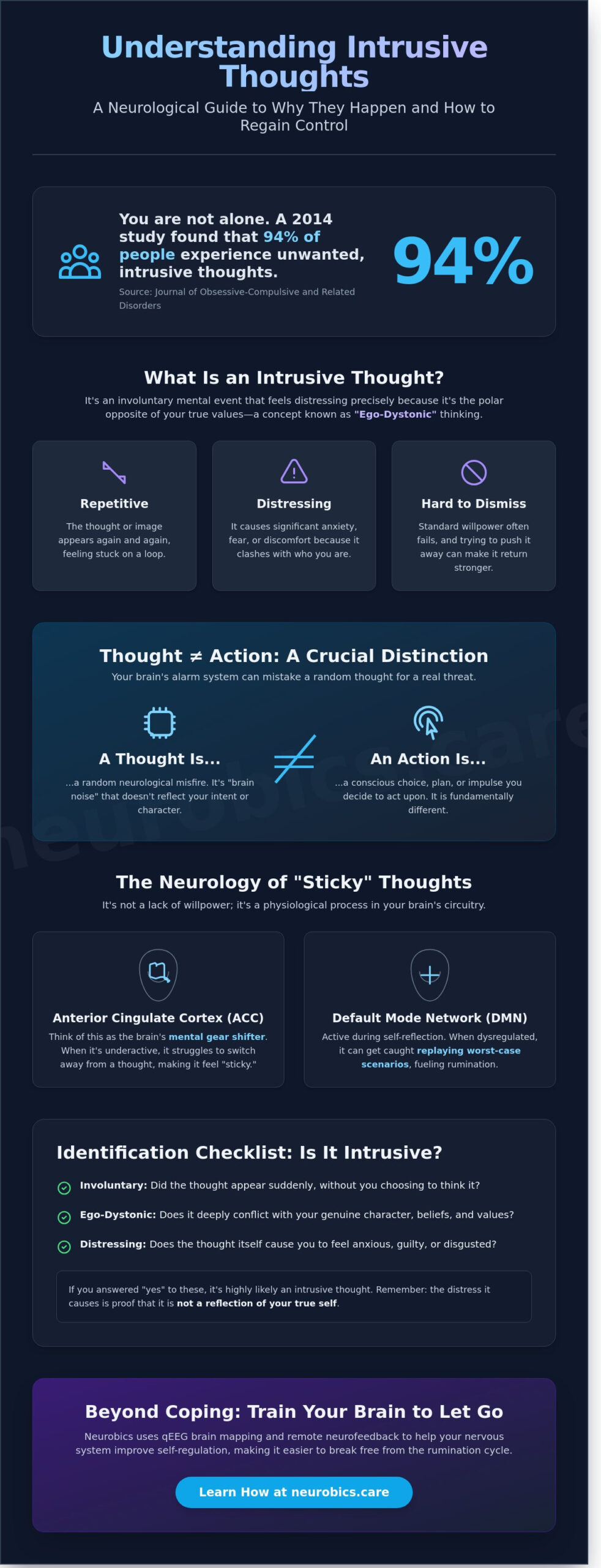
Identification Checklist: Is This an Intrusive Thought?
Identifying an intrusive thought is less about the specific content and more about how your brain reacts to it. When looking for a clear intrusive thoughts definition, it’s helpful to view them as “mental glitches” rather than reflections of your character or intentions. These thoughts are typically repetitive, sticking to your consciousness like a loop you can’t break despite your best efforts. You might find yourself feeling a frantic urgency to “solve” the thought or prove it isn’t true. This urgency is a hallmark of the brain’s alarm system misfiring. They often strike during unrelated, calm activities, like washing dishes or reading, contrasting sharply with your current surroundings.
To determine if you’re experiencing this phenomenon, ask yourself these four questions:
- Is the thought repetitive and difficult to dismiss even when you try to focus on something else?
- Does the content feel “foreign” or repulsive to your personal values?
- Do you feel an immediate need to “check” your surroundings or “prove” the thought wrong?
- Does the image pop into your head during moments of quiet or relaxation?
Signs of Ego-Dystonic Thinking
When to Seek Professional Guidance
In instances where you require objective verification for professional or legal matters, you can visit Morgan Polygraph to explore their professional polygraph services. For addressing the internal patterns of intrusive thoughts, however, training the brain’s self-regulation remains the primary path toward lasting relief.
The Management Checklist: 7 Steps to Regulate Your Mind
Managing unwanted mental images requires a shift from active resistance to passive observation. When you understand the intrusive thoughts definition, you realize these events aren’t personal failings or hidden desires. Instead, they’re glitches in the brain’s warning system. By following a structured approach, you can retrain your nervous system to handle these spikes without falling into a cycle of distress.
- Label the thought: Say out loud or internally, “That is an intrusive thought.” This simple act creates immediate cognitive distance between your identity and the mental event.
- Practice non-engagement: Allow the thought to exist without trying to argue with or debunk it. Treat it like a pop-up ad on a website; it’s there, but you don’t have to click it.
- Anchor in the body: Use grounding techniques to signal safety. Press your feet firmly into the floor or name five things you see. This pulls your focus from the abstract “threat” back to physical reality.
- Avoid checking behaviors: Resist the urge to mentally replay events to prove the thought false. Checking provides temporary relief but strengthens the anxiety loop in the long run.
- Reduce caffeine intake: A 2014 study in Psychopharmacology demonstrated that caffeine can mimic or worsen anxiety symptoms. Lowering your intake helps keep your physiological “baseline” stable.
- Prioritize sleep hygiene: Aim for 7 to 9 hours of quality rest. Sleep deprivation weakens the prefrontal cortex, making it significantly harder for the brain to filter out irrelevant or distressing imagery.
- Accept the presence: Let the thought stay as long as it wants. When you stop trying to push it away, it eventually loses its emotional charge and fades on its own.
Immediate Cognitive Reframing
Treating the thought as mental background noise is a powerful way to reduce its impact. It’s like a radio playing in another room; you can hear the sound, but you don’t have to listen to the lyrics. You can also use the cloud technique by visualizing the thought as a fluffy cloud drifting across a wide blue sky. It moves naturally without your attachment. If a thought feels particularly sticky, try the “So What?” method. By responding to an intrusion with a calm, indifferent “So what?”, you strip away the fear that fuels its recurrence.
Long-Term Nervous System Regulation
True progress involves building vagal tone to help your brain return to a calm state after an intrusion. This isn’t about “fixing” a single thought but about training the brain’s overall resilience. Consistent mindfulness practice allows you to observe mental patterns without judgment, which is far more effective than fighting individual images. At Neurobics, we see how consistent brain training supports this process. Research suggests that 20 sessions of neurofeedback can significantly improve self-regulation by teaching the brain to maintain a balanced, focused state even under stress.
If you’re ready to explore how qEEG-informed training can help you master your mental landscape, reach out to our team today.
Beyond Coping: Training the Brain to Let Go with Neurobics
While a standard intrusive thoughts definition focuses on the content of unwanted mental images, Neurobics examines the underlying neural architecture that allows these thoughts to persist. Most people try to “think” their way out of a loop, yet research indicates that approximately 94% of the population experiences these mental intrusions. The difference between a passing thought and a “sticky” one often lies in the brain’s inability to shift gears. We view this not as a character flaw, but as a lack of regulatory flexibility within specific brain networks.
Our approach moves beyond basic coping mechanisms. We utilize neuroplasticity to help the brain build new pathways. Instead of simply managing the distress when a thought appears, we train the nervous system to remain regulated, making it easier to dismiss “noise” before it triggers a full stress response. This process turns a reactive state into a proactive one, fostering long term mental resilience.
QEEG-Informed Care for Intrusive Thoughts
To address the root of rumination, we begin with a QEEG (Quantitative Electroencephalogram) brain map. This professional measurement allows us to visualize the “sticky” patterns in your brain. Often, we find overactivity in the Anterior Cingulate Cortex, a region that functions as the brain’s cognitive gear shifter. When this area is hyperactive, the brain struggles to move from one thought to the next, leading to the repetitive loops often found in an intrusive thoughts definition.
- Precision Mapping: We identify specific frequency imbalances, such as excessive high-beta waves, that correlate with anxiety and loop-thinking.
- Targeted Protocols: We design neurofeedback sessions to help the Anterior Cingulate Cortex function more efficiently, improving your “braking system.”
- Expert Oversight: Our practitioners provide remote guidance, ensuring your brain training stays on track from the comfort of your home.
Start Your Journey to Mental Clarity
You don’t have to stay stuck in a cycle of unwanted imagery. Our personalized protocols are designed to quiet the mental noise and return the controls to you. If you’re ready to move from understanding a definition to experiencing a shift in your mental state, we invite you to contact us for a personalized intake session. Together, we can build a more resilient, flexible brain.
Building a Resilient Mindset through Brain Regulation
Understanding the intrusive thoughts definition is the first step toward reducing their power over your daily life. These unwanted mental images are common neurological events rather than reflections of your character. Research published in Psychological Medicine suggests that approximately 90% of people experience these thoughts, yet they only become distressing when the brain’s inhibitory filters struggle to reset. By applying the management steps we’ve discussed, you can begin to shift your nervous system from a state of high alert back to one of calm focus.
Frequently Asked Questions
Is it normal to have violent or disturbing intrusive thoughts?
Yes, having disturbing thoughts is a normal part of the human experience. A 2014 study involving participants from 13 countries found that 94% of people reported at least one intrusive thought in the previous three months. These images don’t reflect your character or actual desires. They’re simply “brain noise” that occurs when the mind’s filtering system momentarily lapses.
What is the difference between an intrusive thought and an obsession?
The main difference lies in how you react to the mental image. While the intrusive thoughts definition refers to the initial, unwanted entry of a thought into consciousness, an obsession is when that thought becomes trapped in a loop of anxiety. When a thought feels “sticky” and triggers a need for reassurance or repetitive behavior, it has shifted from a fleeting event into an obsession.
Can ADHD cause intrusive thoughts?
ADHD can definitely contribute to more frequent intrusive thoughts. Research indicates that the ADHD brain often struggles with inhibitory control, which is the ability to suppress irrelevant information. This means your mind might struggle to filter out random mental static that others ignore easily. This same dysregulation in executive function can also contribute to ADHD paralysis, where the brain’s executive functions go offline under cognitive demand. Understanding the types of ADHD and their distinct neural patterns can help clarify why some individuals experience more persistent intrusive thinking than others. At Neurobics, we see how training the prefrontal cortex helps improve this natural filtering process and reduces mental clutter.
Do intrusive thoughts ever go away completely?
Most people won’t stop having random thoughts entirely, but they can stop being intrusive. The goal of brain training and therapy is to lower the emotional charge of these images. When your nervous system is regulated, a thought that used to cause a panic attack becomes a minor background noise. You eventually stop noticing them because they no longer feel like a threat to your safety.
How do I know if my intrusive thoughts are a sign of OCD?
You should look for the presence of compulsions or significant functional impairment. While 94% of people have these thoughts, only about 2.3% of adults meet the clinical criteria for OCD according to global health data. If you spend more than 60 minutes a day ruminating or performing checks to neutralize the thought, it’s helpful to seek a professional qEEG assessment to understand your brain’s patterns.
Can neurofeedback help with repetitive sticky thoughts?
Neurofeedback helps by teaching the brain to shift out of locked states of over-arousal. By monitoring brainwave activity in real time, you can learn to dampen the circuits that keep a thought looping. This process builds mental flexibility and resilience. It’s a core part of how Neurobics supports individuals who feel stuck in repetitive, distressing mental patterns that traditional talk therapy might not fully reach.
Is there a specific EEG wave associated with intrusive thinking?
Excessive High Beta activity, typically between 20 and 35 Hz, is frequently observed in the frontal regions of individuals struggling with rumination. This fast brainwave activity suggests a nervous system that’s stuck in a state of hyper-vigilance. Through qEEG-informed training, we can identify these specific signatures and help the brain return to a more balanced, Alpha-dominant state of calm and focus.
What should I do immediately when a disturbing thought occurs?
You should label the thought as just a thought without trying to push it away. Trying to suppress an image often makes it return with more intensity. Instead, acknowledge it by saying, “I’m having the thought that something bad might happen,” and then return your focus to your physical senses. If you’d like to explore how to strengthen your brain’s natural regulation, please contact the Neurobics team to learn more about our remote training options.
