


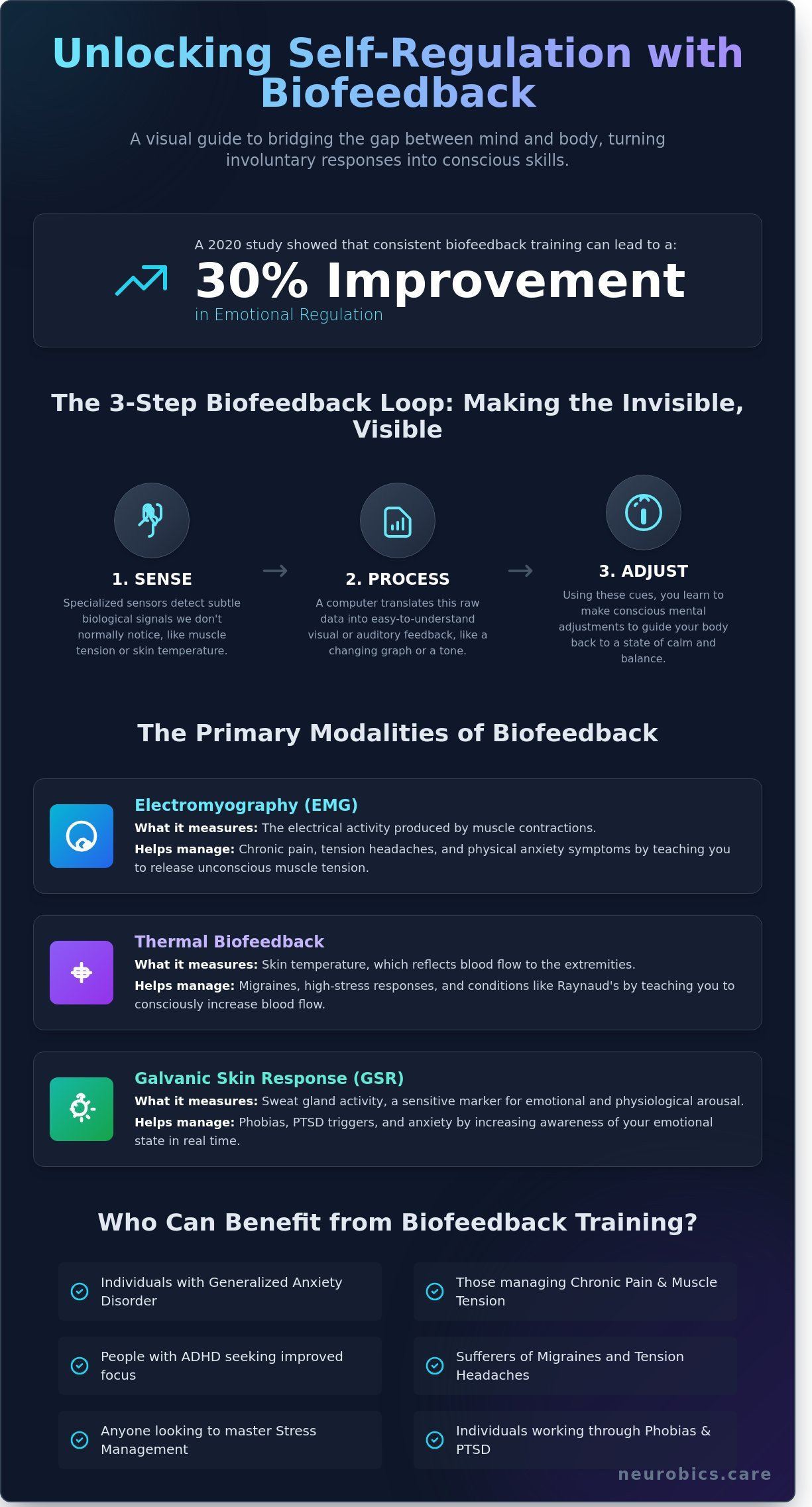
What if you could watch your nervous system react to stress in real time and then consciously guide it back to a state of calm? Most of us feel like our heart rate and muscle tension are automatic responses we can’t influence without medication. It’s exhausting to feel like a passenger in your own body, especially when anxiety or a lack of focus takes over. At Neurobics, we believe that understanding what is biofeedback in psychology is the first step toward reclaiming that lost sense of agency. A 2020 study published in the journal Applied Psychophysiology and Biofeedback showed that consistent training can lead to a 30% improvement in emotional regulation, proving that these internal states aren’t fixed.
In this guide, you’ll discover how biofeedback bridges the gap between your mind and body, allowing you to consciously regulate physiological processes for improved mental health. We’ll explore the scientific foundations of self-regulation and clarify how it differs from traditional meditation. You’ll also learn how to identify if this evidence-based approach is right for your specific challenges and find out exactly how to start your own training journey toward a more balanced, focused life.
Key Takeaways
- Understand what is biofeedback in psychology and how it acts as a physiological mirror to help you consciously influence your autonomic nervous system.
- Discover how specific modalities, like EMG and thermal sensors, translate internal states into actionable data to help manage chronic pain and stress.
- Learn how self-regulation techniques can be applied to improve mental health outcomes for conditions such as ADHD and generalized anxiety disorder.
- Explore the role of operant conditioning in brain training and how visual or auditory feedback helps shape lasting, healthy physiological habits.
- Find out how Neurobics utilizes QEEG-informed maps to transition biofeedback from the clinic to personalized, remote training environments.
Defining Biofeedback: The Psychological Mirror of the Human Body
Biofeedback serves as a high-tech bridge between the conscious mind and the autonomic nervous system. At its core, it’s a non-invasive therapeutic technique that uses specialized sensors to monitor physiological functions we usually don’t notice. When exploring what is biofeedback in psychology, it’s best to view it as a tool for self-discovery. By translating internal signals into external data, it allows individuals to witness their body’s stress response in real time. This process transforms subtle biological shifts into clear information that the mind can act upon.
The process relies on a continuous feedback loop consisting of three distinct stages: sensing, processing, and adjusting. First, sensors detect biological signals like heart rate variability, muscle tension, or skin conductance. Next, a computer processes this raw data into visual or auditory cues, such as a changing graph or a calming tone. Finally, the person uses these cues to make conscious mental adjustments. This method provides a comprehensive overview of biofeedback and its ability to turn “involuntary” processes into skills that can be trained and refined over time.
It’s helpful to distinguish this from neurofeedback. While biofeedback monitors general bodily functions like heart rate or temperature, neurofeedback focuses specifically on brainwave activity using EEG sensors. For a deeper understanding of how these two approaches compare and which may be right for you, our guide on biofeedback vs neurofeedback breaks down the key differences for brain health. At Neurobics, we often use these methods together to provide a complete picture of a person’s mental and physical state, ensuring the training is as precise as possible.
The Science of Self-Regulation
Self-regulation is the body’s ability to maintain internal balance despite external pressures. Most people live in a state of chronic “fight-or-flight,” where the sympathetic nervous system stays overactive. Biofeedback teaches the brain to activate the “rest-and-digest” parasympathetic response instead. The prefrontal cortex, which is the brain’s executive center, learns to override the amygdala’s automatic stress triggers. Awareness is the essential first step; you can’t change a pattern you don’t know exists. By making the invisible visible, we give the mind the leverage it needs to foster lasting psychological change.
Biofeedback vs. Traditional Therapy
In traditional settings, Cognitive Behavioural Therapy (CBT) helps people identify and challenge distorted thoughts. Biofeedback complements this by addressing the physiological side of the same coin. Talking about stress is valuable, but seeing its physical impact on a screen is often a transformative moment for many clients. A 2016 study published in the journal Applied Psychophysiology and Biofeedback found that adding physiological monitoring to therapy significantly improved outcomes for anxiety disorders. This data provides an objective baseline, moving progress away from guesswork and toward measurable, evidence-based development.
The 5 Primary Modalities of Biofeedback in Psychology
Understanding what is biofeedback in psychology begins with recognizing that our bodies provide constant, real-time data about our internal state. To get a comprehensive overview of biofeedback, it’s helpful to see how different sensors target specific physiological systems. Practitioners generally use five primary modalities to help individuals gain control over their involuntary functions, turning subtle biological signals into actionable insights for mental health.
- Electromyography (EMG): This method measures the electrical activity associated with muscle contraction. It’s a vital tool for treating chronic pain and tension-related anxiety. By visualizing tension in the jaw or trapezius muscles, clients learn to release physical “armor” they didn’t realize they were carrying.
- Thermal (Temperature) Biofeedback: This tracks blood flow to the extremities. Since stress causes vasoconstriction, resulting in cold hands, learning to consciously increase skin temperature helps manage migraines and high-stress responses.
- Galvanic Skin Response (GSR): Also known as electrodermal activity, GSR tracks sweat gland activity on the palms or fingers. It serves as a sensitive marker for emotional arousal, making it effective for addressing phobias and PTSD triggers.
Heart Rate Variability (HRV) and Emotional Resilience
HRV is the gold standard for measuring nervous system resilience. It defines the variation in time between each heartbeat; contrary to what many believe, a healthy heart doesn’t beat like a metronome. High HRV indicates a flexible nervous system that can transition smoothly between high performance and deep rest. During HRV training, we use simple techniques to sync your breathing with your heart rhythm. This process, often called coherence, strengthens the vagus nerve and improves your ability to stay calm under pressure.
Neurofeedback: The Most Advanced Form of Biofeedback
Neurofeedback represents a specialized branch that focuses entirely on the central nervous system. Using EEG sensors, we track the electrical activity of the brain in real time. It’s essential to understand how each eeg wave pattern, from slow delta to fast beta waves, influences your mood and focus. By providing the brain with feedback on its own activity, neurofeedback helps “train” the brain to reach more optimal states. This modality is particularly effective for those looking to improve emotional stability or cognitive performance without relying solely on external interventions.
Exploring what is biofeedback in psychology reveals a path toward sustainable self-regulation. If you’re ready to see how these modalities can support your personal growth, feel free to contact us for a professional consultation.
Psychological Applications: Who Benefits Most from Biofeedback?
Understanding what is biofeedback in psychology requires looking beyond the equipment and focusing on the human capacity for change. It isn’t just a relaxation tool; it’s a precise method for rewiring how the brain and body communicate. According to the formal definition from the APA, this process helps individuals gain voluntary control over physiological functions that are usually involuntary. This shift from passive observer to active regulator is why biofeedback has become a cornerstone for treating various psychological conditions.
Biofeedback for ADHD and Cognitive Focus
For individuals with ADHD, the brain often struggles to maintain the right balance of electrical activity. Specifically, many people with attention issues show an excess of slow-wave “theta” activity, which is linked to daydreaming, and a deficit of fast-wave “beta” activity, which is necessary for focus. Neurofeedback, a specialized form of biofeedback, uses specific brain wave protocols to help “quiet” this distracted state.
Instead of relying solely on external stimulants, clients learn to recognize the internal feeling of a focused brain. A 2020 meta-analysis indicated that neurofeedback can lead to a 25% to 30% improvement in task completion and attention span for participants. For example, a student might use theta/beta ratio training to practice staying in a “flow state,” eventually learning to trigger that focus naturally during a three-hour exam without needing constant external cues.
Stress and Anxiety: Breaking the Feedback Loop
Anxiety often feels like an invisible force, but biofeedback makes it visible. By tracking heart rate variability (HRV) and skin conductance, clients can see the “anxiety spiral” happening in real-time on a screen. This data acts as a mirror, revealing the physiological “tells,” such as shallow breathing or increased muscle tension, before a full-scale panic attack occurs.
When you understand what is biofeedback in psychology, you see it as a way to interrupt the body’s fight-or-flight response. Long-term training, typically spanning 15 to 20 sessions, can lead to permanent changes in the stress response. Users don’t just feel better during the session; they build a more resilient nervous system that stays calm even when external pressures rise.
Beyond clinical diagnoses, this technology supports burnout recovery and peak performance. Neurobics provides the tools to help professionals reset a nervous system that has been stuck in high-gear for too long. For executives and athletes, this translates to mental clarity and a 15% increase in decision-making speed under high-pressure conditions. By mastering self-regulation, they maintain the composure needed for elite performance without the cost of chronic exhaustion.
While these tools focus on individual nervous system regulation, businesses are increasingly applying similar data-driven principles to measure and improve the collective well-being and performance of their teams. For organizations looking to understand their overall talent experience, platforms like Benchmarcx provide the tools to benchmark and enhance employee engagement and resilience at scale.
The Learning Process: How Your Brain Masters Self-Regulation
To truly grasp what is biofeedback in psychology, it’s essential to view it as a sophisticated form of education rather than a passive medical treatment. The process doesn’t do something “to” you; instead, it provides the mirror your nervous system needs to see its own reflection. This clarity allows the brain to adjust its internal settings. Over time, these adjustments move from conscious effort to automatic habits that persist long after the sensors are removed.
Operant Conditioning and Reward Systems
The core mechanism behind this transformation is operant conditioning. Operant conditioning is the process of learning through reinforcement. In a typical session, your physiological data is translated into a game, a movie, or a sound. When your heart rate variability improves or your brainwaves reach a calm state, the movie plays clearly or the music becomes louder. This serves as a “reward” for your central nervous system.
This process of learning through reinforcement isn’t limited to human therapy; it’s the same principle used in advanced animal behavior modification. For instance, the expert trainers at JPK9 Academy utilize operant conditioning to help dogs build new, positive behavioral patterns, proving how effective these reward-based systems are for shaping behavior in any complex nervous system.
Your brain is naturally wired to seek these positive cues. It doesn’t need your conscious permission to want the reward; it simply begins to associate specific internal states with the pleasant external feedback. By repeating this loop, the brain learns to maintain the optimal physiological state more frequently to keep the reward active. At Neurobics, we use these precise feedback loops to help clients find their path to internal balance without the need for invasive measures.
Neuroplasticity: Rewiring the Nervous System
The brain’s ability to change its physical structure and functional organization is known as neuroplasticity. When you practice biofeedback, you aren’t just learning a temporary trick. You’re engaging in long-term potentiation, which is a process where synaptic connections between neurons strengthen based on recent patterns of activity. This is the physiological basis of memory and skill acquisition. Understanding what is biofeedback in psychology helps explain why these results are so durable; it’s because the brain is physically changing.
Clinical protocols typically indicate that meaningful, lasting change occurs after 20 to 40 sessions of consistent training. This repetition ensures that the new, healthier neural pathways become the default setting for the nervous system. Eventually, the “equipment-dependent” phase ends. You’ll find that you can recognize and shift your stress response in the middle of a difficult meeting or during a restless night because your brain has mastered the skill of self-regulation naturally.
If you’re ready to explore how this personalized learning process can support your mental well-being, contact us today to speak with a specialist about starting your journey.
Modern Biofeedback: The Shift to QEEG-Informed Remote Training
Traditional biofeedback methods often presented a logistical challenge for those seeking long-term mental health support. For decades, patients had to travel to specialized clinics multiple times a week to achieve meaningful results. This model often led to significant dropout rates in clinical settings because of time constraints and travel fatigue. Today, the field has evolved. By understanding what is biofeedback in psychology through the lens of modern technology, we’ve moved toward a model that prioritizes both precision and accessibility.
The move to remote training isn’t just about convenience; it’s about consistency. Research indicates that the brain learns best through frequent, regular sessions. When training happens in your own environment, the nervous system can integrate these new self-regulation patterns more naturally into your daily life. This shift allows for a more sustainable approach to mental performance and emotional balance.
QEEG-Informed Care: Why Personalization Matters
Standardized protocols often assume every brain requires the same intervention for stress or focus. However, a “one-size-fits-all” approach frequently misses the nuance of individual neural patterns. QEEG, or Quantitative EEG, changes this by creating a detailed map of brain activity. This data allows practitioners to identify the specific root of psychological symptoms, such as localized dysregulation in the prefrontal cortex or imbalances in theta-beta ratios.
By using a brain map, we don’t have to guess which areas need support. We can see exactly how your brain processes information and where it gets stuck in loops of anxiety or fatigue. This level of personalization is why modern biofeedback is so effective for complex cases. You can explore the deeper science behind these mapping techniques in our guide on neurofeedback treatment.
The Neurobics Remote Model
At Neurobics, we’ve bridged the gap between clinical precision and home-based comfort. Our process is designed to be seamless and supportive:
- Professional Equipment: We ship high-grade EEG sensors and hardware directly to your home.
- Expert Guidance: You aren’t left to figure out the technology alone. Our specialists provide remote oversight to ensure every session is productive.
- Data-Driven Progress: We use your initial QEEG map to tailor every training session to your unique brain signature.
The goal is to empower you with the tools to regulate your own nervous system without being tethered to a physical clinic. This approach combines the rigor of a medical facility with the flexibility required by a modern lifestyle. It’s a sophisticated way to build resilience and mental clarity on your own terms.
Ready to start your journey? Contact us to book your initial brain measurement and discover how personalized training can support your goals.
Take Control of Your Mental Landscape
Understanding what is biofeedback in psychology marks the transition from feeling overwhelmed to achieving conscious self-regulation. This method provides a clear window into your nervous system, allowing you to observe and adjust your physiological responses in real time. By mastering these signals, you’re not just managing symptoms; you’re actively rewiring how your brain handles the demands of daily life.
Neurobics brings over 15 years of clinical expertise directly to your home. We don’t believe in one-size-fits-all solutions, which is why our protocols are strictly tailored using detailed QEEG data. Our remote training programs utilize professional-grade hardware to ensure you receive the same level of precision you’d find in a high-end clinic. It’s a sophisticated yet accessible way to foster long-term mental harmony and focus.
Your path to a more resilient mind is backed by science and guided by experts who prioritize your individual progress. Book Your Personalized Brain Mapping Assessment to begin your journey toward lasting balance. You have the capacity to change, and we’re here to provide the tools to make it happen.
Frequently Asked Questions
Is biofeedback a form of psychotherapy?
Biofeedback is a physiological training technique rather than a standalone form of psychotherapy. While it’s often integrated into psychological treatments like Cognitive Behavioral Therapy (CBT), it focuses on teaching you to control involuntary bodily functions. At Neurobics, we use these tools to help you bridge the gap between mental states and physical reactions. This approach provides a data-driven way to understand what is biofeedback in psychology and how it supports emotional resilience.
How long does it take to see results from biofeedback?
Most people notice subtle changes in their stress response within 1 to 5 sessions, but lasting physiological shifts usually require 15 to 20 consistent appointments. Each session typically lasts about 45 minutes. Training the nervous system is similar to physical exercise; it requires repetition to build the muscle memory needed for automatic self-regulation. Research indicates that consistent practice leads to more stable results in managing anxiety and heart rate variability.
Can biofeedback replace my current medication?
Biofeedback is a complementary approach and shouldn’t be used to replace medications without direct supervision from your prescribing physician. It provides you with skills to manage symptoms, which might lead a doctor to adjust your dosage over time. We always recommend a collaborative approach where our practitioners work alongside your medical team. Clinical data suggests that about 70 percent of individuals using these techniques alongside traditional care report a higher quality of life.
What does a typical biofeedback session feel like?
A session feels calm, focused, and entirely non-invasive. You’ll sit comfortably while small sensors are placed on your skin to monitor signals like heart rate or muscle tension. You’ll watch a screen that translates these signals into visual games or graphs. It’s a quiet process of discovery where you learn how your thoughts change your body’s data in real time. There’s no pain or electricity entering the body; it’s simply a mirror for your internal state.
Is biofeedback safe for children with ADHD?
Biofeedback is safe for children and is often used for those aged 6 and older to improve focus and impulse control. In 2012, the American Academy of Pediatrics recognized biofeedback and neurofeedback as a Level 1 “Best Support” intervention for ADHD, placing it on par with traditional medication. It’s an engaging, drug-free way for children to visualize their concentration levels. This helps them develop the internal cues they need to stay on task in school environments.
Do the effects of biofeedback training last after I stop?
The skills you gain during training are designed to be permanent because they represent a fundamental change in how your nervous system operates. Once your brain learns to maintain a state of balance, it tends to keep that setting through regular daily use. Follow-up studies often show that participants retain their self-regulation improvements 12 months after finishing their initial 20-session program. At Neurobics, we focus on ensuring these skills translate into your everyday life.
What is the difference between biofeedback and neurofeedback?
Biofeedback is an umbrella term that usually refers to monitoring peripheral body signals like sweat, temperature, or heart rate. Neurofeedback is a specific type of biofeedback that focuses exclusively on brainwave activity using an EEG. Understanding what is biofeedback in psychology involves recognizing that both methods aim for the same goal: better self-regulation. While biofeedback helps with the “fight or flight” response in the body, neurofeedback targets the electrical patterns in the brain itself. If you want to explore a detailed breakdown of biofeedback vs neurofeedback and which approach best suits your brain health goals, we invite you to contact us for a consultation.
