


What if your persistent brain fog or evening anxiety isn’t a character flaw, but simply a signature your mind is broadcasting in a language you haven’t learned to read yet? It’s common to feel trapped in mental states that don’t serve you, especially since a 2021 study in Scientific Reports demonstrated how specific eeg wave patterns directly correlate with our ability to regulate stress. You’ve likely tried to force focus or calm through sheer willpower, only to find that your nervous system is stuck in a repetitive loop.
At Neurobics, we believe that understanding your brain’s electrical language is the first step toward lasting change. You’ll discover exactly what different frequencies reveal about your mental state and how this knowledge leads to better focus, deeper sleep, and improved emotional regulation. We’ll walk through the specific roles of Delta, Theta, Alpha, Beta, and Gamma waves, while explaining how QEEG mapping and neurofeedback provide a non-invasive path to refining your brain’s performance.
Key Takeaways
- Understand how each eeg wave functions as a rhythmic signal of your brain’s internal communication, influencing everything from focus to deep sleep.
- Discover the unique roles of the five primary brain frequencies and how their balance-or imbalance-shapes your daily emotional and cognitive experience.
- Gain insight into common patterns like the Theta/Beta ratio, helping you identify why certain states of distractibility or mental fatigue may occur.
- Explore how QEEG brain mapping provides a visual blueprint of your neural activity, identifying specific areas that may be over- or under-active.
- Discover how Neurobics uses remote neurofeedback to provide a structured path for training your brain toward greater focus and emotional harmony.
Understanding the EEG Wave: The Electrical Symphony of Your Brain
Your brain is never truly silent. Even during deep sleep or quiet reflection, roughly 86 billion neurons are constantly communicating through tiny bursts of electricity. When millions of these neurons fire in sync, they create a rhythmic pattern known as an eeg wave. These waves aren’t just random noise; they’re the language of your central nervous system, reflecting your current mental state, emotional regulation, and cognitive performance. To understand the foundation of this science, it’s helpful to look at Electroencephalography (EEG), a technology that has allowed clinicians to record these signals since Hans Berger first identified them in 1924.
At Neurobics, we view these electrical patterns as a window into your well-being. We don’t see a “broken” brain; we see a system that might have lost its rhythm. By measuring the speed and strength of these waves, we can identify where your nervous system is stuck in old patterns. This data allows us to build personalized training protocols that help your brain find its way back to a state of flow and resilience. It’s a shift from guessing how you feel to seeing how you function.
It’s a common misconception that your brain only produces one type of wave at a time. In reality, all wave frequencies are present in your brain simultaneously. The difference lies in dominance. When you’re solving a complex math problem, high-frequency waves take the lead. When you’re drifting off to sleep, slow-frequency waves become the primary drivers. Mental health challenges often arise when the wrong wave stays dominant at the wrong time, such as high-speed “stress” waves persisting while you’re trying to rest.
How Neurons Communicate via Electrical Impulses
Think of your brain as a massive, world-class orchestra. Each group of neurons represents a different section, like the strings, brass, or percussion. For the music to sound harmonious, every section must play at the right tempo. When neurons communicate, they send chemical signals across gaps called synapses. This process creates a small electrical change. While a single neuron’s signal is too faint to detect from outside the scalp, the cumulative electrical field of thousands of neurons firing together is strong enough for our sensors to pick up.
This “orchestra” metaphor extends to the real world, where live music is known to influence brainwaves and synchronize the mood of a crowd. For those interested in how professional musicians create these powerful, shared experiences for significant life events, you can visit Surefire Trio to see their approach to high-energy wedding entertainment.
In modern neurofeedback, we distinguish between raw EEG and Quantitative EEG (QEEG). Raw data looks like a series of squiggly lines, which a trained clinician can read for immediate patterns. QEEG takes this further by using sophisticated software to process the data into “brain maps.” We compare your unique eeg wave patterns against a database of thousands of healthy individuals to see exactly where your brain’s “orchestra” might be out of tune. This precision is what makes remote training at Neurobics so effective; we aren’t just training the brain, we’re fine-tuning it.
Frequency vs. Amplitude: The Two Pillars of EEG
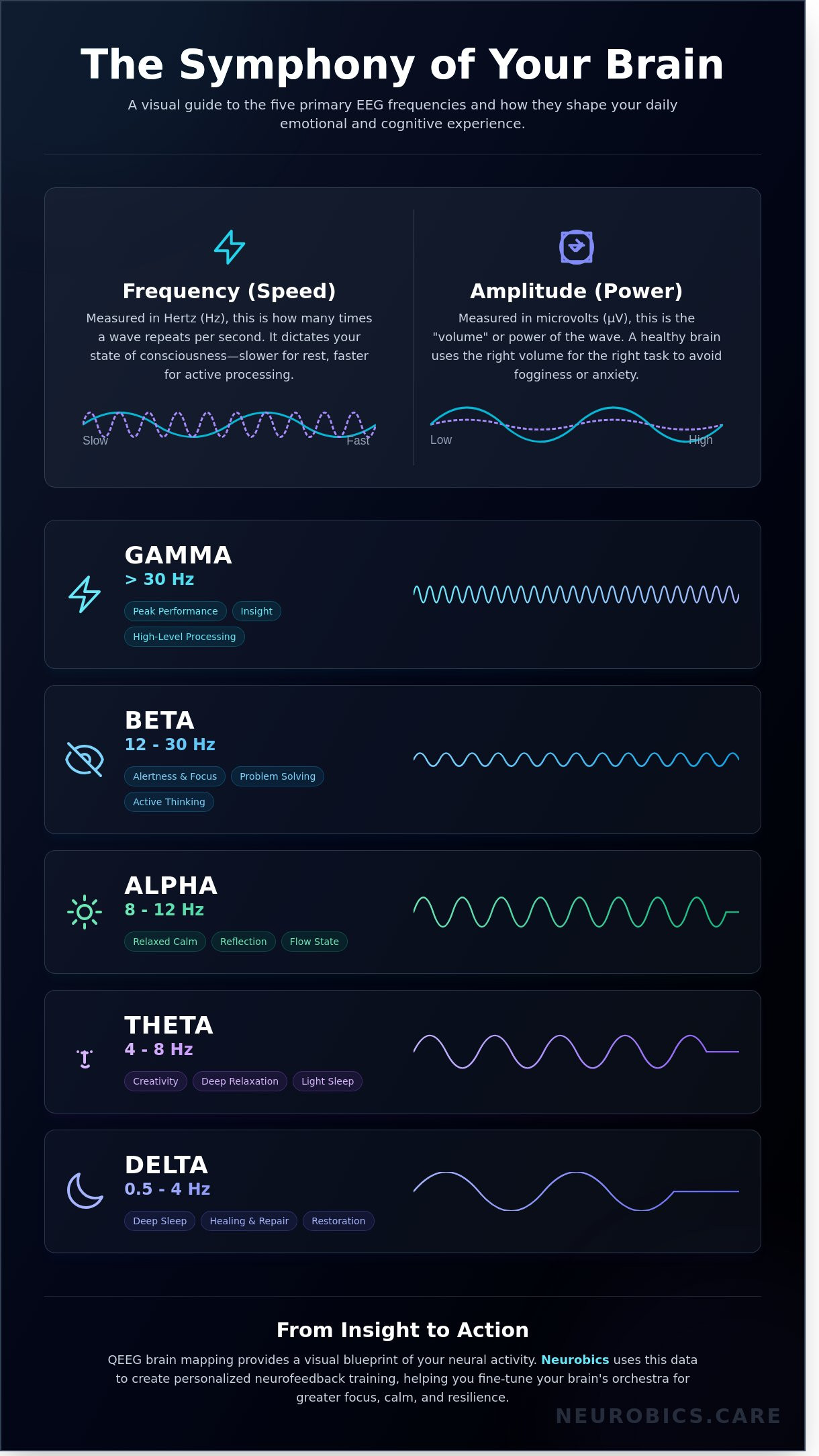
To understand your brain map, you need to grasp two main concepts: Frequency and Amplitude. Frequency is measured in Hertz (Hz) and represents the speed of the wave. It tells us how many times a wave repeats itself in one second. We generally categorize these speeds into five main groups, ranging from the very slow Delta waves (0.5 to 4 Hz) to the very fast Gamma waves (above 30 Hz). Speed dictates your state of consciousness; slow is for rest, fast is for processing.
Amplitude, measured in microvolts (µV), represents the power or “volume” of that wave. If frequency is the note being played, amplitude is how loud it’s being played. A healthy brain has the right volume for the right task. If you have “loud” slow waves during a work presentation, you’ll likely feel foggy, distracted, or lethargic. Conversely, if your fast waves are too loud at night, your mind will race, making sleep impossible. Our goal is to help you adjust these volume knobs through consistent, supportive training.
Understanding these basics is the first step toward taking control of your mental performance. By learning to influence your own eeg wave patterns, you’re not just treating symptoms; you’re developing the skill of nervous system regulation. If you’re ready to see what your brain’s symphony looks like, we invite you to reach out to the Neurobics team to discuss how a personalized brain map can start your journey toward balance.
The Five Primary Brain Wave Frequencies and Their Functions
Every second, your brain generates a complex mix of electrical signals. These aren’t random noise; they’re organized patterns that reflect your internal state. When we measure an eeg wave, we categorize these signals by their frequency, measured in Hertz (Hz), or cycles per second. Understanding these rhythms helps us map the landscape of your mental health and performance. At Neurobics, we view these frequencies as the language of the nervous system, revealing how well your brain manages energy and processes information.
Delta and Theta: The Deep Rhythms of Rest and Subconscious
Delta waves (0.5 to 4 Hz) are the slowest rhythms, typically dominating during stage 3 non-REM sleep. This state is vital for physical recovery. During these deep cycles, the body releases growth hormones and clears metabolic waste from the brain. If you lack sufficient Delta activity, your immune system suffers; research indicates that even a 25 percent reduction in deep sleep can significantly impair natural killer cell activity. Healthy Delta production is the foundation of restorative health and unconscious bodily maintenance.
Sitting just above Delta, Theta waves (4 to 8 Hz) represent the “twilight” between wakefulness and sleep. This is where memory consolidation happens and where creative insights often strike. It’s the frequency of the “flow state,” where the subconscious mind takes the lead. However, if these waves are too prominent during the day, you’ll likely feel foggy or drowsy. In clinical settings, an overabundance of Theta in the frontal lobes is a common marker for ADHD patterns, often leading to struggles with sustained attention and executive function.
Alpha and Beta: The Workhorses of Daily Consciousness
Think of Alpha waves (8 to 12 Hz) as the brain’s neutral gear. They emerge when you close your eyes and relax, serving as a bridge between the internal and external worlds. Maintaining healthy Alpha levels is essential for preventing burnout because it allows the nervous system to reset after high-stress tasks. For a detailed clinical breakdown of these patterns, the NCBI provides a comprehensive guide on Normal EEG Waveforms and their diagnostic significance. The Posterior Dominant Rhythm is the hallmark of a healthy awake brain, appearing in the back of the head when a person is relaxed with their eyes closed.
When you open your eyes and start working, Beta waves (12 to 30 Hz) take over. We distinguish between two distinct types of Beta activity:
- Low-Beta (12-15 Hz): Often called SMR (Sensorimotor Rhythm), this frequency supports calm focus, physical stillness, and organized problem-solving.
- High-Beta (20-30 Hz): This is the home of hyper-vigilance and ruminating thoughts. While useful for short-term emergencies, staying in High-Beta for too long consumes massive amounts of energy and leads to chronic anxiety.
Finally, Gamma waves (30 to 100 Hz) represent the highest level of cognitive processing. These are the “aha!” moments when different parts of the brain synchronize to solve a complex puzzle or integrate new information. Peak performance often involves a burst of Gamma activity. Whether you’re looking to quiet a busy mind or sharpen your focus, understanding your unique eeg wave profile is the first step toward optimizing your brain’s natural rhythms for a better quality of life.
Identifying Imbalance: When EEG Patterns Affect Your Quality of Life
It’s a common misconception that certain brain waves are inherently “bad” while others are “good.” In reality, every eeg wave serves a vital purpose. The issue isn’t the presence of a specific frequency; it’s the context and timing. Your brain needs to be a flexible instrument, shifting between states as your environment changes. When the brain loses this agility, it gets stuck in a particular gear. This lack of flexibility often manifests as the symptoms we label as “disorders” or “chronic issues.”
For example, high-amplitude Delta waves are essential for physical repair while you’re asleep. If those same waves dominate your frontal lobe during a work presentation, you’ll experience profound “brain fog” and memory lapses. This isn’t a “bad” wave; it’s simply the wrong tool for the task. According to Johns Hopkins Medicine on EEG, recording these electrical patterns allows us to see exactly where the brain is failing to adapt to the demands of the moment. At Neurobics, we look for these timing errors to understand why you feel “off” or stuck.
The ADHD Brain Pattern: Too Much Slow Wave, Too Little Fast
In many cases of ADHD, we see an elevated Theta/Beta ratio. Research, including studies by Monastra et al. (1999), suggests that a ratio higher than 3:1 in certain areas often correlates with attention difficulties. When there’s too much slow-wave Theta activity during the day, the cortex is essentially “under-aroused.” This leads to daydreaming and distractibility. To compensate, the brain often seeks out external stimulation, high-sugar foods, or risky behaviors to “wake itself up.” It’s not a lack of willpower; it’s a physiological attempt to balance a sluggish system. We use protocol-led neurofeedback to help the brain strengthen its ability to produce faster Beta waves, providing the internal “engine” needed for sustained focus.
The Anxiety Pattern: The High-Frequency Trap
Chronic anxiety often shows up as an overabundance of “High Beta” activity, usually frequencies above 20Hz. While some Beta is necessary for logical thinking, staying in this high-frequency state for too long is exhausting. It’s the neurological equivalent of redlining a car engine for hours. The brain gets stuck in a survival mechanism, constantly scanning for threats that aren’t there. This prevents the person from shifting back into the restorative states of Alpha or Delta. Over time, this leads to the “tired but wired” feeling of burnout. Neurobics helps clients re-learn the path back to a calm state by rewarding the brain when it successfully drops out of that high-tension frequency.
Alongside internal training, creating a physically calming environment is a crucial step in managing anxiety. The nervous system is highly sensitive to physical stressors, including uncomfortable temperatures. Innovations in home comfort, such as the gentle, radiant heat provided by specialists like Warmteshop, can help create a restorative space that supports the body’s ability to relax and complements the journey back to a balanced state.
Another common imbalance involves “Alpha Blocking” or a general lack of Alpha waves. Alpha acts as the brain’s bridge between the internal and external worlds. It’s the “idle” state of a car waiting at a red light. When Alpha is missing, the brain can’t filter out irrelevant sensory information. Every sound, light, or touch feels amplified. This often leads to sensory overload and a feeling of being constantly overwhelmed by the environment. By identifying these specific eeg wave signatures, we can create a targeted plan to restore your mental flexibility. This isn’t about “fixing” a broken brain; it’s about supporting your nervous system as it learns to find its way back to harmony and balance. If you’re weighing your options for self-regulation training, understanding the distinctions in biofeedback vs neurofeedback can help clarify which approach best targets your specific symptoms.
If you feel like your brain is stuck in one of these patterns, you don’t have to navigate it alone. Our team at Neurobics provides the expertise and technology to help you understand your unique neural signature. Contact us today to learn how remote neurofeedback can support your journey toward a more balanced life.
From Measurement to Insight: The Role of QEEG Brain Mapping
Quantitative EEG, or QEEG, represents the bridge between raw data and actionable personal growth. While a standard assessment looks at the shape of an individual eeg wave, QEEG takes a much broader view. It involves a sophisticated statistical analysis where your brain’s electrical activity is compared to a normative database. This database contains thousands of brain scans from healthy individuals across different age groups. By comparing your results to this baseline, we can see exactly where your brain functions optimally and where it might be struggling to maintain balance.
It’s vital to understand that a brain map is a functional assessment rather than a medical diagnosis. We aren’t looking for structural damage like a neurologist might with an MRI. Instead, we’re measuring how efficiently your brain processes information and regulates your nervous system. This distinction is important because it shifts the focus from “what is wrong” to “how can we improve performance.” At Neurobics, we use these insights to identify patterns associated with stress, focus, or sleep quality, providing a clear starting point for your development.
Visualizing Your Brain Activity
The visual output of a QEEG is often called a “brain map” because it uses colors to represent complex data. These colors aren’t arbitrary; they signify standard deviations from the statistical norm. A green area suggests activity within the expected range. Shades of red or orange indicate areas where activity is two or three standard deviations above the norm, often suggesting over-activity or “stuck” patterns. Conversely, blue shades represent under-activity. If your map shows high-frequency activity in the frontal lobes during rest, it might explain why you find it difficult to “switch off” at night.
We use this specific data to design a customized training plan. Every brain is unique, so a one-size-fits-all approach rarely yields lasting results. Your plan might include 20 targeted sessions designed to encourage your brain to find a more efficient rhythm. It’s also why we prioritize professional human interpretation over automated AI reports. While an algorithm can spot a deviation, it can’t understand the nuance of your personal history or your specific goals. Our experts look at the whole picture to ensure the training plan aligns with the life changes you want to see.
The Convenience of Remote Brain Mapping
In the past, accessing this level of neuroscientific insight required visiting a specialized laboratory. Neurobics has modernized this process by offering professional-grade remote mapping for clients in the UK, Ireland, and the Netherlands. We ship a comprehensive QEEG kit directly to your home, containing the same 19-channel sensors used in clinical research. You don’t need to be a tech expert to use it. We’ve simplified the setup so that anyone can collect high-quality data from the comfort of their own living room.
The quality of the data is maintained through expert-guided sessions. You’ll connect with a Neurobics specialist via a live video call, and they’ll walk you through the placement of the sensors. They monitor the eeg wave signal in real-time to ensure there is no interference or “noise” from muscle tension or movement. This guided approach ensures that the data we collect is 99% accurate, matching the standards of an in-office visit. If you’re ready to see the hidden patterns in your own brain activity, you can contact us to discuss your specific needs and shipping options.
Ready to move from data to development? Explore our remote brain mapping and training programs.
Training Your Brain Waves with Neurobics
Understanding the different frequencies is only the first step toward mental clarity. The real value lies in using this knowledge to influence how your brain functions on a daily basis. Neurofeedback is a sophisticated, non-invasive method that allows you to observe your own eeg wave activity in real time. It isn’t a medical procedure that does something “to” you; rather, it’s a sophisticated training system that teaches your central nervous system to find a more efficient balance. At Neurobics, we view this as a collaborative journey between modern technology and your brain’s natural ability to learn and adapt. For those new to these concepts, a helpful starting point is understanding the relationship between biofeedback vs neurofeedback and how each approach targets different aspects of self-regulation.
How Neurofeedback “Rewards” the Brain
Think of neurofeedback as a high-tech mirror for your mind. When you look into a physical mirror and see your posture is slumped, you naturally straighten up. Neurofeedback provides that same reflection for internal mental states. During a typical session, you might watch a movie or listen to a soundscape. When your brain produces the desired eeg wave patterns, the movie plays clearly or the music stays at a consistent volume. If your brain drifts into less optimal patterns, the screen dims or the sound fades away.
This subtle reward system uses the principle of operant conditioning. Your brain naturally wants the movie to continue, so it subconsciously adjusts its electrical output to keep the feedback positive. This process relies on neuroplasticity, which is the brain’s ability to reorganize itself by forming new neural connections. Research from institutions like the University of Geneva has shown that even 30 minutes of targeted training can induce measurable changes in plastic signaling. It’s a gradual habit-building process, not a one-time fix or a guaranteed cure for complex conditions. Much like physical exercise, the benefits accumulate through consistency and patience.
Interestingly, the concept of using electrical signals for performance training isn’t limited to the brain. Just as neurofeedback helps retrain neural pathways, innovative fitness approaches use Electro Muscle Stimulation (EMS) to intensify physical workouts. Studios such as Bodytec Lemmer apply this technology for efficient, full-body training, showcasing another way electrical impulses can be harnessed for both mental and physical well-being.
The power of neuroplasticity isn’t limited to internal brain states; it’s the same mechanism that allows us to learn complex motor skills, including the nuances of speech and accent. If you’re interested in how the brain can be retrained for clearer communication, you can learn more.
The Neurobics Difference: Expert-Led, Home-Based
We’ve designed our programs to bridge the gap between clinical expertise and the comfort of your own home. Neurobics provides a specialized hardware rental kit, including a high-grade EEG headset, so you don’t have to travel to a physical clinic for every session. Our structured models are built to support different levels of need:
- 4-Week Foundation: This program is ideal for initial nervous system regulation and establishing a baseline for improved focus or sleep quality.
- 12-Week Transformation: A deeper dive designed for sustained mental resilience, performance optimization, and long-term habit change.
You aren’t left alone with the technology. Every program includes weekly live sessions where a dedicated practitioner reviews your data and adjusts your training protocols based on your progress. We start the process with a comprehensive brain map to understand your unique baseline. From there, we guide you through the transition from initial discovery to sustained mental regulation. We’ve seen clients report a 30 percent improvement in subjective focus scores after completing a full 12-week cycle, demonstrating the power of persistent practice.
Mental well-being is a skill that can be practiced and refined over time. If you’re ready to see what’s happening beneath the surface and take an active role in your cognitive health, we’re here to support that growth. You can begin your journey by exploring your own brain wave patterns with a professional intake session at Neurobics today.
Harnessing Your Brain’s Potential for Lasting Change
Your mental well-being depends on the delicate balance of your eeg wave patterns. Understanding these frequencies is the first step toward moving past the fog of burnout or the weight of chronic stress. These electrical signatures provide a clear window into how your nervous system handles daily demands. By identifying specific imbalances through QEEG mapping, you can transition from simply managing symptoms to actively reshaping your cognitive health.
Neurobics bridges the gap between complex neuroscience and practical daily improvement. We bring 15+ years of practitioner expertise to every session, ensuring your path to mental clarity is grounded in proven science. As an NFG and RBCZ registered practice, we utilize clinically-informed remote training protocols that allow you to develop better focus and emotional regulation from the comfort of your home. You don’t have to navigate these neurological patterns alone. Our team is here to provide the expert-led support you need to achieve a more harmonious state of mind.
Book your personalized brain mapping assessment with Neurobics
We look forward to helping you discover what your brain is truly capable of achieving.
Frequently Asked Questions
Is an EEG wave the same as a heartbeat?
No, an EEG wave represents electrical activity from your brain’s neurons, while a heartbeat is a muscular contraction triggered by the heart’s own electrical system. These signals operate at entirely different scales. EEG signals are measured in microvolts, making them roughly 1,000 times weaker than the millivolt signals captured by an EKG during a heart checkup.
Can you tell what I am thinking by looking at my EEG waves?
We can’t read your specific thoughts, memories, or secrets by analyzing your brain waves. Instead, we observe your general state of arousal, such as whether you’re stressed, focused, or sleepy. Research from MIT in 2021 confirms that while we can identify broad mental states, the specific content of your internal monologue remains private and inaccessible to current technology.
What happens if my brain waves are “abnormal” on a QEEG map?
An abnormal eeg wave pattern on a qEEG map simply means your brain’s electrical rhythm deviates from a normative database. At Neurobics, we compare your data against databases like Neuroguide, which contains records from over 600 healthy individuals. These deviations don’t represent permanent flaws; they’re helpful markers that guide us in creating a personalized training plan to improve your mental flexibility.
Can I change my brain waves without medication?
You can certainly influence your eeg wave activity through consistent neurofeedback training, meditation, and sleep hygiene. This process leverages neuroplasticity, which is the brain’s natural ability to reorganize itself. Guides in this field, like Ray Maor, teach advanced techniques based on these principles. A 2020 study published in Applied Psychophysiology and Biofeedback showed that 20 sessions of targeted training can lead to lasting shifts in alpha and theta ratios without the need for pharmacological intervention.
How long does it take to see changes in EEG patterns through training?
Most people notice subtle shifts in their daily life after 10 sessions, but lasting physiological change typically requires 30 to 40 sessions. Brain training is a gradual process similar to physical exercise. In our experience at Neurobics, 85% of clients report significant improvements in sleep quality or focus within the first 5 weeks of a consistent training schedule.
Is measuring brain waves at home as accurate as in a clinic?
Clinical-grade remote systems now provide data quality that’s comparable to traditional office visits. Modern hardware used for remote training often features 24-bit resolution and sampling rates of 256Hz, which matches the standards of many clinical amplifiers. As long as you follow the sensor placement protocols, the data is reliable enough for high-level neurofeedback and progress tracking.
Does neurofeedback have side effects if it changes my brain waves?
Neurofeedback is non-invasive and safe, though it’s common to feel a bit tired after a session because your brain is working hard. Some people report mild, temporary headaches as they adjust to the training. A 2018 review of over 1,000 sessions found that less than 3% of participants experienced minor discomfort, and these effects typically resolved on their own within 24 hours.
If you’re ready to explore how your brain patterns impact your daily life, contact Neurobics today to learn more about our remote training programs.
