


You’ve likely been told that a better planner is the answer, but for the 5 percent of adults living with ADHD, traditional organization tips often feel like a setup for failure. You understand the “ADHD tax” better than anyone, especially when a forgotten invoice or a missed appointment costs you both money and self-esteem. It’s exhausting to know exactly what you need to do while feeling physically unable to start. This is where cbt for adhd becomes essential, as it moves beyond simple scheduling to address the underlying cognitive blocks and emotional dysregulation that stall your progress.
At Neurobics, we believe that understanding your brain is the first step toward lasting change. This guide explains how cognitive strategies help you manage daily life while comparing them to neurofeedback, a tool that targets the physiological roots of focus through qEEG-informed training. You’ll learn how to integrate these methods to stop the cycle of burnout and shame. We’ll provide a clear roadmap for 2026, helping you choose the right support system to achieve a state of calm, sustainable productivity and improved executive function.
Key Takeaways
- Understand how cbt for adhd functions as the “software” for self-management, helping you break the cycle of impulsivity and cognitive avoidance.
- Identify the core clinical modules used to transform therapist-led strategies into sustainable, self-managed habits for daily life.
- Compare the “top-down” cognitive approach with “bottom-up” neurofeedback to determine which intervention best supports your long-term self-regulation.
- Learn why the “ADHD tax” often persists despite having the right tools and how addressing nervous system flooding can unlock task initiation.
- Explore the benefits of stabilizing the brain with qEEG-informed training to enhance the effectiveness of your cognitive behavioral strategies.
What is CBT for ADHD? Understanding the “Software” of Self-Management
Cognitive Behavioral Therapy (CBT) serves as a practical operating system for the ADHD brain. While medication or neurofeedback addresses the biological “hardware,” cbt for adhd focuses on the cognitive software. It’s a structured approach that helps adults identify the specific patterns that lead to procrastination, missed deadlines, and emotional dysregulation. Instead of searching for a hidden trauma, this modality looks at the “here and now” to solve functional problems.
For many, the ADHD experience is defined by a punishing loop. An impulsive decision leads to a mistake, which triggers intense shame, eventually resulting in total avoidance of the task. This cycle isn’t a character flaw; it’s a neurological response. By 2026, clinical standards have shifted to view ADHD management strategies not as a search for a cure, but as the development of a resilient toolkit for lifelong self-regulation. At Neurobics, we see this as a foundational step in regaining agency over one’s daily life.
It’s vital to distinguish between traditional CBT and ADHD-adapted versions. Traditional therapy often targets internal moods like depression or generalized anxiety. In contrast, ADHD-adapted CBT prioritizes executive function. It moves past “why do I feel this way” to “how do I get this done.” It treats the emotional symptoms as secondary to the functional challenges of living with a neurodivergent brain.
The Core Philosophy: Skill vs. Will
ADHD is fundamentally a performance deficit, not a knowledge deficit. Most adults know what they need to do, but they struggle to do what they know at the point of performance. We emphasize that progress comes from “trying differently” rather than simply “trying harder.” CBT teaches you to externalize your executive functions. This means moving the burden of memory and organization out of your mind and into your environment through physical cues, timers, and structured routines. This reduction in cognitive load is essential for sustainable focus and mental energy.
Who is CBT Best For?
This intervention is particularly effective for adults who still experience “breakthrough” symptoms despite being on medication. It’s also a vital support for those struggling with the secondary emotional effects of ADHD, such as chronic low self-esteem or social anxiety. CBT for adhd is a structured, goal-oriented intervention designed to bridge the gap between intention and action through measurable behavioral change. If you’re looking for ways to integrate these skills into a broader plan for brain health, you can always contact us to discuss your specific needs and goals.
The Core Modules of CBT for ADHD: From Planning to Adaptive Thinking
Cognitive Behavioral Therapy isn’t a passive process of self-reflection. When we look at the standard clinical modules of cbt for adhd, we see a highly structured, skills-based framework designed to bridge the gap between knowing what to do and actually doing it. This journey begins with psychoeducation. By learning how the ADHD brain processes dopamine and manages executive function, clients can finally separate their identity from their symptoms. This shift is vital. It moves the conversation away from “I am lazy” toward “My brain has a specific wiring that requires specific strategies.”
The process moves from therapist-led sessions to self-managed habits. Initially, the therapist acts as an external prefrontal cortex, providing the structure and accountability that the client lacks. Over time, these external scaffolds become internal habits. This transition is backed by rigorous data; for example, research from the National Institutes of Health highlights the efficacy of CBT for adult ADHD as a primary method for reducing functional impairment. A major part of this success comes from cognitive restructuring. We work to silence the “inner critic,” that harsh internal voice that develops after years of missed deadlines and social friction, replacing it with a more objective, problem-solving mindset.
Organization, Planning, and Time Management
The “mountain” of a large project often leads to task paralysis. We solve this through “chunking,” which involves breaking a massive goal into micro-tasks that take less than 30 minutes. In 2026, choosing between digital and paper systems is a strategic decision. While digital apps offer syncing, many neurodivergent individuals find that paper planners provide a vital tactile sense of time that “exists” in physical space. We also implement the 5-minute rule. You commit to starting a task for just five minutes. Because task initiation is the primary hurdle, once that initial friction is gone, the momentum often carries you through to completion.
Reducing Distractibility and Managing Impulses
Environmental engineering is about setting yourself up for success before the workday begins. If your phone is a trigger, it stays in a timed lockbox or another room. We also teach distractibility delays. When a random impulse strikes, you don’t follow it; you write it down on a “later list” and return to your work. This builds the mental muscle of impulse control. Finally, we address all-or-nothing thinking. If you get distracted at 10:00 AM, it doesn’t mean the day is ruined. Adaptive thinking helps you “re-start” your day at 10:15 AM rather than waiting for tomorrow to try again. If you’re ready to explore how these cognitive strategies can be paired with physiological training, you can contact us to learn more about our integrated approach.
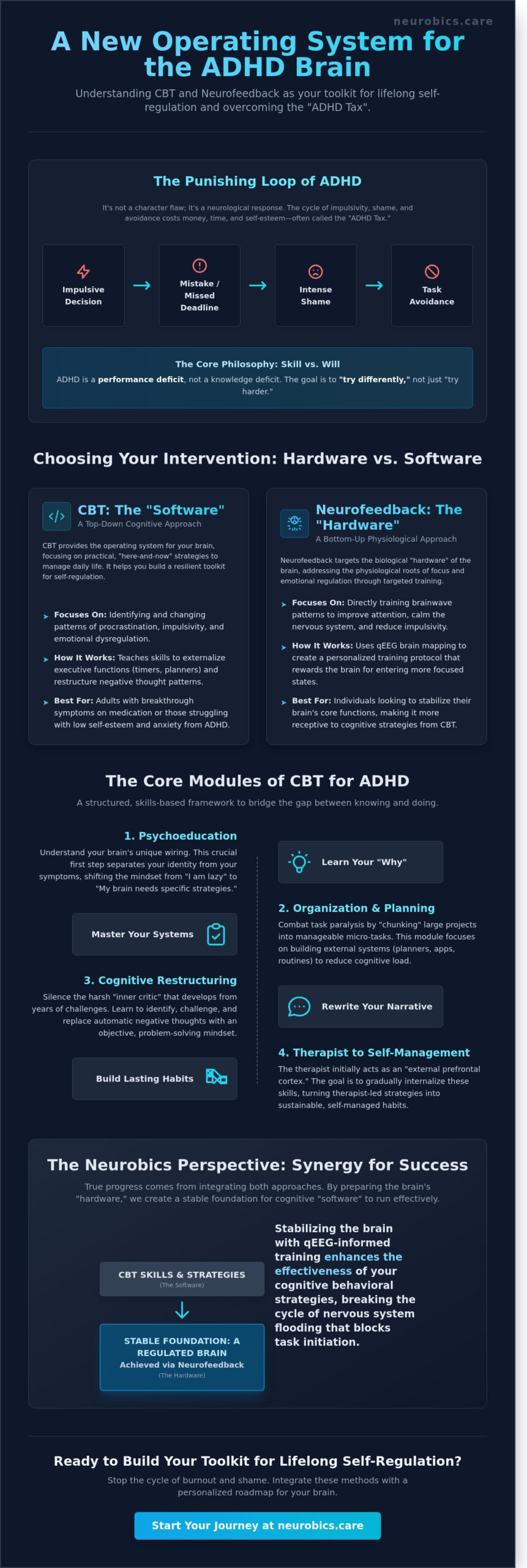
CBT vs. Neurofeedback for ADHD: Choosing Your Intervention Path
Choosing between these two paths isn’t about finding a winner. It’s about understanding how your brain processes information. CBT for ADHD acts as a top-down intervention. It targets the prefrontal cortex, the area responsible for executive functions like planning and impulse control. You learn to use conscious logic to override impulsive urges. In a 2023 study published in The Lancet, researchers found that cognitive interventions significantly improved organizational habits in adults compared to control groups.
Top-Down vs. Bottom-Up Regulation
Neurofeedback takes a bottom-up approach. It doesn’t ask you to think differently. Instead, it trains the brain’s involuntary electrical patterns. By using neurofeedback therapy for ADHD, we target the foundational arousal levels of the nervous system. While CBT helps you build a better schedule, neurofeedback helps quiet the internal noise that makes following a schedule feel impossible.
If you struggle with ADHD paralysis, where you feel frozen despite knowing what to do, your brain might be stuck in a low-arousal state. Bottom-up regulation helps here. If you can start tasks but lose your keys and miss deadlines, the top-down skills of cbt for adhd are essential. One manages the engine’s power, while the other manages the steering.
Commitment levels vary between the two. CBT requires a heavy homework load. You’ve got to practice your new habits in the real world every day to see results. Neurofeedback is more intensive in a clinical or remote setting, often requiring 30 to 40 sessions for lasting change. However, once the brain learns these new self-regulation patterns, they tend to stick. It’s like learning to ride a bike; the physiological memory remains long after the training ends.
A Synergistic Approach
Many practitioners in 2026 now recommend a combined protocol. Using biofeedback for ADHD provides immediate data on your heart rate and nervous system tension. This makes learning new habits easier because you aren’t fighting a stressed nervous system. While CBT teaches you how to drive, neurofeedback ensures the car’s engine is running smoothly. This synergy helps bridge the gap between knowing what to do and actually being able to do it.
At Neurobics, we often see that regulating the nervous system first creates the mental space needed to engage with cognitive strategies. If you’re curious about how this combined approach might work for your specific brain profile, feel free to contact us for a detailed consultation.
Overcoming the “ADHD Tax”: Why Skills Aren’t Always Enough
Many individuals living with ADHD describe a painful gap between “knowing” and “doing.” You might have a desk full of planners or a deep understanding of cbt for adhd, yet find yourself staring at a screen for hours, unable to start a simple task. This isn’t a lack of discipline; it’s the ADHD Tax in action. This term represents the literal and figurative costs, such as late fees, lost productivity, and missed opportunities, that accumulate when executive functions don’t align with your intentions. When the nervous system is overwhelmed, the most sophisticated cognitive tools often remain out of reach.
The Physiological Barrier to Change
When an ADHD brain encounters a demanding or “boring” task, the nervous system frequently triggers a fight-or-flight response. The amygdala perceives a complex project as a physical threat, redirecting energy away from the prefrontal cortex. This is the area responsible for logic, planning, and the execution of behavioral strategies. Because willpower is a finite metabolic resource, your capacity for self-regulation drains rapidly throughout the day. Even the most evidence-based cbt for adhd techniques cannot take root if the brain is stuck in a state of high arousal or “task paralysis.”
This biological bottleneck is why many people find that behavioral therapy reaches a plateau. They have the knowledge, but their brain’s electrical patterns aren’t supportive of implementation. In these cases, looking into the neurofeedback therapy cost becomes a conversation about long-term value. By training the brain to move out of a permanent “stress state,” we create the physiological space needed for cognitive tools to finally work. A 2021 study published in the Journal of Attention Disorders noted that emotional dysregulation is often a better predictor of functional impairment than hyperactivity, highlighting why biological regulation is essential.
Moving Beyond Shame
Chronic stress and burnout make cognitive strategies feel like trying to run a marathon on a broken leg. CBT provides a vital framework to reframe the ADHD Tax as a manageable cost of a neurodivergent brain rather than a personal failure. It’s essential to realize that failing to implement a CBT exercise is a symptom, not a character flaw. Strategies for moving forward include:
- Identifying the “Flooding” Point: Recognizing the physical signs of a nervous system hijack before it leads to a total shutdown.
- Lowering the Stakes: Breaking tasks into such small increments that they no longer trigger a threat response.
- Radical Self-Compassion: Accepting that some days the brain’s “bandwidth” is simply lower due to external stressors.
At Neurobics, we believe that true progress happens when you stop fighting your biology and start supporting it. If you’re ready to bridge the gap between knowing your tools and actually being able to use them, we invite you to book an intake session with our specialists.
The Neurobics Perspective: Preparing the Brain for Cognitive Success
At Neurobics, we view the ADHD brain not as a system to be fixed, but as one requiring better regulation. While cbt for adhd provides vital cognitive tools to manage daily tasks, those tools often fail to “stick” if the nervous system remains in a state of chronic dysregulation. We use qEEG-informed training to stabilize the brain’s physiological foundation first. This ensures that when you work with a therapist to learn executive function skills, your brain is actually receptive to the work. Think of it as upgrading the hardware so the software can run without crashing.
qEEG: Visualizing the Need for Regulation
A Quantitative EEG (qEEG) brain map removes the guesswork from ADHD management. It identifies whether your distractibility stems from under-arousal, where the brain produces too many slow waves, or over-arousal, characterized by excessive high-frequency activity. Clinical data suggests that ADHD isn’t a single condition but a collection of different neurological patterns. By seeing your specific brain map, we can tailor neurofeedback protocols to your unique needs, making the process far more efficient than standardized interventions. This data-driven approach allows you to see exactly why your focus wavers. You can contact Neurobics to schedule a personalized brain mapping assessment and begin understanding your brain’s unique signature.
Home-Based Training for Real-World Results
The most effective brain training happens in the context of your daily life. Neurobics provides remote, home-based neurofeedback that allows you to train in the same environment where you work and rest. This approach eliminates the stress of commuting to a clinic, which is often a significant barrier for busy adults. Our experts guide you through every session remotely, monitoring your data to ensure the protocols stay aligned with your progress. Training at home helps the brain generalize its new “calm and focused” state to the places where you need it most.
Integrating brain training into a holistic ADHD management plan creates a foundation for long-term success. By regulating the nervous system first, you enhance the impact of cbt for adhd, making it easier to implement routines and manage emotional triggers. Our roadmap for success involves three clear steps:
- Mapping: Identifying your specific arousal patterns via qEEG.
- Regulation: Using neurofeedback to train the brain toward a balanced state.
- Integration: Layering in cognitive strategies once the brain is stable enough to maintain them.
If you’ve found that traditional therapy feels like an uphill battle, it might be because your nervous system isn’t yet prepared for the demands of behavioral change. We invite you to explore whether your brain is ready for the next level of focus and clarity.
Bridging the Gap Between Skills and Neural Readiness
Managing ADHD in 2026 requires more than just learning new organizational habits. While cbt for adhd provides the essential cognitive software to navigate daily life, its success often depends on your brain’s underlying readiness to implement those strategies. We’ve seen that addressing the “ADHD Tax” isn’t just about effort; it’s about ensuring your nervous system has the regulation needed to bridge the gap between knowing what to do and actually doing it.
As you work to optimize your performance, many forward-thinking organizations are also refining their recruitment media to better reach diverse talent; you can learn more about how employer brand strategies are evolving to support this shift.
At Neurobics, we draw on 15+ years of clinical experience to help you find this balance. By using personalized QEEG-informed protocols, we create a clear map of your brain’s unique patterns. This data allows us to prepare your neural pathways for cognitive success through remote, expert-guided home training. When your brain is regulated, the skills you learn in therapy finally begin to stick. You don’t have to navigate this journey alone. Our team is here to provide the scientific precision and empathetic support you need to reach your goals. Better focus and mental clarity are within your reach when you have the right map to guide you.
Book a QEEG assessment to see if your brain is ready for CBT
Frequently Asked Questions
Is CBT as effective as medication for ADHD?
While medication targets core biological symptoms, cbt for adhd is highly effective for managing executive dysfunction and organizational challenges. A 2010 study in JAMA found that adults combining medication with CBT showed significantly better outcomes than those on medication alone. It’s a powerful tool for building the practical skills that medication doesn’t teach, helping you create a more structured and balanced life.
How long does it take for CBT to work for ADHD?
Most individuals begin to see measurable improvements in their daily routines within 12 to 15 weekly sessions. This timeframe allows for the identification of negative thought patterns and the implementation of practical coping strategies. At Neurobics, we find that consistent practice between sessions is the primary driver of how quickly these new habits become permanent. It’s a gradual process of retraining your brain for better focus.
Can I do CBT for ADHD on my own without a therapist?
You can practice certain cognitive behavioral techniques independently, but working with a professional is recommended for 85% of clinical cases to ensure lasting change. Self-help books and apps provide useful tools for time management and organization. However, a therapist provides the specific accountability and personalized feedback necessary to navigate complex emotional blocks. This professional support is often what makes the difference in long-term success.
What is the main difference between CBT and Neurofeedback?
The primary difference lies in the mechanism of change, as cbt for adhd focuses on conscious thought patterns while neurofeedback targets subconscious brainwave regulation. CBT teaches you to manage symptoms through logic and behavioral shifts. In contrast, Neurobics uses qEEG-informed training to help the nervous system reach a more focused state. Both methods aim for better self-regulation, but they approach the brain from different angles.
Does insurance typically cover CBT for ADHD in 2026?
Most major health insurance providers in 2026 recognize CBT as an evidence-based treatment and offer partial or full coverage for sessions. Coverage usually depends on your specific plan and whether the provider is in-network. We recommend checking your policy details for behavioral health services to confirm your exact reimbursement rates. This step ensures you can focus on your progress without unexpected financial stress.
Can children benefit from CBT, or is it only for adults?
Children as young as 7 years old can benefit from adapted versions of CBT, though it’s most effective for adolescents and adults. For younger children, the focus often shifts toward behavioral therapy and parent training to create a supportive environment. At Neurobics, we believe that early intervention helps build a foundation of mental resilience. This approach supports the child’s development and improves family harmony.
What happens if CBT doesn’t work for my ADHD symptoms?
If traditional CBT doesn’t yield the desired results, it’s often helpful to explore physiological interventions like neurofeedback or targeted lifestyle adjustments. Approximately 20% of individuals don’t respond fully to talk therapy alone. In these instances, a qEEG assessment can reveal underlying neurological patterns that require a more direct approach. Our team is here to help you find the specific path that leads to your mental clarity.
If you’re ready to explore how a tailored approach to brain health can support your journey, contact Neurobics today to learn more about our intake process or to book an initial consultation.
