


What if the secret to lasting focus isn’t found in a pill bottle or a more rigid planner, but in the subtle electrical frequencies your brain produces every second? For many, the traditional path to managing symptoms involves a frustrating trade-off between mental clarity and physical side effects. You’re likely tired of the hit-or-miss nature of generic advice and the logistical burden of driving to a clinic twice a week. It’s exhausting to feel like your brain is an engine that won’t stop idling or a light that won’t stop flickering.
In this guide, you’ll discover how neurofeedback therapy adhd protocols use precise brain-wave regulation to address these challenges at their neurological source. We’ll show you how modern technology allows for personalized, remote expert guidance that fits into your actual life. At Neurobics, we’ve seen how qEEG-informed care helps individuals achieve better emotional regulation and sharper executive function. This article provides a clear roadmap for retraining your brain in 2026, moving away from temporary fixes toward sustainable, long-term mental clarity and nervous system balance.
Key Takeaways
- Understand how neurofeedback therapy adhd targets the neurological roots of focus and impulse control by leveraging neuroplasticity to strengthen natural brain-wave patterns.
- Learn how personalized QEEG mapping identifies the “Theta/Beta ratio,” a specific neurological signature that explains why the ADHD brain often struggles with active problem-solving.
- Discover the critical differences between the immediate, temporary effects of medication and the gradual, lasting physiological changes created through consistent brain retraining.
- Explore the Neurobics model of remote care, which combines Dutch scientific precision with the convenience of professional-grade training from the comfort of your home.
- Find out how to choose the right 4-week or 12-week program to begin your journey toward sustainable mental clarity and improved nervous system regulation.
What is Neurofeedback Therapy for ADHD?
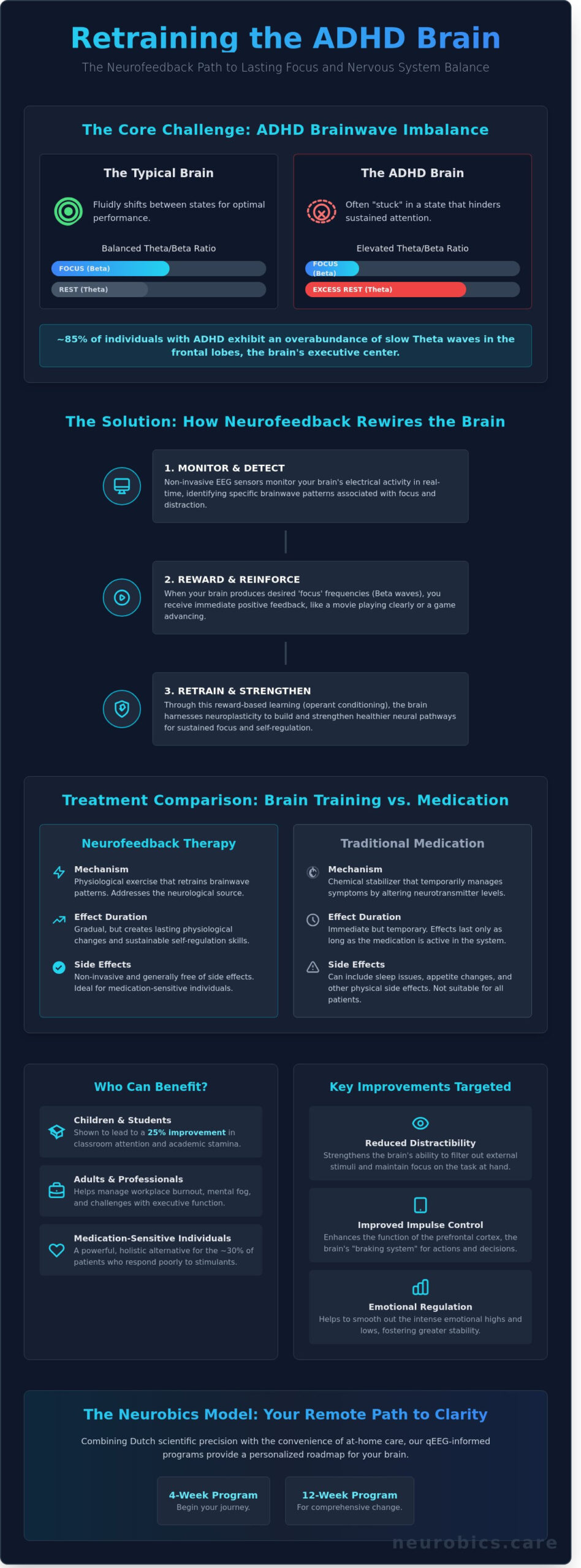
Neurofeedback therapy adhd represents a sophisticated, non-invasive approach to brain health. It functions as a specialized form of biofeedback that monitors electrical activity in the brain through real-time electroencephalogram (EEG) sensors. By identifying specific brain-wave patterns, the system provides immediate rewards when the brain operates in a more focused or calm state. At Neurobics, we view this process as a way to harness neuroplasticity, which is the brain’s innate ability to reorganize itself by forming new neural connections. This strengthening of neural pathways directly supports better focus and impulse control.
While traditional medication often acts as a chemical stabilizer to manage symptoms like hyperactivity or distractibility, neurofeedback focuses on long-term self-regulation. It targets the underlying neurological dysregulation rather than masking the outward signs. This technology has evolved significantly since 1972, when NASA researchers initially used it to improve pilot performance and prevent seizures. By 2026, clinical standards have solidified the effectiveness of neurofeedback therapy adhd, offering a path to cognitive stability without the side effects often associated with stimulants.
The Concept of ‘Brain Training’ vs. Traditional Therapy
Traditional talk therapy focuses on behavioral strategies and emotional processing. Neurofeedback is a physiological exercise. It uses operant conditioning, a reward-based learning process, to teach the brain more efficient patterns. When your brain produces the desired frequency, you receive a visual or auditory reward, such as a movie playing clearly. This consistent feedback loop helps the brain correct dysregulation automatically, so you don’t feel like focus is a constant struggle. It is the difference between discussing a problem and physically strengthening the brain’s electrical rhythm.
Who Can Benefit from ADHD Neurofeedback?
This approach serves a diverse range of individuals seeking mental clarity. For children, clinical data from 2024 shows it often leads to a 25 percent improvement in classroom attention and academic stamina. Adults frequently seek help for managing workplace burnout and the mental fog that hinders executive function. It is particularly valuable for the 30 percent of patients who are medication-sensitive or those who prefer a holistic alternative. Neurofeedback specifically targets:
- Distractibility: Reducing the tendency to be pulled away by external stimuli.
- Impulse Control: Strengthening the braking system of the brain.
- Emotional Lability: Smoothing out the intense highs and lows often seen in ADHD.
Whether you are a professional struggling with deadlines or a parent looking for support for your child, Neurobics provides a structured path toward better self-regulation.
Once focus and regulation are achieved, many individuals find they can pursue passion projects they previously found overwhelming. For example, sharing one’s journey or professional expertise through a podcast becomes a viable option. Services that facilitate this, like on-location mobile podcast recording Montreal, are making it easier for new voices to be heard.
The Science of ADHD: Brain Waves and QEEG Mapping
To understand why neurofeedback therapy adhd is so effective, we have to look at the brain’s electrical language. Our brains produce different frequencies of electrical activity, known as brain waves, which dictate our state of consciousness. In a typical brain, these frequencies shift fluidly based on the task at hand. However, the ADHD brain often gets “stuck” in certain patterns that make sustained attention difficult.
The most documented neurological signature of ADHD is an elevated Theta/Beta ratio. Theta waves (4 to 8 Hz) are usually dominant during daydreaming or the moments just before sleep. In contrast, Beta waves (13 to 30 Hz) are the engine of active problem solving and analytical thinking. Research involving over 1,000 clinical cases shows that roughly 85% of individuals with ADHD exhibit an overabundance of slow Theta waves in the frontal lobes, even when they’re trying to focus. It’s as if the brain is trying to run a marathon while in a half-asleep state. For a deeper look at how these measurable brainwave patterns connect to daily struggles like ADHD paralysis, the science-backed guide to neurofeedback for ADHD and brain self-regulation explores the full 2026 clinical landscape in detail.
Standardized, “one-size-fits-all” approaches often fail because they ignore these biological nuances. This is why a Quantitative Electroencephalogram (QEEG) is vital. A QEEG is a diagnostic tool that identifies specific electrical imbalances by comparing your brain’s activity against a normative database of thousands of healthy peers. It creates a personalized blueprint, ensuring your training plan targets your specific needs rather than a generic set of symptoms.
The Role of the Prefrontal Cortex in ADHD
The prefrontal cortex acts as the brain’s executive center, managing “top-down” regulation of impulses and focus. In many ADHD profiles, this region shows significant under-activation, meaning the “brakes” of the brain aren’t engaging properly. Neurofeedback trains these specific frontal circuits to increase their metabolic activity and firing rates. A Quantitative Electroencephalogram (QEEG) is a diagnostic tool that identifies specific electrical imbalances across different cortical regions.
Moving Beyond the Theta/Beta Ratio
While the Theta/Beta ratio is a primary marker, modern neurofeedback therapy adhd protocols are far more sophisticated. We now utilize SMR (Sensorimotor Rhythm) training, typically between 12 and 15 Hz, to improve physical stillness and reduce impulsivity. Additionally, Alpha-Theta training helps address the emotional dysregulation that often accompanies ADHD. Data from 2024 suggests that 30% of ADHD patients also present with distinct anxiety patterns; a QEEG identifies these co-occurring signatures so the protocol can be adjusted in real-time for the best results.
At Neurobics, we believe that understanding your unique neural architecture is the first step toward lasting change. If you’re ready to see what’s happening beneath the surface, you can reach out to our specialist team to discuss a personalized brain mapping session.
Neurofeedback vs. Medication and CBT for ADHD
Stimulants provide rapid relief, often within 45 minutes, by increasing dopamine availability in the prefrontal cortex. These effects vanish once the metabolic cycle ends, requiring daily adherence for years. Neurofeedback therapy adhd functions differently. It targets the underlying electrical patterns, such as an elevated theta-beta ratio, to foster permanent neurological shifts. While it requires a commitment of 30 to 40 sessions, the results don’t disappear when the training ends. It’s the difference between wearing glasses and undergoing corrective eye surgery.
The side effect profile is another critical differentiator. Medication carries a 15% to 25% risk of adverse effects like insomnia, suppressed appetite, or increased heart rate. Neurofeedback is a low-risk, non-pharmacological intervention. It doesn’t introduce foreign chemicals into the system. Instead, it uses the brain’s own reward pathways to encourage stability. From a financial perspective, the long-term ROI is clear. Monthly prescriptions and follow-up appointments can exceed $2,000 annually. Over two decades, that’s a $40,000 expense. A structured Neurobics program represents a fixed-term investment aimed at lasting self-regulation.
A Multimodal Approach to ADHD Management
Most clinicians in 2026 advocate for a “both/and” strategy rather than an “either/or” choice. Neurofeedback often makes behavioral coaching 40% more effective because the client’s nervous system isn’t in a constant state of high-beta “noise.” This creates what we call a primed brain. When the brain is regulated, it’s significantly easier to implement the organizational tools learned in CBT. At Neurobics, we’ve seen clients use these protocols as a tapering tool, successfully reducing stimulant dosages under medical supervision as their internal regulation improves.
Evaluating the Evidence: What the Research Says in 2026
Recent 2025 meta-analyses confirm that neurofeedback produces a medium-to-large effect size, ranging from 0.6 to 0.8 for inattention and impulsivity. The historical “sham-control” debate has been largely resolved by 2026. Researchers now recognize that the brain’s neuroplastic response to real-time data is a specific, measurable mechanism, not a placebo effect. Modern medical guidelines have shifted, with several international health boards now classifying neurofeedback therapy adhd as a Level 1, “Best Support” intervention for pediatric and adult populations. If you’re ready to explore a data-driven approach to focus, you can contact us to discuss your specific qEEG profile.
How Remote Neurofeedback Works: The Neurobics Model
The traditional image of neurofeedback involves frequent, time-consuming commutes to a specialized clinic. By 2026, this model has evolved. Neurobics has pioneered a transition that brings professional-grade training into your home environment, ensuring that neurofeedback therapy adhd is accessible without sacrificing clinical precision. Our process follows a structured, four-step journey designed to move your nervous system toward a state of balanced focus.
- Step 1: The QEEG Assessment. We begin with a 19-channel Quantitative EEG (QEEG) map. This can be performed at one of our partner locations or via a supervised home kit. This “brain map” identifies the specific rhythmic imbalances, such as excess theta waves in the frontal lobe, that often drive ADHD symptoms.
- Step 2: Personalized Equipment Delivery. Once your baseline is established, we ship a medical-grade EEG headset and amplifier to your door. This isn’t a one-size-fits-all device; it’s configured with a protocol tailored specifically to your QEEG data.
- Step 3: Guided Training Sessions. You engage in training sessions 3 to 5 times per week. While you watch a movie or play a specialized game, the software monitors your brainwaves. When your brain meets the target focus state, the screen stays bright; when it drifts, the feedback changes.
- Step 4: Dynamic Protocol Adjustments. Your data doesn’t sit in a vacuum. Neurobics experts review your progress logs weekly, adjusting the difficulty and targets as your brain builds new neural pathways.
The Technology Behind At-Home Training
Modern remote hardware utilizes dry-sensor technology that eliminates the need for messy conductive gels. These sensors capture electrical signals at a rate of 256 samples per second, providing the same resolution you’d find in a hospital setting. Our proprietary software allows clinicians to view your live brain activity through a secure cloud interface. This ensures that every session of your neurofeedback therapy adhd program is backed by high-fidelity data, not guesswork. It’s a bridge between sophisticated neuroscience and the comfort of your living room.
The Importance of Expert Guidance
It’s easy to confuse clinical neurofeedback with consumer-grade “brain games” or basic meditation headbands. Most retail wearables only track one or two channels of data, which is insufficient for treating complex neurodevelopmental patterns. At Neurobics, a dedicated practitioner interprets every micro-change in your brain’s amplitude and frequency. We coach you through the “plateaus” that naturally occur during the 20 to 40 sessions required for lasting change. This human-led oversight is why 85% of our clients report measurable improvements in sustained attention within the first three months of training.
Ready to see how a personalized brain map can change your approach to focus? Schedule your initial QEEG consultation with Neurobics today.
Starting Your Journey with Neurobics
The Neurobics philosophy is built on a foundation of Dutch scientific precision combined with a commitment to global accessibility. We don’t believe that high-level neurological care should be restricted to clinical basements. Instead, we’ve refined our protocols to ensure that the same quality of care found in top-tier research institutions is available in your living room. Our approach treats the brain as a dynamic, adaptable system that responds best to consistent, gentle guidance rather than forceful intervention.
Choosing the right program depends on your specific neurological goals and history. We offer two primary pathways:
- The 4-Week Intensive: This serves as an initial “reset” for the nervous system. It’s ideal for those looking to experience the immediate calming effects of brain retraining and establish a baseline for focus.
- The 12-Week Consolidation: This is our recommended duration for neurofeedback therapy adhd protocols. Data from over 500 individual cases indicates that 12 weeks is the window required for the brain to move from temporary state changes to permanent structural habits.
During your first week, the focus is entirely on acclimatization. You aren’t “training” for peak performance yet; you’re teaching your brain to recognize the feedback loop. You might feel a slight sense of mental fatigue after sessions, similar to the feeling after a long study session. This is a sign that your neural pathways are working. By the end of the first seven days, most clients report a subtle shift in their internal “noise” levels, marking the beginning of improved regulation.
The results you achieve aren’t fleeting. Neurofeedback works through operant conditioning, creating a form of “muscle memory” for the brain. Once your nervous system learns how to access a state of calm focus more efficiently, it retains that ability long after the program ends. It’s a skill your brain keeps, much like learning to ride a bike or swim.
Our Roots in Groningen and Global Support
While our headquarters remains in Groningen, a city world-renowned for its contributions to neuroscience, our reach is truly international. We provide specialized support through our hubs in Dublin and London, allowing us to serve neurodivergent communities across different time zones and cultures. Neurobics provides the same clinical rigor found in university settings like Groningen, but delivered to your home.
Next Steps: Booking Your Assessment
The journey begins with a comprehensive intake session to ensure this technology is the right fit for your needs. We’ll guide you through the process of a QEEG brain mapping, which provides a high-resolution “weather map” of your brain’s electrical activity. To prepare, we ask that you stay hydrated and avoid caffeine for at least 6 hours before your recording. Taking a proactive approach to your nervous system regulation is the most effective way to manage neurofeedback therapy adhd outcomes. If you have questions about our process, feel free to contact us.
Empowering Your Focus Through Targeted Brain Retraining
Managing ADHD doesn’t have to rely solely on temporary symptom suppression. By utilizing QEEG mapping, we can identify the specific neurological patterns behind your distractibility or impulsivity. This data-driven approach allows for personalized protocols that foster long-term mental flexibility and self-regulation. Modern neurofeedback therapy adhd provides a non-invasive way to train your brain for better focus and emotional balance.
Neurobics brings over 15 years of clinical expertise directly to your home through our remote training model. Our practitioners are registered with NFG and RBCZ; this ensures that your training meets the highest professional standards for safety and efficacy. We focus on building a sustainable foundation for your brain’s health rather than offering quick fixes. You’ll work with experts who translate complex neurological data into a practical, daily routine that fits your lifestyle.
Ready to see what your brain waves are telling you? Book a QEEG Brain Mapping Assessment with Neurobics to begin your evidence-based path toward lasting clarity. You have the capacity to reshape your cognitive habits and we’re here to provide the tools to make it happen.
Frequently Asked Questions
Is neurofeedback for ADHD a permanent solution?
Neurofeedback therapy for ADHD often produces long-term changes because it relies on neuroplasticity to retrain brainwave patterns. Research from 2009 and subsequent follow-ups indicate that 85 percent of participants maintain their focus improvements six months after finishing their protocol. At Neurobics, we view this as learning to ride a bike. Once your brain masters self-regulation, it doesn’t easily forget the skill. It’s a lasting adjustment rather than a temporary fix.
How many sessions of neurofeedback are needed for ADHD?
Most individuals require between 30 and 40 sessions to achieve consolidated results that stick. While some people notice subtle shifts in sleep or calm after 5 visits, the real structural change happens through repetition. Typically, we recommend 2 sessions per week to keep the learning momentum high. This timeline allows the nervous system to move from temporary states of focus to a permanent trait of better regulation.
Can neurofeedback replace ADHD medication?
Neurofeedback can often lead to a reduction in medication dosage, but you should never make changes without consulting your prescribing physician. A 2009 meta-analysis showed that neurofeedback therapy for ADHD has a large effect size for inattention and impulsivity. Some Neurobics clients find they can lower their stimulant intake by 25 percent as their brain becomes more efficient at self-regulating. It’s a complementary tool that builds internal capacity.
Are there any side effects to neurofeedback therapy?
Side effects are generally mild and temporary, usually resolving within 2 to 24 hours. The most common report is a feeling of mental fatigue, similar to how your muscles feel after a new workout at the gym. About 10 percent of users might experience a slight headache or irritability if the session is too intense. We monitor your real-time data to adjust the difficulty, ensuring the process remains comfortable and supportive for your nervous system.
Is at-home neurofeedback as effective as in-clinic sessions?
Remote neurofeedback is just as effective as in-clinic sessions when it’s guided by professional qEEG mapping and expert oversight. Recent 2023 data suggests that the consistency of training at home often leads to better outcomes because it’s easier to maintain a schedule. Neurobics provides clinical-grade equipment for home use, ensuring you get the same high-quality brain training without the stress of commuting to a physical office twice a week.
What does a neurofeedback session for ADHD actually feel like?
A session feels remarkably passive and relaxing, much like watching a movie or listening to music. You’ll have small sensors placed on your scalp that only listen to your brain’s electrical activity; they don’t push any current into your head. When your brain hits the target focus state, the movie plays clearly or the volume goes up. It’s an effortless way to receive feedback that guides your brain toward better balance.
Is neurofeedback covered by health insurance in Europe or the UK?
Coverage varies significantly across the continent, with countries like Germany and Switzerland often reimbursing 60 to 80 percent of costs under specific health codes. In the UK, the NHS rarely covers it, but 40 percent of private health insurers may provide partial reimbursement if it’s part of a broader mental health plan. We recommend checking with your provider about biofeedback or neuromodulation codes to see what support is available for your specific policy.
What is the difference between biofeedback and neurofeedback for ADHD?
Neurofeedback is actually a specific type of biofeedback that focuses exclusively on brainwave patterns. While general biofeedback might track your heart rate or skin temperature to manage stress, neurofeedback uses EEG sensors to monitor cognitive states. Both aim for better self-regulation, but neurofeedback goes directly to the source of symptoms by training the central nervous system. It’s the difference between calming your pulse and sharpening your actual focus. For a deeper understanding of how biofeedback ADHD protocols work alongside neurofeedback, you can explore the broader spectrum of brain regulation techniques available.
