


What if the key to managing your focus wasn’t about trying harder, but about seeing how your brain actually functions in real time? You’ve likely experienced the heavy weight of ADHD paralysis or the frustration of persistent brain fog that medication doesn’t always lift. It’s exhausting to feel like your mind is a high performance engine with a faulty steering wheel. At Neurobics, we understand that these challenges aren’t a lack of will; they’re a matter of physiological regulation. Research published in 2021 indicates that up to 75 percent of individuals using qEEG-informed training see measurable improvements in executive function. By using biofeedback adhd protocols, you can bridge the gap between clinical science and your daily quality of life.
This guide provides a clear path through the confusion of brain training apps versus clinical neurofeedback. We’ll show you how non-invasive technology allows you to observe your nervous system and develop sustainable self-regulation skills. You’ll learn how a personalized plan, built on your specific brain data, can help you achieve a sense of calm and mental clarity. We’re going to examine the frequently asked questions about brain regulation and explain how you can start your journey toward a more balanced, focused mind.
Key Takeaways
- Understand the distinction between general physiological monitoring and neurofeedback, the specialized form of brain training considered the gold standard for managing focus.
- Learn how biofeedback adhd protocols help regulate the brain’s “low arousal” state by balancing Theta and Beta waves for improved concentration and mental clarity.
- Discover why a personalized qEEG brain map is essential to avoid “one-size-fits-all” approaches and ensure your training plan matches your unique neurological profile.
- Explore the evolution of professional-grade at-home systems that provide clinical-level precision and expert guidance without the need for frequent office visits.
- Gain a realistic perspective on what to expect during your first month of training and how the Neurobics approach fosters long-term self-regulation and resilience.
Understanding Biofeedback and Neurofeedback for ADHD
Biofeedback is a broad term for a therapeutic technique that uses electronic monitoring to convey information about physiological functions. For those exploring biofeedback adhd solutions, it’s helpful to view the process as a high-tech mirror for the nervous system. Most of our internal processes happen automatically; we don’t consciously control our heart rate or brain wave frequencies. This technology makes these invisible signals visible, allowing us to influence them through practice.
At Neurobics, we prioritize this bridge between science and self-awareness. When a person with ADHD sees their internal state reflected on a screen, the abstract struggle of “trying to focus” becomes a tangible task. This visual representation allows the brain to recognize its own patterns. Research, including a 2014 meta-analysis published in European Child & Adolescent Psychiatry, suggests that these interventions can lead to sustained improvements in attention and impulsivity over 30 to 40 sessions. It’s a process of gradual development that relies on the brain’s natural plasticity.
The Difference Between Biofeedback and Neurofeedback
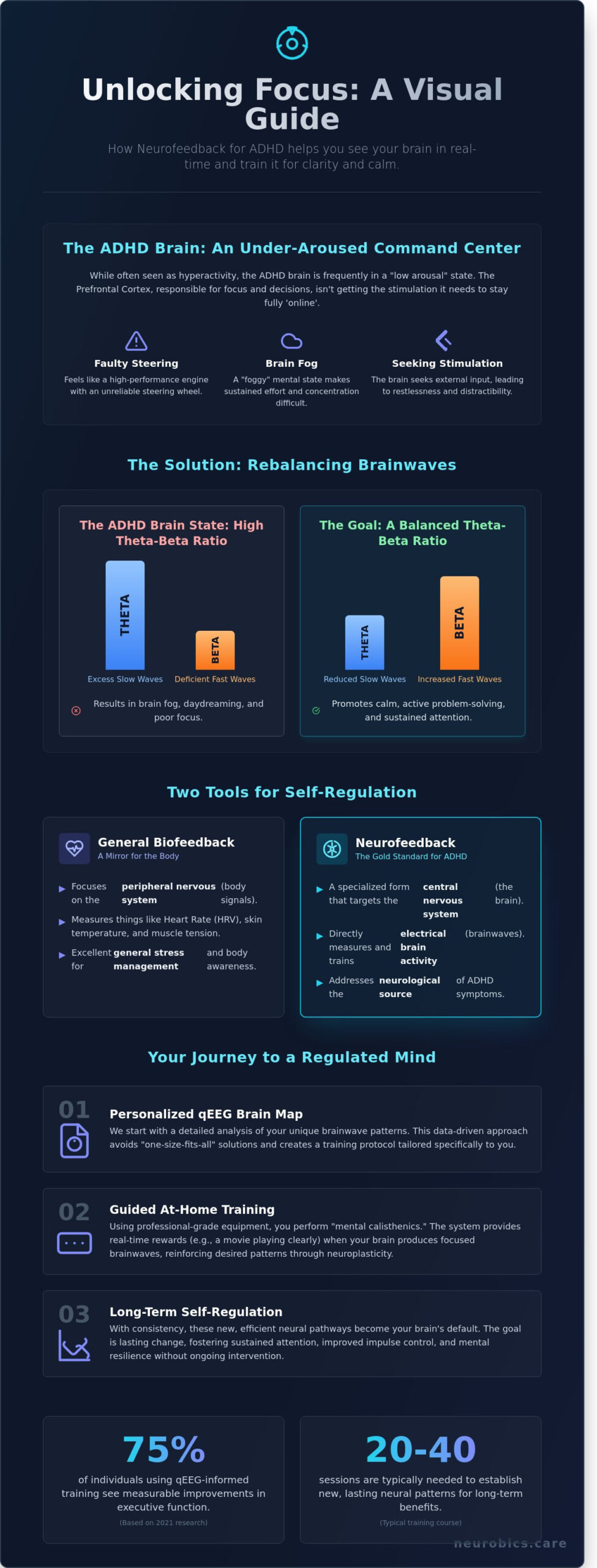
Traditional biofeedback focuses on the body’s peripheral nervous system. This includes monitoring heart rate variability (HRV), skin temperature, and muscle tension. While these tools are excellent for general stress management, ADHD is primarily a neurological challenge involving brain wave dysregulation. This is where What is Neurofeedback? becomes a vital question to answer. Neurofeedback is a specialized form of biofeedback that targets electrical brain activity directly. It’s often considered the gold standard for biofeedback adhd applications because it addresses the source of the symptoms rather than the secondary physical effects of stress.
The Psychology of Self-Regulation
The core of this training is operant conditioning. When the brain produces a desired frequency, the software rewards the user with a visual or auditory cue, such as a movie playing clearly or a game character moving forward. Over time, the brain learns to associate these internal states with the reward. This process helps individuals move from relying on external cues, like a teacher’s reminder, to developing internal control. This transition is fundamental for long-term development. By creating these consistent feedback loops, we help the nervous system find a state of balance and focus that feels natural rather than forced. If you’re ready to explore how these tools can support your journey, you can contact us to learn more about our approach.
How Brainwave Training Addresses ADHD Symptoms
To understand how brainwave training works, we first look at the “low arousal” theory of the ADHD brain. While ADHD often involves outward hyperactivity, the brain itself is frequently in a state of under-arousal. The Prefrontal Cortex, which acts as the brain’s command center for executive functions, doesn’t always receive the stimulation it needs to stay “online.” This leads the brain to seek external stimulation to wake itself up, which manifests as the restlessness or distractibility we see in daily life. Through biofeedback adhd protocols, we can teach the brain to shift out of this idling state and into a more engaged mode of operation.
This process relies on the principle of neuroplasticity. The brain isn’t a rigid organ; it’s a dynamic system that physically reorganizes itself based on repeated experience. When a person participates in neurofeedback for ADHD, they’re essentially performing “mental calisthenics” that strengthen the neural pathways responsible for regulation. Over a typical course of 20 to 40 sessions, these new patterns become the brain’s default setting, leading to lasting changes in how a person processes information and manages impulses.
Targeting the Theta-Beta Ratio
In the world of neurofeedback, we pay close attention to the relationship between slow waves and fast waves. Theta waves (4 to 8 Hz) are usually dominant when we’re drifting off to sleep or daydreaming. Beta waves (13 to 30 Hz) are the fast waves required for active problem-solving and focused attention. Many individuals with ADHD show an excess of Theta waves in the frontal lobes, which creates a “foggy” mental environment that makes sustained effort difficult.
The Theta-Beta ratio is defined as a primary clinical marker in ADHD research. When this ratio is too high, it indicates that the “daydreaming” waves are overpowering the “focus” waves. Training aims to suppress these excessive Theta waves while boosting Beta activity. According to the Current Evidence on Neurofeedback for ADHD, targeting these specific frequencies helps normalize brain activity and reduces the core symptoms of inattention. It’s a precise, data-driven way to help the brain find its natural balance.
From Inattention to Sustained Focus
Improving focus is often a matter of increasing the “signal-to-noise” ratio within the nervous system. In an ADHD brain, the “noise” of internal distractions and slow-wave activity makes it hard for the “signal” of a task, like reading a report or following a conversation, to get through. Brainwave training helps quiet that internal noise. As the brain learns to maintain a state of alert calm, tasks that previously felt exhausting start to feel more manageable—an ideal state for professionals who choose to visit Financial Modelling University to master complex investment analysis.
The most encouraging aspect of using biofeedback adhd techniques is the longevity of the results. Because the brain is learning a new skill rather than just reacting to a temporary chemical change, the benefits often persist years after the training ends. Research has shown that once the brain learns how to enter a focused state efficiently, it continues to use that “muscle memory” in real-world environments. Many clients find that pairing this neurological training with CBT for ADHD helps address both the physiological and cognitive dimensions of focus challenges. If you want to explore how these neurological shifts can support your daily performance, you can contact our specialists to discuss a personalized training plan.
The Critical Role of qEEG Brain Mapping in ADHD Care
Many individuals seek out biofeedback adhd solutions only to find that generic, “one-size-fits-all” protocols yield disappointing results. This lack of progress usually stems from a fundamental misunderstanding of the condition. ADHD isn’t a single, uniform disorder; it’s a collection of symptoms that can arise from very different neurological landscapes. At Neurobics, we believe that effective training must begin with a clear sight of the target. This is why we prioritize the qEEG, or Quantitative Electroencephalogram, as the foundation of every client’s journey.
A qEEG isn’t a simple snapshot. It’s a sophisticated assessment that records electrical activity across 19 or more points on the scalp. While a standard EEG looks for major abnormalities like seizures, a “quantitative” EEG uses digital technology to analyze the power, frequency, and connectivity of brainwaves. This process reveals the specific ADHD “phenotypes” present in a person’s brain. Some people struggle with focus because their frontal lobes produce too many slow waves, while others might have an over-aroused system that’s constantly “on edge.” Knowing which pattern you have is the difference between meaningful progress and wasted effort.
Visualizing the ADHD Brain
The mapping process transforms raw data into a topographic display, creating a color-coded “weather map” of your brain’s performance. These maps allow us to see areas of over-activity and under-activity with clinical precision. For example, we often look for a high Theta/Beta ratio in the frontal cortex, a marker that research has linked to ADHD symptoms in approximately 85 percent of cases.
We don’t just look at your data in isolation. We compare your unique brainwave patterns against a normative database of thousands of healthy individuals in your age group. This comparison highlights exactly where your brain deviates from the norm. It allows us to pinpoint whether your executive function challenges are linked to a lack of “fuel” in the prefrontal cortex or perhaps a communication breakdown between different brain regions. This level of detail ensures that the training we design is grounded in your specific biology.
Personalized Protocols vs. Generic Apps
Training your brain without a map is essentially “blind” training. Generic apps often use a blanket approach, rewarding the same brainwave changes for every user. This is risky. If a person with an already over-active brain uses a protocol designed to increase arousal, they may experience side effects like increased anxiety, irritability, or significant mental fatigue. At Neurobics, we use your qEEG to create a bespoke training roadmap that avoids these pitfalls.
Personalized protocols ensure that we only encourage the specific changes your nervous system needs to find balance. This targeted approach respects the delicate equilibrium of your brain’s chemistry and electrical output. If you want to understand the technical nuances of how we translate these maps into actual training sessions, you can read our Neurofeedback Therapy for ADHD guide. By using a map, we don’t just guess where you’re going; we build a direct path toward sustainable self-regulation and mental clarity.
Comparing Clinical vs. At-Home Biofeedback Options
Biofeedback has moved beyond the confines of the therapist’s office. Historically, families had to drive to specialized clinics twice a week for several months, a schedule that often proved impossible for working parents. Technology has finally caught up with the need for flexibility. Today, the primary choice isn’t between “office or nothing,” but rather between consumer-grade gadgets and professional remote systems.
The market is currently flooded with consumer wearables priced between $150 and $400. While these devices are excellent for general wellness, they often lack the sampling rate and signal clarity required for biofeedback adhd protocols. Clinical sensors capture data at a much higher resolution, filtering out the “noise” created by muscle movement or eye blinks. This precision is what allows for the subtle shifts in nervous system regulation that lead to lasting change.
The Remote Assisted Model
Neurobics bridges the gap between clinical rigor and home convenience by shipping professional-grade equipment directly to your door. This isn’t a standalone “DIY” experience. We provide the same hardware used in top-tier research facilities while maintaining a direct digital link to our experts. A remote specialist monitors your progress, interprets the data, and adjusts your training plan based on your brain’s unique response. It’s a sophisticated partnership that prioritizes your safety and progress.
Is At-Home Training as Effective?
A 2020 meta-analysis published in the journal Applied Psychophysiology and Biofeedback indicated that home-based training yields results comparable to office-based sessions, provided there’s professional oversight. In fact, training in your “natural environment” offers a distinct advantage. Since ADHD symptoms typically surface during homework or remote work, practicing self-regulation in that exact setting helps the brain generalize new skills faster. Success relies on three specific pillars:
- Equipment Quality: Using medical-grade sensors rather than recreational toys.
- Consistency: Completing 2 to 3 sessions per week without the stress of a commute.
- Expert Oversight: Having a practitioner analyze qEEG-informed data to ensure the training remains effective.
For most families, the cost-benefit analysis is simple. You save approximately 5 to 8 hours of travel time every month. This time can be reinvested into rest or family activities, reducing the overall stress levels that often exacerbate ADHD symptoms. You aren’t just buying a service; you’re integrated into a supportive system designed for your specific neural patterns.
Navigating Your ADHD Journey with Neurobics
The Neurobics philosophy centers on a balance between rigorous science and empathy-driven care. We recognize that ADHD isn’t just a checklist of symptoms; it’s a lived experience that affects your confidence and daily rhythm. Our goal is to move beyond temporary fixes by teaching your brain how to find its own state of balance. This process relies on the principle of neuroplasticity, which is the brain’s natural ability to reorganize itself through consistent practice and feedback.
Your first four weeks of training are designed to be a period of discovery. During the first fortnight, you’ll focus on establishing a baseline and learning how the feedback loop works. By the third and fourth weeks, the brain often begins to recognize the desired states of focus more quickly. You might notice you’re less reactive to distractions or that you can return to a task with less mental friction. These small wins represent the first steps toward a more regulated nervous system.
The impact of biofeedback adhd training often ripples into other areas of life. Research indicates that roughly 80% of adults with ADHD also struggle with secondary issues like sleep onset insomnia or generalized anxiety. Because our protocols target the underlying dysregulation of the nervous system, clients frequently report improved sleep quality and a reduction in that restless “driven by a motor” feeling. When the brain learns to down-regulate, the entire body benefits from the shift away from a constant stress response. For those who also experience cognitive blocks and emotional dysregulation, exploring CBT for ADHD cognitive strategies alongside neurofeedback can provide a comprehensive approach to managing daily challenges.
Our qEEG-Informed Process
Everything we do starts with data. We provide you with clinical-grade technology to perform a qEEG brain map in the comfort of your home. This measurement allows us to see exactly how your brain waves are behaving. We use this “brain map” to build a custom training plan, much like the personalized rehabilitation programs developed by the experts at RED Physiotherapy, and we continue to adjust your protocols based on your real-time progress. Neurobics provides the equipment and the expertise, ensuring you never train alone.
Next Steps for Long-Term Regulation
While the first month builds the foundation, lasting change happens through repetition. Our 12-week programs are designed to turn these new mental habits into permanent traits. For those seeking sustained support, our annual options provide a way to integrate brain training into a long-term wellness strategy. We encourage you to view neurofeedback for ADHD as a cornerstone of a holistic ADHD management plan. To explore how we can help you achieve better focus and calm, please contact us for a personalized consultation.
Taking the Next Step Toward Mental Clarity
Navigating ADHD requires more than just willpower. It demands a precise understanding of your nervous system. Through qEEG brain mapping, we move beyond guesswork to see exactly how your brain processes information. This assessment forms the foundation of effective biofeedback adhd training, allowing you to strengthen focus and emotional regulation through neuroplasticity. With over 15 years of clinical expertise and professional registration through NFG and RBCZ, Neurobics provides a bridge between advanced neuroscience and your daily well-being.
You don’t have to navigate this journey alone or settle for generalized solutions. We provide clinical-grade equipment shipped globally, ensuring you receive the same high standard of care regardless of your location. Our team is here to support you in developing the mental resilience and balance you deserve. It’s time to transform how you relate to your mind and unlock your full potential through evidence-based training.
Book a QEEG Brain Mapping Assessment to Start Your Personalized Journey
Your path to a more regulated and focused life is within reach; we’re ready to help you begin.
Frequently Asked Questions
Is biofeedback for ADHD scientifically proven?
Biofeedback is supported by decades of clinical research. In 2012, the American Academy of Pediatrics recognized neurofeedback, a specific type of biofeedback, as a Level 1 “Best Support” intervention for ADHD. This rating puts it on the same level of efficacy as medication. A 2014 meta-analysis by Arns and colleagues confirmed that improvements in attention and impulsivity are often maintained 6 months after the training ends, suggesting long-term neurological change.
How many sessions of biofeedback are needed for ADHD?
Most individuals require between 30 and 40 sessions to achieve lasting results. While you might feel more focused after the first 10 appointments, the brain needs consistent repetition to make these changes permanent. We typically recommend 2 or 3 sessions per week. This frequency helps the nervous system integrate new patterns of self-regulation, ensuring the progress you make stays with you long after you finish your program at Neurobics.
Can biofeedback replace ADHD medication?
Biofeedback isn’t a direct replacement for medication, but it’s a powerful tool that often leads to reduced reliance on stimulants. Many clients find they can lower their dosage by 30% or more after completing a full training protocol under medical supervision. A 2013 study in European Child & Adolescent Psychiatry showed that neurofeedback can produce clinical outcomes comparable to Ritalin. It’s essential to consult your prescribing physician before making any changes to your regimen.
Are there any side effects to neurofeedback or biofeedback?
Side effects are generally minimal and temporary. Some people report a slight tension headache or mental fatigue, similar to the feeling after a long study session. These symptoms usually disappear within 2 to 24 hours. Since the process is non-invasive and doesn’t involve chemicals, it avoids the appetite loss or sleep disturbances often linked to ADHD drugs. It’s a gentle way to encourage the brain toward better balance without systemic risks.
What is the best age to start biofeedback for a child with ADHD?
The ideal time to start is usually around age 6 or 7. By this stage, a child’s brain is sufficiently developed to engage with the feedback loops, yet still highly plastic. Research shows that early intervention can prevent the secondary emotional challenges, like low self-esteem, that often develop by age 10. Starting early gives a child the tools to navigate school with greater confidence and a more regulated nervous system.
How much does biofeedback for ADHD typically cost?
A single clinical session typically costs between $100 and $250 depending on the provider’s level of expertise. For a standard 40-session protocol, families should budget between $4,000 and $10,000. While the upfront cost is higher than a monthly prescription, the benefits of biofeedback adhd training are designed to be permanent. Neurobics uses qEEG-informed care to ensure your resources are focused on the most effective protocols for your specific brain patterns.
What is the difference between a brain-training app and clinical biofeedback?
Clinical biofeedback uses medical-grade sensors to monitor actual physiological activity, while most apps only use touch-screen interactions. Professional systems provide the high-resolution data needed to target specific areas like the prefrontal cortex. Apps can be engaging, but they don’t offer the 95% accuracy or the personalized guidance of a practitioner who understands your unique neurological signature. It’s the difference between a general fitness game and a data-driven personal trainer.
Can I do biofeedback for ADHD by myself at home?
You can perform biofeedback adhd training at home, provided you use professional-grade equipment and expert supervision. Remote training has become much more accessible since 2020, allowing you to train in a comfortable environment. However, DIY kits without professional oversight often lack the calibration needed for real progress. Neurobics provides remote programs that include high-end hardware and regular consultations to keep your development on the right track. If you’re ready to explore how a tailored program could support your journey, we invite you to contact our team for an initial consultation.
