


What if the “ADHD paralysis” you experience isn’t a character flaw, but a specific, measurable pattern of brainwaves that can be gently retrained? You’ve likely felt the frustration of stimulant side effects or the exhaustion of trying to “try harder” when your nervous system simply won’t cooperate. It’s common to feel that focus is a moral obligation you’re failing to meet, rather than the biological regulation issue it truly is. At Neurobics, we believe that your brain’s unique architecture requires a tailored approach. Utilizing neurofeedback for adhd offers a science-backed path to self-regulation by using personalized, QEEG-informed technology to help you regain control.
This guide explores the 2026 landscape of brain training, where targeted protocols based on 20 years of clinical research lead to measurable changes in neural connectivity. You’ll learn how we bridge the gap between clinical precision and daily well-being to help you achieve lasting mental flexibility. We’ll preview how QEEG mapping identifies your specific cognitive patterns and how these insights translate into a sense of calm and sustainable focus. By the end, you’ll understand how to move beyond the cycle of burnout and build a more resilient, regulated mind through the power of neuroplasticity.
Key Takeaways
- Learn how the brain utilizes real-time feedback to monitor its own activity, fostering the inherent ability to self-regulate and improve focus.
- Understand how QEEG mapping identifies specific brain wave patterns, allowing for personalized neurofeedback for adhd that addresses the root of neurological under-arousal.
- Compare the “bottom-up” physiological training of neurofeedback with traditional behavioral strategies to find the most effective balance for your unique needs.
- Explore how professional-grade brain training has evolved, offering a safe and supported remote experience that brings expert care into your home environment.
- Discover the Neurobics philosophy of precision-led care, where scientific data and human-centered support create a sustainable path toward mental flexibility.
Understanding Neurofeedback for ADHD: The Science of Self-Regulation
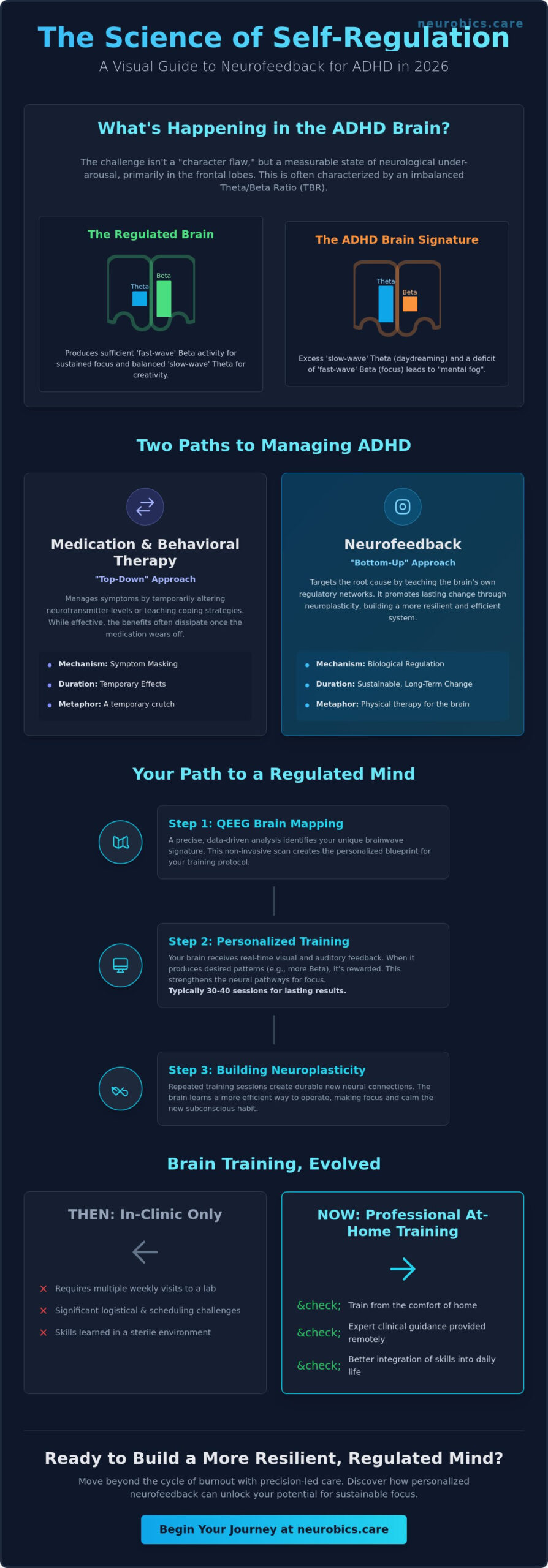
Neurofeedback for ADHD is often misunderstood as a simple exercise, but it’s actually a sophisticated form of biofeedback that monitors real-time electrical activity in the brain. Through sensors placed on the scalp, the brain begins to “see” its own patterns in a way that isn’t possible through introspection alone. This visual and auditory feedback allows the central nervous system to recognize inefficient states and learn to self-correct. Neurofeedback is a non-invasive neuromodulation technique used to improve executive function. By providing this mirror to the mind, the brain can identify when it’s drifting into a state of inattention and pivot back toward a state of focus.
There’s a fundamental difference between symptom masking and biological regulation. Conventional approaches often rely on stimulants to manage behaviors by temporarily altering neurotransmitter levels. While these can be effective, the effects typically dissipate once the medication leaves the system. In contrast, neurofeedback targets the underlying biological regulation. It doesn’t just cover up the symptoms; it teaches the brain to maintain a state of “quiet focus” naturally. You can find a deeper technical background on this process in this overview of What is Neurofeedback? which details its clinical history and development.
How Neurofeedback ‘Rewires’ the ADHD Brain
The engine behind these changes is neuroplasticity, which is the brain’s innate ability to form new neural connections throughout life. During a session, the brain receives a reward, such as a clear image or a pleasant sound, when it produces the desired brainwave patterns. When it slips into a distracted or hyperactive state, the reward stops. This repeated cycle strengthens the neural pathways associated with sustained attention. It’s much like physical therapy for the mind. Over an average of 30 to 40 sessions, the process shifts from a conscious effort to a subconscious habit. The brain simply learns a more efficient way to operate, making focus feel less like a struggle and more like a natural state of being.
The Shift from Clinical Office to Home-Based Care
For decades, accessing this technology required visiting a specialized lab multiple times a week. This created significant barriers for families managing busy schedules and school commitments. By 2026, the standard of care has shifted toward professional, remote-assisted training. High-fidelity EEG devices now allow clients to train from the comfort of home while receiving expert guidance from practitioners at Neurobics. This transition hasn’t sacrificed clinical quality. Training in one’s own environment often leads to better integration of these new skills into daily life because the brain is learning to regulate itself where it matters most. If you’re curious about how this technology can fit into your routine, you can contact us to discuss your specific needs.
The ADHD Brain Signature: Theta/Beta Ratios and QEEG Mapping
The ADHD brain isn’t running too fast. Instead, it’s often in a state of under-arousal. This can feel counterintuitive when you’re dealing with hyperactivity, but the science points to a specific electrical signature. Your brain produces different frequencies of electrical activity, known as brain waves, to manage different tasks. These range from Delta (deep sleep) and Theta (daydreaming) to Alpha (relaxed alertness) and Beta (active focus).
Decoding Brain Waves: Focus vs. Drowsiness
Theta waves are vital for creativity and processing emotions, but they become a hurdle when they dominate during tasks that require concentration. When the brain stays in a “daydreaming” Theta state while you’re trying to read or work, focus feels nearly impossible. Beta waves, on the other hand, are the workhorses of the brain. They’re responsible for logical thinking, planning, and the “executive function” that ADHD often disrupts.
Neurofeedback acts like a mirror for your nervous system. By providing real-time rewards, such as a change in a sound or a visual cue, the brain learns to produce more Beta and less Theta. While a recent meta-analysis of neurofeedback effectiveness highlights the need for rigorous, blinded studies to confirm long-term outcomes, clinical practice shows that teaching the brain to “shift gears” can lead to significant improvements in self-regulation. The process doesn’t force the brain into a state; it simply rewards it for finding the right frequency at the right time.
QEEG Mapping: The Blueprint for Personalized Training
A Quantitative Electroencephalogram (QEEG) is often described as a “weather map” of the brain. Unlike a standard EEG that looks for abnormalities like seizures, a QEEG records brain wave activity at 19 or more locations simultaneously. This data is then compared to a normative database to identify exactly where your brain’s communication patterns might be out of sync. One-size-fits-all protocols often fail because ADHD isn’t a single condition. One person might have an excess of slow waves, while another might actually have too much “high Beta,” leading to an anxious, over-aroused version of ADHD.
At Neurobics, we use this QEEG blueprint to create a tailored map of your unique nervous system. This precision allows us to move beyond guesswork and address the root causes of your specific challenges. By understanding the “why” behind the symptoms, we can support your journey toward mental clarity and balance. If you’re ready to see what your own brain map reveals, you can schedule a consultation with our team to discuss your goals.
Neurofeedback vs. Medication and Behavioral Therapy
The question of whether neurofeedback can replace medication is common. For many, it isn’t about choosing one over the other, but rather finding the right balance for their unique biology. Stimulants work by temporarily altering brain chemistry, but their effects stop once the medication leaves the system. Neurofeedback aims for long-term structural and functional changes. Some individuals find that after a consistent training program, they can work with their physician to reduce their dosage, though this process should always be medically supervised. Neurofeedback addresses biological dysregulation while CBT for ADHD focuses on coping strategies.
Addressing the ‘Placebo’ Question: What the Research Says
Critics often ask if the benefits of brain training are simply a placebo effect. However, a 2018 meta-analysis published in European Child & Adolescent Psychiatry analyzed over 500 cases and found that neurofeedback produced significant, lasting improvements in inattention and impulsivity. Unlike many interventions that see a decline in effectiveness once treatment ends, neurofeedback often shows a persistent effect. This is known as the lack of a washout effect; because the brain has learned a new way to self-regulate, the skills remain. At Neurobics, we use QEEG-informed protocols to ensure training is based on your specific neural patterns, which significantly increases efficacy compared to generic, non-targeted approaches.
A Multimodal Approach: Combining Neurofeedback with CBT
The most robust results often come from a multimodal approach. When you combine the biological training of neurofeedback with the practical life-skill coaching of Cognitive Behavioral Therapy (CBT), you create a powerful synergy. Improved regulation makes the brain more receptive to the lessons taught in therapy. If you’re interested in how different forms of regulation compare, you can explore our guide on Biofeedback for ADHD: A Comprehensive FAQ and Guide to Brain Regulation. By stabilizing the underlying nervous system, neurofeedback for adhd provides the foundation upon which behavioral success is built. This integrated path ensures that you aren’t just managing symptoms, but actively developing the mental flexibility needed for a better quality of life. For a deeper understanding of how cognitive strategies address the emotional and organizational blocks that stall daily functioning, our comprehensive resource on CBT for ADHD in 2026: cognitive strategies and how they compare to neurofeedback offers an in-depth comparison of both approaches.
The Evolution of Care: Professional Neurofeedback at Home
Remote care has transformed from a simple convenience into a clinical standard. Professional neurofeedback for adhd no longer requires three trips a week to a physical office. Instead, Neurobics brings the laboratory to your living room using medical-grade EEG sensors and secure cloud-based monitoring. This shift ensures that high-quality brain training is accessible regardless of your geographic location.
The transition to a remote program follows a structured, four-stage process designed to maintain clinical integrity:
- Assessment: You complete a detailed clinical intake and, in many cases, a qEEG brain map to identify the specific neural signatures of your ADHD.
- Equipment Logistics: A professional-grade headset, sensors, and a specialized amplifier are shipped directly to your home.
- Training: You engage in 20 to 30-minute sessions where your brain activity is translated into real-time visual or auditory feedback.
- Clinical Support: A practitioner reviews your session data weekly, ensuring that the training protocols evolve as your brain learns to self-regulate.
Safety and efficacy are the primary concerns for those moving away from traditional clinics. It’s vital to distinguish between consumer-grade gadgets and clinical remote systems. The “remote-assisted” model used by Neurobics ensures that your progress is supervised by experts. Recent data suggests that when supervised by a clinician, home-based neurofeedback for adhd can achieve results comparable to in-office visits, provided the hardware meets medical standards for signal-to-noise ratios.
How Remote Neurofeedback Training Works
The hardware involves high-fidelity sensors that detect micro-voltages of electrical activity on the scalp. This signal is sent to an amplifier and then to software that analyzes the data in milliseconds. This creates a “feedback loop.” When your brain reaches a state of focused calm, the software rewards you; perhaps a movie plays clearly or a game character moves faster. This process uses operant conditioning to strengthen neural pathways. Neurobics clinicians adjust these thresholds remotely, ensuring the challenge remains effective as your focus improves.
Setting Up for Success: Your Home Training Environment
Consistency is the engine of neuroplasticity. We recommend training in a quiet, dedicated space with consistent lighting to minimize sensory distractions. For pediatric care, a parent typically serves as a “home coach,” assisting with sensor placement and ensuring the child remains engaged. Setting a routine, such as training at 4:00 PM every Tuesday and Thursday, helps the nervous system prepare for the session. For a deeper look at how these sessions fit into a broader treatment plan, explore our Neurofeedback Therapy for ADHD: A Comprehensive Guide to Brain Retraining in 2026.
If you’re interested in bringing clinical-grade brain training into your daily routine, you can connect with a Neurobics specialist to start your assessment process.
Beginning Your Journey with Neurobics: Precision Brain Training
At Neurobics, our philosophy centers on the belief that peak mental performance shouldn’t be a mystery. We combine the clinical precision of neuroscience with a deeply human-centered approach to care. Our goal is to help you move beyond simply managing symptoms; we want to help you build a resilient nervous system that can adapt to the demands of modern life. This journey is about more than just technology. It’s about a partnership where your unique brain data guides every step of your development.
Our QEEG-Informed Remote Process
The journey begins with a Quantitative Electroencephalogram (QEEG) intake. This process allows us to see exactly how your brain functions in real-time, identifying specific patterns associated with your symptoms. We ship medical-grade, clinical-standard equipment directly to your door in the UK, Ireland, or elsewhere in Europe. You don’t need to travel to a clinic to receive world-class care. Our Dutch-based experts monitor your progress through every remote session. They analyze your data to ensure the training remains effective and safe. If you’re ready to see how this data-driven approach can help you, you can contact us to discuss your specific ADHD challenges and goals.
Sustaining Mental Flexibility Beyond the Program
One of the most common questions we hear is whether the benefits of neurofeedback for adhd will last. Research indicates that once the brain learns these new patterns of self-regulation, the effects are long-lasting. It’s similar to building muscle memory. A standard 12-week program, typically consisting of 30 to 40 sessions, is often the “tipping point” where the brain adopts these healthier states as its new default.
- 12-Week Intensive: Focuses on establishing core regulation and reducing distractibility through consistent reinforcement.
- Annual Optimization: Provides ongoing support for those who want to maintain high-level cognitive performance and adapt to new life stressors.
- Resilience Building: Shifts the nervous system from a state of constant “fight or flight” to one of flexible, calm focus.
Completing your program doesn’t mean your growth stops. Many of our clients find that their improved mental flexibility allows them to engage more effectively with other therapies or professional challenges. Taking the first step toward a more regulated brain is a commitment to your long-term well-being. We invite you to reach out and discover how a customized, science-backed plan for neurofeedback for adhd can help you reclaim your focus and balance. Our team is here to support your transition from feeling overwhelmed to feeling in control.
Taking the Next Step Toward Focused Self-Regulation
Navigating life with ADHD often feels like managing a motor that won’t stop revving. Modern science shows us that this isn’t a lack of will, but a specific brain signature involving theta and beta wave imbalances. By using neurofeedback for adhd, you’re moving beyond temporary fixes toward lasting physiological change. This process relies on the brain’s natural neuroplasticity to strengthen the circuits responsible for focus and emotional control.
At Neurobics, we’ve spent over 15 years refining these clinical protocols to ensure they’re both effective and accessible. You don’t need to live near a high-end clinic to receive premium care. We ship professional-grade equipment globally and provide expert Dutch support to guide your progress from the comfort of your home. Every plan begins with a precise qEEG map, ensuring your training targets your specific neural patterns rather than a generic template.
Book your personalized QEEG brain mapping assessment today
Your brain possesses an incredible capacity for growth and balance. We’re here to provide the tools and expertise to help you unlock that potential.
Frequently Asked Questions about Neurofeedback for ADHD
Is neurofeedback for ADHD a permanent solution?
Neurofeedback provides long lasting benefits rather than a temporary fix. Clinical studies, including a 2014 follow up by Gevensleben, show that improvements in focus and impulse control can persist for 6 to 12 months after completing a full protocol. Because the brain learns to self regulate, these skills often become a permanent part of the nervous system’s repertoire. Neurobics focuses on this durable skill building to ensure the brain maintains its new patterns.
Can neurofeedback replace ADHD stimulants or other medications?
Neurofeedback for ADHD is often used as a complementary approach rather than an immediate replacement for medication. A 2018 meta analysis in European Child and Adolescent Psychiatry indicates that while some individuals eventually reduce their dosage under medical supervision, any changes must be managed by a prescribing physician. Our goal at Neurobics is to strengthen the brain’s natural regulatory capacity, which helps improve the overall efficacy of a combined treatment plan.
How many sessions are typically required to see results for ADHD focus?
Most individuals require 30 to 40 sessions to achieve stable, long term changes in focus and attention. While initial shifts in calm or sleep quality might appear within the first 10 sessions, the consolidation of new neural pathways takes consistent practice over several months. This timeline allows the brain to move from temporary states of focus to a more permanent trait of self regulation. Consistency is the foundation of this developmental process.
Is neurofeedback safe for children with ADHD and sensory sensitivities?
Neurofeedback is a non invasive, drug free method that is safe for children as young as 5 years old. Since the process involves monitoring brainwaves rather than introducing electrical currents, it’s particularly well suited for those with sensory processing issues. At Neurobics, we customize the feedback, such as adjusting audio volumes or visual brightness, to ensure a comfortable and supportive environment for sensitive nervous systems. It’s a gentle way to encourage neurological growth.
What is the difference between biofeedback and neurofeedback for ADHD?
Neurofeedback is a specific branch of biofeedback that focuses exclusively on brainwave activity, whereas general biofeedback monitors peripheral signals like heart rate or muscle tension. While biofeedback helps manage the physical symptoms of stress, neurofeedback for ADHD directly targets the cortical patterns associated with executive function and impulse control. Both methods support the nervous system, but neurofeedback offers a more direct route to cognitive self regulation and mental clarity.
Can I do neurofeedback at home without professional supervision?
Professional supervision is essential for safety and efficacy, even when using remote training equipment at home. Research from the International Society for Neuroregulation and Research emphasizes that qEEG informed protocols require expert oversight to avoid unwanted side effects like headaches or fatigue. Neurobics provides remote setups that include professional monitoring, ensuring your home training remains precise, effective, and aligned with your unique brain map. We guide you through every step.
Is neurofeedback covered by insurance for ADHD treatment in 2026?
Coverage varies significantly by provider, but more insurers are recognizing CPT code 90901 for biofeedback and neuroregulation as of 2026. Some plans cover a portion of the cost if it’s deemed medically necessary for ADHD or associated conditions. We recommend checking with your specific carrier to see if they reimburse for EEG biofeedback to help manage the investment in your long term mental health. Documentation of clinical necessity is often the key to approval.
What happens if I don’t see results after the first few sessions?
It’s normal not to see dramatic changes in the first few sessions because the brain needs time to adapt and learn new habits. If progress seems slow after 10 sessions, we review the qEEG data to adjust the training protocol. At Neurobics, we view every session as valuable data that helps us refine the approach. This ensures we’re targeting the specific frequencies that will best support your unique path toward better focus and balance.
To learn more about how tailored brain training can support your journey toward better focus and self regulation, please contact our team at Neurobics to book an initial intake session. If you’d like to explore the neurological roots of feeling stuck, our in-depth resource on ADHD paralysis and the brain’s freeze response explains why executive function goes offline during moments of high cognitive demand and how qEEG-informed insights can help you regain momentum.
