


What if you could see the exact moment your brain slips into anxiety or loses focus, and more importantly, what if you could train it to stop? You’ve likely felt the frustration of being stuck in repetitive mental loops, wondering if a consumer brain wave monitor like the $249 Muse 2 or the recently FDA-cleared Naox Link can truly offer a way out. It’s natural to feel skeptical about whether a wearable device can actually help you overcome ADHD paralysis or chronic stress. At Neurobics, we believe that while technology is now more accessible, a monitor is simply a mirror; it takes professional insight to turn that reflection into a roadmap for growth.
This article will help you understand the 2026 EEG landscape, explaining why the global neurofeedback market has grown to $1.5 billion and what that means for your mental performance. You’ll discover how to distinguish between basic wellness gadgets and clinical-grade tools, and why expert guidance is the essential ingredient for turning raw data into lasting mental health improvements. We’ll walk through the practical steps of using a monitor for self-regulation, ensuring you have the confidence to choose the right path for your unique brain.
Key Takeaways
- Modern EEG technology has moved from the laboratory to the home, allowing you to use a brain wave monitor to observe your nervous system’s activity in real-time.
- Sensor count is a key differentiator; while entry-level gadgets help with relaxation, professional-grade systems provide the high-resolution data needed for targeted mental development.
- Raw data requires a roadmap, which is why a qEEG brain map is essential for identifying your unique patterns and setting realistic goals for self-regulation.
- Effective training isn’t just about the hardware; it’s about the professional protocols that help you translate electrical signals into lasting improvements in focus, sleep, and emotional balance.
- Remote assisted neurofeedback offers a sophisticated middle ground, providing you with clinical-grade equipment and expert guidance without the need for frequent office visits.
What is a Brain Wave Monitor and How Does It Support Mental Health?
A brain wave monitor is a sophisticated tool that acts as a bridge between your internal experience and objective reality. By utilizing Electroencephalography (EEG), these devices detect the tiny electrical impulses generated when your brain cells communicate. For decades, this technology was confined to sterile hospital labs and bulky, wired equipment. However, by May 2026, the landscape has shifted dramatically. Portable, high-precision sensors now allow individuals to observe their brain activity from the comfort of their own homes. This shift isn’t just about convenience; it’s about moving from passive observation to active mental development.
It’s helpful to distinguish between simple biofeedback and more advanced neurofeedback monitoring. While a basic monitor might show you your heart rate or a general stress level, a true neurofeedback system uses EEG data to provide real-time cues that help your brain learn to self-regulate. Think of a brain wave monitor as a mirror for your mind. It doesn’t put anything into your brain; it simply shows you what your brain is doing so you can learn to shift your state more effectively. This real-time visibility is what allows you to identify specific patterns related to stress, focus, and sleep quality.
Common Use Cases: From ADHD to Peak Performance
When you feel “stuck,” it’s often due to specific neurological patterns that are hard to change through willpower alone. For someone experiencing ADHD paralysis, a monitor can reveal an overabundance of slow-wave activity in the frontal lobes, which makes initiating tasks feel physically impossible. Similarly, burnout markers often appear as a lack of “alpha” waves, the frequency associated with calm, wakeful rest. By visualizing these states, you can move away from self-criticism and toward targeted training. Whether you’re trying to deepen a meditation practice or maintain “flow” during deep work, seeing the data helps you identify the internal feeling of focus and recreate it on demand.
The Emotional Benefit of ‘Seeing’ Your Brain
There’s a profound relief that comes with seeing objective biological data. When an anxiety pattern is visible on a screen, it’s no longer a personal failing; it’s a regulation issue that can be addressed. This validation helps dissolve the stigma often attached to ADHD or chronic stress by viewing them as physiological states rather than character flaws. At Neurobics, we’ve seen how this clarity builds a sense of agency. You aren’t just a passenger in your mind; you’re the driver. If you’re ready to see what your own brain activity looks like and begin the journey of self-regulation, you can reach out to our team to discuss how remote monitoring can support your goals.
The Science of EEG: How Sensors Capture Your Brain’s Electrical Activity
Every thought, emotion, and movement you experience is fueled by a tiny spark of electricity. Your brain contains roughly 86 billion neurons, and when these cells communicate in large groups, they create a rhythmic electrical pattern often described as an “electrical storm.” A brain wave monitor doesn’t generate these signals; it simply listens to them. Because these impulses are incredibly faint, measured in micro-volts, the sensors must be sensitive enough to distinguish brain activity from “noise” like muscle tension, blinking, or even nearby electronic devices. This is why the signal-to-noise ratio is a critical factor in the quality of any EEG device.
Once the sensors capture these raw electrical signals, sophisticated software takes over. Using a mathematical process, the software breaks down the complex “storm” into specific frequencies that we can understand and analyze. This translation allows us to see how much energy your brain is spending in different states, such as deep sleep or intense focus. Without this digital decoding, the data would remain a chaotic jumble of lines rather than a useful map for mental development.
Decoding the Frequency Bands: Alpha, Beta, Theta, and Delta
These electrical patterns oscillate at different speeds, which we categorize into four primary frequency bands. Alpha waves act as the bridge between your conscious and subconscious minds; they appear when you’re relaxed and present. Beta waves are the high-frequency workhorses of your waking life, handling active thinking and problem-solving. However, an overabundance of Beta is often linked to feelings of anxiety and agitation. Theta and Delta waves represent the deeper layers of the mind. Theta is the realm of creativity and light sleep, while Delta is the hallmark of deep, restorative rest. Understanding the balance between these bands is the first step toward better self-regulation.
Dry vs. Wet Sensors: What You Need to Know
The choice of sensor significantly impacts the clarity of your brain data. Dry sensors, found in popular consumer devices like the Muse 2 or the $129.99 NeuroSky MindWave, offer great convenience because they don’t require messy conductive gels. They’re perfect for quick meditation sessions or general wellness tracking. However, wet or paste-based sensors remain the gold standard for clinical precision. They create a more stable, low-resistance connection with the scalp, which provides a much cleaner “picture” of your brain’s activity. At Neurobics, we prioritize this level of accuracy by providing remote assisted neurofeedback programs that bring clinical-grade equipment and precision into your home environment.
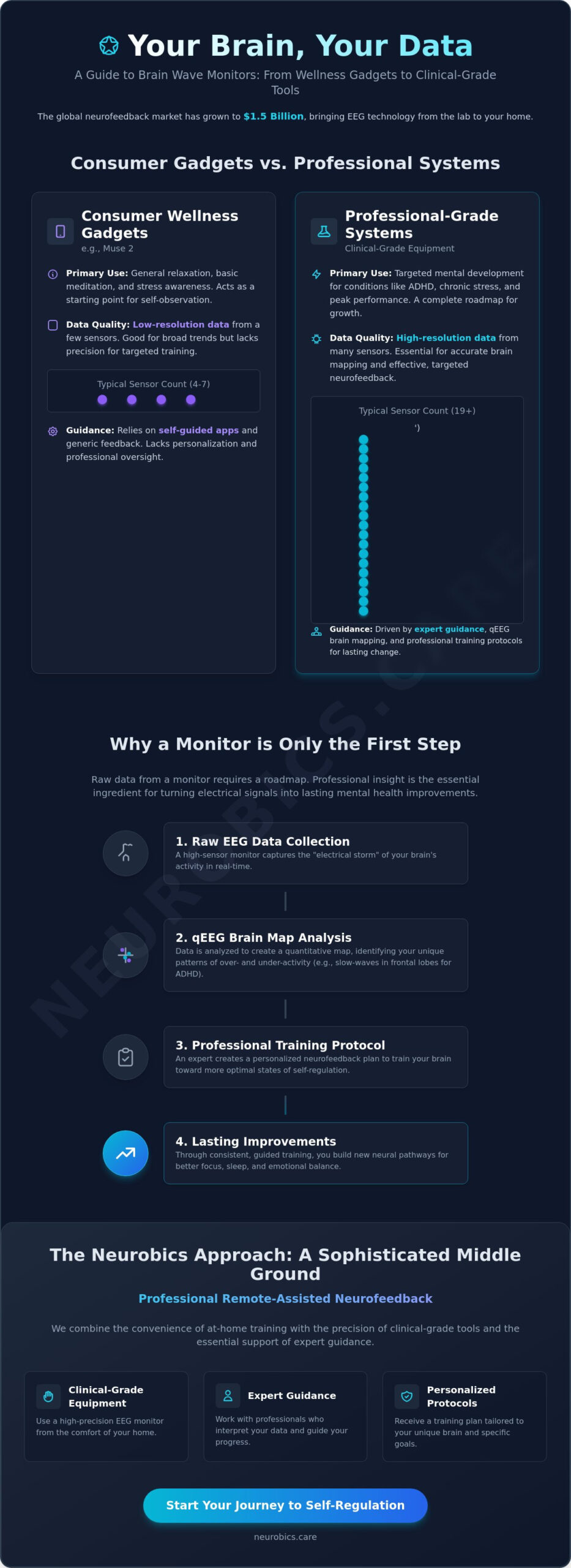
Consumer Gadgets vs. Professional Monitoring: A Practical Comparison
Choosing between a $130 gadget and a clinical-grade system depends entirely on your goals. The rise of wearable technology has made the brain wave monitor more accessible than ever, with entry-level devices like the NeuroSky MindWave Mobile 2 priced at approximately $129.99. These tools are impressive feats of engineering, but they differ fundamentally from professional systems in both scope and intent. While a consumer device provides a glimpse into your mental state, professional systems offer a high-definition map of your entire nervous system.
The most significant technical difference lies in the channel count. Most consumer headbands feature only one or two sensors, typically placed on the forehead. This is sufficient for detecting basic relaxation states, but it cannot capture the complex interactions between different brain regions. In contrast, professional monitoring utilizes 10 to 20 sensors to provide a comprehensive view of the brain’s electrical landscape. This higher resolution is necessary for identifying the subtle patterns associated with long-term mental health challenges. Furthermore, professional hardware is often backed by medical-grade certifications such as RBCZ or NFG standards in Europe, ensuring that the data collected is both accurate and reliable.
Software also plays a vital role in this comparison. Consumer devices rely on subscription-based apps designed for gamification and general wellness, often costing around $95 annually for full feature access. Professional clinical software suites are far more complex, allowing practitioners to adjust training protocols in real-time based on the user’s unique neurobiology. For researchers or those interested in high-end applications, you can check out Ergoneers to see how specialized behavioral research platforms manage complex data. Without this level of customization, you may find yourself training the wrong patterns, which can lead to frustration rather than progress.
When a Consumer Headband is Enough
A consumer-grade brain wave monitor is an excellent choice for general stress management and basic meditation tracking. If your primary goal is to see if your morning breathing exercises are helping you feel more “calm” or “focused,” these low-stakes devices provide a helpful entry point. They’re perfect for those who are simply curious about their brain activity and want a portable tool for daily wellness routines without the need for clinical precision.
When to Upgrade to Professional-Grade Hardware
If you’re seeking support for specific conditions like ADHD, autism, or chronic insomnia, a professional upgrade is usually necessary. These complex challenges require a full QEEG (brain map) to identify specific areas of dysregulation that a simple headband might miss. Professional hardware is a tool for a practitioner, not just a standalone product. At Neurobics, we bridge this gap by shipping clinical-grade equipment directly to your home as part of our remote assisted neurofeedback programs. If you’re ready to move beyond basic tracking and begin a guided journey toward better self-regulation, you can contact our team to explore your options.
Why a Monitor is Only the First Step: The Role of QEEG and Training Protocols
Owning a brain wave monitor is a significant first step toward mental clarity, but it is important to understand that data alone does not create change. If you’ve ever used a heart rate monitor while running, you know that seeing your pulse reach 150 beats per minute doesn’t improve your cardiovascular health; the improvement comes from the specific workout you perform based on that data. The same principle applies to your neurology. Seeing a graph of your electrical activity provides awareness, but turning that awareness into a more resilient nervous system requires a structured training protocol and expert interpretation.
The transition from “monitoring” to “training” begins with moving away from guesswork. Without a professional roadmap, you might inadvertently reward brain states that increase your discomfort. For example, trying to suppress all slow-wave activity without understanding your unique neural signature could lead to increased irritability or sleep issues. Professional oversight ensures that the feedback you receive is aligned with your specific goals for self-regulation, turning a simple device into a powerful tool for neuroplasticity.
Understanding QEEG-Informed Care
A professional assessment usually starts with a Quantitative EEG (qEEG), often called a brain map. Unlike the 1 or 2 sensors found on entry-level gadgets, a professional qEEG uses a 19-point measurement system to create a high-resolution baseline of your brain activity. This map identifies specific areas of “over-arousal,” which often correlate with anxiety or insomnia, and “under-arousal,” which is frequently seen in those struggling with ADHD paralysis or brain fog. Understanding the neurofeedback therapy cost in the context of this assessment is vital, as the value lies in the precision of the data. This baseline allows a practitioner to tailor the monitor’s feedback to your unique brain, ensuring every session is productive. For professionals and students in the northern Netherlands, accessing this level of qEEG brain mapping is now more convenient than ever, as explored in our guide to neurofeedback Groningen services that combine local expertise with remote flexibility. If you’re ready to move past guesswork and into evidence-based clarity, a QEEG assessment Groningen provides the data-driven foundation needed to design a truly personalized neurofeedback program.
The Feedback Loop: How Your Brain Learns
Neurofeedback works through a process called operant conditioning. When your brain wave monitor detects that your brain has reached a desired state, such as a calm Alpha rhythm, it provides a “reward” in the form of a pleasant sound or a clear visual on a screen. Your brain naturally wants to receive that reward again, so it begins to repeat the pattern. Over time, thanks to neuroplasticity, these new pathways become the brain’s default setting. At Neurobics, we prioritize the human element of this technology. We provide weekly live sessions with experts to adjust your protocols in real-time, ensuring that your brain is always challenged just enough to grow without becoming overwhelmed. If you’re ready to move beyond just watching data and start a guided training program, you can book an intake with our team today.
Professional Remote Neurofeedback: The Neurobics Approach to Brain Health
The gap between owning a brain wave monitor and achieving genuine mental resilience is often wider than most people expect. At Neurobics, we close this gap by providing a comprehensive, remote assisted neurofeedback model that prioritizes human expertise over standalone hardware sales. Instead of asking you to navigate complex EEG data on your own, we ship clinical-grade equipment directly to your home. This approach ensures you have the precision of a professional lab with the comfort and consistency of your own living room. We believe that technology is most effective when it is paired with the steady hand of a practitioner who understands your unique neural signature.
Our process is built on a foundation of scientific accuracy and starts with an at-home QEEG brain measurement. This initial step allows us to see the specific electrical patterns of your nervous system and identify where dysregulation may be occurring. Based on this map, we design personalized programs, typically ranging from 4 to 12 weeks, depending on your individual goals for focus, sleep, or emotional balance. For those in the Netherlands, the UK, and Ireland, we provide dedicated local support to ensure your equipment is set up correctly and your training remains on track throughout the entire process.
Expert-Guided Training from Your Living Room
One of the biggest hurdles to successful brain training is the logistical strain of frequent office visits. By bringing the technology to you, we eliminate the commute while maintaining strict clinical standards. Our practitioners monitor your progress remotely, reviewing your session data to ensure you’re training safely and effectively. This remote oversight allows for protocol adjustments that simply aren’t possible with a consumer app. Integrating these sessions into your daily life leads to better long-term compliance and more sustainable results, as you’re learning to regulate your nervous system in the environment where you actually live and work.
Maintaining a high-performing work environment often involves more than just personal mental wellness; it also requires a robust and secure technological infrastructure. For business owners looking to optimize their professional technology stack, Mytech Partners offers the managed IT services and strategic consulting necessary to support a productive and resilient workforce.
Taking the Next Step Toward Self-Regulation
Investing in a guided program is fundamentally different from buying a standalone brain wave monitor. While a gadget might offer temporary insight, a professional program provides the structure and expert feedback needed for lasting neuroplasticity. If you’re specifically looking for symptom relief, our neurofeedback for ADHD guide provides deeper insight into how we target those specific patterns. Every brain is unique, and your training should reflect that individuality. If you’re ready to move beyond basic monitoring and start a professional development plan, please Contact Neurobics to discuss your personalized brain mapping and training plan.
Empowering Your Mental Development Through Precision
You now understand that a brain wave monitor is more than just a wearable gadget; it’s a window into your nervous system’s potential for change. By moving from basic observation to targeted training, you can begin to shift the patterns that lead to burnout, anxiety, or focus issues. The journey toward better self-regulation is most effective when it combines advanced technology with professional expertise. Real progress happens when raw electrical data is translated into a personalized roadmap for neuroplasticity.
Neurobics brings over 15 years of expert experience directly to your home. We ship clinical-grade hardware to your door and provide the professional oversight necessary for safe, effective progress. As a practice registered with the Dutch Healthcare Federation (NFG) and RBCZ, we prioritize clinical standards and personalized care in every program. You don’t have to navigate the complexities of your brain alone.
Book Your Personalized Brain Mapping Assessment with Neurobics and take the first step toward a more balanced, resilient mind. Your brain has the capacity to evolve, and we’re here to support that growth every step of the way.
Frequently Asked Questions
Can I buy a brain wave monitor and use it on my own without a professional?
You can purchase consumer devices like the $249.99 Muse 2 for independent use, but achieving therapeutic results usually requires expert guidance. Without a professional to interpret the data, it is difficult to know if you are training the correct neural patterns or inadvertently reinforcing dysregulation. At Neurobics, we provide the necessary oversight to ensure your home training is both safe and effective.
Is a brain wave monitor the same thing as a neurofeedback machine?
A monitor is the hardware that records your brain’s activity, while a neurofeedback system includes the software and protocols that provide real-time rewards. The monitor acts as the listener; the neurofeedback process is the actual training session. Professional setups integrate both components to create a closed-loop system where your brain learns to self-regulate through consistent, guided feedback.
Are brain wave monitors safe to use every day?
EEG monitors are entirely non-invasive and safe for daily use because they only record electrical signals rather than emitting them into your body. Industry data from early 2026 shows that the global EEG devices market has reached $1.67 billion, reflecting the widespread safety and acceptance of this technology. Most training protocols involve 20 to 40-minute sessions a few times per week to allow for proper integration.
Will a brain wave monitor help with my ADHD symptoms?
A brain wave monitor is a powerful tool for managing ADHD by identifying the specific “theta-beta ratio” associated with inattention. Since ADHD treatment accounted for 31.45% of the neurofeedback market’s revenue in 2025, the science behind this application is well-established. By visualizing your focus levels in real-time, you can learn to recognize and maintain the brain states required for better concentration and task completion.
What is the difference between a 1-channel and a 19-channel monitor?
A 1-channel monitor captures data from a single point on the scalp, whereas a 19-channel system provides a comprehensive map of the entire brain. While 1-channel devices are suitable for basic meditation and stress tracking, professional qEEG mapping requires 19 sensors to see how different brain regions interact. This higher resolution is essential for creating the personalized protocols used in professional remote assisted training.
How much does a professional-grade brain wave monitor setup cost?
The cost of a setup depends on its complexity; for example, a BrainBit Headband Pro with 8 channels costs approximately $1,199.00 in 2026. Renting a professional system for home use typically ranges between $600 and $1,200 per month, which often includes the hardware and software access. These prices reflect the clinical precision and durability required for meaningful mental health improvements rather than basic wellness tracking.
Can I get insurance coverage for a brain wave monitor or neurofeedback training?
Coverage varies by provider, but many private insurers now reimburse neurofeedback training when it is performed by registered professionals. In the Netherlands, practitioners registered with the NFG and RBCZ often qualify for partial reimbursement through supplementary insurance plans. It’s best to contact your provider directly to confirm if your 2026 policy includes biofeedback or alternative mental health support.
Do I need to shave my head or use messy gels to use an EEG monitor?
You do not need to shave your head, and many modern brain wave monitor options now use dry sensors that require no conductive gel at all. While some clinical-grade sensors use a small amount of water-based paste to ensure the highest signal clarity, it is easily removed with a damp cloth. Most home-based systems are designed for convenience, allowing you to begin your session in less than five minutes.
