


Could “online neurofeedback training” mean learning how to work with clients, or receiving brain training yourself from home? The phrase can describe both. If you’re looking for personal support rather than a professional course, confirm that the service is designed for clients. It’s reasonable to ask who guides the process, how a training plan is chosen, and how you can raise questions during training.
In client-focused remote training, you use equipment at home while a practitioner provides guidance and follows your progress. An assessment such as a qEEG brain measurement may help inform an individualized protocol, but it isn’t a medical diagnosis. Practitioner education, by contrast, is designed to teach people how to deliver neurofeedback.
This article explains how these paths differ, what personalized remote sessions may involve, and what to ask before choosing a provider. When comparing options, look for clear information about assessment, equipment, practitioner contact, and progress reviews. Neurobics offers remotely guided neurofeedback for individuals, with at-home training and professional support. Understanding what the service involves can help you decide whether to ask about it.
Key Takeaways
- Online neurofeedback training can mean a course for practitioners or guided training for a client; check which one a provider offers.
- Learn how intake, assessment, protocol planning, home practice, and progress reviews may fit together.
- Understand what qEEG can contribute to protocol planning and why it should not be confused with a medical diagnosis.
- Ask who guides your training, how your protocol is chosen, and when it may be reviewed.
- Neurobics’ remote client training includes home-use equipment and professional support.
Online Neurofeedback Training: Is It a Course or Training for You?
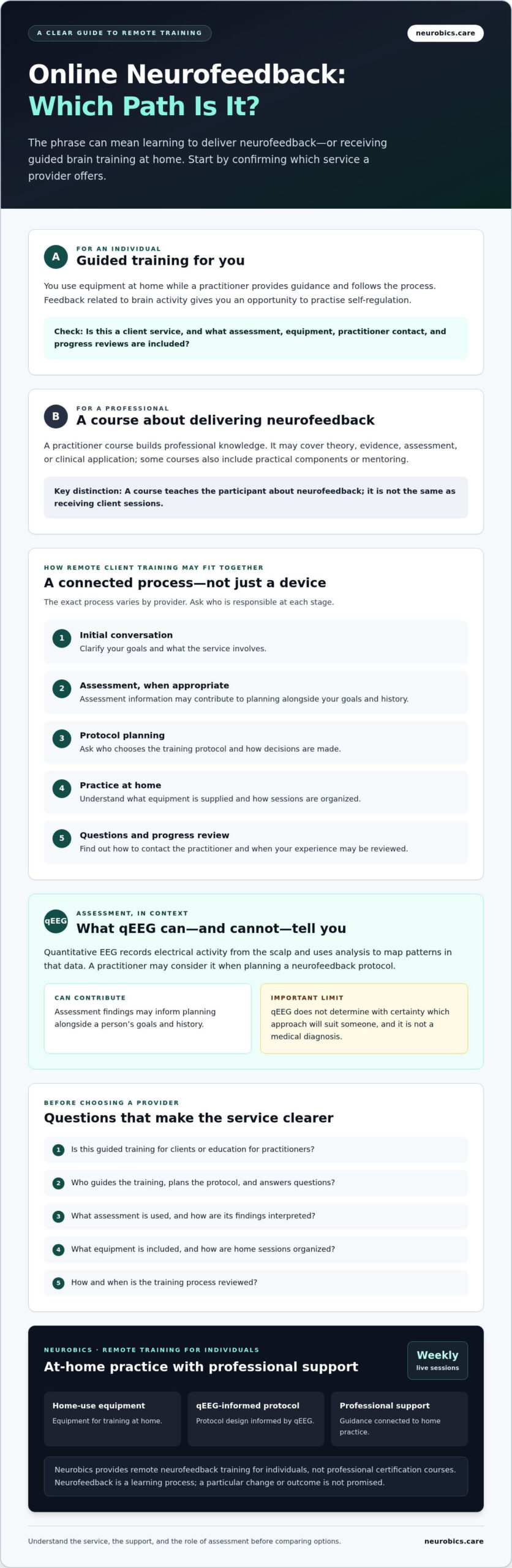
Online neurofeedback training can refer to education for professionals who want to learn about neurofeedback, or guided training for an individual receiving it. If you’re looking for support for yourself, check that the provider is describing a client service, not a practitioner course. The audience should be clear from the service description and from what you’re asked to do.
In client-focused remote training, you use equipment at home while a provider supports the process remotely. The equipment provides feedback related to brain activity, giving you an opportunity to practise self-regulation. Setup and support vary between providers, so the word “online” alone doesn’t tell you what assessment, equipment, or practitioner involvement is included. Ask for those details before comparing programs.
What does online neurofeedback training mean for an individual?
A guided program is more than access to a device or a self-help app: it involves a provider who helps oversee your training. For example, you might complete sessions at home and discuss questions or observations with a practitioner. When comparing services, check what equipment is supplied, who plans the protocol, and how you can contact the practitioner. Neurofeedback is a broad field with different approaches and technologies; Neurofeedback offers a foundational overview of its history and methods.
The aim is to practise responding to feedback about brain activity. This is a learning process, not a promise of a particular change or outcome. Ask how the provider supports you during training, how your experience is reviewed, and what you can do if you have questions or concerns.
How is a neurofeedback course for professionals different?
A professional course is designed for practitioners or people preparing to work in the field. It may cover theory, evidence, assessment, or clinical application, and some courses combine online learning with practical components or mentoring. Its purpose is to build professional knowledge, not to provide neurofeedback sessions to the person taking the course.
Neurobics provides remote neurofeedback training for individuals, not professional certification courses. If you’re looking for a clearer introduction to the underlying terminology, explore Neurobics’ article, What is Neurofeedback? Whether you’re comparing a course or a client service, look beyond the word “online” and ask what participation actually involves.
How Remote Neurofeedback Training Connects Assessment, Practice, and Support
A well-defined remote program connects several steps rather than treating home sessions as isolated device use. The exact process varies by provider, but it may include an initial conversation, an assessment when appropriate, protocol planning, guided practice at home, and regular review. Ask what happens at each stage and who is responsible for it. That makes it easier to understand how the practitioner stays involved once training begins.
What role can QEEG brain mapping play?
Quantitative EEG, or qEEG, records electrical activity from the scalp and uses analysis to map patterns in that data. A practitioner may consider the assessment alongside the person’s goals and history when planning a neurofeedback protocol. It can help inform decisions, but it does not determine with certainty which approach will suit someone and does not serve as a medical diagnosis. For a fuller explanation, see At-Home QEEG Brain Mapping.
Neurofeedback systems and methods vary, so assessment is only one part of the picture. A comprehensive review of neurofeedback discusses the field’s methodology, system design, and clinical applications. Use it as background, then ask a provider how assessment findings are interpreted and connected to a training plan, and what other information may inform that plan.
What does supported training at home involve?
In a remote service, equipment is supplied for use at home as part of a guided program, rather than simply sold as a standalone device. The practitioner explains how training is organized, helps establish the protocol, and provides a way to discuss questions and review the process. The precise equipment and support model depend on the provider, so ask what is included before you begin.
Neurobics’ program information describes home-use equipment, QEEG-informed protocol design, professional support, and weekly live sessions. These features connect home practice with practitioner input. Having equipment available is not the same as receiving ongoing guidance, so check how sessions and support are arranged rather than assuming the training is unsupervised DIY use.
Before starting, ask what information the practitioner uses to plan training, how you can raise concerns, and how your progress will be reviewed. You can also request a clearer explanation of the assessment process through Neurobics’ contact page.
Online Neurofeedback Training vs. Practitioner Courses: Choose the Right Path
The right option depends on your goal. Client-focused online neurofeedback training is a service you receive, while a practitioner course is education for people learning about professional practice. They differ in who participates, what the provider offers, and how equipment is used. Use the comparison below to identify what to ask next.
| What to compare | Client training | Practitioner course |
|---|---|---|
| Audience | Individuals seeking guided training for themselves | Practitioners or learners building professional knowledge |
| Purpose | Receive a supported neurofeedback service | Study concepts or clinical applications |
| Provider relationship | A practitioner supports the client’s training | An instructor or course provider delivers education |
| Participation | Complete training sessions and take part in reviews as arranged | Engage with course materials and any practical components offered |
| Assessment and equipment | Ask whether assessment is included, optional, or separate, and what equipment support is provided | Check whether equipment is used for learning and what practical instruction is included |
| Contact and review | Confirm the type and frequency of practitioner contact and how progress is discussed | Check how instruction, feedback, and any mentoring are structured |
Which online neurofeedback option fits your goal?
If you want personal brain training, look for a provider that clearly describes client assessment, practitioner involvement, and ongoing support. For professional development, examine who the course is designed for, what its curriculum covers, whether it includes practical learning, and what credentials or qualifications it supports. BCIA information concerns professional certification; it can help explain a practitioner pathway, but it isn’t a substitute for assessing a client service.
If the description is unclear, ask directly: “Is this program for someone receiving neurofeedback, or for someone learning to provide it?” A general overview of neurofeedback therapy may also help you understand the topic, but it won’t tell you what a particular provider includes.
Neither option should be confused with simply buying a device and using it without guidance. For client training, clarify what support comes with the service. For a course, check whether any equipment is intended for instruction rather than personal care. Neurobics provides guided training for individuals, not professional certification courses. If you’re considering its client service, ask Neurobics about remote training, the assessment process, and how support is structured.
How to Evaluate an Online Neurofeedback Provider Safely and Realistically
A responsible provider should be able to explain who guides your training, how its approach is chosen, and what support you can expect. Use the questions below to understand the service before deciding whether it feels appropriate for you. Neurofeedback isn’t a guaranteed cure, and suitability and experience can vary from person to person.
What questions should you ask before starting?
- Who conducts the intake and assessment? Ask what information is gathered, whether an assessment such as qEEG is part of the service, and how findings may inform the training plan.
- How is the protocol selected and reviewed? Find out who makes those decisions and what might prompt a review or adjustment.
- What practitioner support is included? Clarify how and when you can discuss questions or concerns during training, and how the provider reviews your experience and progress.
- What does the service not provide? Ask whether it includes medical diagnosis or emergency mental health care. Neurofeedback services shouldn’t be assumed to replace either.
Clear answers help you distinguish a supported service from access to equipment alone. Before proceeding, make sure you understand what the provider includes, how to contact the practitioner, and what to do if questions come up during training.
How can you recognize responsible claims?
Look for language that describes the purpose and limits of training without promising a cure, guaranteed results, or a specific outcome. A provider should also explain that assessment data, including qEEG findings, can inform protocol planning but isn’t itself a medical diagnosis. Be cautious if marketing makes strong claims without explaining the process behind them.
It’s reasonable to ask about practitioners’ relevant training, credentials, and any registrations they cite. Check current details through the relevant organization rather than relying on a claim alone. These details can help you assess transparency, but they don’t determine whether a particular approach is right for you.
If you have health concerns, or aren’t sure whether neurofeedback is suitable alongside other care, discuss your situation with an appropriate healthcare professional. Online neurofeedback training should be presented as a guided service with clear boundaries, not a substitute for medical assessment or treatment. For questions about the support Neurobics describes for its remote training, contact the Neurobics team.
What Guided Online Neurofeedback Training with Neurobics Includes
After comparing client training with practitioner courses and deciding what to ask a provider, look at what a specific service includes. Neurobics offers remote neurofeedback training for individuals. Its model combines training at home with practitioner support, rather than providing a standalone device for unsupervised use.
How Neurobics supports a personalized remote process
The process may include an intake and qEEG brain measurement. The assessment records patterns of electrical brain activity and may inform protocol planning in light of the individual’s needs and goals. It is an assessment, not a medical diagnosis, and its findings are one source of information, not a promise of a particular result.
For home participation, equipment is shipped to the client, and training is supported remotely. Neurobics’ described program includes professional support and weekly live sessions, giving participants an opportunity to stay connected with a practitioner during the process. The plan is personalized; ask how assessment findings would be used in your case and how your training would be reviewed.
For a broader practical overview of home-based training, look for At-Home Neurofeedback: The Complete Guide. It can complement this discussion by helping you think through what participating at home may involve.
What is a sensible next step?
Before deciding, write down what you hope to explore, what questions you have about assessment, and what kind of support would help you feel comfortable. Ask whether the service appears appropriate for your situation and what it does and does not include. Clarifying these points can help you make a more informed decision without assuming that remote training is right for everyone.
If you’d like to learn more about the process, discuss your questions with Neurobics, including how assessment, practitioner support, and suitability are approached. A conversation can help you understand the service before deciding whether to proceed.
Make Your Next Step an Informed One
Online neurofeedback training can mean education for practitioners or guided training for an individual, so first confirm which service a provider offers. For client training, look for clear information about assessment, practitioner support, protocol planning, and progress reviews. QEEG brain measurement may inform an individualized protocol, but it isn’t a medical diagnosis, and neurofeedback can’t guarantee a specific result.
Neurobics provides remote training for individuals, with personalized protocol design informed by QEEG measurement when used, and professional support. If you’re considering this approach, clarify your goals and ask what the process would involve for you. Discuss your questions about remote neurofeedback with Neurobics and find out whether its service may fit your needs.
A thoughtful conversation can help you make a decision with greater clarity and confidence, one step at a time.
Frequently Asked Questions
Is online neurofeedback training a course for practitioners or a service for clients?
It can mean either, so check who the program is designed for. A practitioner course teaches professionals about neurofeedback or its clinical application. A client service provides guided training to an individual, often with sessions completed at home and practitioner support provided remotely. Neurobics offers remote client training, not professional certification courses. If a provider’s description is unclear, ask whether you’ll be receiving training or learning how to deliver it.
Can you do neurofeedback training online at home?
Yes, some providers offer home-based neurofeedback with remote practitioner guidance. The equipment, assessment process, and level of support vary, so “online” doesn’t necessarily mean the same thing from one service to another. Neurobics’ model includes equipment shipped to the client for home use, professional support, and weekly live sessions. Ask what guidance is included before starting, and don’t assume a device is intended for unsupervised use.
How does remote neurofeedback training work?
Remote training commonly begins with an intake to understand a client’s goals and circumstances. An assessment may be included or considered, then findings and other relevant information can inform protocol planning. The client practises at home using the provider’s equipment, with practitioner support and progress reviews arranged according to that provider’s model. Neurobics describes personalized protocol design, QEEG brain measurement to inform protocols, and weekly live sessions as part of its supported program.
Do I need a QEEG brain map for online neurofeedback?
Not necessarily. Whether QEEG is used depends on the provider’s approach and the service being considered. QEEG records and maps patterns of electrical brain activity, and assessment findings may inform an individualized training protocol. They don’t constitute a medical diagnosis or guarantee a particular training choice or outcome. Neurobics makes QEEG brain measurement available to inform personalized protocols. Ask whether an assessment is included, optional, or not part of the program.
Is online neurofeedback training the same as buying a neurofeedback device?
No. A device is equipment; a guided training service may also include assessment, protocol planning, practitioner involvement, and support. These elements vary by provider, so check whether equipment is supplied for use within a supported program or sold separately. Neurobics provides remote client training with home-use equipment and professional support, rather than standalone hardware sales. Don’t assume that buying a device gives you the guidance or individualized planning of a client service.
Does online neurofeedback training guarantee results?
No responsible provider should promise a cure or guarantee a specific result. People’s circumstances and responses differ, and neurofeedback may not be suitable for everyone. Ask how the provider describes the aims and limitations of training, how progress is reviewed, and what happens if you have concerns. If you have health questions or are considering neurofeedback alongside other care, discuss your situation with an appropriate healthcare professional.
Can neurofeedback courses certify me to provide neurofeedback?
Not automatically. A course may teach neurofeedback concepts or practical skills, but completing one doesn’t necessarily mean you hold a professional certification or meet the requirements to practise. Certification depends on the credentialing organization and its criteria. Before enrolling, check the course’s intended audience, curriculum, practical components, and whether it explicitly supports a recognized certification pathway. Information about professional credentials is separate from choosing a neurofeedback service for your own training.
