


Remote assisted neurofeedback combines home-based practice with professional guidance. If you are considering training outside a clinic, the key question is not only what equipment you will use, but how assessment, planning, and practitioner support fit together. In a guided program, you practise at home while a practitioner helps shape the approach and discuss your experience.
At Neurobics, remote training includes home-based equipment and expert guidance. Structured four-week and twelve-week programs include weekly live sessions. A QEEG assessment can inform a personalized training plan by giving practitioners information about patterns in brain activity. It supports planning, not medical diagnosis, and the findings need to be interpreted alongside your goals and personal context.
This article explains what professional support can involve before training begins, as you use the equipment, and when the training experience is reviewed. It also covers what QEEG can and cannot tell you, how remote and in-person formats differ, and practical questions to consider when deciding whether guided home training suits your routine.
Key Takeaways
- Remote assisted neurofeedback pairs home practice with practitioner guidance, rather than relying on a device or app alone.
- Intake, QEEG-informed planning, supported training, and review can each contribute to the process.
- Compare remote and in-person formats by considering travel, where you prefer to practise, and how you want to access practitioner support.
- Use your goals, privacy, connectivity, and readiness to follow guidance to assess whether home training may fit your circumstances.
- Neurobics combines home equipment and professional support. Its structured four-week and twelve-week programs include weekly live sessions.
What remote assisted neurofeedback means beyond training at home
Remote assisted neurofeedback combines practice at home with professional guidance throughout the process. “Remote” describes where you train; “assisted” describes the practitioner’s role in shaping and supporting the program. Receiving equipment or opening a generic app is not the same as following a structured plan informed by assessment and practitioner input.
Neurofeedback uses information about brain activity to provide feedback during training, with the aim of supporting self-regulation. In a guided remote format, home practice is one part of a broader process. A practitioner contributes to assessment and protocol planning, then supports you as training progresses. Guidance does not necessarily mean someone watches every session live.
What makes remote neurofeedback assisted?
Assistance starts with understanding your goals and relevant assessment information. A practitioner uses that context to plan a training protocol, while you practise at home and discuss your experience as part of the program. At Neurobics, structured four-week and twelve-week programs include weekly live sessions. These provide regular opportunities to speak with a practitioner, but they are not continuous observation of every home session.
Home practice and practitioner involvement work together, but they serve different purposes. For example, if you are unsure how to fit training into your week, you can discuss your routine during a live session. The practitioner can consider that experience in the context of your plan and the structure of the program.
How QEEG-informed training fits into the picture
QEEG, or quantitative electroencephalography, is a quantitative analysis of recorded electrical brain activity. Its findings can give a practitioner additional information to consider when planning an individualized training protocol. They are one input to the plan, not a stand-alone explanation of a person’s experiences.
A QEEG assessment does not independently establish a medical diagnosis, and neurofeedback training itself is not a diagnostic process. A personalized plan also cannot guarantee a particular outcome. QEEG-informed planning makes the training approach more individually considered, while professional interpretation keeps the findings in context.
How professional guidance supports remote neurofeedback training
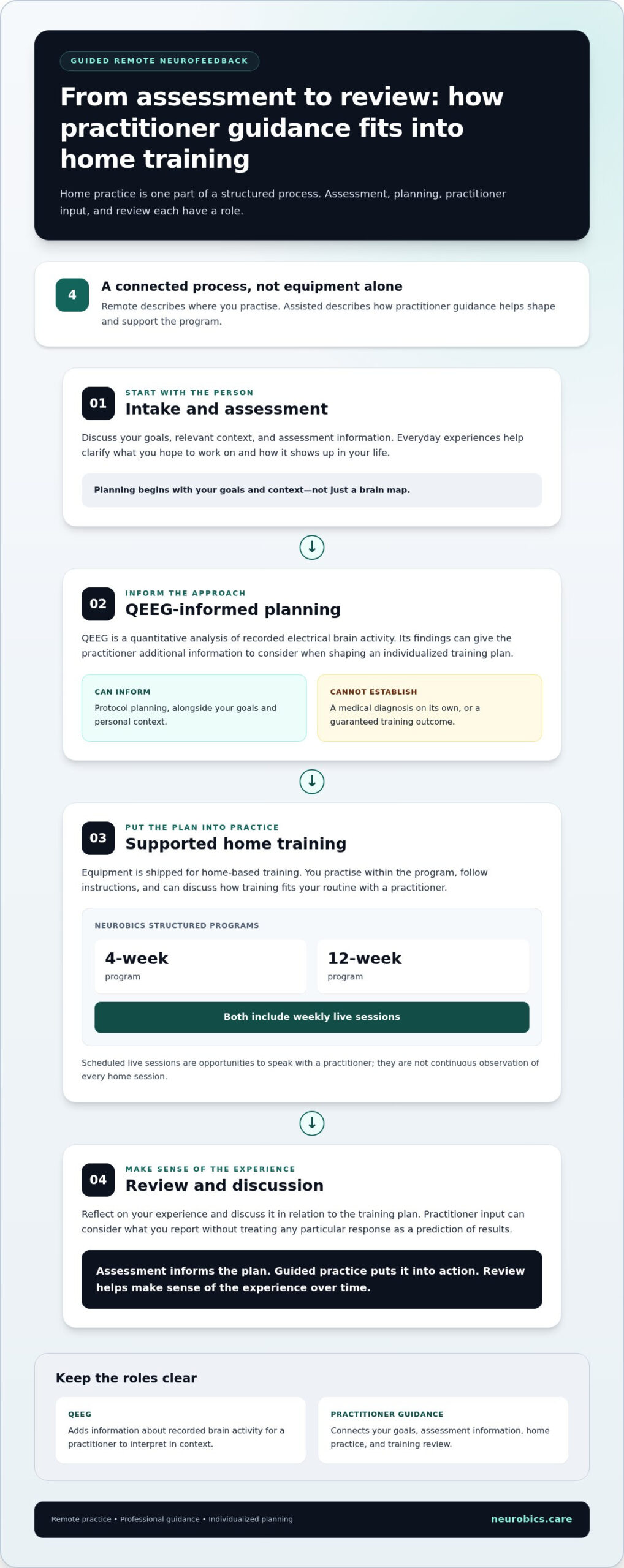
Professional guidance connects the main stages of remote training: understanding your goals, planning an approach, supporting home practice, and reviewing your experience. At Neurobics, the process brings together an intake assessment, QEEG-informed protocol planning, home-based practice, and practitioner contact through the program.
- Intake and assessment: Discuss your goals, relevant context, and assessment information.
- Protocol planning: Use the available information to shape an individualized training plan.
- Supported home training: Practise at home within the program, with practitioner input.
- Review: Reflect on your experience and discuss it in relation to the training plan.
From assessment to an individualized training plan
Planning begins with the person, not just a brain map. Intake context helps clarify what you hope to work on and how the issue shows up in everyday life. QEEG information adds recorded brain activity patterns for the practitioner to consider when developing a protocol. It does not diagnose a condition on its own.
For example, you might describe difficulty staying focused during long work periods. Your account of that experience, alongside QEEG findings, can inform a training plan without treating the assessment as proof of a diagnosis or a prediction of results. For a closer look at the assessment process, see At-Home QEEG Brain Mapping: Clinical Precision from Your Living Room.
What practitioner support can look like during home training
Guidance does not necessarily involve continuous live observation. Neurobics’ structured four-week and twelve-week programs include weekly live sessions, creating scheduled opportunities to discuss your training experience with a practitioner. The practitioner can consider what you report in light of the plan without assuming that any particular response predicts a specific outcome.
Equipment is shipped for home-based training. Following the instructions and keeping practice connected to your individualized plan are both parts of the process. During live sessions, practitioner input gives you an opportunity to discuss how the training fits your experience and routine.
Assessment informs the plan, guided practice puts it into action, and review helps make sense of the experience over time. A comprehensive review of neurofeedback offers further background on the field’s methods and applications. For a broader account of remote training, see At-Home Neurofeedback: The Complete Guide to Professional Remote Brain Training in 2026, or explore Neurobics’ remote neurofeedback support.
Remote assisted neurofeedback versus in-person or unguided training
Remote does not have to mean unguided. In remote assisted neurofeedback, home practice can be part of a professionally planned program, with practitioner contact built into the structure. The practical difference from in-person training is where you practise and how you access support, not whether guidance is possible. Remote and clinic-based formats have different settings and arrangements, so they should not be assumed to be identical.
Remote versus in-person: what changes and what does not
In-person training takes place at a clinic, so travel is part of the routine and the practitioner is physically present for the appointment. With remote training, practice takes place at home and practitioner contact happens remotely. Neurobics ships equipment for home-based training, and its structured programs include weekly live sessions.
Home access may suit you if your schedule or location makes regular clinic visits difficult. It also means making space in your home, setting aside time to follow the program, and using the equipment in that setting. A quiet, consistent spot can make it easier to include practice in your routine. In-person contact may feel preferable if you like attending a clinic or find its setting more suitable.
These are differences in logistics and experience, not proof that one format works better for everyone. Remote training should not be presented as producing outcomes identical to in-person care. Your experience can vary, and the formats involve different settings and kinds of contact.
Guided training versus using a device independently
A device can provide feedback, but access to technology alone does not provide an individualized plan or professional interpretation. In a guided approach, assessment information can inform protocol planning, and practitioner input gives you a place to discuss your experience in relation to that plan. Using a device independently leaves you to decide what the feedback means and how to respond without the same professional context.
When comparing formats, consider whether training is connected to assessment and practitioner involvement or provides access to a tool alone. The International Society for Neuroregulation & Research (ISNR) offers a broader professional resource for learning about neurofeedback and neuroregulation. For a plain-language overview of the method, see What is Neurofeedback? A Comprehensive Guide to Brain Self-Regulation in 2026.
How to decide whether professionally supported home training fits
Assess fit by looking beyond convenience. Consider whether you have a clear goal, time for home practice, a private place to train, reliable internet for remote communication, and a willingness to follow practitioner guidance. These practical factors can help you decide whether remote assisted neurofeedback feels workable in your circumstances.
Practical questions to consider before starting
- Goals: What would you like to work on? How would you describe a meaningful change in everyday life without expecting a guaranteed result?
- Routine: Can you make room for regular home sessions alongside work, family, or other commitments?
- Privacy and setting: Do you have a place where you can focus and use the training equipment comfortably?
- Connectivity: Can you take part in remote communication reliably from where you live?
- Guidance: Are you comfortable discussing your experience with a practitioner and following the structure of a program?
You do not need perfect circumstances. These questions can help you clarify your priorities and discuss practical considerations during an intake conversation. If your schedule changes often, for example, think about when home practice is most realistic rather than assuming it will fit automatically.
Expectations, evidence, and appropriate boundaries
Neurofeedback is skills-oriented training that uses feedback during practice to support self-regulation. That description does not mean a particular symptom will improve, or that everyone will experience training in the same way. Personal experiences and progress vary, and no specific result or timeline can be guaranteed. Consider claims about training carefully and distinguish reported experiences from established outcomes.
It is also important to understand the role of the service. Remote neurofeedback is not emergency care, and it is not a substitute for medical assessment when one is needed. If you are facing an urgent mental health concern, remote training is not the right form of immediate support. A program also involves a time commitment and willingness to practise and engage with guidance. For broader context on evaluating commitment and value, see Neurofeedback Therapy Cost in 2026: A Guide to Value and Outcomes.
If these questions have helped clarify what you need from a supported home format, you can discuss remote neurofeedback with Neurobics.
How Neurobics approaches remote assisted neurofeedback
Neurobics brings together QEEG-informed protocol planning, equipment shipped for home training, and professional guidance. The aim is to give home practice a considered structure, with a practitioner involved in shaping the approach rather than leaving you to interpret device feedback alone. An assessment informs planning, but it is not a medical diagnosis or a promise of a particular result.
What the Neurobics remote model brings together
The process takes personal context and assessment information into account. QEEG findings can inform an individualized protocol, while your goals help provide context for the training plan. Equipment is shipped for home-based practice, supported by expert guidance. This approach connects personal assessment and practitioner input with training beyond a clinic setting.
Weekly live sessions are included in Neurobics’ structured four-week and twelve-week programs. They provide scheduled opportunities for practitioner contact as part of the program, rather than continuous observation during every home session. The format offers structure and support, while individual experiences and progress can differ.
Neurobics has operated for over 15 years, according to its company history, and its practice is registered with NFG and RBCZ. This background provides context about the practice, but it does not mean training will produce a specific clinical outcome. The focus remains on individualized planning and guided practice, with measured expectations.
A gentle next step for exploring remote support
An initial conversation gives you a chance to share what you hope to work on, ask questions about the assessment, and understand how the program is structured. You can consider whether home practice and remote practitioner contact fit your routine and preferences. Taking time to understand the process can help you decide whether you want to proceed.
If you’d like to explore whether remote assisted neurofeedback may suit your circumstances, contact Neurobics to discuss your goals and questions.
Consider a supported path for training at home
Remote assisted neurofeedback combines home practice with professional input, rather than relying on a device alone. Neurobics uses QEEG-informed assessment to help shape personalized protocols, alongside home-based equipment and expert guidance. Its structured four-week and twelve-week programs include weekly live sessions.
The right format depends on your goals, routine, and comfort with remote support. QEEG can inform a training plan, but it is not a medical diagnosis. Neither an assessment nor a program can guarantee a particular result or timeline. Neurobics has operated for over 15 years according to its company history, which provides context rather than a promise of outcomes.
If you are considering training at home, an initial conversation can help you understand the assessment and program structure and decide whether the approach fits your circumstances. Explore remote neurofeedback with Neurobics and take the next step at a pace that feels right for you.
Frequently Asked Questions
What is remote assisted neurofeedback?
Remote assisted neurofeedback is brain activity training completed at home with professional guidance. “Remote” refers to where you practise, while “assisted” means a practitioner contributes to assessment, protocol planning, or support during the program. It differs from simply receiving a device or using an app independently. At Neurobics, QEEG-informed planning, home-based equipment, and practitioner involvement come together in a structured training approach.
Is remote neurofeedback as effective as in-person neurofeedback?
Remote and in-person neurofeedback involve different settings, travel requirements, and ways of arranging practitioner contact. Individual experiences can vary, so one format should not be assumed to produce the same results as the other. Remote training may make home practice more accessible for some people, while others may prefer attending a clinic. Consider your circumstances, the support included, and your goals rather than assuming one approach suits everyone.
Can neurofeedback be done at home with professional support?
Yes. Neurofeedback can be practised at home as part of a professionally guided program. Neurobics provides home-based equipment and professional guidance, with weekly live sessions included in structured four-week and twelve-week programs. Training is connected to practitioner-informed planning rather than being device use alone.
How does QEEG brain mapping help guide remote neurofeedback?
QEEG is a quantitative analysis of recorded brain activity. A practitioner can consider its findings alongside intake information and personal goals when planning an individualized neurofeedback protocol. For example, your description of difficulty concentrating during work can provide context for interpreting assessment information and shaping a plan. QEEG findings do not independently establish a medical diagnosis or guarantee how you will respond to training.
Do I need technical experience to use remote neurofeedback equipment?
Prior neurofeedback experience is not described as a requirement for Neurobics’ home-based training. Equipment is shipped for home use, and professional guidance is part of the remote approach. You will need to follow the program’s instructions and use remote communication to take part in practitioner sessions. You can raise practical questions as you learn about the program structure.
Is remote assisted neurofeedback a medical diagnosis or a replacement for therapy?
No. Neurofeedback training is not itself a medical diagnosis, and QEEG findings alone do not establish one. Remote training should not be presented as a substitute for medical assessment or therapy when those are needed. It is a skills-oriented training approach that uses feedback to support practice in self-regulation. If you have health concerns, discuss them with an appropriate healthcare professional. Remote neurofeedback is not emergency care.
How long does remote neurofeedback training take?
There is no single duration that applies to everyone, and no specific response timeline can be guaranteed. Neurobics offers structured remote programs of four weeks and twelve weeks, with weekly live sessions included. Your experience of training depends on your circumstances and the program structure. Consider the time commitment alongside your goals and routine, and discuss the process before deciding to begin.
