


At-home brain mapping can show recorded brainwave activity, but the results need context to be useful. It’s natural to wonder what the sensors measure, whether the findings amount to a diagnosis, and how a guided assessment differs from a consumer device that simply monitors brain activity.
At-home brain mapping uses sensors in a cap to passively measure brainwave activity. The cap does not send anything into the brain. A brain map is not a medical diagnosis, and readings alone cannot explain someone’s experience. In a guided assessment, a practitioner considers the findings alongside your goals and circumstances, then uses that information to help shape a training plan.
This article explains what a measurement can show, where its limits are, and why interpretation matters. You’ll also learn how Neurobics combines remote assessment with supported neurofeedback training, so the findings can inform a thoughtful next step rather than leave you trying to make sense of a graph alone.
Key Takeaways
- Understand what at-home brain mapping records and why qEEG findings need context rather than being read as a diagnosis.
- Learn how to approach an assessment, from clarifying your goals to discussing findings and possible next steps.
- Separate measured brainwave patterns from interpretations and conclusions that require a broader clinical assessment.
- See how Neurobics combines an at-home assessment with a cap kit, smartphone connection, cloud-based progress tracking, and weekly video check-ins.
What Is At-Home Brain Mapping, and What Does It Measure?
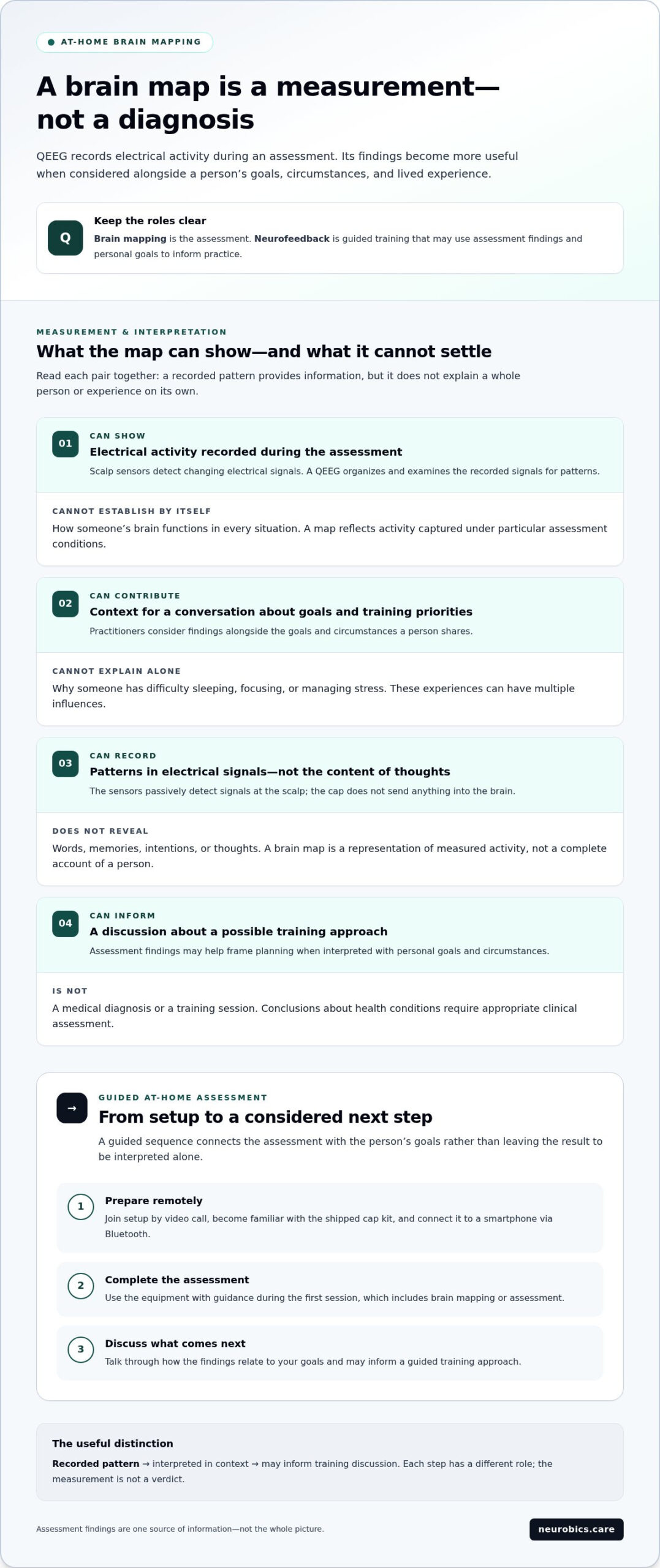
At-home brain mapping records patterns of electrical brain activity using sensors placed on the scalp. In a QEEG assessment, short for quantitative electroencephalography, recorded signals are organized and examined for patterns. The measurement describes activity captured during the assessment. It does not reveal thoughts, explain someone’s whole experience, or provide a medical diagnosis.
Brain mapping assesses recorded brainwave patterns; neurofeedback is training that may use those findings to guide practice. This distinction matters because a map is a starting point for interpretation, not a verdict about a person. The broader field of brain mapping includes different approaches to representing brain structure or function. QEEG focuses on electrical activity recorded over time.
With at-home brain mapping, the setting changes, but the basic idea remains: sensors passively detect electrical signals, and the resulting data are reviewed in context. A map is not a complete account of who you are. It is one source of information that may help frame a conversation about your goals, daily experience, and possible training priorities.
What does QEEG brain mapping record?
Sensors detect changing electrical signals at the scalp and produce data that can be displayed as patterns. They do not read words, memories, intentions, or thoughts. Think of a weather map: it organizes measurements of conditions in particular places, but it does not tell you everything about a day or why it feels the way it does. A brain map also needs careful interpretation.
How is brain mapping different from neurofeedback?
Mapping is the assessment; neurofeedback is the training informed by assessment findings and personal goals. The two can be part of a broader, guided process, but they are not interchangeable. A measurement alone is not training, and a training plan should not be confused with a diagnosis. For a fuller introduction to the training approach, see the published guide What is Neurofeedback?
Interpretation has limits. A recorded pattern may offer useful context, but it cannot, by itself, establish why someone has difficulty sleeping, focusing, or managing stress. Those experiences can have multiple influences, and conclusions about health conditions require appropriate clinical assessment. A responsible reading of a brain map keeps the data in proportion: it can inform discussion and planning while leaving room for the person’s history and lived experience.
How Does an At-Home Brain Mapping Assessment Work?
An at-home brain mapping assessment is a guided sequence, from remote preparation to a conversation about how the findings may inform training. At Neurobics, the first session includes brain mapping or assessment. This establishes a reference point before training is planned and connects the assessment with your goals, rather than treating it as a separate, self-directed task.
What happens during remote setup and measurement?
Setup takes place by video call, and the cap kit is shipped based on your location and preferences. During setup, you’re guided through using the equipment and connecting it to a smartphone via Bluetooth. This remote support gives you an opportunity to ask practical questions about the kit before the assessment. The process takes place at home, with guidance rather than guesswork.
Brain mapping can refer to a range of approaches, so it helps to understand what a particular assessment is intended to contribute. The Organization for Human Brain Mapping advances understanding of the brain through mapping and neuroimaging, a broad field with distinct methods. In Neurobics’ program, the assessment provides a reference for discussing your goals and training approach, not an isolated result to interpret on your own.
How does the assessment connect to guided training?
After the assessment, practitioners consider the findings alongside the goals you’ve shared. That discussion helps inform the training approach. During training, the system provides light or sound cues. The assessment and training have different roles: one supports planning, while the other is guided practice. The guide At-Home Neurofeedback: The Complete Guide explains more about the home-based training experience.
The sequence can be thought of in three stages:
- Prepare remotely. Join the video setup and become familiar with the shipped kit and its smartphone connection.
- Complete the assessment. Use the equipment as guided during the first session, which includes brain mapping or assessment.
- Discuss the next step. Talk through how the findings relate to your goals and may inform training.
This structure keeps the process collaborative. You can share what you hope to work on, ask how the assessment informs the training approach, and raise questions as you begin. To understand how assessment and guided training fit together, read about the remote neurofeedback process.
What Can an At-Home Brain Map Tell You, and What Can It Not?
A brain map offers a structured view of the electrical activity captured during an assessment. Its usefulness depends on keeping that view in proportion: it reflects a recording made under particular conditions, not a permanent profile of how someone’s brain functions in every setting. It is not a window into the meaning of a person’s thoughts or a forecast of what they will do.
It can help to separate the recording from the questions people often hope it will answer:
| Question | What the map can contribute | What it cannot settle on its own |
|---|---|---|
| What was recorded? | A representation of electrical activity during the assessment. | How a person’s brain functions in every situation or at every moment. |
| What might it suggest? | Patterns for a practitioner to consider when discussing possible training priorities. | A definitive explanation of someone’s daily experience. |
| What will happen next? | A reference that can contribute to planning. | A fixed prediction about future performance or results. |
What patterns may help guide a training plan?
A practitioner may consider assessment findings alongside a person’s chosen aims when discussing training priorities. For instance, someone who wants to feel more focused during study could bring that goal to the conversation and explore how the assessment may inform a plan. The goal helps make planning relevant, but it does not make a recorded pattern proof of a particular condition or guarantee a result.
Why does interpretation need individual context?
Numbers and visual patterns can look precise, yet their practical meaning depends on how they are used. Assessment information can help organize a conversation about priorities; it should not be treated as a complete account of a person. The guide At-Home QEEG Brain Mapping explores how to approach assessment information as one part of a guided process, rather than as a label to apply to yourself.
A useful question to keep in mind is, “What decision is this information helping us make?” If a chart leads to a sweeping claim about personality, ability, or future performance, that goes beyond what the recording can establish. A careful interpretation stays close to the assessment’s purpose and treats conclusions with appropriate restraint.
A brain map can therefore serve as a practical reference for planning without becoming a verdict or prediction. Its grounded use is to inform the next training conversation, while recognizing that it captures activity during a particular assessment.
How to Prepare for and Make Sense of Your Brain Mapping Results
A little reflection can make the assessment discussion more useful. Before your at-home brain mapping session, choose one or two areas you’d like to explore, such as maintaining attention during a familiar task or winding down after a demanding day. Think of a recent, ordinary example that illustrates your goal. You do not need a special preparation routine. Focus on describing what you’ve noticed in your own words.
You can use this simple sequence to keep the process grounded:
- Choose a goal. Describe what you’d like to work on in practical terms.
- Join the remote setup. Follow the guidance for becoming familiar with the assessment process.
- Review the discussion. Note the points that feel relevant and ask for clarification where needed.
- Agree on a next step. Identify what you want to focus on and how you’ll reflect on your experience as you proceed.
What questions can help you discuss your results?
Keep a few questions handy so the conversation addresses what matters to you: “What part of the assessment is most relevant to the goal I shared?” “How might that inform the training approach?” and “What would be useful for me to notice in everyday life?” These prompts help turn a technical discussion into practical next steps. If an explanation is unclear, ask for it in plain language.
It may also help to write down your own observations after the discussion. For example, note the situations in which you find it easier or harder to stay engaged, along with the conditions around them. The aim is not to score yourself or search for a pattern in every moment. It is to have concrete examples to bring into future conversations about your goals.
How should you approach findings over time?
Use the discussion as a point of orientation, then pay attention to your own experience as training progresses. You might reflect on whether the goal you chose still feels relevant or whether a different everyday situation deserves more attention. There’s no need to expect change on a fixed schedule. Give yourself room to notice gradual shifts, no change, or new questions without forcing a particular interpretation.
Keeping a brief personal note can make those reflections easier to compare over time. Record the situation, what you were trying to do, and what you noticed, without turning each entry into a judgment. This can help you explain what matters to you and decide what you’d like to discuss next.
To see how your goals can inform a guided process, explore Neurobics’ remote assessment and training.
What Guided At-Home Brain Mapping Looks Like with Neurobics
Neurobics combines at-home brain mapping with a remote, expert-guided neurofeedback program. The assessment is part of a supported process: practitioners consider the findings alongside your goals, then use that context to inform training and review progress. This is different from using a monitoring device on your own and trying to interpret its readings without guidance.
The first session includes brain mapping or assessment. A cap kit is shipped based on your location and preferences, and setup takes place by video call. The cap’s sensors monitor brainwaves in real time and connect to a smartphone through Bluetooth. This is non-invasive, passive monitoring: the cap records activity and does not send anything into the brain.
What support accompanies the assessment?
After the assessment, the findings and your goals can help shape the training approach. During training, the system provides light or sound cues. Progress is tracked through a cloud platform, giving practitioners information to review with you. Weekly video check-ins use live results to discuss progress and fine-tune training. Ongoing support is also available through messages or calls.
The value of this structure lies in connecting measurement with ongoing review. A reading is not treated as a stand-alone answer; it becomes one reference point in a conversation about your aims and how training is being approached. Check-ins create space to raise questions or discuss changes in your priorities, without assuming that everyone will have the same experience or follow the same path.
Who may find a guided approach relevant?
A guided approach may interest people exploring support for focus, calm, clarity, or brain performance. Some may also be looking for additional ways to understand their experiences of ADHD, anxiety, or learning challenges. Neurofeedback is not a medical diagnosis or a substitute for professional medical advice, and an assessment does not establish the cause of these experiences. Instead, it can inform a training discussion in context.
Neurobics’ remote program is available in Dubai, London, Istanbul, and Taipei. The home-based format brings assessment and training into a remote setting, while video guidance and check-ins keep practitioner support part of the experience. The cap’s passive monitoring and smartphone connection are components of the guided system, not a promise of a particular change or outcome.
Explore Neurobics’ guided remote neurofeedback to understand how assessment findings and your goals can inform a training plan.
Take a Thoughtful Next Step
A brain map can be a starting point for a more focused conversation about what you’d like to work on. Before deciding whether guided training feels right for you, consider which everyday changes would matter most, such as staying present during demanding tasks or feeling steadier through periods of stress. Clear goals can help keep the discussion practical and personal.
At-home brain mapping is most useful when its findings are approached with curiosity and realistic expectations. You do not need to interpret every pattern yourself. The next step can simply be learning how an expert-guided process connects assessment with your aims.
Explore Neurobics’ expert-guided at-home brain mapping to learn more about the approach and consider whether it aligns with what you’re looking for. Progress begins with informed questions, and taking time to understand your options is a meaningful step forward.
Frequently Asked Questions
Is at-home brain mapping safe?
Neurobics’ brain mapping uses non-invasive, passive monitoring. The cap records brainwave activity without sending anything into the brain. The assessment is intended to inform a guided training process, not replace medical care. If you have a health concern or are unsure whether an assessment is appropriate for your circumstances, discuss that with your healthcare professional. Follow the remote setup guidance and raise any questions during the assessment process.
Can a brain map diagnose ADHD or anxiety?
No. A brain map alone cannot diagnose ADHD, anxiety, or another health condition. It records brainwave activity that a practitioner may consider alongside your goals and experiences, but those patterns are not proof of a diagnosis. Difficulty concentrating, for example, can have different explanations, and a QEEG assessment does not determine the cause by itself. Keep diagnosis questions separate from a discussion about whether guided neurofeedback training may fit your goals.
Does a brain mapping cap send anything into the brain?
No. The cap’s sensors passively detect electrical activity. They do not stimulate the brain or transmit signals into it. During neurofeedback training, the system can provide light or sound cues, but these are feedback to the user, not energy sent into the brain. This distinction can be useful when comparing brainwave monitoring with brain stimulation technologies, which are different approaches and should not be treated as interchangeable.
Can an at-home brain map read my thoughts?
No. An at-home brain map records patterns of electrical activity, not the content of your thoughts, memories, intentions, or private experiences. A sensor reading cannot tell a practitioner exactly what you’re thinking or why you made a particular choice. If a chart appears to show a pattern, it needs interpretation and context. It is not a transcript of the mind or a reliable prediction of what you’ll think or do.
What happens after an at-home brain mapping session?
After the assessment, the findings can be discussed in relation to your aims and considered when shaping a training approach. In Neurobics’ program, progress is tracked through a cloud platform, and weekly video check-ins use live results to fine-tune training. You can use these conversations to share what you’re noticing in daily life, ask how the information relates to the plan, and clarify which questions the assessment cannot answer.
Can I use brain mapping without professional guidance?
Brainwave data can be difficult to interpret meaningfully without relevant context, so a graph viewed on its own may invite conclusions it cannot support. Neurobics provides brain mapping as part of remote, expert-guided neurofeedback, where a practitioner can discuss findings in relation to your goals and training. If you’re considering an assessment for personal insight, remember that recorded patterns are not a diagnosis or a complete explanation of your experiences.
How is a brain map different from an MRI?
A brain map based on QEEG records electrical activity at the scalp, while an MRI uses magnetic fields and radio waves to create images of internal structures. They capture different kinds of information and are not substitutes for one another. A QEEG map may contribute information about recorded brainwave patterns, whereas an MRI can show anatomical images. Which assessment is appropriate depends on the question being considered.
