


Clinical qEEG can add quantitative analysis to an EEG recording, helping describe patterns in recorded brain activity. It does not diagnose a condition by itself. Its findings need to be interpreted alongside the recording, a person’s history, and the concerns that prompted the assessment. If you’re comparing qEEG with a routine EEG or wondering whether a colour-coded map explains symptoms on its own, the distinction matters: it can’t.
This article explains what qEEG measures, how recording quality and analysis choices shape the findings, and why results are best treated as contextual evidence rather than a diagnosis. It also explains how assessment findings may help inform practical goals for supervised neurofeedback, without promising a particular outcome.
We’ll look at the difference between EEG recording and quantitative analysis, the limits of conclusions drawn from brain maps, and the questions that connect assessment with everyday goals such as focus, sleep, or stress regulation. At Neurobics, an initial brain-mapping or assessment session helps inform expert-guided neurofeedback training, rather than diagnose a condition.
Key Takeaways
- Understand what qEEG measures and how it differs from interpreting brainwave patterns.
- Learn why recording quality, analysis choices, and clinical context shape qEEG findings.
- Use clinical qeeg as contextual information, not as a standalone diagnosis.
- Know what to look for in a clear explanation of an assessment, including its limits and relevance to your goals.
- See how Neurobics connects an initial assessment with tailored, expert-guided home training and progress reviews using a passive, non-invasive system.
Clinical qEEG: What It Measures, and Why the Clinical Context Matters
qEEG applies quantitative analysis to electroencephalography signals recorded through an EEG. Sensors placed on the scalp capture electrical activity, and computational methods organize and examine features of the recording. The electroencephalography (EEG) provides the underlying signal; quantitative analysis offers another way to describe patterns in it.
Clinical qEEG is a quantitative analysis of recorded brain activity, interpreted alongside a person’s history, assessment aims, and lived experience. A brain map can help describe patterns in the data, but it is not a diagnosis on its own. Its meaning depends on recording quality and how the observations relate to the person being assessed.
How qEEG differs from a standard EEG
EEG is the recording method; qEEG is an additional layer of analysis applied to recorded EEG data. A routine EEG may be reviewed visually for features relevant to the reason it was requested. Quantitative analysis can also summarize selected features and display them in graphs or maps. It does not replace visual review, clinical judgment, or other assessment methods.
For example, a recording might be made while someone sits quietly with their eyes open. The raw EEG is a changing signal over time. Quantitative analysis may summarize aspects of that signal and show how they vary across recording locations. That summary describes an observation. It does not explain why the pattern occurred or what it means for the person’s health.
What makes qEEG interpretation clinical?
Interpretation becomes clinical when recorded patterns are considered in relation to a clear assessment question and the person’s broader context. A clinician may consider reported concerns, relevant history, the conditions under which the recording was made, and the purpose of the assessment. Similar-looking observations can have different significance in different contexts, so a map should not be read as if it speaks for itself.
A useful discussion separates what the data show from what can reasonably be concluded. For example, a report might describe a measured pattern in a particular recording. Whether that observation relates to someone’s difficulty concentrating, disrupted sleep, or another concern requires careful interpretation. The map alone cannot establish the cause or confirm a diagnosis.
When reviewing findings, it can help to distinguish:
- Observation: what was recorded or summarized in the analysis.
- Context: the assessment purpose, history, and recording conditions relevant to interpretation.
- Conclusion: what the evidence supports, what remains uncertain, and whether further assessment is needed.
This distinction also helps connect assessment with practical goals without overstating what qEEG can tell you. If the aim is to inform neurofeedback, findings may contribute to decisions about training priorities. Progress and day-to-day experience remain important parts of the picture. The assessment offers information to consider, not a verdict about the person.
From Brainwave Recording to qEEG Findings: How Interpretation Works
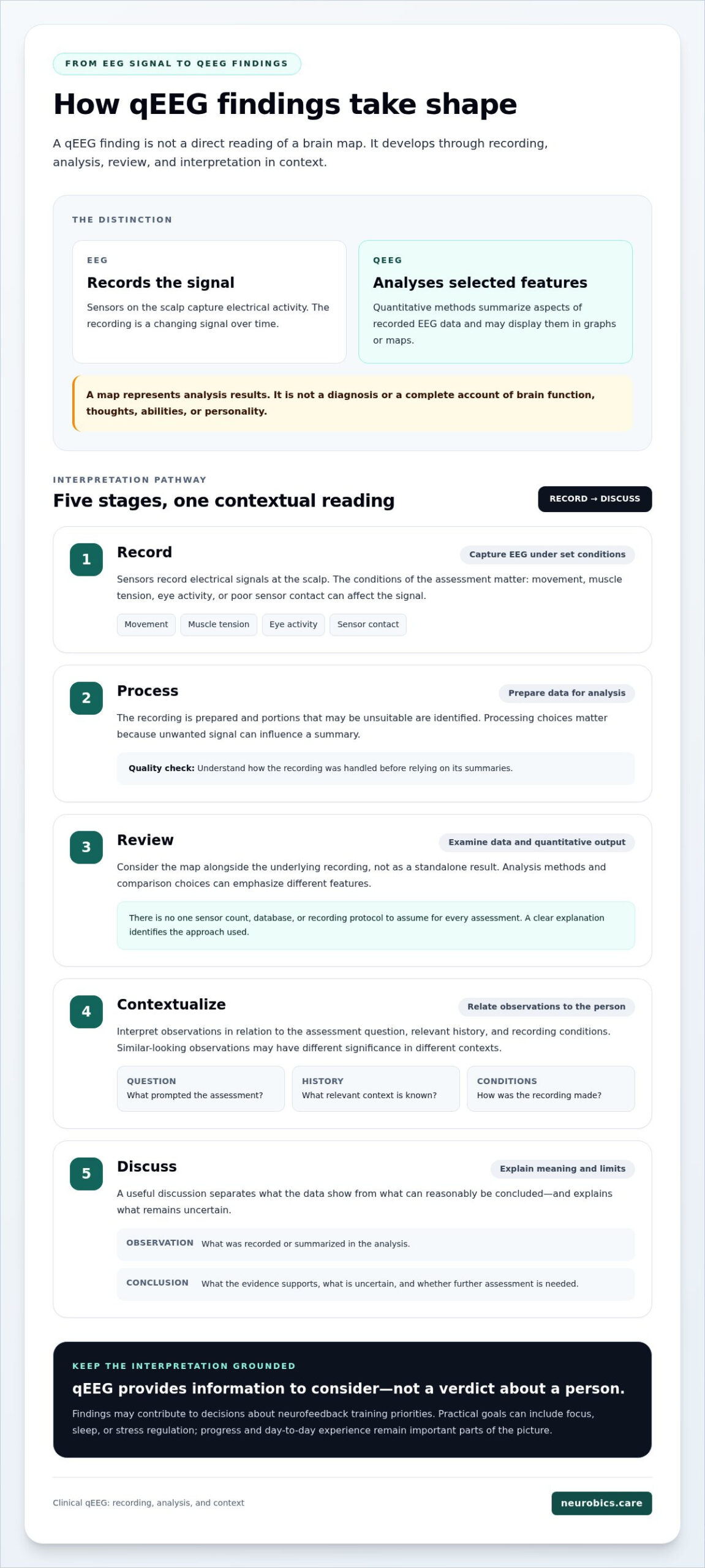
A qEEG finding is the result of several steps, not a direct reading of a map. The recording captures electrical signals, software processes selected features, and a clinician reviews the output before considering what it may mean in context. Each stage can shape the interpretation. A useful report should explain how observations were reached and what they can reasonably support.
How recorded brain activity becomes a qEEG map
Sensors detect electrical signals at the scalp, and software helps organize and analyze the recorded data. The analysis may summarize selected features and display them visually. A map represents those results; it is not a complete account of brain function or a picture of thoughts, abilities, or personality.
Interpretation can be understood as a sequence:
- Record: Capture the EEG under the conditions set for the assessment. Movement, muscle tension, eye activity, or poor sensor contact can affect the signal.
- Process: Prepare the recording for analysis and identify portions that may be unsuitable. Processing choices matter because unwanted signal can influence a summary.
- Review: Examine the recorded data and quantitative output. Consider the map alongside the underlying recording, not as a standalone result.
- Contextualize: Relate observations to the assessment question, relevant history, and recording conditions.
- Discuss: Explain what the findings may suggest, what they cannot establish, and how they might inform next steps.
The analysis also depends on the methods used to summarize and compare data. Different choices can emphasize different features, and comparison methods may vary. There is no one sensor count, database, or recording protocol to assume for every assessment. A clear explanation identifies the approach used and helps readers understand what it contributes.
How clinical context shapes interpretation
A pattern gains practical meaning only when considered alongside the reason for the assessment. For example, if someone is exploring difficulty maintaining focus, a practitioner can discuss whether recorded patterns are relevant to that stated goal. That does not justify leaping from a single observation to a diagnosis. A finding should be weighed with other information rather than interpreted in isolation.
Context doesn’t change what was recorded; it helps define what the observation can responsibly mean for this person and this assessment. This is especially important when a report uses technical labels or colour-coded displays, which can look more conclusive than the underlying evidence allows. Consider what the result describes, how it relates to the assessment purpose, and where uncertainty remains.
Neurofeedback provides feedback related to brain activity, while biofeedback is a broader term for feedback about bodily signals. In qEEG-informed training, assessment findings may help shape training goals, but they do not determine a person’s whole plan on their own. Neurobics connects assessment with expert-guided remote neurofeedback. Explore qEEG-informed neurofeedback to learn how this approach can support training goals.
What Clinical qEEG Can, and Cannot, Tell You
A qEEG report can describe patterns in recorded brain activity and contribute information to a wider assessment. Its value may lie in helping frame questions and, in some settings, inform a training focus. On its own, it cannot establish why someone has a particular difficulty, confirm a medical condition, or predict how that person will respond to neurofeedback.
qEEG findings are assessment evidence to interpret, not a medical diagnosis or proof of cause. Keeping those roles separate makes it easier to understand a brain map without treating its colours or labels as a verdict.
| What qEEG records | What interpretation may suggest | What it cannot establish alone |
|---|---|---|
| Electrical signals captured during the EEG recording and features summarized through quantitative analysis. | Patterns that may be relevant to the assessment question or worth discussing alongside other information. | The cause of a person’s symptoms, a standalone diagnosis, or a guaranteed response to a training approach. |
What qEEG findings may contribute to an assessment
For someone whose stated goal is to improve focus during work, an assessment may provide patterns to discuss when considering suitable training priorities. Interpretation should connect those observations to the person’s experience and assessment aims, rather than assign a condition based on a map. The practical question is not simply “What colour is this area?” but “What does this observation add to our understanding of the goal?”
Clinical qeeg can contribute one perspective among several. Its findings may guide further discussion or help shape a supervised neurofeedback focus, while the person’s reported experience and progress remain relevant. A finding does not prove that a specific pattern caused a concern, and it does not guarantee that a particular training plan will produce a specific result.
Why a brain map cannot answer every clinical question
A brain map is limited to the recorded signals and the analysis applied to them. It does not capture a person’s full history, daily circumstances, or every factor that may relate to their wellbeing. A broader clinical assessment draws on more than qEEG. Decisions about medical diagnosis or treatment require appropriate medical evaluation.
Neurofeedback informed by an assessment is a training service, not a diagnostic service or a substitute for medical care. A responsible interpretation explains which observations appear in the data, how they relate to the stated goal, and what remains uncertain. If a health concern needs diagnosis or treatment, qEEG alone cannot answer that question. It should not be used to delay or replace appropriate medical advice.
How to Evaluate a Clinical qEEG Assessment and Its Practical Use
A useful assessment should leave you clearer about its purpose, scope, and relevance to your goals. You should be able to understand what was measured, how the findings were interpreted, and what they can reasonably inform. A brain map is most useful when it supports a thoughtful conversation, not when it is expected to answer every question on its own.
Questions that clarify the meaning of an assessment
As you review an assessment, focus on how the information connects to your concerns and what boundaries apply to the interpretation. Clear answers help distinguish measured observations from conclusions and make next steps easier to understand.
- What was measured? Ask what the recording and analysis describe, in language you can follow.
- What was the assessment intended to inform? The purpose may shape which findings are discussed and how they are used.
- How were my goals and history considered? For example, if your goal is steadier focus during daily tasks, ask how the findings relate to that aim without treating them as a diagnosis.
- What can’t the map establish by itself? A sound explanation should name uncertainty and avoid claims about a cause, condition, or guaranteed response that the assessment cannot support.
These questions are not a test of technical knowledge. They help make sure the discussion is relevant to you, rather than leaving you with a graphic that looks precise but is difficult to apply to everyday life.
Connecting findings with a training plan
For neurofeedback, assessment information may help shape individualized training goals. It can offer a starting point for deciding what to focus on, while your stated aims and experience remain central. A plan should be explained as a training approach informed by assessment, not as treatment for a medical condition or evidence that a diagnosis has been made.
Neurobics’ first session includes brain mapping or assessment to help inform training priorities. In its home-based program, the cap monitors brainwaves passively and non-invasively. It measures activity and does not send anything into the brain. The technology provides information for guided training rather than delivering brain stimulation.
Ongoing review can help practitioners consider whether training remains aligned with your goals and make adjustments where appropriate. Reviewing progress is a way to refine training, not to prove a diagnosis or promise a particular result. Real-life changes, such as whether focus during a workday feels more manageable, are meaningful to discuss alongside training information.
If you’re considering assessment-informed neurofeedback, start by defining what you’d like to work toward. You can contact Neurobics about an assessment to discuss your goals and how they may inform a supervised training plan.
How Neurobics Uses Assessment in Remote, Expert-Guided Neurofeedback
Neurobics uses assessment to help shape a supervised neurofeedback plan around a person’s goals. The process connects an initial brain-mapping or assessment session with home training and ongoing expert guidance. It is a training service, not a medical diagnostic or treatment service, and assessment findings are not presented as proof of a condition.
From initial brain mapping to individualized training
The first session includes brain mapping or assessment. Alongside the person’s stated concerns and aims, this information can help guide training priorities. For example, someone hoping to support steadier focus in daily routines can discuss that goal with the practitioner and consider how assessment information may inform a training approach. The map is one part of the conversation, not a diagnosis or a promise of change.
From there, the practitioner tailors a training protocol to the agreed goals. The plan is intended to support brain self-regulation through neurofeedback, with expert guidance connecting assessment information to practical training decisions. The aim is not to label a person or assume that one pattern explains their experience. Goals provide a useful reference point for discussing whether the training remains relevant over time.
What ongoing remote guidance looks like
Home training uses a sensor cap that connects to a phone through Bluetooth. The system provides light or sound cues, and progress is tracked through a cloud platform. The cap monitors brainwaves passively and non-invasively; it does not send anything into the brain. It measures brain activity for feedback rather than stimulating the brain.
Remote guidance continues beyond the initial assessment. Weekly video check-ins use live results to fine-tune training, while cloud-based tracking makes progress available for review. Ongoing support is also provided through messages or calls. These touchpoints create opportunities to discuss how training fits into everyday life and whether its focus still aligns with the person’s goals.
Progress review is a practical part of guided training, not a way to confirm a diagnosis. A person might reflect on whether a chosen goal, such as maintaining attention during work, feels different over time. The practitioner can consider that experience alongside training information and adjust the plan where appropriate. No single data point guarantees a particular response, so discussion and review remain important.
This is how clinical qEEG-informed assessment can contribute to remote neurofeedback: it offers information for tailoring training goals, while expert guidance and the person’s own experience help shape the process. If you’d like to discuss your goals and this assessment-informed approach, contact Neurobics about remote neurofeedback.
Let Your Goals Shape the Next Step
Before choosing a brain-training approach, define what you’d like to work toward in everyday life. It might be staying focused through a task, feeling more settled before sleep, or noticing how stress affects your routines. A clinical qeeg can contribute to a broader conversation, but your goals should help guide it and keep any next step personally relevant.
You don’t need to have every answer before exploring your options. A thoughtful discussion can help you understand how assessment-informed neurofeedback fits your aims and whether a guided training process feels appropriate. The focus is on making an informed choice, not expecting a map or program to determine your path for you.
Explore expert-guided remote neurofeedback and consider how supported brain training might fit your goals. Progress begins with a clear intention and a process that respects your individual experience.
Frequently Asked Questions
Does clinical qEEG use radiation?
No. EEG-based qEEG analyzes electrical signals captured by sensors; it does not use radiation to create an image. This differs from imaging methods that use other technologies to produce pictures of internal structures. The exact setup can vary by assessment. Neurobics’ cap provides non-invasive, passive brainwave monitoring: it records activity without sending anything into the brain. If comparing tests, ask what the specific procedure records.
Can medication affect qEEG results?
Medication and other individual factors may be relevant context when a practitioner interprets qEEG data, but a specific pattern should not be attributed to a medicine without appropriate evidence. If you take prescribed medication, share its name and relevant timing with the practitioner or clinician discussing your assessment. Don’t stop, pause, or change a prescribed dose for testing unless the prescriber advises you to do so.
Can sleep or tiredness influence a qEEG assessment?
Sleepiness or fatigue can be relevant context because the recording reflects activity during the assessment, not a person in every state. The direction or size of any influence should not be assumed from tiredness alone. If you slept unusually poorly, feel unwell, or are more tired than usual, tell the practitioner so that circumstance can be considered when discussing the findings. This keeps interpretation anchored to the actual session.
Is a clinical qEEG assessment painful?
qEEG records electrical activity through sensors rather than sending stimulation into the brain. Neurobics’ cap provides non-invasive, passive brainwave monitoring. Comfort can still be personal, and the exact arrangement may differ by assessment, so it’s reasonable to raise practical concerns beforehand. Neurobics provides ongoing support through messages or calls, where you can discuss questions about using the cap as part of home-based training.
Can qEEG show whether neurofeedback is working?
qEEG may contribute information to a training review, but a map alone cannot establish whether an individual is improving in daily life. Neurobics’ weekly video check-ins use live results to fine-tune training, and cloud-based progress tracking supports review over time. For a useful discussion, relate any measured change to your original goals and lived experience; a shift in a measure is not, by itself, proof of clinical improvement.
Do qEEG brain maps look the same for everyone?
No. Maps represent recorded activity, and their appearance depends on the data and analysis used. A colour or label should not be read as a universal normal-versus-abnormal verdict. Ask how the display relates to the assessment question and what it leaves out. Clinical qEEG findings are most useful when discussed in the context of the individual, rather than treated as a complete picture of brain health.
Explore Neurobics’ expert-guided remote neurofeedback to consider whether it fits your goals.
