


Brain wave biofeedback at home measures brain activity and uses real-time feedback to support self-regulation practice. Sensors in an EEG cap record brainwaves, while visual or auditory cues respond to activity during a session. With remote training, you practise at home with expert guidance.
It’s natural to wonder how a brain-training session can be meaningful when you’re not in the same room as a practitioner. Remote training can still be structured around your needs. An initial brain mapping or assessment helps establish a starting point for a personalized approach.
This article explains how brainwaves are measured, what happens during a remote session, and how professional guidance shapes training. It also clarifies what at-home biofeedback can and can’t tell you, so you can assess whether it fits goals such as focus, sleep, stress regulation, or mental performance.
Key Takeaways
- Understand how EEG feedback can support practice in noticing and regulating brain activity during remote sessions.
- Learn what a neurofeedback device measures and how feedback can guide attention and self-regulation exercises.
- See how brainwave frequency bands describe different patterns of activity, without treating them as a diagnosis on their own.
- Recognize why training protocols and session recommendations are shaped around individual goals and brain measurements.
- Explore how Neurobics’ remote assisted neurofeedback can bring professionally guided training into a home setting.
How Does Neurofeedback Work?
Neurofeedback measures electrical brain activity and provides feedback, often through visual or auditory cues. The aim is to help a person practise self-regulation, not to diagnose a condition from a single brainwave pattern.
In the United States, home EEG options broadly include consumer devices paired with training software and professionally guided remote systems. Sensors and feedback vary, so the key distinction is whether training is tailored and supervised, not simply whether it happens at home.
Hardware and Training Software
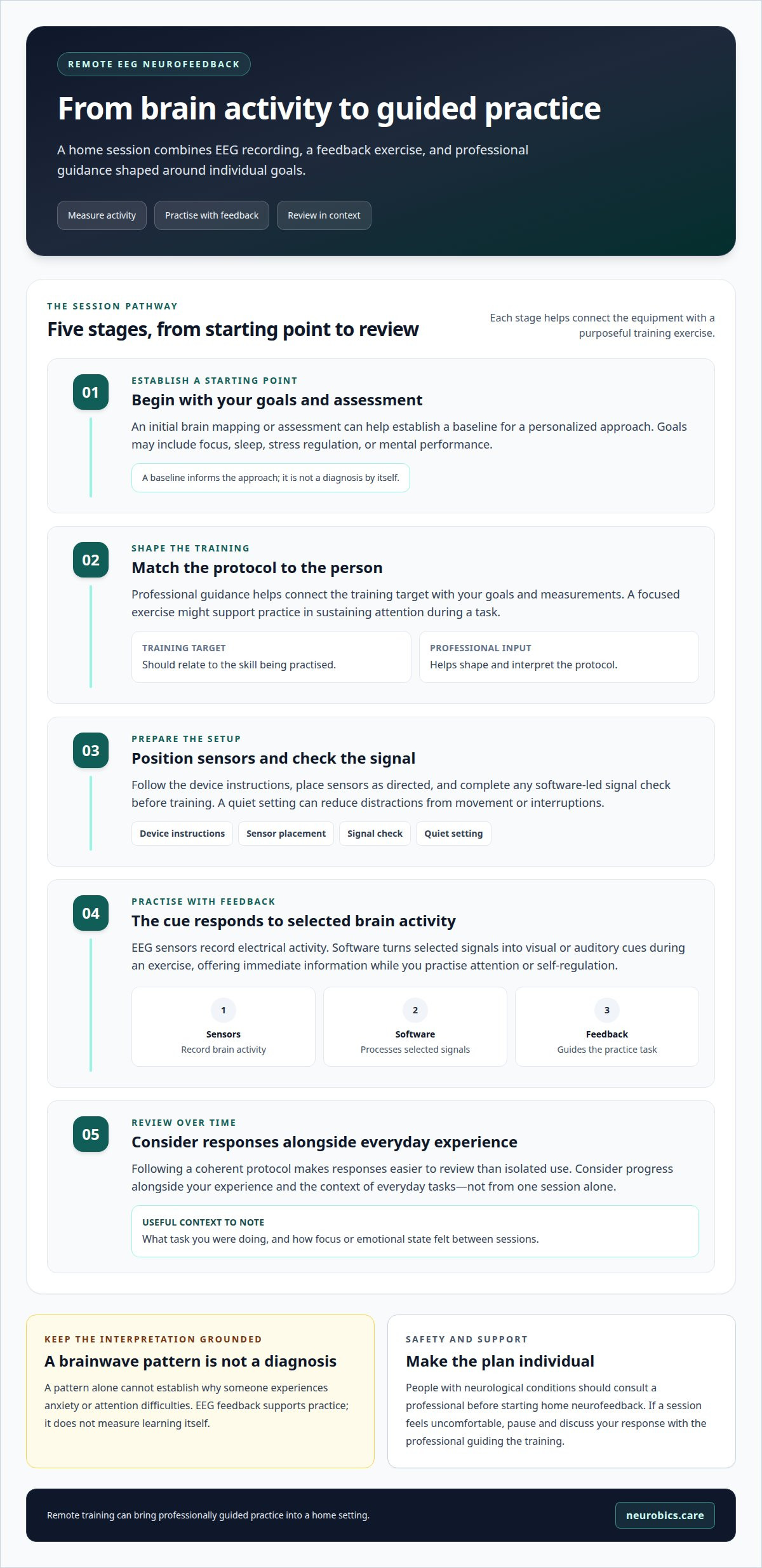
Hardware records brain activity, while software turns selected signals into feedback during an exercise. A sensor alone doesn’t provide a personalized training plan. For example, a system might change a visual cue as activity shifts, while the software determines how that change guides the exercise.
Brainwave Patterns and Conditions
Brainwave patterns are measured features of electrical activity, not diagnoses of neurological conditions. They can be considered alongside a person’s goals and functioning, but a pattern alone cannot establish why someone experiences anxiety or attention difficulties. This distinction prevents a training target from being mistaken for a medical conclusion.
Neurofeedback effectiveness can depend on how well the training target fits the person, the quality of the recording, and whether sessions follow a coherent protocol. Feedback should relate to the intended skill, such as sustaining attention during a task. A QEEG-informed approach can help establish a baseline; progress is then considered alongside the person’s experience, not inferred from one session.
Muse offers a point of comparison because consumer EEG tools and professionally guided neurofeedback serve different purposes. A consumer tool may provide a guided exercise, while professional training uses expert interpretation to shape the protocol. Neither a device name nor an EEG reading alone shows whether an approach suits someone’s needs.
People with neurological conditions should consult a professional before starting home neurofeedback. There is no universal list of side effects or contraindications established here, so safety should be considered in relation to the individual and training plan. If a session feels uncomfortable, pause and discuss your response with the professional guiding the training.
Ongoing expenses can depend on whether software access, professional guidance, and other parts of a program are included. Compare what the setup supports, not just the hardware.
What is a neurofeedback device?
A neurofeedback device records brain activity and supports training through a feedback task. Its practical value depends on how its sensors, software, and training approach work together.
When choosing an FDA-cleared EEG neurofeedback device, match its stated intended use to your goal, then consider sensor placement, feedback format, and professional guidance. A clearance label alone doesn’t determine whether a training approach suits you.
For setup, follow the device instructions, position its sensors as directed, and complete any software-led signal check before training. Choose a quiet setting so movement or interruptions don’t distract you from the task.
EEG-Based Learning and Concentration Training
EEG-supported training uses measured brain activity to guide practice in attention and self-regulation. During a concentration exercise, software may change a visual or audio cue in response to selected activity. The cue gives the learner immediate information during practice, but it doesn’t measure learning itself. Consider progress alongside everyday examples, such as staying with a reading task.
Device Features and Training Approaches
Device features determine how a training exercise presents information and which activity it responds to. Sensors collect signals, while software may use a game, sound, or visual display as feedback. For example, a screen might respond as you practise maintaining attention. An engaging format can support participation, but the training target and method should still fit your goals.
EEG Channels and Training Quality
EEG channels are recording locations, and their number describes how many locations a system measures. More channels don’t automatically mean better training: quality also depends on signal clarity, sensor placement, and how the information shapes the protocol. A focused exercise may use a targeted setup, while a broader assessment can collect activity across more locations. Channel count is one feature, not a standalone measure of quality.
Sleep routines, planned breaks, and a steady session schedule can complement concentration practice. For example, someone training after a short night may find it harder to stay engaged with an attention task. These habits don’t replace EEG training or establish a treatment effect; they help put changes in focus and emotional state between sessions in context.
Consistency makes training easier to review over time. Following the recommended protocol allows a practitioner to interpret responses more meaningfully than isolated use. If attention feels different during a reading exercise one day and a work task another day, noting the context can help guide later discussion. Neurofeedback is a learning process, not an instant performance test.
When considering remote training, think about how the device’s features and professional support fit your goals and routine.
How are brain waves measured?
EEG records electrical activity through sensors placed on the scalp, while quantitative EEG (QEEG) organizes those recordings for analysis. The resulting brain map can provide a baseline for comparing activity over time, but frequency bands describe patterns, not a diagnosis or a complete picture of mental health.
Frequency means how many cycles occur each second; one hertz equals one cycle per second. Brainwave bands are often described using ranges, and the figures below show two different conventions for each band:
- Delta: 0.5-4 Hz in one convention, and 0.1 to 3 Hz in another; associated with deep sleep and relaxation.
- Theta: 4-8 Hz or 4 to 7 Hz; related to daydreaming, creativity, and deep meditation.
- Alpha: 8-12 Hz or 8-15 Hz; linked with feeling relaxed and alert.
- Beta: 12-30 Hz or 16-30 Hz; associated with wakefulness and cognitive tasks.
- Gamma: 30-100 Hz or 31-100 Hz; tied to high-level thinking and consciousness.
- Infra-low: 0.1 or less HZ.
These ranges overlap or differ depending on the convention, so a single boundary shouldn’t be treated as a personal threshold. An alpha reading alone, for example, can’t show whether someone feels calm, focused, or ready for sleep. Interpretation depends on the recording context and the question being explored.
During QEEG, sensors in a cap record activity across the scalp. The resulting map provides a structured snapshot that can be compared with later recordings. It doesn’t reveal every aspect of brain function or independently establish why someone experiences a particular symptom. A practitioner considers the map alongside the person’s goals and relevant history.
In neurofeedback sessions, monitoring connects selected activity with visual or auditory feedback. For instance, a cue may change as the training task responds to a chosen signal. That response supports practice, but it doesn’t prove the training is effective or that everyday functioning has improved. Consider progress through the training record and meaningful changes in daily activities.
A QEEG baseline is useful when it helps shape a clear training question, such as which patterns to monitor during focus practice. It gives the practitioner a reference point, not a fixed label for the person. Comparing later recordings with the baseline can inform discussion of training, while frequency bands remain one part of a broader, individualized interpretation.
Personalized protocols and professional guidance
A personalized neurofeedback protocol connects a person’s training goal with selected signals, feedback, and a schedule. Professional guidance helps interpret responses and adjust the plan, rather than relying on a device’s default settings alone.
A practitioner may consider the person’s goals, relevant QEEG findings, session responses, and everyday functioning when shaping training. Someone aiming to practise sustained attention, for example, may use a different task from someone focused on relaxation. The protocol gives each session a purpose and a way to review progress.
Follow the neurofeedback provider’s recommendations for session frequency and duration. The appropriate schedule depends on the training plan and the person’s response. Keeping a record of sessions and observations can make later discussions more useful than relying on memory alone.
Some neurofeedback plans involve 20 to 40 sessions, and training may continue over several months. These are possible ranges, not established requirements or expected timelines; the number of sessions, duration, and results vary, and this schedule is not appropriate for everyone. A practitioner can use the person’s progress and session responses to guide decisions about continuing or adapting training.
Professional equipment can cost thousands of dollars, reflecting a category of equipment rather than a particular training outcome. Access to equipment alone doesn’t provide protocol design or interpretation. In remote training, practitioner support connects each home session to the broader plan, including how the selected signal is used and how responses inform later sessions.
EmWave2 is a device name readers may encounter in discussions of health-professional use. The name alone doesn’t establish which signal a device measures, whether its feedback is EEG-based, or how a practitioner uses it. Before comparing it with neurofeedback, clarify the training goal and distinguish the measured signal from the exercise or relaxation practice.
Meditation and relaxation exercises can complement a planned training routine, but they aren’t interchangeable with EEG neurofeedback. You might practise a calming exercise separately, then discuss how that experience relates to your sessions. Keeping the activities distinct helps practitioners interpret progress without treating a calmer feeling as proof of a particular brainwave change.
For a neurological condition or a new concern during home training, seek professional input before changing the protocol. A structured review can consider your experience, session consistency, and training goals together. This supports individualized adjustments instead of reactions to a single reading or unusually difficult session.
EEG biofeedback and brain-wave monitoring
EEG biofeedback pairs a recorded brain signal with feedback during a training task. Monitoring describes activity; feedback uses selected activity to guide practice. Neither function alone explains a person’s symptoms or establishes a clinical diagnosis.
EEG has been used by doctors and scientists to study the brain for more than 100 years. During neurofeedback, sensors record brainwave activity, and the system can provide visual or auditory cues. For example, a sound or screen element can respond to the signal selected for a session. This creates an observable link between the task and measured activity.
Monitoring is most useful when the question is clear. A practitioner might track a selected signal during a concentration exercise, then consider the session record alongside the person’s experience. A QEEG brain map can provide a baseline for this review. It describes patterns in a recording, not the full mental state of the person being assessed.
That distinction matters for concerns such as depression, anxiety, or cognitive difficulty. A brainwave pattern associated with a symptom doesn’t prove that the pattern caused it or that one reading explains the person’s experience. Professional interpretation places recorded activity in context rather than treating a map as a label. Difficulty focusing during one task, for example, isn’t by itself evidence of a disorder.
A useful monitoring process keeps these elements distinct:
- Recording: sensors capture brain activity during the session.
- Feedback: a visual or auditory cue responds to selected activity.
- Interpretation: the practitioner considers the recording, task, and reported experience together.
- Review: later observations are compared with the baseline and training goal.
Data quality also affects interpretation. Traditional gel-based EEG systems can take up to 30 minutes to acquire data. A recording still needs appropriate sensor contact and a suitable setting; movement or interruptions can make a session harder to interpret. The map is a reference point, not a complete account of symptoms or functioning.
At-home monitoring can make structured training possible outside a clinic, but the key question is what the recording guides. A clear goal, an interpretable signal, and professional review connect measurement with training without confusing a feedback response with clinical evidence. Neurobics provides EEG-informed remote training with professional guidance, so monitoring can be considered in relation to your goals.
Neurobics
Neurobics offers remote neurofeedback for people seeking structured brain training at home with professional guidance. Personalized training connects your goals with relevant brain measurements and a tailored protocol, rather than leaving you to interpret device readings alone. It may suit people exploring focus, sleep, or stress regulation who want support with remote sessions. Neurofeedback is a training service, not a medical diagnosis or substitute for other care. Contact Neurobics to discuss whether guided remote training fits your goals.
Make Your Next Step Deliberate
Choosing brain wave biofeedback at home isn’t simply about using equipment in a familiar space. It’s also a chance to clarify what you want to practise, what guidance would help, and how you’ll reflect on changes in everyday life. A focused goal, such as maintaining attention during work or building steadier relaxation habits, gives training direction without turning each session into a test.
You don’t need every detail decided before exploring your options. A conversation can help you consider whether a professionally guided approach fits your needs and which questions matter most. Neurobics provides remote neurofeedback and at-home training, with expert guidance beyond a clinic setting.
Contact Neurobics to discuss neurofeedback and consider a next step that feels informed and manageable. Thoughtful practice can begin with a clear question and a willingness to learn.
Frequently Asked Questions
Can neurofeedback be done at home?
Yes. Neurobics provides home-based training with a cap kit, remote setup by video call, and weekly video check-ins to review and refine training. The cap connects to a phone, and progress is tracked through a cloud platform. This format may suit someone seeking guided sessions at home; it differs from buying a device for unsupervised use.
Who Can Benefit from Neurofeedback Therapy?
Neurofeedback may be worth exploring if you want structured training around a personal goal, such as improving focus or practising calm. Start with a specific challenge in daily life, not a broad promise of change. For example, you might want to stay with a chosen activity. A practitioner can help determine whether this training approach fits your goal.
Can neurofeedback help with ADHD and focus?
Neurofeedback can be explored as a training approach for people with ADHD-related focus goals, but it isn’t a guaranteed treatment or replacement for medical care. Make the goal observable, such as completing a chosen task before switching activities, then discuss it during training reviews. This gives progress discussions a practical reference point without treating a session result as proof of broader change.
Does a higher channel count mean better neurofeedback?
Channel count alone can’t tell you whether a training setup is appropriate. Ask what the planned assessment needs to capture and how those findings will guide the training plan. When a practitioner explains how the recorded information relates to your goal, that gives more useful context than comparing channel numbers alone.
How long does it take to see changes?
There’s no single date when everyone should expect to notice a difference. Before training, identify a practical sign you can observe, such as how often you return to a task after distraction. Review that marker with the practitioner as training continues. This helps distinguish a meaningful shift in daily experience from a temporary change during one session.
Is neurofeedback covered by insurance?
The information here doesn’t establish whether a particular insurance plan covers neurofeedback. Before making a financial decision, ask your insurer whether the specific service is eligible and what documentation it requires. If comparing plans or benefits, describe the service accurately as neurofeedback training. Don’t assume coverage based on EEG equipment or professional guidance alone.
What is brain wave biofeedback (EEG neurofeedback) and how does it work?
EEG neurofeedback uses recorded brain activity to shape a practice task. In Neurobics’ cap system, sensors monitor brainwaves, while light or sound cues are part of the session. The system is passive: it reads activity rather than sending signals into the brain. This is feedback-based training, not brain stimulation.
Can you safely do EEG neurofeedback at home?
Neurobics’ cap is non-invasive and passive: it monitors brain activity without sending anything into the brain. Home training is guided remotely, with setup and check-ins included in the service. Not all home devices are interchangeable. If you have a neurological condition, seek professional advice before beginning at-home neurofeedback training.
