


Brain feedback makes activity that’s usually invisible available for practice. Neurofeedback for depression uses real-time signals from brain activity, typically measured with EEG or fMRI, to guide training: a person receives feedback as their brain activity changes and learns to work with those signals. It doesn’t directly switch a mood or diagnose depression.
It’s understandable to ask whether neurofeedback for depression can make a meaningful difference, especially when depression affects daily life in ways that are hard to explain. Some evidence suggests neurofeedback may help reduce depressive symptoms, but results are not guaranteed, and training is not a substitute for appropriate mental health care. This article explains how neurofeedback works, what a training session involves, and how EEG-based methods differ from fMRI-based approaches. You’ll also learn what the evidence can and can’t tell us, so you can understand where neurofeedback may fit in a broader approach to mental well-being.
Key Takeaways
- Understand what brain-signal feedback shows during training and how it can guide practice in self-regulation.
- See how EEG and fMRI differ in the brain activity they measure and the feedback they provide.
- Learn what shapes a neurofeedback plan, including the role of assessment and the structure of training.
- Explore how costs and insurance considerations may affect access, without confusing neurofeedback with other depression treatments.
- Recognize when remote, expert-guided training may fit into a broader approach to mental health support.
What Is Neurofeedback Therapy?
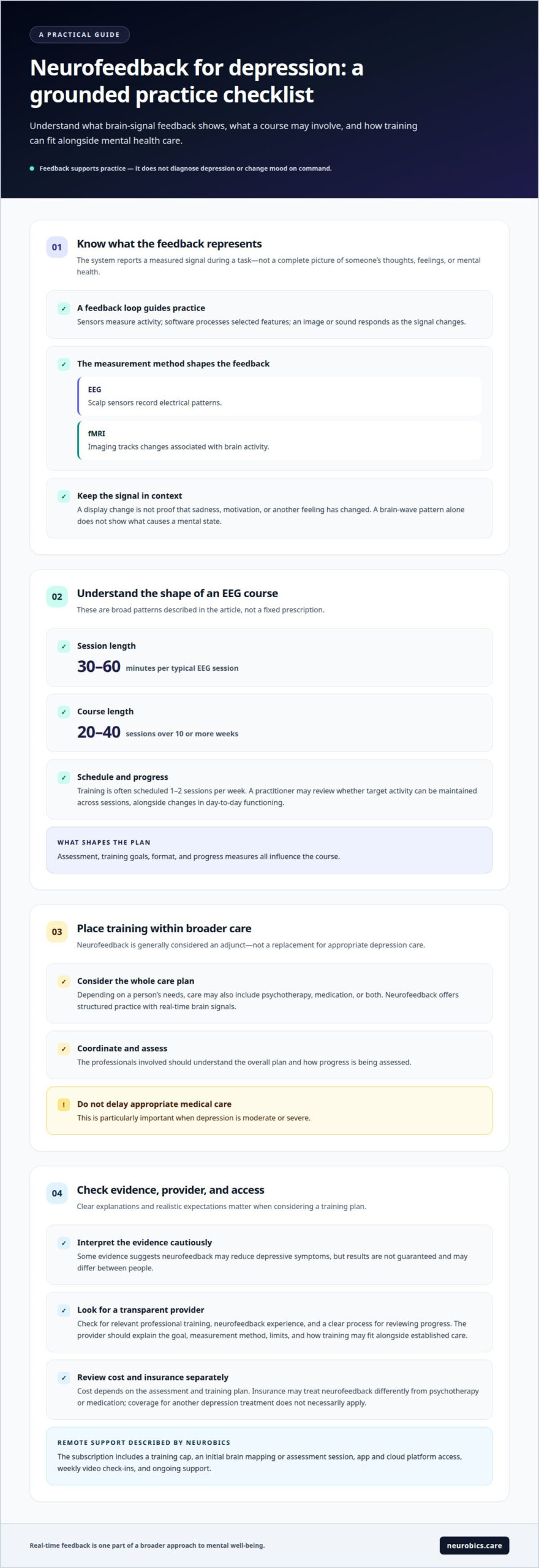
Neurofeedback is a non-invasive training method that provides feedback about brain activity. In a session, EEG sensors measure electrical signals while a person watches a visual display or listens to audio. The feedback changes in response to the measured activity. With practice, participants learn to engage with these signals. The aim is to support self-regulation, not to diagnose depression or change someone’s mood on command.
A typical EEG session lasts 30 to 60 minutes. A course may involve 20 to 40 sessions over 10 or more weeks, often scheduled 1-2 sessions per week. These are broad treatment patterns, not a fixed prescription. The format, training goals, and progress measures shape the course. For example, a practitioner may track whether a person can maintain the target activity across sessions, alongside changes in day-to-day functioning.
The cost of neurofeedback depends on the assessment and training plan. Neurobics offers remote neurofeedback with a subscription that includes the training cap, an initial brain mapping or assessment session, access to the app and cloud platform, weekly video check-ins, and ongoing support. Insurance coverage is a separate consideration: policies may treat neurofeedback differently from psychotherapy or medication. Review your plan’s rules and documentation requirements, and don’t assume coverage for another depression treatment also applies to neurofeedback.
Neurofeedback for depression is generally considered an adjunct to standard care, not a replacement for it. A care plan may also include psychotherapy, medication, or both, depending on the person’s needs. Cognitive behavioral therapy (CBT), for example, can address thought and behavior patterns, while neurofeedback provides structured practice with real-time brain signals. Coordination matters: the professionals involved should understand the overall plan and how progress is being assessed. Neurofeedback should not delay appropriate medical care, particularly when depression is moderate or severe.
Limitations also matter. Some evidence suggests neurofeedback may reduce depressive symptoms, but findings do not mean the approach works the same way for everyone. A relationship between a brain-wave pattern and a mental state does not, by itself, show that the pattern causes that state. A qualified provider should explain the training goal, the measurement method, how progress is reviewed, and what the evidence can reasonably support. For example, look for a clear explanation of how a protocol relates to the person’s needs, rather than a promise of a specific result.
To find a qualified provider, look for relevant professional training, experience with neurofeedback, and a clear process for assessing progress. Choose someone who explains the limits of the method and how training can fit alongside established depression care.
Neurofeedback definition and real-time brain-signal feedback
Neurofeedback makes measured brain activity available as feedback during a training task. EEG sensors record electrical patterns at the scalp, while software translates selected features into a visual or audio signal. The display does not show thoughts, emotions, or a diagnosis. It reflects changes in the signal being measured, giving the participant information to use while practising a task.
The process works as a feedback loop: sensors measure activity, software processes it, and an image or sound responds. For example, a moving shape might progress when the selected signal meets a training condition. If the signal changes, the display may change too. The participant can observe the response and practise engaging with the task.
That visible response is what distinguishes neurofeedback from passive observation. In an EEG session, the person takes part in a task while the system provides ongoing feedback. The signal is measured repeatedly, so the display can respond as activity shifts. This differs from taking a single brain measurement and reviewing it later, because feedback accompanies the practice itself.
Real-time feedback still needs careful interpretation. EEG captures electrical activity, but it does not reveal a person’s full mental state. A change on screen is not proof that sadness, motivation, or another feeling has changed. For instance, the feedback might shift without an immediate emotional difference. The display reports a measured signal, not a complete account of someone’s experience.
The target signal depends on the training plan. A practitioner selects what to observe and how the feedback should respond, rather than asking the participant to control every brain signal at once. Training is structured around a defined goal, such as practising a steady response during a simple task. What a signal means depends on how it is measured and the context in which it is used.
EEG and fMRI can both provide real-time brain feedback, but they measure different kinds of activity. EEG records electrical patterns from the scalp. fMRI uses imaging to track changes associated with brain activity. The signal affects what the participant sees and how the training task is designed. Neither display is a direct reading of depression or a standalone explanation for symptoms.
In practice, neurofeedback links a measured signal to a task, then uses the task’s response to support practice. A computer game, changing image, or tone can make that relationship easier to follow. Understanding what the signal represents helps keep expectations grounded: feedback supports training, while depression and daily wellbeing involve more than any single measurement.
EEG- and fMRI-based neurofeedback
EEG and fMRI can both provide real-time feedback, but they measure different signals. EEG records electrical activity through sensors placed on the scalp. Functional magnetic resonance imaging, or fMRI, uses imaging to track changes associated with brain activity. The method determines what information is available during training. Neither approach provides a complete picture of depression, thoughts, or emotional experience.
With EEG neurofeedback, a person wears scalp sensors while completing a task. Software processes the electrical signal and connects it to feedback, such as a changing image or tone. A visual display might respond when the selected signal changes. The participant observes that response while practising. EEG therefore makes electrical activity the immediate focus of the task.
In fMRI neurofeedback, feedback comes from imaging rather than electrical patterns recorded at the scalp. A participant may receive a visual cue linked to changes in a selected brain signal. This gives the training a different measurement basis from EEG. The image still represents a measured feature, not a direct reading of sadness, motivation, or a diagnosis. Interpretation depends on understanding what the system measures.
The practical difference is the signal pathway: EEG sensors record electrical activity at the scalp, while fMRI uses imaging. That difference can affect the training setup and the feedback shown. In EEG training, a person might follow a simple on-screen task as the display responds. An fMRI task links feedback to an imaging-based signal. In either case, the participant receives information during practice.
Research has examined fMRI neurofeedback for depression using the 17-item Hamilton Depression Rating Scale. A study figure described clinical improvement in the neurofeedback group, unlike the imagery control group. That comparison is a finding from a study, not a promise about an individual’s response. It also cannot establish that one method is suitable for every person or every training goal.
Choosing between EEG and fMRI is not simply a matter of picking the more advanced-sounding technology. Ask what signal is being measured, how the feedback relates to the training goal, and how progress is assessed. A practitioner can explain why a protocol uses EEG rather than imaging and what the feedback can reasonably indicate. Clear explanations help distinguish measured brain activity from broader clinical outcomes.
Both approaches use a feedback loop, but they are not interchangeable measurement tools. EEG training works with electrical signals recorded at the scalp; fMRI training uses imaging-based signals. Understanding this distinction makes it easier to interpret claims about a method and discuss how an approach may fit within care for depression.
How EEG neurofeedback works
An EEG session begins with sensors placed against the scalp. They record electrical activity; they do not send electricity into the brain. A computer processes the signal and prepares feedback for a chosen task. The person might sit comfortably and watch a visual display. The goal is to practise while observing how the display responds to measured activity.
Before training, the practitioner sets up the recording and explains the task. Good sensor contact matters because movement or poor contact can affect the signal. Blinking, jaw tension, and shifting in a chair can also create activity that makes the signal harder to interpret. For example, a changing display might reflect movement rather than the signal the task is designed to train.
Next, software links a selected feature of the EEG signal to feedback. A game might move forward when the signal meets a training condition, then pause when it does not. The participant can notice what they were doing as the display changes. Relaxing the shoulders or settling attention may coincide with a different response, though the feedback itself does not establish what caused the change.
The feedback loop continues throughout the task. Sensors record activity, software processes it, and the screen or sound responds. The practitioner may adjust the task if the signal is noisy or difficult to interpret. For instance, a brief pause can allow the person to sit still before training resumes. This helps keep the task connected to the intended measurement.
EEG training is not simply about making one reading look “better.” The selected signal and feedback rule need to match the training goal. A practitioner can explain what the display represents and what it cannot show. A screen response is not a direct measure of mood, motivation, or depression severity. Those experiences require broader clinical understanding than an EEG signal alone can provide.
With repeated practice, the participant learns to notice patterns in the task. One person might find that a steady posture helps them stay engaged with a display; another might respond differently. These observations can guide practice, but they do not prove that a particular strategy will work outside the session. The practitioner reviews the task and adapts it to the measured signal and training aims.
Progress is considered across sessions, not inferred from one successful moment. The practitioner can review whether the signal remains interpretable and whether the person can engage with the task. Changes in daily life are assessed separately. For example, concentration during a session and energy during a workday are related questions, but they are not the same measure.
In depression care, EEG neurofeedback offers structured practice with real-time brain signals. It does not diagnose depression or replace a broader assessment. Understanding each step, from sensor placement to feedback review, helps explain what the training can reasonably contribute: a guided opportunity to practise self-regulation using a defined signal and task.
What is neurofeedback for depression and how does it work?
Neurofeedback for depression uses brain-signal feedback as structured practice in self-regulation. During EEG training, sensors record activity while software connects a selected signal with a task. A display might brighten or a tone might change as the signal shifts. The participant observes the response and practises engaging with the task. The signal provides information for training, not a diagnosis or direct measure of mood.
The goal in depression-related training is to practise regulation, not to force a particular emotion. A person might work with a visual task while feedback reflects a selected EEG feature. The practitioner explains what the feature represents and how the task supports the training plan. This matters because brain activity and lived experience are connected, but one signal cannot explain every aspect of depression.
Research findings need careful context. Small neurofeedback trials for depression have reported remission rates of 40% to 50%. Those figures describe results in small studies, not an expected outcome for every person. Study design, participant characteristics, and the protocol can affect findings. A remission figure also doesn’t tell an individual whether neurofeedback is appropriate or how it compares with their broader care plan.
One important distinction is between association and cause. A brain-signal pattern may occur alongside a mental state, but that relationship alone does not prove the signal causes the state. Feedback can still provide a defined practice task. For example, someone might notice how attention or posture relates to a changing display. That observation supports practice, but does not establish why depressive symptoms began.
Progress involves more than a momentary change on screen. The practitioner can review whether the feedback remains meaningful and whether the person can engage with the task. Changes in symptoms and daily functioning should be considered separately from EEG responses. For example, completing a task with steadier attention does not automatically mean sleep, motivation, or low mood has changed.
Neurofeedback is best understood as a possible adjunct to established depression care, not a substitute for it. Psychotherapy, medication, or both may remain part of a person’s care plan. A coordinated approach helps keep brain training in perspective, especially when symptoms affect everyday functioning. Neurofeedback should not delay appropriate medical care, particularly for moderate or severe depression.
If you’re considering guided brain-signal training, Neurobics can help you explore your goals and how remote neurofeedback may fit alongside your existing care.
Neurobics
Neurobics offers remote neurofeedback with expert guidance for people exploring structured brain training. Its approach includes a QEEG-informed brain assessment to help shape an individualized training plan. This can be a relevant next step if you want to understand how measured brain activity informs training, or how remote sessions may fit alongside your existing depression care. At-home training offers a way to practise outside a clinic while remaining guided through the process.
Neurofeedback is not a diagnosis or a replacement for appropriate mental health care. If you’d like to discuss whether guided training aligns with your goals, contact Neurobics.
Consider Your Next Step in Brain Training
To decide whether neurofeedback for depression may fit your care plan, start by identifying what you hope to support in daily life. You might want to explore self-regulation practice, understand the training process, or consider how it could complement existing care. These priorities give you a clearer starting point for a conversation.
A useful discussion can focus on your goals, preferred training format, and what meaningful progress would look like in everyday life. Keeping those priorities in view can help you decide whether this approach feels appropriate for your needs.
If you’d like to discuss your goals, contact Neurobics. You can explore the option at your own pace and make an informed decision.
Frequently Asked Questions
Can neurofeedback replace antidepressants or psychotherapy?
No. Neurofeedback is an adjunct to depression care, not a substitute for medication or psychotherapy. Don’t stop or change prescribed medication because you’re considering brain training. If you already have a care plan, discuss how training could fit alongside it with the professional supporting your treatment. For example, therapy might continue to address coping patterns while neurofeedback provides a separate, structured practice task.
How does neurofeedback work?
Neurofeedback turns a measured brain signal into feedback during a training task. Sensors collect activity, software processes a selected feature, and a screen or sound responds. For example, an image might change as the signal shifts. The participant uses that response as information while practising. It represents the measured signal, not a direct reading of someone’s mood, thoughts, or diagnosis.
Is neurofeedback effective for depression?
Some evidence suggests neurofeedback may reduce depressive symptoms, but findings do not establish a reliable outcome for everyone. To assess effectiveness, distinguish changes in a training signal from changes in everyday wellbeing. For instance, a person might engage differently with a task, while mood and daily functioning need separate consideration within their broader care.
Which Treatment Is More Effective?
No single treatment is best for everyone. Medication, psychotherapy, neurofeedback, and other approaches differ in purpose and method. A useful comparison considers a person’s symptoms, treatment history, needs, and priorities. Someone seeking practical coping strategies may value a different treatment focus from someone considering structured brain-signal practice. Effectiveness should be judged by meaningful changes in wellbeing, not by technology alone.
What does research say about neurofeedback effectiveness for depression?
Research includes small trials, so findings should be interpreted cautiously. One reported comparison found clinical improvement on the 17-item Hamilton Depression Rating Scale in a neurofeedback group, unlike an imagery control group. A study result describes participants in that study; it cannot predict an individual response or establish that the same approach suits everyone. Protocol and study design also matter.
What types of neurofeedback are used to treat depression?
EEG-based training uses scalp sensors to measure electrical activity, while fMRI-based training draws on imaging signals. Both can provide feedback during a task, but their measurements differ. QEEG brain mapping is an assessment that may inform a tailored protocol; it is not itself a feedback method. Asking what signal guides the training task helps clarify what a particular approach involves.
How does neurofeedback compare with antidepressants, psychotherapy, and TMS?
These approaches work differently: antidepressants are medication, psychotherapy involves therapeutic work, and TMS uses magnetic stimulation. Neurofeedback instead provides feedback during brain-signal training. They are not interchangeable, so comparisons should consider the intended goal and how progress will be evaluated. Neurofeedback may be considered alongside established care, not as a reason to stop another treatment.
What are the risks, side effects, and contraindications of this training?
Neurofeedback is non-invasive and uses passive brain monitoring: the system measures brain activity but does not send anything into the brain. Suitability depends on the person and training context. Share relevant health history and current treatments with the professional guiding the training so these factors can inform the plan. Neurofeedback is not emergency mental health care and should not delay appropriate support if symptoms are severe or worsening. The training’s scope and limits should be explained clearly.
