


Could a headset you wear in your living room truly reshape your neural pathways as effectively as a high-end clinic? Many people exploring brain training in 2026 find themselves asking: is at home neurofeedback effective, or is it just a high-tech placebo? It’s a valid concern, especially when the market is flooded with everything from simple $299 meditation aids to professional systems. You’ve likely felt that tension between the convenience of remote care and the fear of investing in technology that lacks the clinical depth your brain requires.
At Neurobics, we agree that your mental health is too important to leave to guesswork or unguided wellness toys. While the FDA currently exercises enforcement discretion for general wellness devices, there’s a world of difference between a self-guided app and a qEEG-informed remote protocol. This article promises to bridge that gap by revealing the scientific evidence and practical requirements that determine whether remote training delivers clinical-grade results. We will provide a clear framework to help you distinguish professional remote services from DIY gadgets, ensuring your journey toward better focus and emotional regulation is built on a foundation of expert-led precision.
Key Takeaways
- Learn how professional remote programs differ from basic consumer gadgets to answer the question: is at home neurofeedback effective for achieving clinical-grade results?
- Understand why a personalized at-home QEEG brain map is the essential first step for identifying your specific neural dysregulation patterns.
- Discover the “dosage advantage” of training in your natural environment, which often allows for more frequent sessions and faster neuroplastic changes.
- Identify the key practical factors, such as user compliance and a distraction-free environment, that determine the success of your remote training.
- Explore how structured, expert-led programs bridge the gap between high-end clinical expertise and the convenience of your own living room.
Defining Effectiveness: DIY Gadgets vs. Professional Remote Neurofeedback
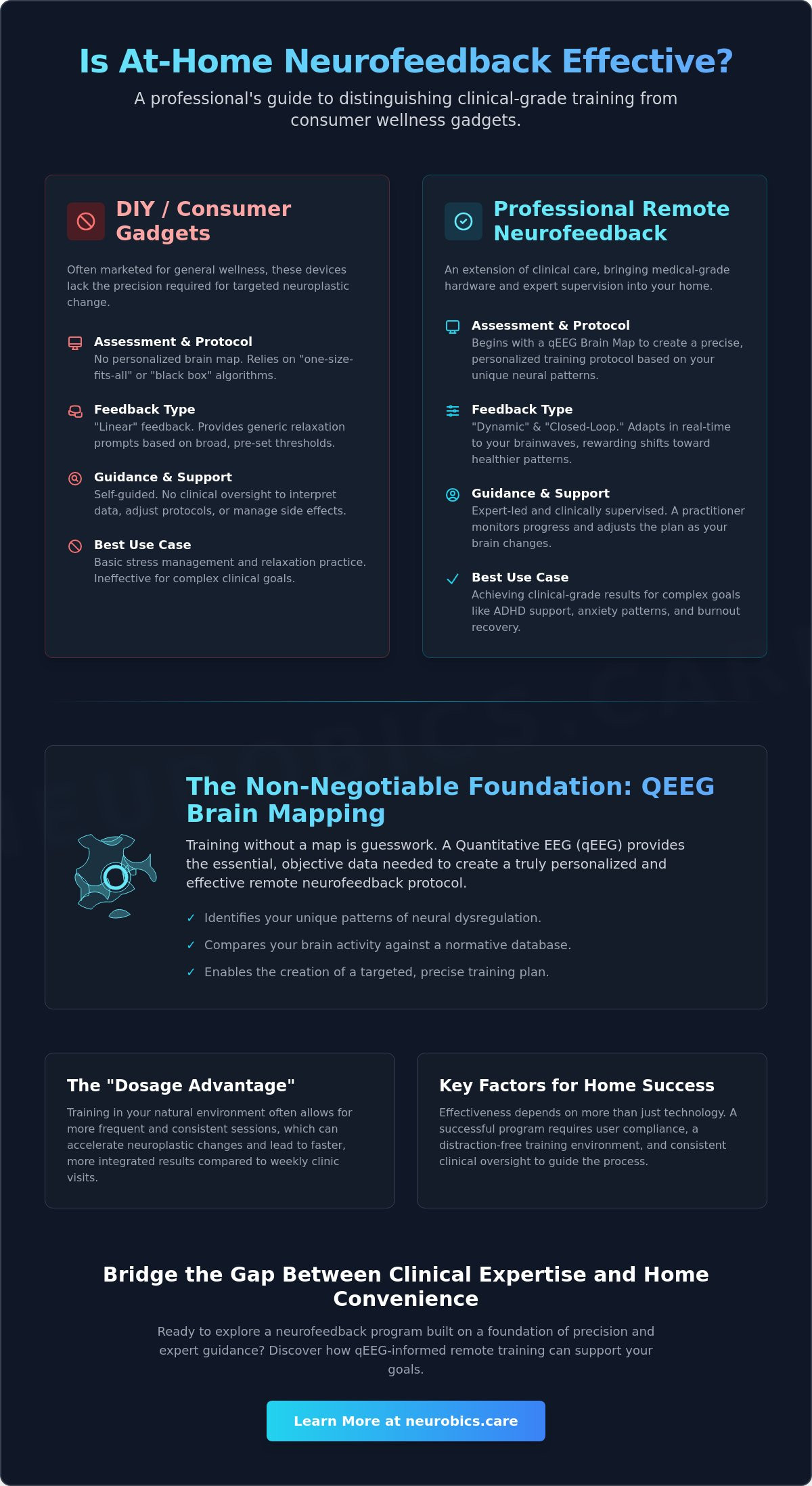
Professional remote neurofeedback is a clinically-supervised extension of traditional EEG biofeedback that brings the precision of a specialized brain clinic into your private living space. When people ask is at home neurofeedback effective, the answer depends entirely on whether they’re using a consumer-grade toy or a professional system. While the underlying technology has become more portable in 2026, the core science hasn’t changed. To understand the foundation of this work, it helps to start with the basics of What is Neurofeedback? and how it utilizes brainwave data to encourage self-regulation.
The true measure of effectiveness lies in the “closed-loop” system. This process involves three distinct stages: high-fidelity measurement of your brainwaves, expert analysis of that data, and targeted feedback that rewards your brain for moving toward healthier patterns. Many consumer meditation apps offer “linear” feedback, which provides generic relaxation prompts based on broad thresholds. In contrast, professional remote systems are “dynamic.” They adapt in real-time to your brain’s specific needs, targeting the exact frequency bands that require adjustment. It’s a common misconception that “at home” means you’re on your own. In a professional context, you’re never training in a vacuum; you’re simply training in a more comfortable location.
The Spectrum of Home Brain Training
- Low-tier: These are generic meditation aids and relaxation headbands. They’re helpful for basic stress management but lack the sensor resolution needed for targeted neuroplastic change.
- Mid-tier: Semi-automated consumer neurofeedback apps offer more engagement. However, they often rely on “black box” algorithms that apply the same logic to every user, regardless of their unique brain chemistry.
- Top-tier: Remote-assisted professional training provides medical-grade hardware and clinical oversight. This tier ensures that is at home neurofeedback effective for complex goals like ADHD support or burnout recovery.
Why Clinical Supervision is the Variable for Success
The practitioner is the most critical component of a successful home program. Brains are highly individual. A protocol that helps one person find focus might make another feel over-stimulated if the frequency bands aren’t managed with care. A skilled clinician interprets subtle EEG shifts that an automated app would miss, adjusting your training plan as your symptoms evolve. This expert-led approach minimizes the risk of side effects and ensures that your sessions lead to lasting improvements in emotional regulation. If you’re ready to see how professional guidance changes the training experience, you can always reach out to our team for a detailed discussion of your goals.
The Science of Success: Why QEEG Brain Mapping is Non-Negotiable
If you’re wondering, is at home neurofeedback effective, the answer often lies in the quality of the initial assessment. Training a brain without a map is like trying to navigate a new city without GPS; you might move, but you won’t necessarily reach your destination. For a home program to achieve clinical results, it must begin with a comprehensive at-home QEEG brain mapping. This diagnostic tool provides the objective data needed to move beyond guesswork and into targeted care.
A comprehensive review of neurofeedback highlights that successful outcomes are deeply rooted in the precision of the initial measurement. QEEG, or Quantitative Electroencephalogram, doesn’t just look at whether brainwaves are present. It compares your brain’s electrical activity against a normative database to identify specific dysregulation patterns unique to you. This process transforms raw data into a personalized protocol that can be loaded onto your remote device. Generic training without this map is akin to taking a one-size-fits-all medication; it ignores the unique architecture of your nervous system.
Visualizing Dysregulation: From Data to Protocol
QEEG identifies where your brain has an “excess” or a “deficit” in specific frequencies. For instance, someone with ADHD might show an overabundance of slow Theta waves in the frontal lobes, while someone with anxiety might exhibit too much high-frequency Beta activity. By pinpointing the source of these symptoms, we can create a plan that targets the root cause rather than the surface behavior. QEEG-informed care prevents the training of the wrong brain areas, ensuring that each session moves you closer to your goals without unintended consequences.
Remote QEEG: Bringing the Lab to the Living Room
In 2026, professional-grade EEG equipment is no longer confined to hospital basements. We ship specialized hardware directly to your door, allowing for a clinical-level scan in your own environment. During this process, remote technicians guide you through the setup to ensure “clean” data collection, free from the electrical noise that often plagues consumer gadgets. Once the scan is complete, the data is analyzed to form the basis of your 4-week or 12-week program. If you’re curious about how your specific brain patterns impact your daily life, you can book an intake with our team to discuss the mapping process further.
Clinic vs. Home: A Comparative Analysis of Outcomes
Historically, the clinical setting was the gold standard because it offered a sterile, controlled environment for brain measurement. In 2026, the conversation has shifted significantly. When patients ask is at home neurofeedback effective compared to in-person visits, the answer lies in the balance between signal precision and real-world application. While clinics offer high-end supervision, they also introduce “white coat” stress and logistical hurdles that can hinder progress. Home training allows for a more relaxed state, which is often more conducive to the neuroplastic changes we want to see.
One of the most significant benefits of remote work is the “transfer of learning.” This concept refers to the brain’s ability to apply what it learns during a session to daily life. If you only train in a quiet, dark clinic, your brain might struggle to maintain that same focus in a noisy office or a busy household. By training at home, your nervous system learns to regulate itself in the exact environment where your symptoms typically occur. This real-world practice is supported by a neurofeedback treatment efficacy review, which emphasizes that clinical results are highly dependent on how well the training translates to the user’s lived experience.
The Dose-Response Advantage of Remote Training
Consistency is the engine of brain change. In a traditional clinic, most people only manage one session per week due to the high cost and travel time. This often leads to a “two steps forward, one step back” pattern where the brain forgets the training between appointments. Home users have a distinct advantage: they can train three to five times per week. This higher frequency creates a stronger “dose” of neurofeedback, leading to faster and more permanent neural shifts. Through our remote monitoring platform, Neurobics practitioners see exactly how often you’re training and how your brain is responding, allowing us to coach you through the process with clinical precision.
Technological Parity in 2026
The gap between “wet” clinical sensors and “dry” home sensors has effectively closed. Modern professional headsets now use sophisticated signal processing to filter out electrical noise from household appliances, ensuring the data is as clean as a lab recording. It’s vital to remember that the hardware we provide at Neurobics is not a retail toy. We use medical-grade, dry-sensor technology that prioritizes signal fidelity over sleek marketing. This shift from complex “paste-and-wire” setups to user-friendly professional headsets has made clinical-grade care accessible to anyone. If you’re ready to experience this level of precision, you can contact us to begin your journey.
Practical Factors: What Determines Your Results at Home?
While technology provides the framework, the human element ultimately determines the speed of progress. When evaluating is at home neurofeedback effective for your specific goals, the answer depends heavily on user compliance. Unlike a clinic where an appointment forces participation, home training requires a personal commitment to the schedule. Consistency is the variable that turns temporary states into permanent traits. If the sessions aren’t completed with the recommended frequency, the brain doesn’t receive enough “reps” to solidify new neural pathways.
The training environment also plays a vital role in clinical outcomes. Training in a chaotic room with the television on or family members interrupting can significantly degrade the quality of the biofeedback. For the brain to engage with the signal, it needs a dedicated, quiet space where it can focus on the rewards. For busy professionals, finding a private office for rent Dubai World Trade Center can offer the ideal distraction-free environment for such focused mental work. Interestingly, the psychological comfort of being at home often reduces cortisol levels, making the nervous system more receptive to learning than it might be in an unfamiliar clinical setting. This lower stress state can actually accelerate progress, provided the environment remains distraction-free.
At Neurobics, we utilize a “Human-in-the-Loop” model to ensure you never feel lost. Weekly live check-ins with an expert are vital for success. These sessions allow us to review your data, discuss how you’re feeling, and make real-time adjustments to your protocol. This expert oversight prevents the “efficacy gap” that often occurs with unguided consumer gadgets. If you’re unsure how to set up your home training space, our team is available to provide a personalized assessment of your needs.
Creating a Successful Training Routine
Timing your sessions can influence your results. For those seeking improved focus, morning training often yields the best results as it sets a regulated tone for the workday. Conversely, those struggling with sleep or high evening stress may find that regulation protocols are most effective when performed in the late afternoon. For children with ADHD, a support system is essential. Having a parent act as a “coach” to ensure the headset is placed correctly and the environment is quiet makes a measurable difference in the child’s progress.
Troubleshooting the ‘Efficacy Gap’
If progress feels slow, we often look at lifestyle variables. Poor sleep hygiene or extreme chronic stress can act as a “brake” on neuroplasticity, making it harder for the brain to retain the training. Our practitioners use remote data to pivot protocols if a plateau occurs, ensuring the training remains challenging but achievable. The feedback loop’s precision depends entirely on a clean EEG signal, as electrical noise can mask the very brainwave patterns we aim to reward. Maintaining high signal quality is a non-negotiable requirement for professional-grade results at home.
The Neurobics Model: Expert-Guided Remote Regulation
Neurobics serves as the essential bridge between high-level clinical expertise and the practical reality of your daily life. When asking is at home neurofeedback effective, the answer depends on the quality of the partnership between the client and the practitioner. Our model isn’t a self-help app; it’s a structured, medical-grade service that brings Dutch-standard healthcare oversight directly to your doorstep. Whether you’re seeking support for ADHD, recovering from burnout, or looking to improve long-term stress regulation, our programs are designed to meet you where you are.
We offer structured journeys through our 4-week and 12-week remote programs. These aren’t generic training blocks. They’re outcome-focused paths that evolve as your brain waves do. By maintaining rigorous professional standards, we ensure that your progress is measurable and sustainable. Each program includes the necessary hardware rental and continuous remote assistance, providing a seamless transition from the clinic to the home environment without sacrificing the depth of care.
Personalized Protocols, Professional Support
The “Neurobics Difference” lies in our commitment to being QEEG-informed and data-driven. We don’t guess; we measure. Every protocol is practitioner-led, meaning a human expert reviews your sessions to ensure you’re on the right track. For those with chronic regulation needs, our annual subscription offers the long-term stability required for lasting change. While we serve an international audience, we maintain specialized local support in major European hubs to ensure our clients receive prompt, expert care regardless of their location.
Your Next Steps Toward Regulation
Moving from the consideration phase to the diagnostic phase is a significant step toward a better quality of life. The process is designed to be simple and supportive. It begins with our streamlined equipment rental and an initial at-home brain mapping session. This diagnostic foundation ensures that your training is perfectly aligned with your unique neural profile. If you’re ready to discover if is at home neurofeedback effective for your specific needs, we invite you to Contact Neurobics to discuss your brain profile with our team. We’re here to help you navigate the path to a more regulated, focused, and balanced life.
Taking the First Step Toward Neural Balance
The landscape of brain training has evolved rapidly. We’ve seen that the answer to whether is at home neurofeedback effective depends almost entirely on the clinical foundation of the program. By combining the precision of at-home QEEG brain mapping with professional oversight, you can achieve results that match or even exceed traditional clinic visits. The ability to train frequently in your own environment allows your brain to integrate these changes more deeply into your daily life, turning temporary improvements into lasting regulation.
At Neurobics, we bring over 15 years of clinical expertise to every remote session. As a practice registered with the Dutch Healthcare Federation (NFG), we prioritize your safety and progress through professional remote monitoring included in all our programs. You don’t have to navigate this journey alone. If you’re ready to move beyond generic apps and embrace a data-driven approach to mental well-being, the path forward is clear. We invite you to Book a QEEG Brain Mapping Assessment with Neurobics today. Your brain has an incredible capacity for change; we’re here to help you unlock it.
Frequently Asked Questions
Is at-home neurofeedback as effective as in-office treatment?
Yes, at-home training is often as effective as in-office treatment when it follows a practitioner-led protocol. The primary reason for this is the “dosage advantage.” Home users typically train three to five times weekly, whereas clinic visits are often limited to once a week. This increased frequency allows for more consistent reinforcement of neural pathways, which can lead to faster and more sustainable results.
Can I do neurofeedback at home without a doctor or professional?
While you can buy retail meditation headbands, achieving clinical-grade results requires professional oversight. A practitioner is essential for interpreting your qEEG data and adjusting your protocol as your brain changes. Without this guidance, you’re using a generic tool that lacks the precision needed to address specific dysregulation patterns like ADHD or chronic stress.
How long does it take to see results from at-home neurofeedback?
Most individuals require between 20 and 40 sessions to achieve lasting neural changes. You might notice subtle shifts in your sleep quality or stress levels within the first 10 sessions, but these are often temporary. The cumulative effect of a full program is what solidifies self-regulation, making the brain’s new habits permanent and automatic.
Are the headsets used for home neurofeedback clinical-grade?
The equipment provided by professional services like Neurobics is medical-grade and fundamentally different from retail gadgets. These headsets use advanced dry-sensor technology that matches the signal fidelity of traditional “wet” sensors used in clinics. This ensures that the brainwave data being measured is accurate enough to drive a sophisticated, clinical-grade feedback loop.
What are the side effects of doing neurofeedback at home?
Side effects are rare and usually mild, such as temporary fatigue or a slight headache after a session. These “neural workouts” can be taxing, much like physical exercise. Professional monitoring ensures that your protocol isn’t too intense, which prevents over-stimulation and ensures that the training remains a comfortable, supportive experience for your nervous system.
Is at-home neurofeedback effective for ADHD and anxiety?
Research indicates that is at home neurofeedback effective for ADHD and anxiety when the program is qEEG-informed. A 2022 study on remote systems showed that 69% of participants with high anxiety scores moved into the healthy range after training. The key is using a map to target the specific brain areas responsible for these symptoms.
What happens if I set up the sensors incorrectly at home?
If the sensors aren’t placed correctly, the software will detect “noise” or “artifacts” and pause the feedback. This prevents you from training the wrong patterns. In a professional remote assisted program, technicians review your signal quality during the initial sessions to ensure you’re getting a clean connection before you begin your daily training routine.
Does insurance typically cover remote neurofeedback training?
Insurance coverage for remote training is inconsistent and varies widely by provider and region. While some international health plans may offer partial reimbursement, many clients pay out-of-pocket for these services. It’s common for individuals to use Health Savings Account (HSA) or Flexible Spending Account (FSA) funds to manage the costs of professional home programs.
