


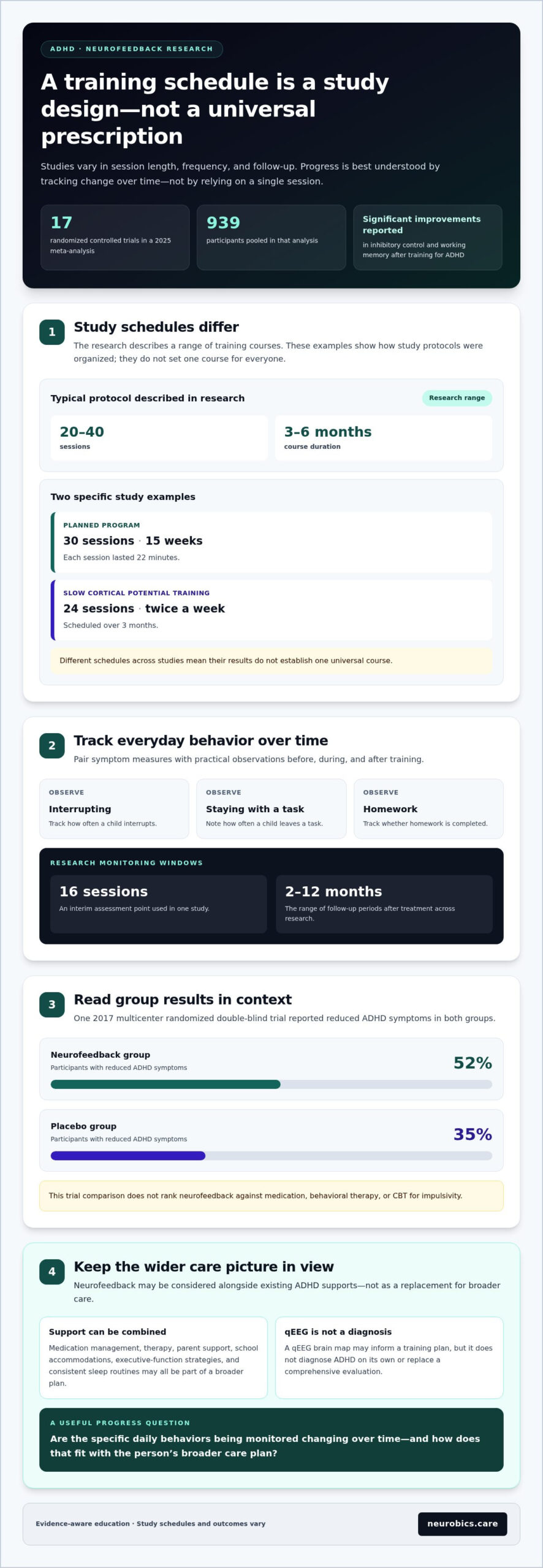
Impulsivity is not simply a matter of trying harder to stop. Neurofeedback for impulsivity may help by giving the brain practice in self-regulation, including the inhibitory control involved in pausing before acting. A 2025 meta-analysis pooling 17 randomized controlled trials with 939 participants found significant improvements in inhibitory control and working memory after neurofeedback training for ADHD, according to the meta-analysis authors.
It’s understandable to want evidence that training can make a difference beyond a change on a screen. Research also examines behavior, such as false alarms on tasks where a person must withhold a response. These results need to be considered alongside everyday functioning and the broader ADHD picture.
This article explains how neurofeedback may relate to ADHD and impulse control, what behavioral measures can show, and where the evidence has limits. It also looks at how neurofeedback can fit alongside other supports, so you can understand the approach without treating it as a replacement for broader care.
Key Takeaways
- Understand how neurofeedback may support self-regulation and why inhibitory control matters when pausing before an impulsive response.
- Learn why behavioral measures, such as false alarms on response-inhibition tasks, can add a different perspective to symptom ratings.
- See how training schedules vary across studies and what that means when considering the research.
- Explore how neurofeedback may fit alongside medication, therapy, school accommodations, and everyday strategies for ADHD.
- Find out how remote, guided neurofeedback can make structured training accessible at home.
How Can Neurofeedback Help ADHD?
Neurofeedback trains self-regulation by providing feedback about brain activity during a task. For ADHD, studies examine attention, hyperactivity, and impulse control, but protocols and outcomes vary.
Treatment timelines and progress monitoring
A treatment timeline describes how often sessions occur, how long training continues, and when progress is reviewed. It matters because improvement is assessed over time, not from one session. A typical ADHD protocol described in the research runs 20-40 sessions over 3-6 months. Individual studies use different schedules, so their results do not establish one universal course.
For example, one planned program used 30 sessions across 15 weeks, with each session lasting 22 minutes. Another intervention used 24 slow cortical potential training sessions, scheduled twice a week over 3 months. These are study designs, not a single prescription for every patient.
Progress monitoring can compare symptoms and daily functioning before, during, and after training. Useful examples include tracking how often a child interrupts, leaves a task, or completes homework. Interim assessment after 16 sessions appeared in one study; follow-up periods in research ranged from two to twelve months after treatment.
Research does not establish neurofeedback as more effective than medication, behavioral therapy, or CBT for impulsivity. A 2017 multicenter randomized double-blind trial reported reduced ADHD symptoms in 52% of the neurofeedback group and 35% of the placebo group, but that comparison does not rank neurofeedback against those other treatments.
A treatment-as-usual control group helps researchers compare neurofeedback with usual care rather than no support. In one randomized trial, neurofeedback was combined with treatment as usual for 3 months. This design can show whether adding training changes measured outcomes, but it cannot establish that neurofeedback should replace medication or behavioral support.
FDA-cleared devices and clinical guidelines
FDA clearance applies to a specific device and intended use, so it should not be inferred from research on neurofeedback generally. For ADHD, the American Academy of Pediatrics rated neurofeedback Level 1, while AAPB/ISNR guidelines rated it Efficacious and Specific (Level 5). These ratings describe ADHD evidence, not a blanket device clearance or a separate approval for impulsivity.
A qEEG brain map can inform a training plan, but it does not diagnose ADHD on its own or replace a comprehensive evaluation. When considering a provider in the United States, look for clear explanations of the assessment, training goals, progress measures, and how care coordinates with existing ADHD supports.
In the United States, cost depends on the case, course length, assessment, and delivery format; a fee is given after a quote request. Insurance coverage depends on the plan’s benefits and billing criteria, so neurofeedback should not be assumed to be covered.
Combining neurofeedback with other ADHD supports
Neurofeedback is brain training that uses feedback about brain activity during a task. For ADHD, it may be considered as one part of a broader support plan, alongside established clinical care rather than as a substitute for it.
Children and adults with ADHD-related difficulties may consider training when attention, impulsive responses, or hyperactivity affect everyday activities. Studies include both age groups, but do not identify one profile that will benefit most. Goals such as staying with homework, waiting for a turn, or following a work task give progress monitoring a practical focus.
Other supports address different needs and can continue alongside neurofeedback. For example, a family might combine training with medication management, therapy, parent support, school accommodations, executive-function strategies, and consistent sleep routines. One neurofeedback study included children who were taking ADHD medication. This shows that combined care has been studied, not that medication should be started, stopped, or changed for training.
- Medication and clinical care: Keep decisions about medication within the person’s existing care plan.
- Home and school strategies: Use reminders, shorter task steps, or classroom accommodations to support daily functioning.
- Therapy and parent support: Practise coping and planning strategies in the settings where symptoms arise.
Neurofeedback protocols often train selected patterns in brain activity, rather than treating ADHD as one uniform brainwave profile. One approach targeted theta activity at 4-8 Hz and beta activity at 13-20 Hz. These bands describe the training target; they do not provide a standalone ADHD diagnosis or explain every person’s symptoms. A qEEG brain map also cannot diagnose ADHD by itself.
Autism and ADHD symptoms can occur together, but findings from autism studies need careful interpretation. A randomized trial included 21 adolescents with autism in the neurofeedback group and 20 in a control group. Its estimated effect on hyperactivity was 0.32, with a confidence interval from −0.94 to 1.58. Because that interval includes no effect, the result does not establish a clear hyperactivity benefit.
Adult ADHD has also been studied. In a University of Tübingen study, adults received 30 one-hour sessions of slow cortical potential neurofeedback. Researchers assessed symptoms six months after the course, and 90% of participants had moderate to significant improvement. This is a study finding, not a promise for every adult or a direct comparison with other supports.
When considering neurofeedback for impulsivity, ask how training fits the person’s existing supports and measurable daily goals. Combining brain training with practical strategies can keep the focus on real-world functioning, not just changes recorded during sessions.
Impulsivity and inhibitory control
Neurofeedback measures brain activity and provides feedback during a task. The person practises responding to that feedback, with the aim of learning self-regulation. For impulsivity, the relevant skill is inhibitory control: pausing before an action, such as interrupting or clicking before reading instructions. This describes a training rationale, not proof that everyone will gain stronger control.
A 2025 meta-analysis pooling 17 randomized controlled trials with 939 participants found significant improvements in inhibitory control and working memory after neurofeedback training for ADHD, according to the Authors of the 2025 meta-analysis. These outcomes are related to impulse regulation, but they are not identical to fewer impulsive actions in daily life. The findings support further study, rather than establishing neurofeedback as a standalone treatment for impulse-control disorders.
Randomized controlled trials help assess whether changes may be linked to training. Researchers assign participants to groups and compare outcomes, reducing the risk that differences existed before training. A controlled trial may compare neurofeedback with usual care or another condition. The comparison matters: improvement after training alone cannot show whether training caused it or whether time and other supports contributed.
A sham-controlled study adds a comparison condition designed to resemble neurofeedback without providing the same active training feedback. Participants may not know which condition they receive, helping reduce expectation effects. One sham-controlled study enrolled 27 students selected for relatively high impulsivity or inattention questionnaire scores. Its findings can inform this specific group, but cannot directly establish effects for children with diagnosed ADHD or adults.
Researchers can also examine response-inhibition tasks. In a “go/no-go” task, a person responds to a “go” signal and withholds a response to a “no-go” signal. A false alarm occurs when the person responds despite the instruction to stop. One study reported fewer false alarms after neurofeedback, indicating a change in experimentally measured impulsive behavior. Task results are useful, but differ from observations at school, home, or work.
Brain measures add another layer. A study found changes in the Nogo-P3 brain response after training, but not in the Nogo-N2. Source localization suggested modulation in medial frontal regions, including the anterior cingulate cortex and superior frontal gyrus. These findings offer clues about cortical processes involved in control; they do not prove that a measured brain change causes lasting behavioral improvement.
For someone considering neurofeedback for impulsivity, the evidence is best understood by outcome and population. ADHD trials assess ADHD-related measures, while a task study of students does not establish effectiveness for every impulse-control condition. Practical evaluation should consider both task performance and concrete goals, such as waiting to speak or pausing before reacting.
Behavioral impulsivity and acting without thinking
Behavioral impulsivity appears in ordinary moments, not just clinical scores. A child might answer before a teacher finishes a question, or an adult might send a message without rereading it. These examples involve acting quickly despite a competing goal. Observing when, where, and how often they happen helps distinguish a recurring pattern from a response tied to one situation.
Researchers measure one part of this behavior with response-inhibition tasks. In a go/no-go task, participants respond to a “go” signal and withhold a response to a “no-go” signal. A false alarm means responding when the task asks them to stop. One study reported fewer false alarms after training, a change in experimentally measured impulsive behavior, not direct proof of change in daily life.
Another study examined whether impulsivity scores changed over time in children receiving neurofeedback. The neurofeedback group included 19 children, while 17 children were in a waiting-list control group. Participants weren’t randomly allocated. The estimated interaction was −1.95, with a 95% confidence interval from −3.69 to −0.21. That result describes the study’s measured pattern; its design limits how confidently it can establish cause.
For a family, a useful next step is to define observable goals before evaluating training. Parents and teachers could, for example, record whether a child waits for a turn during class discussions or follows a pause-before-answer cue. Adults might track interrupting colleagues, making unplanned purchases, or switching tasks before finishing. A simple record of the situation and response gives progress reviews a practical reference point.
Context matters because the same action can have different triggers. A child who calls out during a noisy lesson may respond differently in a quiet conversation. An adult who makes rushed decisions during a stressful work deadline may show a different pattern at home. Comparing settings and triggers helps clarify whether behavior changes alongside training or with changes in routines and support.
Training practises brain regulation through feedback, while daily strategies create opportunities to practise pausing. A family could pair a practice task with a visual reminder at homework time. An adult could use a written checklist before sending an important email. These are examples of practical supports, not evidence that neurofeedback alone produces the behavior.
Effects should be interpreted across measures, not from one task result. Temporary fatigue, headache, irritability, restlessness, or sleep changes have been reported after neurofeedback. Recording these experiences alongside behavior, session timing, and everyday goals can make reviews more informative for children and adults.
Behavioral measures of impulsivity and attention
Behavioral measures test what a person does, rather than relying only on brain activity or symptom descriptions. For example, a classroom record might track how often a child interrupts during group work. A task might measure missed targets, premature responses, or errors when attention shifts. Each measure captures a different part of ADHD symptoms, so one score cannot represent every daily challenge.
Inattention and impulsivity also require separate measures. A child may miss instructions without acting impulsively, while another may respond quickly but sustain attention well. Researchers therefore examine patterns across tasks and observations. At home, a parent could note whether unfinished chores follow distraction, rushing, or difficulty switching tasks. That distinction makes progress reviews more meaningful.
Laboratory tasks offer controlled conditions. In a response-inhibition task, a participant may press for a “go” signal and withhold a response for a “no-go” signal. Researchers can count false alarms, or responses made when stopping was required. These results are specific to the task. They don’t automatically show whether a student waits more often in class or an adult pauses before replying at work.
Reports from parents, teachers, and participants add context that a brief task cannot capture. For children with ADHD, a teacher might describe changes in following directions, while a parent notes routines at home. Adults can track missed appointments or interruptions during meetings. Medication use, sleep, and changes in school or work demands can also affect patterns observed across assessments.
One study estimated an interaction between post-training time, neurofeedback group, and impulsivity at −1.95, with a 95% confidence interval from −3.69 to −0.21. For inattention, the estimate was −0.29, with a confidence interval from −2.28 to 1.71. The inattention interval includes no effect, so these results do not support treating both behavioral outcomes as equivalent.
Study design adds another important layer. One trial stopped after interim analyses found no trend toward neurofeedback effects on behavioral measures, in line with ethical guidelines. That finding deserves attention alongside positive results from other research. The practical takeaway is to look for measured changes in specific daily behaviors, rather than assume a brain-training result means every ADHD symptom has changed.
A useful progress record can pair an observable goal with its setting, such as completing a homework step before changing activities. Reviewing that record alongside task results may clarify whether changes appear at home, school, or work. These observations can also make discussions about assessment and training goals more specific.
Neurobics: Remote Neurofeedback
Neurobics offers remote neurofeedback for people interested in structured brain training at home. The program combines home-based sessions with expert guidance, allowing you to practise self-regulation in familiar surroundings. A personalized QEEG brain measurement can inform a training plan, while goals such as pausing before responding or staying with a task connect training to everyday life.
This approach may suit people seeking guided neurofeedback as one part of broader ADHD support, rather than a replacement for clinical care, medication, or practical strategies. Training and progress can be considered in relation to specific daily goals, such as completing a routine or waiting to speak.
To explore whether remote training fits your needs, contact Neurobics with your questions.
Turn your goals into a thoughtful next step
A useful next step is to define what you want to change in everyday life and how you’ll notice progress. Choose a specific behavior, such as waiting before responding or finishing a routine task, and note the situations where it matters most. This gives conversations about neurofeedback for impulsivity a practical starting point, grounded in your priorities rather than a broad label.
It can also help to reflect on the supports already in place and the questions you want answered. For example, ask how training goals are set, how progress is reviewed, and how the approach can sit alongside existing ADHD care. These points can help you decide whether structured brain training fits your needs and circumstances.
If you’re ready to explore that possibility, connect with Neurobics to discuss a thoughtful next step. A clear goal and an open conversation can help you move forward with greater confidence.
Frequently Asked Questions
Is Neurofeedback Safe?
Safety depends on the person’s health context, training plan, and oversight. Before starting, share relevant neurological and mental-health history, current medication use, and previous experiences with brain training. Ask how concerns are handled and how the plan can be reviewed if your experience changes. This preparation supports an informed decision and keeps training within a broader care plan.
What Are the Benefits of Neurofeedback?
Neurofeedback offers structured practice in noticing and regulating brain activity. Potentially useful outcomes depend on the person’s goals, such as maintaining focus during a demanding task or feeling more settled during transitions. It can be helpful to define what “better” would look like before training begins. That makes it easier to judge whether the approach is relevant to your priorities, rather than relying on a broad promise.
What Happens During a Neurofeedback Session?
A session usually involves following a computer-based task while receiving feedback, with a practitioner guiding the training process. For a more focused experience, set up in a quiet place, silence notifications, and make sure the screen and seating feel comfortable. Afterward, note anything that affected concentration, such as interruptions or feeling unusually tired. Those details can help make future sessions more consistent.
What Is Neurofeedback Therapy?
“Neurofeedback therapy” is a common term for training that uses feedback about brain activity. The word therapy can be confusing: neurofeedback training is distinct from psychotherapy and does not itself provide an ADHD diagnosis. Before beginning, clarify the training goals and how the approach relates to any care you already receive. This helps set realistic expectations about the role of brain training.
Which neurofeedback protocols are used to treat impulsivity, and how many sessions are typical?
Protocols differ in the brain activity they target and the feedback they use. There isn’t one session count that fits everyone; the plan depends on the training approach and how progress is reviewed. Ask what the protocol is designed to practise, how its goals connect to your concerns, and when the plan will be reassessed. These questions make the course easier to understand.
What are the risks, side effects, and contraindications of neurofeedback?
Before training, discuss relevant health history, current treatment, and any previous reactions to brain-training exercises. This gives the practitioner context for planning and monitoring sessions. Don’t stop or change prescribed medication because you’re beginning neurofeedback; medication decisions belong with the professional managing that care. If a new concern arises during training, raise it promptly so the plan can be reviewed with your care team.
What should I expect during a neurofeedback session, and how is progress measured?
Progress is most useful when reviewed against goals chosen before training, rather than judged by how a single session felt. Keep observations consistent and note major routine changes that could affect concentration or self-regulation. At review points, discuss what seems to be changing, what remains difficult, and whether the original goals still fit. This creates a clearer basis for deciding what to focus on next.
If you’d like to explore whether guided neurofeedback fits your goals, contact Neurobics to discuss the remote program and your next steps.
