


Have you ever felt that being told to “just use a planner” is less of a helpful tip and more of an insult to your intelligence? If you struggle with chronic time management issues or the heavy weight of ADHD paralysis, you know that the problem isn’t a lack of desire or discipline. It’s a matter of how your brain regulates its own energy and resources. This is where brain training for executive function offers a different path. Instead of fighting against your biology, you can begin to work with it by understanding the underlying electrical patterns that drive your daily experience.
We understand how exhausting it is to feel like you’re constantly running uphill just to stay organized or keep your emotions in check. You deserve a strategy that respects the complexity of your nervous system. At Neurobics, we focus on how QEEG-informed neurofeedback can strengthen the specific neural circuits responsible for focus, impulse control, and mental flexibility. In this guide, you’ll discover a clear, evidence-based approach to improving your cognitive performance and finding a sense of calm control, even under pressure.
Key Takeaways
- Understand how executive function serves as your brain’s internal management system, governing your ability to focus, shift tasks, and regulate emotions.
- Learn how the prefrontal cortex and specific brain wave frequencies dictate your state of arousal and why balancing these patterns is essential for mental clarity.
- Discover why physiological interventions like neurofeedback often provide more lasting benefits than generic digital brain games by targeting the root of neural regulation.
- Explore a structured path for brain training for executive function that begins with a personalized QEEG assessment to identify your unique cognitive profile.
- Find out how professional remote neurofeedback allows you to access clinical-grade training and expert guidance from the comfort of your own home.
What is Executive Function and Why Does Training Matter?
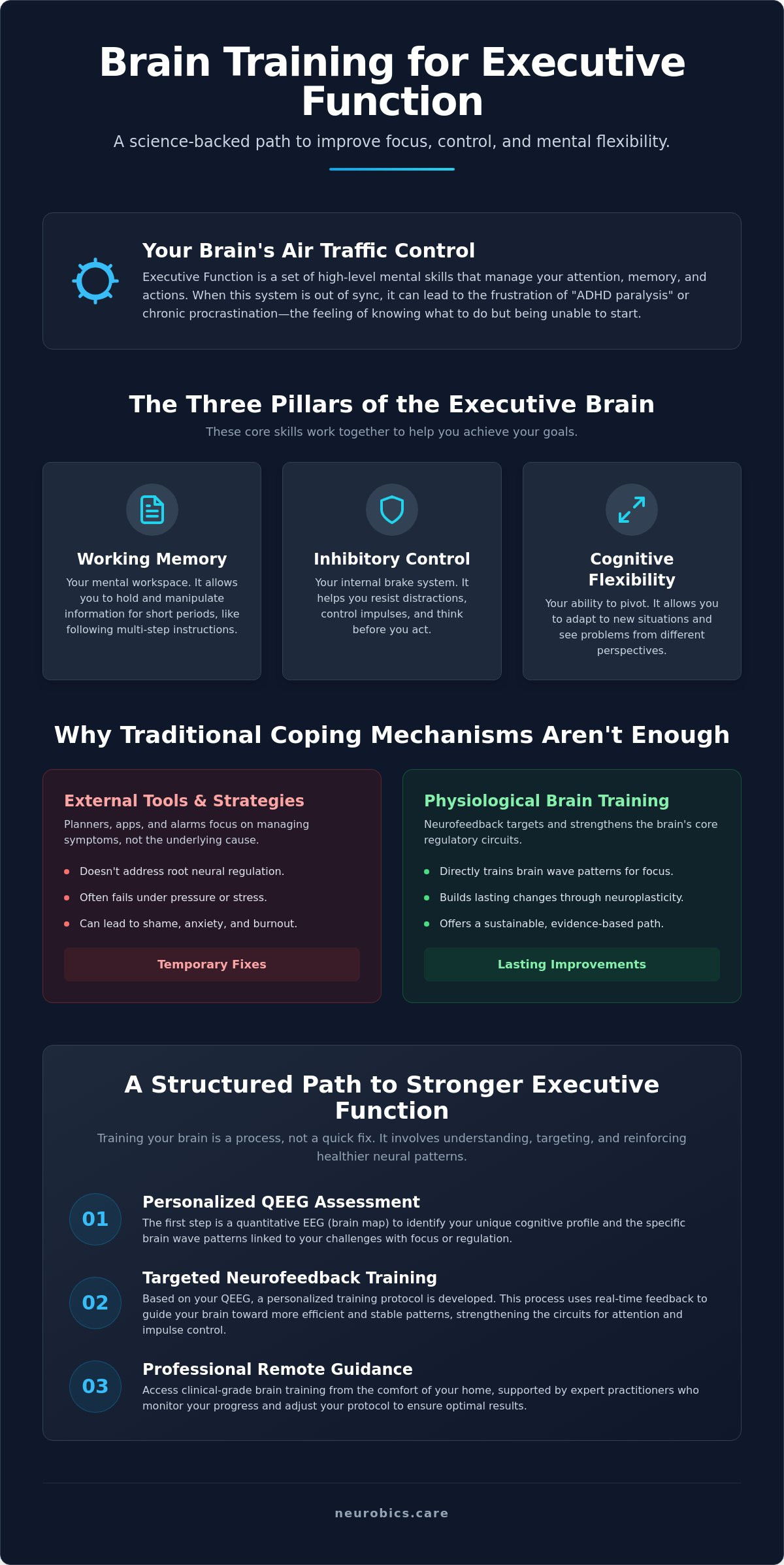
Imagine a busy airport where dozens of planes are landing and taking off simultaneously. Without an air traffic control tower to coordinate the timing and sequence, chaos would ensue. In the human brain, executive function serves this exact purpose. It’s a set of high-level cognitive processes that allow us to manage ourselves and our resources to achieve goals. Understanding what executive functions are is the first step toward realizing why they’re so vital for daily life. When these systems are out of sync, we often experience the frustration of “ADHD paralysis” or chronic procrastination. It’s the exhausting feeling of knowing exactly what you need to do, yet feeling physically unable to initiate the first step.
The Three Pillars of the Executive Brain
Neuroscience generally categorizes these mental skills into three core pillars. First, working memory acts like a mental workspace. It allows you to hold a phone number in your head while looking for a pen or to follow multi-step instructions without losing your place. Second, inhibitory control is your internal brake system. It helps you resist the urge to check social media when you need to finish a report or keeps you from reacting impulsively during a heated conversation. Finally, cognitive flexibility is the ability to pivot. It’s what allows you to change plans when your schedule is disrupted or to approach a complex problem from a new perspective when the first solution fails.
When Coping Mechanisms Aren’t Enough
Many people spend years trying to fix these issues with external tools. They buy expensive planners, set dozens of phone alarms, or use specialized software like GoBuid to streamline their professional documentation. While these tools have their place, they often fail because they don’t address the underlying neural regulation. If your brain’s “brakes” aren’t functioning at a physiological level, a louder alarm won’t help you stop an impulsive distraction. This gap often leads to a heavy emotional toll. Chronic struggles with task management frequently result in deep-seated shame, anxiety, and eventual burnout, as individuals blame their “lack of willpower” instead of recognizing a biological challenge.
The good news is that these circuits aren’t set in stone. The brain is remarkably plastic, even in adulthood. Through targeted brain training for executive function, it’s possible to strengthen these pathways. Professional approaches, such as those we facilitate at Neurobics, focus on the electrical patterns that govern arousal and focus. By addressing the root cause rather than just the symptoms, we can move beyond temporary coping strategies. This shift from “managing” to “training” offers a more sustainable, evidence-based path toward mental regulation and long-term cognitive health.
The Neural Mechanics: How Brain Waves Shape Your Focus
To understand why brain training for executive function is effective, we must look at the biological foundation of focus. Your ability to concentrate isn’t a nebulous personality trait. It’s a direct reflection of how your neurons communicate through electrical impulses. At the heart of this communication is the Prefrontal Cortex (PFC), the region of the brain located just behind your forehead. This area acts as the conductor of your mental orchestra, responsible for orchestrating complex thoughts and actions in accordance with your internal goals.
The Prefrontal Cortex and Cognitive Control
The PFC doesn’t work in isolation. It communicates with deeper brain regions to execute plans and filter out irrelevant information. When you attempt to start a difficult task, the PFC must send clear signals to suppress distractions. In cases of executive dysfunction, these signals are often weak or inconsistent. Instead of a clear directive, the brain receives a “noisy” message, making it incredibly difficult to stay on track. The dorsolateral prefrontal cortex serves as the primary neuroanatomical substrate for the top-down modulation of cognitive control and executive processing. While some research on brain training games suggests they can improve specific cognitive tasks, neurofeedback targets the underlying electrical rhythms the PFC uses to communicate.
Brain Wave Rhythms and Mental States
These electrical rhythms, or brain waves, are measured in frequencies that dictate our state of arousal. Theta waves are slower and typically associated with daydreaming, creativity, or the moments just before sleep. When Theta waves are overactive during the day, it can feel like your brain is in a “fog,” making task completion feel like wading through water. On the other hand, Beta waves are faster and represent active, alert focus. Optimal executive performance requires a delicate balance between these states. If Beta waves are too low, the brain remains under-aroused, leading to the distractibility and impulsivity often associated with attention challenges.
A common biomarker used in clinical settings is the “Theta/Beta ratio.” A high ratio often indicates that the daydreaming Theta waves are drowning out the focused Beta waves. Quantitative EEG (QEEG) mapping allows us to see these unique patterns in real-time. By creating a digital map of your brain’s electrical activity, we can identify exactly where the regulation is breaking down. It’s not about a generic diagnosis; it’s about understanding your specific neural signature. If you’re curious about what your own brain waves might reveal, you can explore our remote neurofeedback options to see how personalized data can guide your progress. This level of precision is what makes modern neurofeedback a sophisticated tool for lasting cognitive change.
Comparing Brain Training Methods: What Actually Works?
When searching for brain training for executive function, you’ll likely encounter a sea of colorful apps promising to sharpen your mind. It’s tempting to believe that playing a digital puzzle for ten minutes a day will solve complex challenges like emotional dysregulation or task initiation. However, the science behind these “brain games” is often mixed. While you might get exceptionally good at the specific game you’re playing, that skill rarely transfers to your actual work or personal life. This is known as the “transfer effect” problem. To truly improve what executive functions are in a practical sense, the training must address the brain’s baseline physiological state rather than just its ability to solve a specific puzzle.
Brain Games vs. Neurofeedback
Traditional behavioral strategies, such as Cognitive Behavioral Therapy (CBT), focus on teaching you new ways to think and act. These are valuable “top-down” approaches. Neurofeedback, however, is a “bottom-up” process. It trains the brain to regulate its own electrical rhythms, such as the Theta and Beta waves discussed earlier. Instead of just learning a new coping mechanism for a noisy environment, you’re training your brain to filter out that noise naturally. If you’re interested in how this works in a modern setting, you can read our At-Home Neurofeedback: The Complete 2026 Guide. This distinction is crucial because a brain that’s physiologically balanced is much more receptive to behavioral changes.
Professional Guidance vs. DIY Gadgets
The market is currently flooded with wearable biofeedback gadgets that claim to improve focus. While these can be interesting tools for general wellness, they often lack the precision needed for clinical-grade improvement. Training your brain without a QEEG map is like trying to navigate a new city without a GPS. You might move, but you don’t know if you’re heading in the right direction. Professional brain training for executive function relies on expert interpretation of your unique brain map to design a protocol specifically for you. Without expert oversight, there’s a risk of “blind training,” which can be ineffective or even counterproductive. At Neurobics, we prioritize weekly support to ensure your progress is steady and your protocol is adjusted as your brain begins to shift toward a more regulated state.
Medication is another common path for managing executive dysfunction. It can be highly effective for many, but it’s important to remember that medication typically works by temporarily altering neurochemistry. It doesn’t create the long-term structural or functional changes that consistent physiological training can. For many of our clients, combining their existing support systems with professional neurofeedback provides the most comprehensive path toward lasting mental regulation.
Implementing an Executive Function Training Protocol at Home
Moving from understanding the theory of brain waves to actually changing them requires a structured, data-driven approach. Effective brain training for executive function isn’t about trial and error. It begins with a clear baseline. The first step in any professional protocol is QEEG brain mapping, which provides a high-resolution snapshot of your brain’s current electrical activity. This map reveals where your neural “air traffic control” is struggling, allowing for the creation of a personalized training plan that targets your specific needs rather than relying on generic exercises.
Why Personalization is Non-Negotiable
Two people can both struggle with “poor focus,” yet their brains might look entirely different under a QEEG scan. One individual might have an excess of slow Theta waves, leading to a foggy, daydreaming state. Another might have overactive high Beta waves, resulting in a racing mind and “anxious focus.” A one-size-fits-all training program would likely fail at least one of these people because it wouldn’t address their unique physiological profile. By using high-resolution data to target specific dysregulated circuits, QEEG-informed training provides the brain with the precise feedback it needs to master self-regulation. This level of customization ensures that the training is both safe and effective for your specific nervous system.
Once your protocol is designed, consistency becomes the most important factor. For most people, the “sweet spot” for neuroplasticity is 2 to 3 sessions per week. This frequency provides enough repetition to encourage the brain to form new, more efficient neural pathways, while also allowing for the rest needed to integrate these changes. As your brain adapts and your executive function improves, your practitioner will monitor your progress and adjust the training parameters. This dynamic process ensures that you continue to be challenged as your mental regulation becomes more automatic.
Creating a Sustainable Training Routine
Integrating 20 to 30 minute training sessions into a busy professional life can feel daunting, especially if you’re already dealing with ADHD paralysis. The beauty of remote assisted neurofeedback is that it removes the friction of a commute. You can train in a supportive, familiar environment where you feel most comfortable. To overcome the initial hurdle of starting, we recommend anchoring your training to an existing habit, like having your morning coffee or finishing your workday. This helps build the “habit loop” necessary for long-term success. Having professional support and weekly live sessions also provides the accountability many people need to stay on track when their internal motivation dips.
If you’re ready to move past temporary fixes and start building a more resilient brain, you can book an intake with our team to discuss how a personalized home protocol could work for you. Professional guidance ensures that every minute you spend training is moving you closer to your goals.
The Neurobics Approach: Professional Remote Neurofeedback
At Neurobics, we believe that effective brain training for executive function requires more than just high-quality technology; it requires a partnership between the individual and the practitioner. Our approach is rooted in 15 years of clinical experience, combining the rigorous standards of Dutch healthcare with the modern flexibility of a remote service. We don’t simply provide a device and leave you to figure it out alone. Instead, we guide you through a structured process designed to bridge the gap between clinical science and your daily life, ensuring that every session contributes to lasting neural change.
Your journey begins with a comprehensive intake and an at-home QEEG measurement. Once we’ve analyzed your data, we provide a personalized oral report. This isn’t a generic printout; it’s a deep dive into your unique neural architecture. We explain exactly how your brain wave patterns correlate with the challenges you face, such as task initiation or emotional regulation. From there, we design a protocol specifically for you, whether you’re looking for a focused four-week intensive or an annual program for long-term nervous system maintenance. This clarity helps demystify the process and sets a solid foundation for your progress.
Clinical Precision Meets Home Convenience
We’ve eliminated the logistical barriers to high-level care by shipping professional-grade EEG equipment directly to your door. This allows you to access the same quality of training you’d find in a top-tier clinic without the stress of travel. However, the technology is only one part of the equation. Our model includes weekly live sessions with our experts to monitor your data, answer your questions, and adjust your protocol in real-time. If you’re curious about the investment required for this level of professional oversight, you can explore our guide on Neurofeedback Therapy Cost to understand the value of a guided clinical approach.
Your Journey Toward Self-Regulation
The ultimate goal of our work is to move you beyond temporary coping mechanisms and toward true neural self-regulation. When your brain learns to balance its own rhythms, the symptoms of executive dysfunction begin to recede naturally. Success in our program often looks like a quiet mind during a busy workday, the ability to start a complex project without the weight of “ADHD paralysis,” and a newfound sense of emotional resilience under stress. For professionals navigating high-stakes digital environments, such as those protected by CyberOne, this level of cognitive reliability is essential for reclaiming your mental clarity and building a brain that supports your goals.
We’re here to help you navigate this path with confidence and expert support. If you’re ready to see what a personalized brain map can reveal about your cognitive potential, we invite you to contact us to discuss your brain mapping intake. Together, we can build a clear, evidence-based path toward the mental flexibility and focus you deserve.
Take the First Step Toward Lasting Mental Clarity
We’ve explored how your brain’s electrical rhythms dictate your ability to focus, plan, and regulate emotions. By moving beyond temporary coping mechanisms and targeting the underlying physiological patterns, you can build a more resilient and efficient nervous system. Professional brain training for executive function is a journey of self-discovery and growth, rooted in the incredible plasticity of the human brain. It’s about giving your prefrontal cortex the tools it needs to lead effectively.
With Neurobics, you benefit from over 15 years of clinical experience and the precision of QEEG-informed personalized protocols. You’re never training alone; our expert-guided weekly sessions ensure your path is clear and your progress is measurable. This structured approach allows you to train from the comfort of home while maintaining clinical-grade standards. We’re committed to helping you bridge the gap between where you are now and the cognitive performance you know you’re capable of.
Ready to see your brain’s potential in high resolution? Book your personalized QEEG intake assessment today to begin your transformation. You have the capacity to strengthen your mental foundation and reclaim your focus. We’re here to guide you every step of the way.
Frequently Asked Questions
Can brain training really improve executive function in adults?
Yes, neuroplasticity allows the adult brain to reorganize and strengthen its neural pathways through consistent brain training for executive function. While it was once believed that cognitive patterns were fixed after childhood, we now know that targeted interventions can improve the prefrontal cortex’s ability to regulate attention and impulses. Many adults find that tasks requiring complex planning and task initiation become significantly easier as their nervous system becomes more efficient.
How long does it take to see results from neurofeedback for executive function?
Most individuals begin to notice subtle shifts in their mental clarity or emotional control within 10 to 15 sessions. For these changes to become lasting and structural, a typical program usually consists of 20 to 40 sessions. The exact timeline depends on your unique brain map and how consistently you engage with your personalized protocol, as repetition is key to neural adaptation.
Is neurofeedback better than brain games for ADHD?
Neurofeedback is generally more effective for real-world application because it addresses the brain’s underlying physiological state rather than just a specific task. Digital brain games often only improve your performance within the game itself. Neurofeedback trains your brain’s ability to enter and maintain a focused state, which transfers more naturally to your professional life and daily responsibilities.
Do I need a medical diagnosis to start executive function training?
You don’t need a formal medical diagnosis to begin training your brain for better regulation. At Neurobics, we focus on identifying patterns of dysregulation through QEEG mapping to help you reach your peak cognitive performance. Our goal is to support your nervous system and mental clarity, whether or not your symptoms meet the criteria for a specific clinical condition.
Is at-home neurofeedback as effective as in-office sessions?
At-home training is just as effective as in-office sessions when it’s supported by professional-grade equipment and expert guidance. Remote assisted neurofeedback actually offers a distinct advantage by allowing you to train more frequently in a comfortable, low-stress environment. This increased consistency is often the deciding factor in achieving successful, long-term cognitive improvements.
What is the Theta/Beta ratio and why does it matter for focus?
The Theta/Beta ratio is a well-studied biomarker that compares slow, “daydreaming” waves to faster waves associated with active focus. A high ratio often indicates that the brain is struggling to suppress internal noise, making it difficult to stay on task. Balancing this ratio is a core objective of brain training for executive function, as it helps the brain shift into a productive state more easily.
How much does a professional neurofeedback program cost?
The investment for a professional program depends on the duration of your training and the level of clinical support you require. A comprehensive service typically includes your initial QEEG brain mapping, the use of professional-grade equipment, and weekly live sessions with a practitioner. This guided model ensures that your training is safe, precise, and adjusted as your brain begins to show progress.
Can I do neurofeedback while taking ADHD medication?
You can certainly engage in neurofeedback while continuing your prescribed medication. Many of our clients find that training helps them build the internal self-regulation skills that medication alone doesn’t address. It’s helpful to keep your healthcare provider informed about your progress so they can monitor how your brain’s increasing efficiency complements your existing support system.
