


What if the key to managing ADHD wasn’t about forcing yourself to try harder, but about teaching your brain how to shift out of a persistent fog on its own? For many, the daily struggle with executive function and the frustration of medication side effects can make it feel like your mind is working against you. It’s a common experience to feel “stuck” in patterns of distraction that seem impossible to break through sheer willpower alone.
Understanding how neurofeedback works for adhd begins with a shift in perspective; it’s about viewing the brain as a dynamic system capable of learning new, more efficient rhythms. This process isn’t about “fixing” a broken mind, but rather using the science of neuroplasticity to encourage better self-regulation. By leveraging personalized qEEG data, we can see the unique neurological patterns that drive your symptoms and provide the precise feedback your nervous system needs to find balance.
Key Takeaways
- Understand how neurofeedback works for adhd by utilizing operant conditioning to reward the brain for reaching more focused and regulated states.
- Learn how qEEG brain mapping identifies specific patterns, such as the Theta-Beta ratio, to create a personalized training plan tailored to your unique neurological needs.
- Discover the non-invasive nature of the feedback loop, where sensors simply “read” brain activity to provide real-time information without any external stimulation.
- Explore how consistent practice leverages neuroplasticity to help the brain move out of “stuck” patterns, leading to improved executive function and emotional balance.
- Find out how Neurobics brings clinical-grade technology into your home, allowing for professional-level brain training with expert guidance outside of a traditional clinic setting.
Understanding the Mechanism: How Neurofeedback Trains the ADHD Brain
Neurofeedback is essentially a sophisticated mirror for your brain. It’s a non-invasive method that utilizes Electroencephalogram (EEG) technology to measure the electrical activity produced by your neurons. Unlike many traditional approaches, it doesn’t involve putting anything into the body or the brain. Instead, it provides a comprehensive overview of neurofeedback by showing the brain exactly what it’s doing in real time. This allows for a deeper level of self-awareness that is often missing in traditional ADHD management.
At the heart of how neurofeedback works for adhd is a psychological principle called operant conditioning. This is a learning process where the brain is rewarded for producing specific, healthier patterns of activity. When your brain waves reach the desired state, such as increased focus or calmness, you receive a positive signal, often through a video or sound. Over time, your brain naturally seeks out these rewards, effectively learning to regulate itself without conscious effort or external pressure.
Think of these sessions as a “mental gym.” Just as you wouldn’t expect to build significant muscle after one visit to a fitness center, your brain requires repetition to strengthen its neural pathways. Each session reinforces the ability to maintain attention and manage impulses. It’s a gradual process rooted in biology, focusing on long-term development rather than providing a temporary or overnight fix.
The Biological Feedback Loop
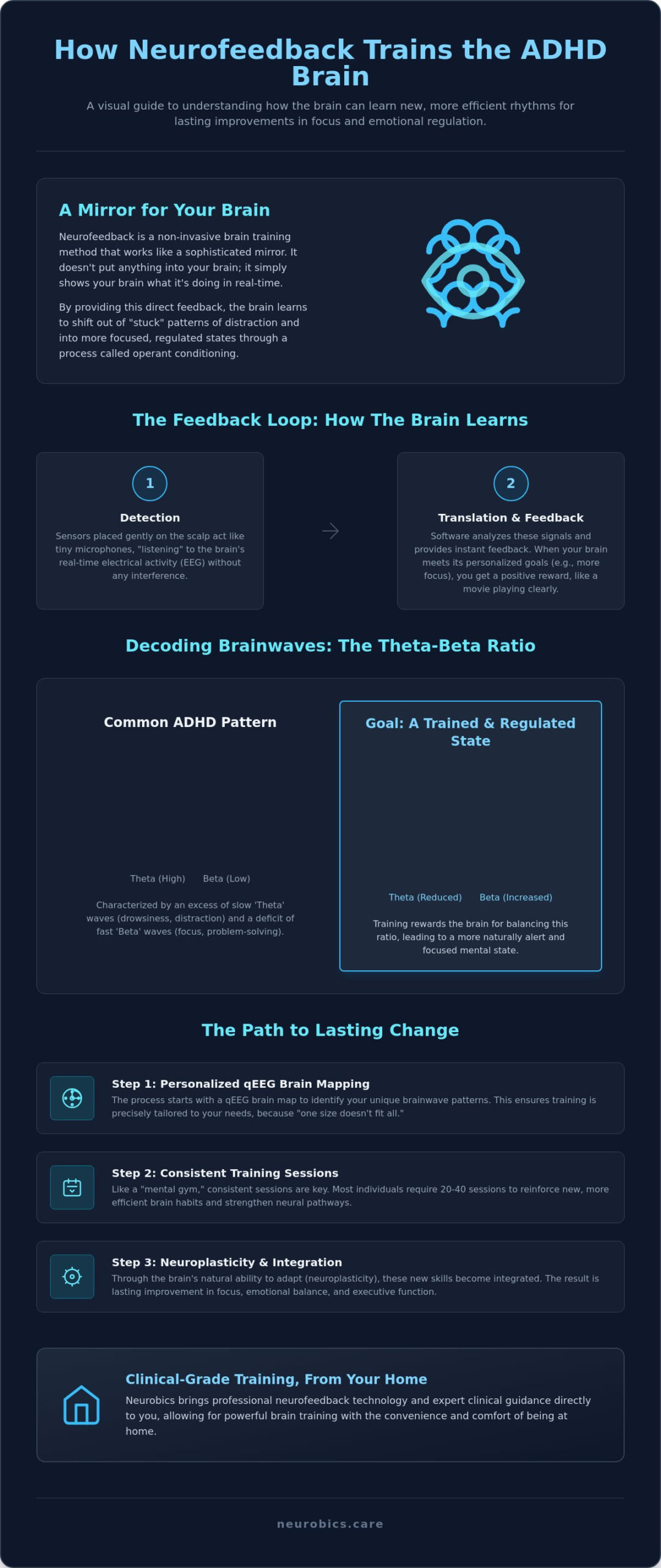
The process begins with small sensors placed gently on the scalp to detect electrical signals. These sensors act like tiny microphones, listening to the electrical “chatter” of the brain without interfering with it. A computer then translates these complex signals into an easy-to-understand format. The feedback loop operates through three main stages:
- Detection: Sensors read the brain’s real-time electrical output.
- Translation: Software analyzes the waves and compares them to the personalized target goals.
- Feedback: If the brain is meeting its goals, a movie might play at full brightness; if attention drifts, the movie dims.
This immediate loop allows the brain to see its own performance and instinctively begin to self-correct.
Neuroplasticity and Long-Term Change
The reason these changes can become permanent is due to the brain’s inherent malleability. Neuroplasticity is the brain’s ability to reorganize itself by forming new neural connections throughout life. By consistently rewarding focused states, we encourage the brain to build and solidify these new pathways. Understanding how neurofeedback works for adhd involves recognizing that the brain isn’t static; it can be trained to function more efficiently. Most individuals require between 20 to 40 sessions to ensure these changes are lasting, allowing the brain to integrate these new self-regulation skills into daily life for long-term balance.
The Science of Brain Waves: Decoding the ADHD Theta-Beta Ratio
Our brains operate through a spectrum of electrical frequencies, each associated with a different state of consciousness. From the deep, restorative cycles of Delta waves during sleep to the rapid, active pulses of Beta waves during a complex work meeting, these rhythms dictate our mental state. For those exploring how neurofeedback works for adhd, the conversation often centers on the “Theta-Beta Ratio.” This measurement looks at the specific balance between slow-wave activity (Theta) and fast-wave activity (Beta) in the frontal regions of the brain, where executive function resides.
In many individuals with ADHD, this ratio is skewed. There’s often an overabundance of slow waves and a relative deficit of fast waves. This isn’t a sign of a “broken” brain; rather, it indicates a nervous system that struggles to shift into the appropriate gear for the task at hand. By understanding these electrical signatures, we can move away from viewing ADHD symptoms as behavioral choices and see them as biological patterns that can be influenced through consistent training.
Theta Waves: The “Drowsy” Brain
Theta waves are perfectly normal when we’re drifting off to sleep or engaged in deep meditation. However, in many ADHD brains, these slow waves remain dominant even during waking hours. This excess of Theta often manifests as a persistent “brain fog” or a feeling of being mentally under-aroused. It’s the biological root of daydreaming and distractibility. When Theta waves take over during the day, it can lead to a state of Understanding ADHD Paralysis, where the brain feels “stuck” and unable to initiate even simple tasks despite a strong desire to do so.
Beta Waves: The “Engaged” Brain
On the opposite end of the spectrum, Beta waves are the high-frequency signals required for logical thinking, organization, and sustained attention. They’re the engine of executive function. In a typical brain, Beta activity increases naturally when a task requires focus. For individuals with ADHD, the brain often struggles to “switch on” these Beta waves when needed. There’s significant evidence for neurofeedback in treating ADHD suggesting that training the brain to shift this ratio can lead to more consistent mental clarity.
Neurofeedback works by specifically targeting this imbalance. By monitoring your real-time brain activity, the system identifies when you’re slipping into a high-Theta state and rewards you when you produce more Beta waves. This process essentially teaches your brain how to find the “on” switch for focus. If you’ve ever felt like your mind is perpetually stuck in low gear, exploring your own neurological patterns through professional brain mapping can be a transformative first step toward better self-regulation.
From QEEG Mapping to Personalized Protocols: Why One Size Doesn’t Fit All
While general scientific principles help us understand how neurofeedback works for adhd, the real clinical power lies in the depth of personalization. Every brain has its own unique landscape of activity. A standard protocol that helps one person might be completely ineffective for another because their specific “hot spots” of dysregulation are located in different brain regions. This is why a baseline measurement is the most critical step in any successful brain training journey. Without a clear picture of your starting point, training is merely guesswork.
At Neurobics, we move beyond generic “brain training” by utilizing QEEG technology to inform every session. This data-driven approach ensures that we aren’t just training the brain in a general sense; we’re targeting the specific areas that drive your unique ADHD symptoms. By looking at the current evidence and practice for neurofeedback, it’s clear that the most effective outcomes occur when the training is tailored to the individual’s neurological signature.
What is a QEEG Brain Map?
A Quantitative Electroencephalogram, or QEEG, is often described as a “brain map.” It’s a sophisticated analysis that compares your brain’s electrical activity against a massive database of “neurotypical” patterns. This allows us to visualize your brain activity as a topographical map of frequencies, highlighting areas where activity is either too high or too low. You can now access this high-level diagnostic tool through At-Home QEEG Brain Mapping, which provides the same clinical precision as an in-person visit.
These maps identify several key markers, including:
- Processing Speed: Identifying where slow waves might be causing mental fatigue.
- Connectivity: Seeing how well different parts of the brain communicate with each other.
- Asymmetry: Finding imbalances between the left and right hemispheres that can affect mood and focus.
Personalizing the Protocol
Once we have your map, we create a protocol that is unique to you. If your ADHD presents as high-energy impulsivity, your protocol will focus on calming overactive regions. Conversely, if you struggle with “inattentive type” ADHD and feel stuck in a fog, the training will focus on boosting the fast waves necessary for alertness. Training the wrong area can be ineffective; for example, trying to “calm” a brain that is already under-aroused may actually increase feelings of lethargy. This highlights the importance of professional oversight. Our experts at Neurobics interpret your QEEG data to ensure the feedback loop is always working in your favor, moving your nervous system toward a state of sustainable balance.
What to Expect During a Session: The Feedback Loop in Action
Entering a neurofeedback session feels significantly different from traditional clinical environments. The physical setup is designed for comfort and focus. You sit in a relaxed position while a few high-precision sensors are placed on specific points on your scalp, guided by your personalized qEEG map. These sensors are connected to a specialized amplifier that sends your brain’s electrical activity to a computer. It’s vital to understand that this is a one-way street; the sensors only read your brain’s natural output. Nothing is being “put into” your brain, and there’s no sensation associated with the measurement itself.
This real-time data allows you to see how neurofeedback works for adhd through a direct, visual interface. Instead of a complex graph, you might watch a movie or interact with a simple game on a screen. The software is programmed to respond only when your brain waves meet the targets set in your protocol. When you’re in a state of focused, calm awareness, the movie plays at full brightness and the sound is clear. If your brain slips back into an unfocused or “foggy” state, the screen dims or the music fades. This immediate feedback helps the brain recognize its own shifts in arousal levels.
The Feedback Experience
The beauty of this process is what we call “effortless effort.” You don’t need to consciously “try” to make the movie play. In fact, over-analyzing or trying too hard can often create tension, which produces the wrong type of brain wave activity. Your brain is a natural pattern-seeker. It wants the reward of a clear picture and consistent sound. Over the course of a session, your nervous system begins to adjust itself instinctively to keep the feedback positive. This subconscious learning is the foundation of long-term self-regulation.
- Visual Cues: The screen might grow larger, brighter, or more colorful as you hit your target frequencies.
- Auditory Cues: Music or tones play only when your brain is in the “zone,” providing a gentle reward for focus.
- Instinctive Learning: The brain treats the clear feedback as a biological reward, reinforcing the focused state without conscious strain.
A Typical Training Schedule
A standard session usually lasts between 20 to 40 minutes. This duration is long enough to provide meaningful practice but short enough to avoid mental fatigue. Most individuals see the best results when they train 2 to 3 times per week, allowing the brain to consolidate what it’s learned between sessions. Consistency is the primary driver of successful neurofeedback outcomes. By maintaining a regular rhythm, you provide your nervous system with the steady reinforcement it needs to make these new patterns permanent. If you’re ready to see how this feedback loop can work for you, we invite you to reach out to our team to discuss a personalized training plan.
Remote Neurofeedback: Professional Brain Training from Your Home
A common misconception is that professional brain training requires a clinical office setting. While in-clinic sessions were once the only option, modern technology has shifted the landscape significantly. Many individuals now find that training in their own environment leads to better results because the nervous system is already in a familiar, low-stress state. Neurobics supports this shift by shipping the same clinical-grade equipment used in top-tier centers directly to your home. This approach removes the logistical barriers of travel and allows you to integrate your sessions into a routine that truly fits your lifestyle.
Choosing remote training doesn’t mean you’re navigating the process alone. In fact, professional remote assisted neurofeedback ensures that every session is monitored by an expert who analyzes your data and adjusts your protocol as your brain evolves. This level of oversight is essential for understanding how neurofeedback works for adhd in a practical, real-world context. The goal is to provide the same precision found in a clinic with the comfort and privacy of your own living room, ensuring that your training is both high-quality and convenient.
Clinical Grade vs. Consumer Wearables
It’s important to distinguish between professional hardware and basic consumer wearables. While the market for home neurofeedback devices is projected to grow at a 15% compound annual rate through 2033, not all equipment is created equal. Many meditation headbands or apps offer a generic experience that lacks the high-fidelity EEG sensors required for targeted ADHD protocols. Clinical-grade sensors are necessary to capture the precise electrical signatures identified in your qEEG map. Without this high-resolution data, it’s difficult to create the specific feedback loop needed to address complex patterns like the Theta-Beta ratio discussed earlier. Our remote model provides you with professional-grade technology while an expert ensures the sensors are placed correctly and the data remains clean.
The Path to Self-Regulation
The ultimate objective of any neurofeedback program is independence. The equipment is simply a teaching tool; it’s a set of training wheels for the nervous system. As you progress through your sessions, your brain begins to internalize the focused state it discovers during the “mental gym.” Eventually, the equipment is no longer necessary because the brain has learned how to regulate its own arousal levels instinctively. This transition from external feedback to internal agency is the most rewarding part of the process. It offers a sense of empowerment, giving you the tools to manage your focus and emotions long after the training ends. If you’re ready to begin your journey toward a more regulated mind, we invite you to contact our team to learn more about our remote training options.
Empowering Your Brain’s Natural Potential
Mastering the rhythms of your own mind is a journey of patience and biological recalibration. We’ve explored how neurofeedback works for adhd by moving beyond surface-level symptoms to address the underlying electrical patterns of the brain. From balancing the Theta-Beta ratio to the clinical precision of qEEG mapping, this process provides a clear roadmap for sustainable self-regulation.
With over 15 years of clinical expertise, Neurobics combines professional-grade equipment shipped directly to your door with deeply personalized, qEEG-informed protocols. This modern approach ensures you receive expert-led care in the environment where you feel most comfortable. It’s time to shift from feeling stuck in a mental fog to experiencing the clarity and agency that comes with a balanced nervous system.
Take the first step toward understanding your unique neurological signature and book a QEEG brain mapping assessment with Neurobics today. We look forward to supporting you on your path to better focus and long-term mental well-being.
Frequently Asked Questions
Is neurofeedback for ADHD scientifically proven?
Neurofeedback is an evidence-based intervention supported by decades of peer-reviewed research. While clinical opinions can vary across the medical community, many studies demonstrate significant improvements in focus and impulse control. Understanding how neurofeedback works for adhd involves looking at these clinical outcomes, which show that rewarding healthier brain wave patterns leads to measurable changes in neurological function. It is a recognized tool for building the self-regulation skills necessary to manage ADHD symptoms effectively.
How long do the effects of neurofeedback last for ADHD?
The changes achieved through neurofeedback are intended to be long-lasting because they’re rooted in the brain’s physical structure. Unlike medication that leaves the system every day, neurofeedback utilizes neuroplasticity to build new neural pathways. Once the brain internalizes these more efficient rhythms over a full course of 20 to 40 sessions, it typically retains the ability to self-regulate. Most people find that the improvements in attention and emotional balance remain stable without the need for ongoing training.
Can neurofeedback replace ADHD medication?
Neurofeedback is a complementary approach designed to build internal self-regulation skills rather than a direct pharmaceutical replacement. Many individuals use both methods together to manage their symptoms more comprehensively. Decisions regarding changes to any medication regimen must always be made in consultation with a prescribing physician. Neurobics provides the technology and professional guidance to improve brain function, but we don’t offer medical advice or manage medication protocols.
Are there any side effects to neurofeedback training?
Neurofeedback is non-invasive and generally considered safe with very few side effects. The most common experience is a sense of “mental fatigue” or a mild headache immediately after a session, similar to the tired feeling you might have after a long day of intensive learning. These sensations are temporary and typically resolve quickly as the nervous system adapts to the training. It’s a gentle process that avoids the systemic side effects often linked to pharmacological treatments.
How many sessions of neurofeedback are needed for ADHD?
Most individuals require between 20 and 40 sessions to achieve lasting neurological changes. This range provides the brain with enough repetition to move from temporary shifts in arousal to permanent structural adjustments. Training usually occurs 2 to 3 times per week to maintain a consistent learning rhythm. This steady reinforcement is necessary to ensure the brain doesn’t slip back into old patterns of distraction or mental fog, making the new habits permanent.
Is neurofeedback effective for both children and adults with ADHD?
Brain training is effective for both children and adults because neuroplasticity continues throughout the entire lifespan. While children often see improvements in emotional regulation and classroom behavior, adults frequently report better executive function and a reduction in “ADHD paralysis.” For families seeking specialized support for younger populations, you can check out Balanced Minds Psychology & Wellness. The training protocols are always tailored to the individual’s specific qEEG map. This ensures the intervention addresses the unique neurological challenges faced at different stages of life, regardless of the person’s age.
What is the difference between biofeedback and neurofeedback for ADHD?
Biofeedback is a broad category of training that involves monitoring physiological signals like heart rate, breathing, or muscle tension. Neurofeedback is a specialized sub-type of biofeedback that focuses exclusively on the brain’s electrical activity. While general biofeedback is excellent for overall stress management, neurofeedback is used specifically to target the brain wave imbalances directly linked to ADHD. It provides the precise data needed to train the frontal regions of the brain responsible for focus and planning.
How does remote neurofeedback compare to in-office treatment?
Remote neurofeedback provides the same clinical-grade technology and expert oversight as an in-office visit while offering significantly more flexibility. By using professional equipment at home, you can train in a low-stress environment that often leads to better session engagement. Understanding how neurofeedback works for adhd in a remote setting involves recognizing that “remote” does not mean “unsupervised.” Experts at Neurobics still monitor your data and adjust your protocols to ensure your training maintains clinical precision.
