


What if the reason you’re still struggling with focus isn’t a lack of willpower, but a biological rhythm that your brain simply hasn’t learned to maintain yet? It’s a common frustration for many people who feel that traditional talk therapy, while helpful for emotional processing, only provides “band-aids” for deep-seated executive function challenges. You’ve likely experienced the exhaustion of trying to “think your way” out of a physiological state, or perhaps you’re seeking alternatives to medication due to side effects and the daily “rebound” periods that disrupt your evening. When weighing neurofeedback vs therapy for adhd, it’s important to understand that these aren’t necessarily competing methods, but rather different layers of support for a complex nervous system.
In this guide, we’ll clarify the fundamental differences between biological brain training and behavioral interventions to help you determine the most effective path for managing your symptoms. You’ll gain a data-driven understanding of how qEEG-informed training works to support self-regulation from the inside out, moving beyond simple coping mechanisms. We’ll also look at how advancements in 2026, where portable systems now hold nearly half of the market share, allow for clinical-grade progress through remote neurofeedback. By the end, you’ll see how Neurobics helps bridge the gap between understanding your brain patterns and actually changing them for the long term.
Key Takeaways
- Differentiate between top-down behavioral strategies and bottom-up biological training to find the right balance for your specific needs.
- Gain clarity on the core differences of neurofeedback vs therapy for adhd, looking at how cognitive restructuring compares to direct brain state conditioning.
- Understand how real-time feedback acts as a form of physical therapy for the brain, building focus through consistent and guided repetition.
- Identify why a qEEG brain map is a vital prerequisite for any effective protocol, providing a clear “weather map” of your unique activity.
- Explore the convenience of remote neurofeedback, which brings clinical technology and professional support directly into your daily routine.
Understanding the ADHD Brain: Top-Down vs. Bottom-Up Regulation
Focus isn’t just a matter of willpower. It’s a complex dance of electrical frequencies and chemical signals. For many, ADHD is often misunderstood as a lack of discipline, but it’s more accurately described as a challenge in brain self-regulation. The brain simply struggles to maintain the optimal level of arousal needed for the task at hand. When we explore the debate of neurofeedback vs therapy for adhd, we are essentially looking at two different ways to help the brain find its balance.
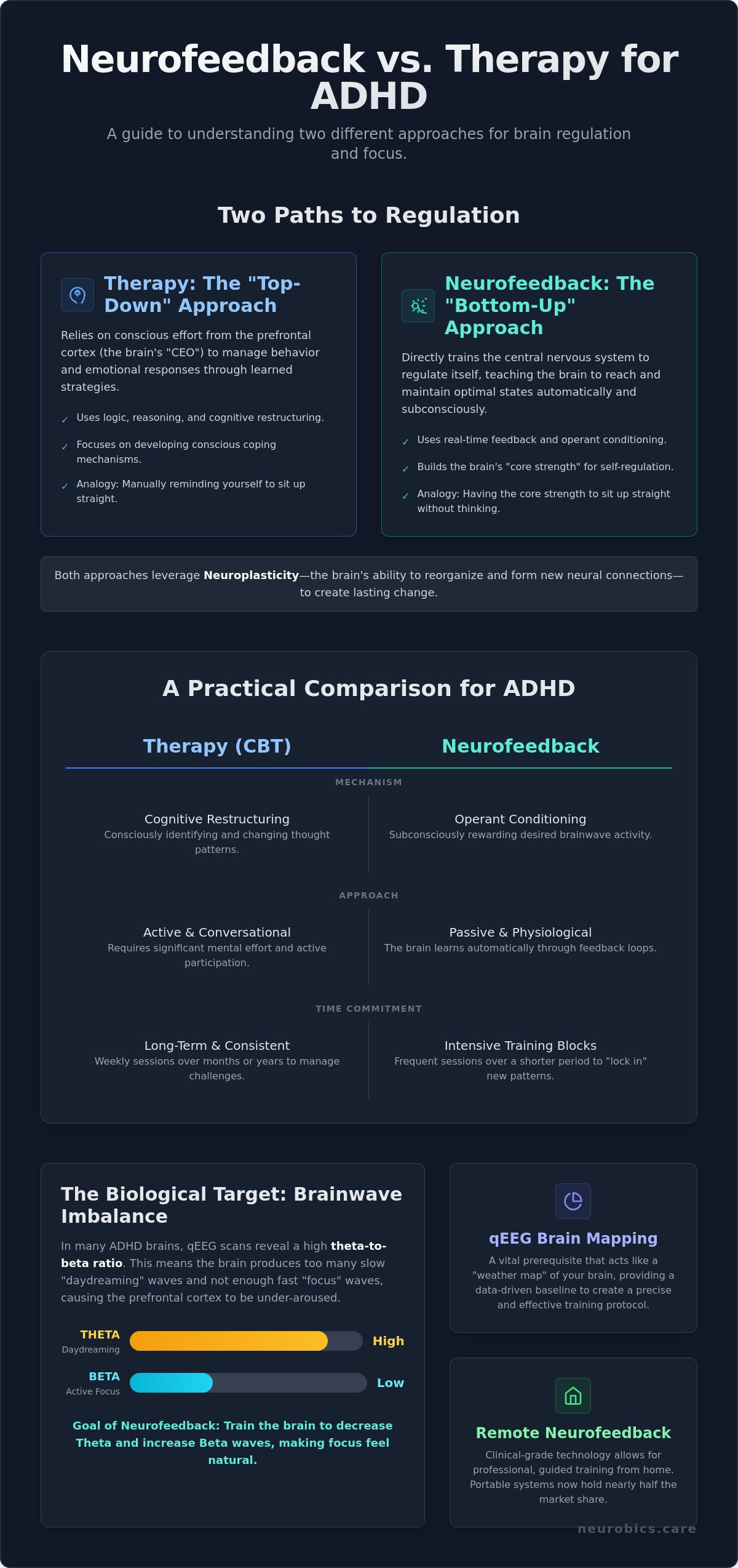
Therapy typically functions as a “top-down” approach. It relies on the prefrontal cortex to use logic, reasoning, and consciously developed strategies to manage behavior. You learn to recognize triggers and implement coping mechanisms. On the other hand, Neurofeedback acts as a “bottom-up” intervention. Instead of using effort to change your state, it trains the central nervous system to reach an optimal state automatically. It’s the difference between reminding yourself to sit up straight and having the core strength to do so without thinking. Both methods rely on neuroplasticity, which is the brain’s ability to reorganize itself by forming new neural connections, allowing for lasting changes in how you function.
The Role of the Prefrontal Cortex in ADHD
The prefrontal cortex acts as the brain’s CEO, managing executive functions like planning, focus, and impulse control. In many ADHD brains, qEEG measurements reveal a specific pattern known as a high theta-beta ratio. This means there’s an abundance of slow theta waves, which are associated with daydreaming, and not enough fast beta waves, which drive active concentration. When this ratio is out of sync, the “CEO” is essentially asleep on the job. Neuroplasticity is the brain’s ability to reorganize itself by forming new neural connections. Through targeted training, the brain can learn to reduce this ratio, making focus feel more natural and less like a constant struggle.
Why Traditional Therapy Can Feel Like an Uphill Battle
It’s incredibly frustrating to know exactly what you should be doing but find yourself unable to execute the plan. This “intention-action gap” is a hallmark of biological under-arousal. If your brain is stuck in a sluggish state, even the best organizational tools from a therapist can feel like heavy weights you aren’t strong enough to lift. At Neurobics, we view therapy as an essential set of life skills that works most effectively when the brain is “primed” for learning. By addressing the biological foundation first, the strategies learned in therapy finally have a stable ground to take root, reducing the exhaustion of constantly trying to “out-think” your own biology.
Neurofeedback vs. Therapy: A Practical Comparison for ADHD
Comparing neurofeedback vs therapy for adhd involves looking at two fundamentally different mechanisms of change. Traditional psychotherapy, particularly Cognitive Behavioral Therapy (CBT), operates through cognitive restructuring. This process involves identifying unhelpful thought patterns and consciously replacing them with productive behaviors. It’s an active, conversational journey that requires significant mental effort during every session. In contrast, neurofeedback utilizes operant conditioning. By providing real-time rewards for specific brain wave patterns, it trains the central nervous system at a subconscious level. Evidence from a controlled multicenter study suggests that this direct physiological training can lead to significant improvements in core ADHD symptoms by targeting the brain’s underlying electrical activity.
The time commitment and pace of these interventions also vary. Therapy usually requires weekly sessions over many months or even years to maintain progress and manage life’s evolving challenges. Neurofeedback often works most effectively in intensive training blocks, where the brain receives frequent, consistent feedback to “lock in” new self-regulation patterns. Think of it as the difference between learning a new language through conversation (therapy) and strengthening the neural pathways that allow you to process sound and logic more clearly (neurofeedback). While therapy provides the essential strategies you need to navigate the world, neurofeedback aims to reduce the internal “noise” and biological friction that makes using those strategies feel so difficult. If you’re curious about how these timelines might look for your specific situation, you can reach out to our team for a personalized discussion.
When to Choose Traditional Psychotherapy (CBT)
CBT remains a gold standard for managing the emotional and social complexities that come with ADHD. It’s particularly effective for addressing the “emotional fallout” that often accompanies a late diagnosis, such as low self-esteem, chronic anxiety, or relationship strain. A therapist helps you build external systems, like calendar management and environmental modifications, that provide the structure an ADHD brain lacks. For a deeper look at how these approaches compare for different needs, read Neurofeedback vs. CBT for ADHD: Which Is Right for You?
When to Prioritize Neurofeedback Training
Neurofeedback is often the preferred starting point for individuals who find “effortful” focus nearly impossible despite their best intentions. If you feel that you’ve reached a plateau with medication, or if stimulants are not an option due to side effects, training your brain’s self-regulation can offer a sustainable alternative. The goal here is long-term physiological stability. By improving the brain’s baseline state, you reduce the constant reliance on sheer willpower. This makes it an ideal choice for those seeking a data-driven approach to brain performance that addresses root biological patterns rather than just managing the resulting behaviors.
The Science of Neurofeedback: How It Trains the ADHD Brain
To understand how neurofeedback works, imagine sensors placed gently on the scalp to read the electrical output of your brain in real time. This information is sent to a computer that translates your brain waves into a visual or auditory “reward” loop. When your brain enters a state of calm focus, a movie might get brighter or a game character might move forward. When you drift into a distracted or “noisy” state, the feedback pauses or dims. This immediate response allows your brain to see its own activity and adjust itself. While the comparison of neurofeedback vs therapy for adhd often focuses on the “what,” the science here is about the “how.” You aren’t just learning about focus; you’re experiencing it in a measurable, reinforced way.
This process is frequently described as physical therapy for the brain. Just as a physical therapist uses specific exercises to strengthen a muscle, neurofeedback uses repetition and consistency to strengthen the neural pathways responsible for self-regulation. It isn’t a passive experience, nor is it based on a “placebo” effect or simple belief. The brain learns through physiological reinforcement. It naturally seeks the reward, whether that’s a clear image on a screen or a pleasant tone, and eventually begins to prioritize those efficient brain wave patterns even when the sensors are removed.
Professional oversight is the critical factor that separates clinical-grade neurofeedback from generic “brain games” or self-help apps. In 2026, portable and wearable systems hold 48% of the market share, but the equipment is only as effective as the protocol behind it. At Neurobics, we use qEEG-informed care to ensure the training is tailored to your unique brain signature. This expert guidance ensures you aren’t just playing a game, but engaging in a targeted clinical intervention designed for your specific nervous system needs.
Operant Conditioning: The “Reward” System
The core mechanism of neurofeedback is operant conditioning. Your brain is a pattern-seeking machine that constantly adjusts based on the feedback it receives from its environment. When the “reward” (the movie playing or the rocket flying) is tied to a desired brain state, the brain unconsciously learns to produce that frequency more often. Over several sessions, this unconscious learning starts to feel like a conscious, accessible mental state. You begin to recognize the “feeling” of focus and can return to it more easily during your daily life without the need for external equipment.
Long-Term Potentiation: Making the Changes Stick
The goal of any neurofeedback program is to create lasting change through a process called Long-Term Potentiation (LTP). This is the biological equivalent of “practice makes perfect.” When you repeatedly fire specific neural pathways associated with focus, the connections between those neurons become physically stronger and more efficient. By the end of a dedicated training block, the brain has essentially “rewired” itself to maintain these regulated states independently. If you want to see how these biological changes can support your specific goals, feel free to connect with our specialists to discuss your options.
Why QEEG Brain Mapping is the Deciding Factor
A Quantitative EEG (qEEG) serves as a sophisticated biological weather map for your brain activity. While traditional therapy relies on your ability to describe your internal state, qEEG measures it directly. It records the electrical patterns across different regions, identifying where communication is efficient and where it might be stalled. This baseline measurement is essential because it transforms the conversation around neurofeedback vs therapy for adhd from one of trial and error into a targeted clinical strategy. Without this map, any intervention is essentially a best guess; with it, we have a clear blueprint for change. It allows us to move beyond the “how do you feel” phase and into the “how is your brain functioning” phase.
This mapping process is particularly vital because ADHD isn’t a monolithic condition. Some brains show signs of under-arousal, characterized by excessive slow-wave activity that makes starting tasks feel like moving through molasses. Others exhibit over-arousal, where high-frequency waves create a constant sense of inner restlessness or anxiety. Traditional therapy often treats the symptoms of these states similarly, but their biological origins are opposites. QEEG removes the guesswork that often plagues medication trials or behavioral interventions. By seeing exactly which areas of the brain are dysregulated, we can create a training plan that addresses the root cause of your focus issues rather than just managing the resulting behaviors.
At Neurobics, we believe that understanding your own brain patterns is the first step toward true regulation. This data-driven approach provides a level of clarity that conversation alone cannot reach. It bridges the gap between feeling like something is wrong and knowing exactly how to support your nervous system. When you have an objective map of your neural activity, you no longer have to wonder why certain tasks feel impossible; the evidence is right there in the data.
Personalizing Your Protocol
Data-driven care is at the heart of the Neurobics approach. We use your unique qEEG data to create a tailored training program, typically ranging from 4 to 12 weeks depending on your initial brain patterns. This isn’t a one-size-fits-all solution; your protocol is built to reinforce the specific frequencies your brain needs to find its balance. This level of personalization ensures that every session is moving you closer to your goals for improved executive function. If you’re ready to see what’s happening under the hood, you can explore our At-Home QEEG Brain Mapping services to begin your journey with clinical precision from your own living room.
Measuring Progress Over Time
One of the most rewarding aspects of this process is the ability to see objective evidence of change. Follow-up maps provide a visual comparison of your brain’s activity before and after training, offering proof that your efforts are yielding results. This objective data serves as a powerful motivator, especially for those who have spent years feeling like they were trying harder without seeing lasting progress. It provides a profound psychological benefit, as it validates your experience and shows that your brain is indeed capable of reorganizing itself for better regulation. To get started with your own assessment and take the first step toward a more regulated life, book an intake session today.
Remote Neurofeedback: Professional Care from Your Living Room
The convenience of modern technology has fundamentally changed how we approach brain health. In the past, choosing between neurofeedback vs therapy for adhd often meant committing to dozens of time-consuming clinic visits, which could be a significant barrier for those already struggling with executive function. At Neurobics, we’ve removed this obstacle by bringing clinical-grade technology directly to you. Our remote model involves shipping professional EEG equipment to your door, allowing you to engage in high-level brain training without the logistical burden of travel. This approach addresses the high dropout rates often seen in traditional settings by making the training a seamless part of your daily life.
This isn’t a DIY solution or a generic self-help app. We provide a “Remote Assisted” experience, meaning you’re never training in isolation. Every session is monitored and guided by experts who ensure your protocol remains optimized based on your real-time progress. By combining the precision of a clinical setting with the comfort of your own home, we create a sustainable path toward better regulation. This structure ensures that your journey is professional, data-driven, and deeply personalized to your unique lifestyle and neural needs.
Our programs are designed to be comprehensive. From the initial qEEG assessment to your weekly live support sessions, we provide a clear framework for growth. You’ll have constant access to practitioner expertise, ensuring that the biological training you receive is as rigorous as any in-office treatment. This model allows for the intensive training blocks that research shows are most effective for “locking in” new brain patterns, all while maintaining your existing work and family commitments.
The Advantage of Training in Your Own Environment
Traditional clinical environments can sometimes induce a subtle stress response, which might skew brain wave measurements. When you train in your own living room or office, we capture your brain’s activity in the very environment where you actually need to focus and stay calm. This leads to more authentic measurements and more relevant training outcomes. Consistency is also much easier to maintain when the equipment is always available. You don’t have to worry about traffic or scheduling conflicts, which reduces the friction that often prevents long-term success with behavioral interventions.
Starting Your Journey with Neurobics
Your journey begins with a comprehensive intake process, starting with an at-home or in-office qEEG measurement. For those near our physical locations, such as Neurofeedback Groningen, we offer in-person assessments before transitioning to a remote training block. We provide flexible options to suit different needs, including our 4-week prepayment plan or annual subscriptions for long-term maintenance and peak performance.
Each week, you’ll receive live support and data reviews to track your evolution. This ensures that as your brain patterns change, your training adapts with them. If you’re ready to explore how this professional, home-based approach can support your specific needs, feel free to contact us to see if remote neurofeedback is right for your ADHD journey. We’re here to help you navigate the biological side of focus with clarity and expert care.
Empowering Your Brain’s Natural Capacity for Regulation
Deciding on the right path between neurofeedback vs therapy for adhd is ultimately about understanding which layer of your nervous system requires the most attention right now. While behavioral therapy offers vital strategies for managing daily life, neurofeedback addresses the underlying biological rhythms that often make those strategies feel out of reach. By integrating both approaches, or prioritizing the physiological foundation first, you can reduce the exhaustion of “trying harder” and start working with your brain’s natural patterns rather than against them.
At Neurobics, we combine over 15 years of clinical expertise with professional, qEEG-informed remote protocols to ensure your training is precise and effective. Our status as a registered provider with NFG and RBCZ reflects our commitment to quality assurance and expert-led care. We believe that lasting change starts with a clear, data-driven understanding of your own unique neural signature. If you’re ready to move beyond coping mechanisms and toward true regulation, Book a QEEG Brain Mapping Assessment with Neurobics today. A more focused, balanced life is within your reach, and we’re here to help you navigate the way.
Frequently Asked Questions
Is neurofeedback better than CBT for ADHD?
Neither approach is objectively “better” because they address different layers of the ADHD experience. Cognitive Behavioral Therapy (CBT) focuses on top-down regulation, teaching you conscious strategies to manage behavior and emotions. Neurofeedback provides a bottom-up intervention, training the brain’s biological foundation to reach a focused state more naturally. When considering neurofeedback vs therapy for adhd, many clients find that the two are most effective when used together, especially when combined with specialized clinical support from A and J Behavioral Health for children and adolescents.
How many sessions of neurofeedback are needed for ADHD?
Most individuals require between 20 and 40 sessions to achieve lasting physiological changes in brain wave patterns. At Neurobics, we typically structure these into intensive blocks, such as our 4-week prepayment program, to build momentum and reinforce new neural pathways. The exact number depends on your initial qEEG brain map and how quickly your nervous system adapts to the feedback loops.
Can neurofeedback replace ADHD medication?
Neurofeedback is a training method for self-regulation and is not a medical substitute for prescription medication. It’s a non-invasive tool that helps the brain function more efficiently on its own. While we don’t provide medical advice, many of our clients find that improved biological regulation allows them to consult with their physicians about potentially adjusting their medication levels or managing side effects more effectively.
What are the side effects of neurofeedback for ADHD?
Side effects are uncommon and generally mild, often described as a sense of mental fatigue similar to the feeling after a long study session. Some individuals might experience a temporary headache or slight restlessness if the protocol is too demanding. Because our remote assisted neurofeedback is guided by experts, we monitor your data closely and adjust the training in real time to ensure the process remains comfortable and productive.
Is at-home neurofeedback as effective as in-clinic sessions?
At-home training is just as effective as in-clinic sessions when it utilizes clinical-grade hardware and professional oversight. In 2026, modern home sensors have achieved high levels of parity with traditional clinic equipment. Neurobics ships the same professional technology used in offices to your door, ensuring that your remote training is backed by the same clinical precision and expert guidance you’d receive in person.
Does insurance cover neurofeedback for ADHD?
Insurance coverage for neurofeedback remains inconsistent in 2026, and many providers still categorize it as an out-of-pocket expense. However, many clients successfully use Health Savings Accounts (HSA) or Flexible Spending Accounts (FSA) to fund their programs. Since Neurobics practitioners are registered with NFG and RBCZ, we recommend checking with your specific provider to see if “biofeedback” or “neurotherapy” services are eligible for reimbursement under your plan. For healthcare facilities navigating these administrative challenges, HPC Healthcare Partners provides specialized medical and mental health billing services.
What happens during a QEEG brain mapping session?
During a qEEG session, a specialized cap with sensors is placed on your scalp to record the electrical activity of your brain. The process is entirely passive and painless; the sensors only “listen” to your brain waves without sending any current into your body. This data creates a visual “weather map” of your brain, identifying specific patterns of dysregulation that we use to build your personalized training protocol.
Can adults benefit from neurofeedback as much as children?
Adults can benefit from neurofeedback just as much as children because the brain maintains its plasticity throughout adulthood. While a child’s brain might sometimes reorganize more quickly, adults often bring a higher level of motivation and awareness to the process. Many adults report significant improvements in executive function and a reduced need for heavy coping mechanisms after completing their personalized Neurobics program.
