


What if the key to managing your focus wasn’t found in a five-minute questionnaire, but in the unique electrical rhythms of your own brain? For many of the 404 million adults globally living with symptomatic ADHD, the traditional diagnostic process can feel remarkably thin. You might feel misunderstood by practitioners who rely solely on subjective checklists, leaving you uncertain about which treatments will actually work for your specific neural makeup. It’s exhausting to follow one-size-fits-all advice when your internal experience tells you there’s more to the story.
A qeeg assessment for adhd changes this narrative by providing a data-driven blueprint of your brain activity. At Neurobics, we use this objective brain map to move beyond labels and validate your experiences through science. This assessment doesn’t just identify patterns; it creates a clear, personalized path forward for remote neurofeedback training. We will explore how we translate complex brainwave data into a practical plan for self-regulation, helping you build the mental capacity for a more balanced life.
Key Takeaways
- Learn why a qeeg assessment for adhd offers a more objective view of your brain’s unique activity than traditional checklists alone.
- Understand the specific brainwave patterns, such as the Theta/Beta Ratio, that act as a scientific fingerprint for focus and attention.
- Discover why personalized protocols are essential for safe training and why generic neurofeedback apps often fall short.
- Explore how Neurobics brings clinical-grade technology into your home through a guided, remote brain measurement process.
- See how these data-driven insights provide a clear blueprint for a neurofeedback program tailored to your unique mental capacity.
What is a QEEG Assessment for ADHD?
Think of QEEG as a high-resolution map for the mind. While a standard EEG records the raw electrical activity of the brain, Quantitative electroencephalography (QEEG) takes that information and processes it through sophisticated algorithms. This allows us to compare your unique neural rhythms against a large database of healthy peers. It’s essentially the difference between looking at a blurry, black-and-white photograph and a 4K digital scan. A QEEG is a non-invasive measurement of electrical activity across 19 or more points on the scalp.
It’s vital to understand how we use this tool at Neurobics. In a clinical setting, a qeeg assessment for adhd identifies specific neural patterns associated with focus, impulsivity, and attention. However, we don’t use this data for medical diagnosis. Instead, we use these insights as a precise guide for your training protocols. It’s the “GPS” that tells us exactly where your nervous system needs support to reach its full potential, ensuring your journey toward better self-regulation is based on facts rather than guesswork.
Moving Beyond Subjective ADHD Checklists
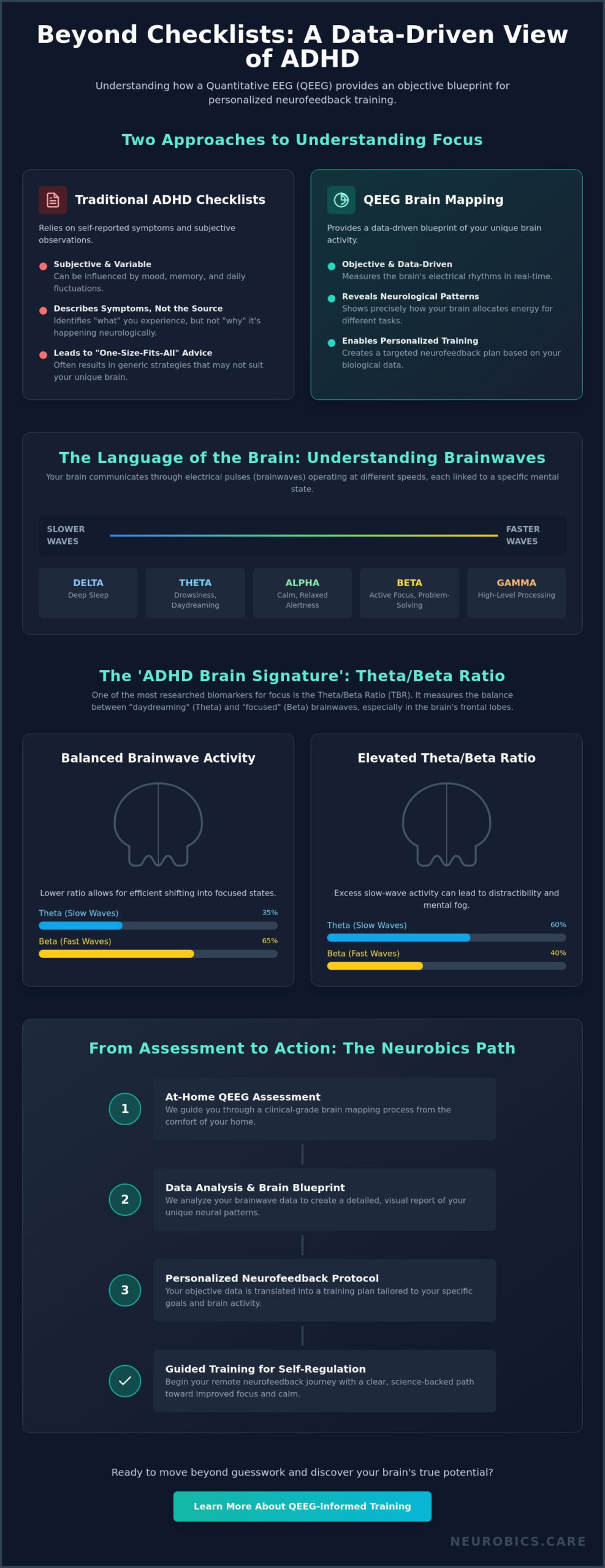
Most people seeking help are used to filling out long forms and questionnaires. These checklists are helpful, but they’re often influenced by how you’re feeling that day, your memory of recent events, or even personal bias. They describe the symptoms, not the source. By contrast, brain mapping provides a biological window into real-time functioning. When you see your internal experiences reflected in a visual map, it often brings a profound sense of validation. You’re no longer just “distracted”; you’re seeing exactly how your brain manages its energy and where the bottlenecks occur.
The Role of Brain Mapping in Neurobics Programs
This assessment serves as the essential foundation for our 4-week and 12-week programs. We don’t believe in “blind” training. During your intake session, we align this objective data with your personal goals, whether that’s better sleep or improved focus at work. For those interested in the technical side of how we achieve this remotely, our At-home QEEG brain mapping pillar details the clinical precision we bring directly to your living room. It’s a partnership where modern technology meets human-centered care, providing a clear path forward that’s as unique as your brain itself.
The Science: Visualizing the ‘ADHD Brain Signature’
Our brains communicate through electrical pulses called brainwaves. These waves operate at different speeds, or frequencies, each associated with a specific state of mind. Delta waves are the slowest, typically occurring during deep sleep, while Theta waves appear during drowsiness, creativity, or deep relaxation. Alpha waves represent a calm, “idling” state of relaxed alertness. When we need to focus, solve problems, or engage in active conversation, our brains produce fast-wave Beta. Finally, Gamma waves handle high-level information processing and “binding” different thoughts together.
When we conduct a qeeg assessment for adhd, we’re looking for how these frequencies distribute across different regions of the brain. In many cases, we find what’s often referred to as a “brain signature.” This isn’t a sign of a “broken” brain; rather, it’s an imbalance in how the nervous system allocates its electrical energy. Research into the Utility of QEEG in ADHD Diagnosis and protocol development suggests that these patterns are measurable and provide a scientific foundation for personalized training. By visualizing these rhythms, we can see why certain tasks feel effortless while others feel nearly impossible.
Understanding Theta/Beta Ratios
In many ADHD brains, the ratio of slow-wave Theta to fast-wave Beta is significantly higher than in neurotypical brains. This specific metric, known as the Theta/Beta Ratio (TBR), is one of the most widely researched biomarkers in neurofeedback. When Theta is too high in the frontal lobes, it’s like the brain is trying to perform complex tasks while stuck in a “sleepy” or daydreaming state. This imbalance often correlates with symptoms like distractibility, impulsivity, and difficulty starting tasks. Measuring this ratio through a qeeg assessment for adhd is the essential first step in creating a training plan that helps the brain shift into more productive states.
Brain Waves and Daily Life
At Neurobics, we use mapping to differentiate these types, ensuring we don’t accidentally over-stimulate an already anxious brain or under-target a foggy one. If you’re curious about which neural profile matches your daily experience, you can reach out to our team to discuss how brain mapping might provide the clarity you’ve been seeking. This objective data allows us to move away from the frustration of “trying harder” and toward the precision of training smarter, building the mental capacity you need for a more balanced life.
Why Personalization Matters: QEEG vs. Generic Protocols
You might wonder if a generic neurofeedback app can provide the same benefits as a clinical program. It’s a fair question. The market is full of wearable devices promising better focus with a few taps on a smartphone screen. However, these tools often use “blind” protocols. This means they apply the same training to every user regardless of their underlying brain state. This approach ignores the fundamental reality that your nervous system is unique. Training your brain without a map is like trying to navigate a new city without a GPS; you might move, but there’s no guarantee you’re heading in the right direction.
A professional qeeg assessment for adhd removes this guesswork. Without this objective data, you risk training the wrong area of the brain or reinforcing a frequency that actually makes your symptoms worse. For instance, if your ADHD is characterized by an overactive nervous system, a generic protocol designed to “boost” activity might leave you feeling more anxious or restless. At Neurobics, we use your map to identify the specific neural bottlenecks that prevent you from reaching a state of flow. We target the source, not just the symptoms.
The Danger of One-Size-Fits-All Training
Every nervous system has its own baseline. What works for one person’s ADHD might increase anxiety or irritability in another. By using a qeeg assessment for adhd, we ensure we’re rewarding the right brainwave patterns for your specific physiology. This precision is what allows for true, lasting neurofeedback for ADHD success. We don’t just want change; we want the right kind of change for your lifestyle and goals. Personalized training ensures that your efforts result in a more balanced, regulated state of being rather than just more mental noise.
Expert Support and Protocol Refinement
Data is only as good as its interpretation. Our Dutch-registered practitioners (NFG/RBCZ) don’t just hand you a chart; they provide an oral report that makes the science actionable. We translate the complex graphs of your brain map into a language you can use for your own growth. This isn’t a static document. Your map serves as a one-time investment that guides your training for the entire year, but we refine your protocol during weekly live sessions. This ensures the training stays aligned with your real-world progress. We look at how you’re sleeping, how your mood is shifting, and how your focus is improving to make sure the technology is serving your long-term well-being.
What to Expect: The At-Home QEEG Assessment Process
Transitioning from a clinical setting to the comfort of your home is a hallmark of the Neurobics experience. Traditionally, obtaining a qeeg assessment for adhd required traveling to a specialized facility, often located in major metropolitan areas. We’ve removed that barrier by bringing clinical-grade technology directly to you. Our remote model is designed for individuals who value both scientific precision and the ease of a familiar environment. It’s a streamlined process that prioritizes your comfort without compromising on data quality.
The journey begins when we ship a professional-grade EEG cap and the necessary recording equipment to your door. Once it arrives, you’ll schedule a remote-guided session with one of our practitioners. During this live video call, we’ll walk you through the setup to ensure a high-quality signal. This step is crucial; we don’t leave you to figure out the technicalities alone. We monitor the data in real-time to ensure every sensor is reading your neural activity accurately, providing the same level of oversight you’d find in a physical clinic.
During the recording, we’ll ask you to alternate between an “eyes open” and “eyes closed” state. This isn’t just a rest period. By comparing these two states, we can see how your brain shifts gears. Does your frontal lobe produce too much slow-wave activity when you try to focus? Does your nervous system struggle to “quiet down” when your eyes are closed? These dynamics provide the raw data for your personalized training plan, identifying the specific areas where your self-regulation needs support.
Preparing for Your Brain Measurement
To get the most accurate results from your qeeg assessment for adhd, a few simple preparations are necessary. We recommend washing your hair thoroughly to ensure good contact between the sensors and your scalp. Avoiding caffeine for a few hours before the session is also important, as stimulants can temporarily alter your brainwave patterns and mask your natural baseline. Choosing a quiet, distraction-free space helps us capture your authentic neural activity without external interference. While our remote model is available internationally, we also offer in-person options in major European cities for those who prefer a face-to-face experience.
The Oral Report: Understanding Your Results
After the data is processed, we’ll meet for a follow-up oral report. You’ll see colored “head maps” that visualize your brain’s electrical landscape. We translate complex Z-scores, which measure how far your activity deviates from the norm, into plain English. We explain exactly what these deviations mean for your daily life and how they inform your first 4-week training block. This report is the bridge between raw data and your first step toward better self-regulation. If you’re ready to see the data behind your focus, you can book your at-home brain measurement today to start your journey.
From Assessment to Action: Starting Your Neurofeedback Journey
Completing your qeeg assessment for adhd marks the transition from feeling misunderstood to having a clear, data-driven blueprint for change. We view this moment as “Day 1” of a structured journey toward better self-regulation. This map isn’t a static diagnostic label that stays in a drawer. Instead, it’s the foundation for every training session that follows. By identifying your brain’s specific electrical patterns, we move beyond generic advice and target the actual neural mechanisms that lead to “ADHD paralysis” or emotional volatility. It’s about replacing frustration with a methodical, science-backed plan.
The goal of this process is to give you back a sense of agency over your own mind. When you understand the “why” behind your focus challenges, the “how” of training becomes much clearer. The insights from your qeeg assessment for adhd are immediately integrated into your training protocol, ensuring that every minute you spend in a session is optimized for your unique physiology. This approach values your time and prioritizes long-term well-being over quick, temporary fixes. It’s a partnership where technology serves your personal growth.
Choosing the Right Program for Your Goals
Your assessment results will help us determine the most effective path forward for your specific needs. For some, a focused 4-week training block provides the necessary reset to jumpstart their progress and improve immediate focus. Others find that a more comprehensive 12-week program allows for deeper, more resilient shifts in nervous system regulation. We also offer an annual subscription for those who want to make brain training a consistent pillar of their mental performance routine. To help you plan your journey, you can explore our guide on neurofeedback therapy cost, which details the value and expected outcomes of each option.
Contact Neurobics for a Professional Consultation
We understand that starting a new training program is a significant decision for you and your family. You aren’t just using a device; you’re entering a partnership with experts who have over 15 years of experience in the field. Led by R.S. Verment, our team at Neurobics is dedicated to providing internationally relevant, expert-led care that bridges the gap between clinical science and your daily quality of life. We invite you to reach out with any questions about your specific situation or how the remote mapping process works.
The first step toward a more regulated mind is simply gathering the facts about how your brain functions. Whether you’re struggling with burnout, focus, or the daily frustrations of ADHD, we’re here to help you navigate the path to improvement with clarity and support. Book your intake assessment or contact our team today to discover what your brain map can reveal about your potential.
Empowering Your Brain’s Natural Capacity for Focus
Navigating ADHD doesn’t have to be a journey of trial and error. By moving beyond subjective checklists and embracing the objective insights of a qeeg assessment for adhd, you gain the clarity needed to build a more regulated life. This process isn’t just about identifying patterns; it’s about creating a personalized blueprint that respects your brain’s unique physiology and your specific goals for focus and emotional balance. You’re no longer guessing which strategies might work; you’re following a map designed for your specific nervous system.
At Neurobics, we combine home-delivered, clinical-grade EEG technology with over 15 years of clinical neurofeedback expertise. Our practitioners, registered with the Dutch Healthcare Federation (NFG), are dedicated to ensuring your training is safe, effective, and tailored to you. You deserve a path forward that’s built on science and supported by experienced professionals who understand the complexities of the human brain. We prioritize your long-term growth by translating complex data into practical, life-changing results.
Take the first step toward understanding your brain’s unique rhythms and unlocking your full potential. We’re here to guide you through every stage of the process, from the initial measurement to your first breakthrough in self-regulation. Book Your Personalized QEEG Assessment & Intake Session today and start your journey toward a calmer, more focused future. It’s time to work with your brain, not against it.
Frequently Asked Questions
Is a QEEG assessment the same as a medical ADHD diagnosis?
No, a qeeg assessment for adhd is not a standalone medical diagnosis. While the FDA has cleared certain QEEG based devices as diagnostic aids for children and adolescents, they’re intended to supplement a complete clinical evaluation. At Neurobics, we use this data as a functional blueprint to guide your training protocols rather than to provide a medical label. Our focus is on helping you understand and improve your brain’s self-regulation.
Can I perform a QEEG assessment on myself without a professional?
You can’t accurately perform this assessment on your own. Clinical precision requires precise sensor placement and the ability to distinguish between actual brainwaves and “artifacts” like muscle tension or eye blinks. Our practitioners guide you through the process remotely in real-time to ensure the data is clean. Interpretation also requires comparing your results against a normative database, which is a task for a trained expert.
How long does a QEEG brain mapping session take at home?
A typical at-home session usually takes between 60 and 90 minutes. This timeframe includes setting up the specialized EEG cap, ensuring a high-quality signal, and recording data in both eyes-open and eyes-closed states. We move at a megasured pace to ensure you feel comfortable and the data is accurate. This thoroughness is essential for creating a training plan that truly reflects your unique neural patterns.
Will my insurance cover the cost of a QEEG assessment for ADHD?
Insurance coverage for a qeeg assessment for adhd is inconsistent and depends on your specific provider. While some plans may cover neurofeedback under CPT code 90901, many individuals pay out of pocket. It’s often possible to use Health Savings Accounts (HSA) or Flexible Spending Accounts (FSA) for these services. We recommend contacting your insurance company directly to verify if they support QEEG informed brain training under your current policy.
Is the QEEG assessment safe for children with ADHD?
Yes, the assessment is completely safe, non-invasive, and painless for children. The EEG cap only records the electrical activity your brain is naturally producing; it doesn’t send any electricity or stimulation into the head. Most children find the process quite interesting because they get to see a visual representation of their brainwaves. It’s a gentle way to provide them with scientific validation of their internal experiences.
What happens if my QEEG scan doesn’t show typical ADHD patterns?
It’s important to remember that there’s no single “ADHD brain.” While many show a high Theta/Beta ratio, others might present with different patterns like excessive Alpha waves or focal hotspots. If your scan doesn’t show “typical” markers, it doesn’t mean your struggles aren’t real. The map simply reveals your unique neural signature, which still allows us to identify the specific bottlenecks in your self-regulation and customize your training.
Do I need to stop my ADHD medication before the QEEG assessment?
You generally don’t need to stop your medication, but you must consult your prescribing physician before making any changes. We typically want to see how your brain functions in its everyday state. Knowing which medications you’re taking allows our practitioners to interpret the data correctly. We focus on how your nervous system regulates itself within the context of your current treatment plan and daily life. If you’re also looking for data-driven ways to optimize your medication, you can check out MedGenyx to learn how genetic testing can help identify the most effective treatments for your biology.
How often should I repeat the QEEG assessment during my training?
Most clients only need one assessment to guide their entire training journey. We don’t repeat the scan unless there’s a significant change in your goals or we need to refine a protocol after a long period of progress. For the majority of our 4-week and 12-week programs, the initial map provides a reliable and sufficient guide. We prioritize steady, consistent training over frequent re-mapping to ensure you see lasting results.
