


What if the most sophisticated brain training wasn’t found in a sterile clinic across town, but in the quiet of your own living room? Many people seeking better focus or deeper sleep feel trapped between two extremes. You might be exhausted by the thought of a long commute to a specialized center, yet skeptical of simple meditation headbands that lack clinical depth. It’s a valid concern, especially when you want the certainty of professional neurofeedback at home without the fear of training your brain incorrectly or without expert guidance.
We believe that your mental well-being deserves more than a one-size-fits-all gadget. You shouldn’t have to choose between the convenience of your home and the excellence of a clinical setting. It’s now possible to access the same expert-led protocols and high-grade technology used in top-tier facilities from your own couch. This approach ensures you’re guided by real data rather than guesswork, providing a sense of security and professional oversight throughout your journey toward better self-regulation. Just as you would expect expert results when you visit Nadirah London Beauty Clinic & Academy, our remote neurofeedback brings clinical-grade oversight to your own living room.
In this guide, we’ll explore how Neurobics uses QEEG-informed care to create personalized training plans for your unique nervous system. You’ll learn how remote assisted neurofeedback delivers measurable results for sleep, anxiety, and focus. We’ll also explain how you can benefit from professional equipment and clinical expertise without the burden of a permanent purchase or the stress of a clinic commute.
Key Takeaways
- Understand the critical differences between basic consumer meditation headbands and clinical-grade remote neurofeedback systems.
- Learn why a QEEG brain map is the essential first step for identifying your unique brainwave patterns and ensuring personalized care.
- Discover how to access professional neurofeedback at home using medical-grade equipment and expert-led protocols.
- Explore the seamless remote workflow that brings a professional lab setup and clinical oversight directly to your door.
- See how Neurobics combines decades of clinical experience with the flexibility of home-based training for better focus, sleep, and regulation.
Defining Professional Neurofeedback at Home: Beyond the Consumer Headband
The surge in wearable technology has created a bit of a misunderstanding about what it actually takes to change brain patterns. While many people start their journey with consumer-grade meditation headbands, these tools are fundamentally different from a clinical service. To understand What is Neurofeedback? in a professional context, one must look past the hardware and focus on the protocol and the practitioner. True professional neurofeedback at home isn’t just a gadget you buy; it’s a remote-assisted clinical service that brings medical-grade precision into your daily routine.
The evolution of EEG technology has been remarkable. Just a decade ago, high-fidelity brainwave monitoring required bulky amplifiers and a room full of wires. Today, we use sophisticated sensors that maintain a high signal-to-noise ratio while remaining portable. This allows Neurobics to provide clients with clinical excellence without the need for frequent office visits. This shift to remote-assisted neurofeedback means the clinician remains the architect of your progress. They analyze your data, set the goals, and watch for signs of progress or fatigue, ensuring you aren’t left to guess if you’re doing it right. This modernization of clinical delivery is part of a broader trend in the medical sector, where specialized firms like healthcarebizbrokers.com support the growth and transition of healthcare-related businesses.
The Three Pillars of Professional Remote Training
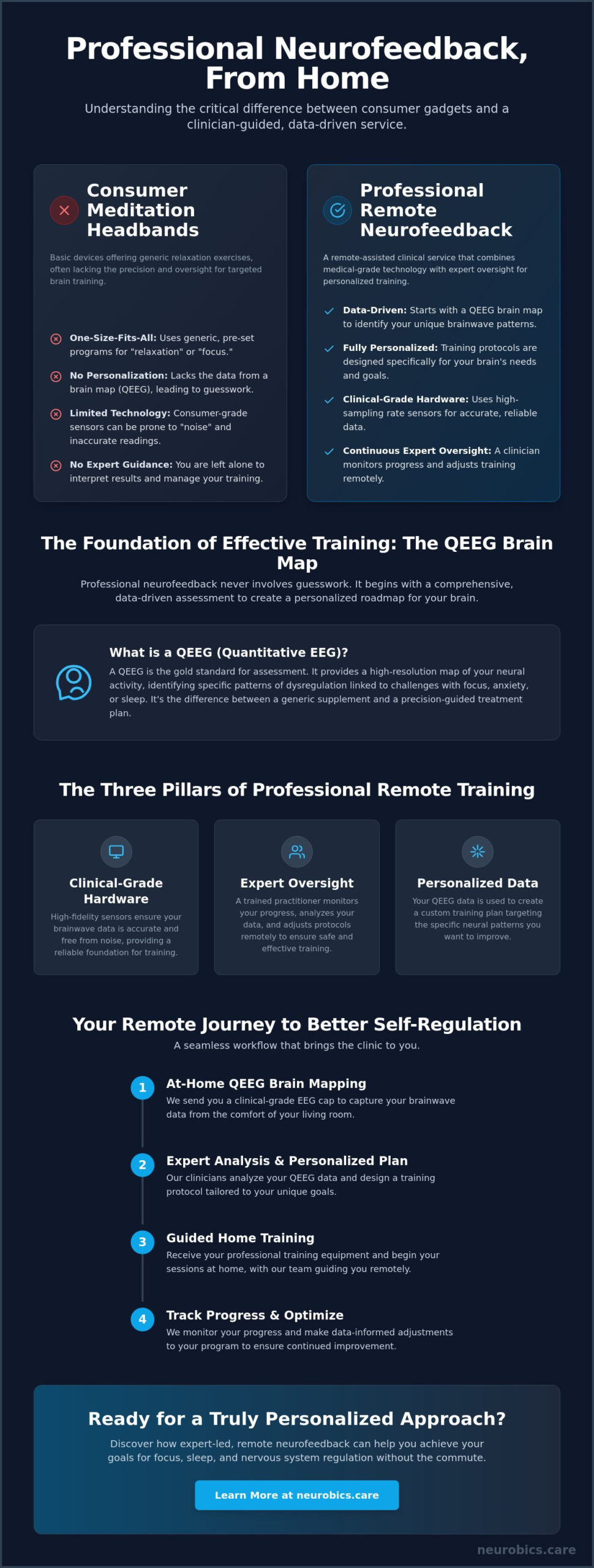
Clinical-grade hardware is the first pillar. Unlike consumer Bluetooth devices that often struggle with “noise” from muscle movement, professional systems use high-sampling rate sensors to ensure the data is accurate. The second pillar is expert oversight. A practitioner monitors your progress remotely, adjusting the training thresholds as your brain learns. Finally, everything is built on personalized data. Professional training doesn’t use generic “relaxation” settings. Instead, it uses protocols designed specifically for your brain’s unique signature, ensuring every session is purposeful and safe.
Who Benefits Most from a Professional Home Model?
This model is particularly effective for those managing ADHD or anxiety, where consistency and frequency are vital for lasting change. Training three or four times a week at home often yields better results than once a week in a clinic. High-performance professionals also find this approach invaluable; it allows for cognitive optimization without the time-drain of a commute. Additionally, it serves as a vital bridge for clients in remote areas who otherwise wouldn’t have access to world-class neurofeedback experts. If you’re curious about whether this model fits your lifestyle, you can always reach out to us at Neurobics to discuss your specific goals.
The Role of QEEG: Why Professional Home Training Starts with a Brain Map
If you’ve ever wondered why some brain training feels effective while others seem like a placebo, the answer usually lies in the assessment. A Quantitative EEG (QEEG) is often referred to as the gold standard in the clinical applications of neurofeedback. Rather than simply guessing which areas of the brain need support, a QEEG provides a high-resolution map of your neural activity. It identifies specific dysregulation patterns, such as an excess of Theta waves in the frontal lobe, which is frequently associated with difficulties in maintaining focus or executive function. This data is the foundation of any successful professional neurofeedback at home program.
At Neurobics, we prioritize this scientific foundation through our at-home QEEG brain mapping process. We don’t believe in generic protocols. By measuring the electrical activity across different regions of your scalp, we can see exactly where your nervous system is stuck in “high alert” or where it’s struggling to engage. This assessment transforms raw electrical data into a customized roadmap, ensuring that every minute you spend training is targeted toward your specific needs. It’s the difference between taking a multivitamin and receiving a precision-guided treatment plan.
From Data to Protocol: The Clinical Advantage
Clinicians use these brain maps to target specific Brodmann areas, which are regions of the cerebral cortex defined by their cell organization and function. There’s a significant difference between “training for a goal,” like better sleep, and “training for a specific brain signature,” such as reducing high-beta activity in the right parietal lobe. While a consumer app might offer a generic relaxation soundscape, a professional protocol adjusts the feedback based on your real-time EEG data. QEEG removes the guesswork from mental health support by providing a clear visual representation of how your brain processes information.
At-Home Assessment Logistics
You might worry that a remote measurement lacks the precision of an in-office session. However, Neurobics facilitates professional brain measurements in your own environment using the same high-fidelity sensors found in top clinics. We ship the necessary hardware to your door and guide you through the setup via a secure video link. Once the data is collected, you receive a detailed oral report. This consultation is vital; it’s where we translate complex graphs into a clear explanation of your brain’s current state and how your personalized protocol will address it. If you’re ready to see what your brain map reveals, you can connect with our team to start the process.
Consumer Apps vs. Clinician-Guided Systems: A Comparison Framework
When you begin exploring brain training, the market often presents two very different paths. On one side, you’ll find sleek, mass-marketed headbands designed for general relaxation. On the other, there are clinical systems intended for professional neurofeedback at home. Understanding the difference between these options is vital because they don’t just differ in price; they differ in the fundamental quality of the data and the safety of the training. To truly understand What Is Neurofeedback Therapy, one must view it as a precise clinical intervention rather than a simple wellness exercise.
The most significant technical hurdle in home training is the signal-to-noise ratio. Your brain’s electrical signals are incredibly faint, measured in microvolts. Consumer gadgets often use simplified sensors that struggle to distinguish between actual brainwaves and “noise” caused by muscle tension or eye blinks. If the equipment provides “dirty” data, the feedback your brain receives is inaccurate. This leads to what we call the “DIY Trap.” Without a clinician to filter this data, you might inadvertently reinforce the wrong neural patterns, potentially increasing the very restlessness or anxiety you’re trying to soothe.
Hardware: Medical Grade vs. Gadget Grade
The hardware is the foundation of your success. Most consumer devices use dry sensors for convenience, but these can often lack the stability needed for deep clinical work. Professional systems often utilize high-impedance sensors that ensure a clean, stable connection. For complex conditions like ADHD, multi-channel recording is essential. It allows us to see how different regions of the brain communicate, a level of detail that single-sensor consumer headbands simply cannot reach. Neurobics prioritizes specific, medical-grade amplifiers for our remote programs because we know that lasting change requires the highest possible data integrity.
Software and Feedback Sophistication
The intelligence of the software is where the clinical advantage becomes clear. Professional platforms allow for “z-score training,” a sophisticated method where your brain activity is compared to a normative database in real-time. This ensures the training is always moving you toward a healthy, balanced state. Consumer apps often rely on generic thresholds that don’t adapt to your specific physiology, leading to a plateau in progress. With a professional system, a clinician monitors your sessions remotely, adjusting these complex thresholds to keep your brain challenged but not overwhelmed. While the cost of professional neurofeedback is higher than a simple app subscription, it’s an investment in clinical outcomes and the peace of mind that comes with expert oversight. If you have questions about which system is right for your needs, you can always reach out to our team for a detailed consultation.
Implementing Professional Training: The Remote Workflow in 2026
The transition from understanding the science to actually starting professional neurofeedback at home is designed to be seamless and supportive. It begins with the arrival of a professional-grade kit, which is essentially a high-end portable laboratory. Unlike consumer gadgets, this equipment includes high-fidelity sensors and specialized amplifiers that ensure clinical-grade data collection. Once you unbox your system, a practitioner guides you through the setup via a live video session. This human connection is vital; it ensures the sensors are placed correctly and that you feel confident in the process from day one.
One of the greatest advantages of the remote model is the ability to train more frequently. In a traditional clinic, most clients only visit once or twice a week due to the constraints of scheduling and travel. However, neuroplasticity, the brain’s ability to reorganize itself, responds best to consistent, repetitive input. Implementing professional neurofeedback at home allows for a training density that most clinics simply can’t match. By training three to five times a week in your own environment, you provide your nervous system with the steady feedback it needs to establish new, healthier patterns more efficiently.
The First 30 Days: Establishing Regulation
The initial month is focused on creating a stable foundation for your remote neurofeedback training. During this period, your brain is learning how to interact with the software and the feedback loop. It’s a phase of gentle discovery where we observe how your nervous system responds to specific protocols. Your clinician is there to support you through the learning curve, reviewing your data after every session to ensure the thresholds remain optimal. You’ll quickly establish a rhythm that fits your life, whether that’s training before work or in the quiet of the evening.
Ongoing Adjustments and Milestones
As your brain adapts and learns, the training must evolve. We don’t stick to a static plan; we use both objective EEG data and your subjective reports on sleep, mood, and focus to refine the protocol. These ongoing adjustments are what distinguish a professional service from a DIY app. We celebrate milestones as they happen, such as a noticeable shift in your ability to stay calm under stress or an improvement in cognitive clarity. Eventually, as these patterns become second nature, we transition from intensive training to a maintenance phase. If you’re ready to begin this structured journey, you can schedule your initial consultation with our expert team today.
Navigating Your Brain Training Journey with Neurobics
Choosing a partner for your brain health is a significant decision that requires a balance of trust and scientific rigor. Neurobics serves as the vital bridge between high-level clinical expertise and the convenience of your own environment. With over 15 years of experience supporting clients internationally, from Dubai to the Netherlands, we’ve refined the process of delivering professional neurofeedback at home. We believe that technology is merely a sophisticated tool; the true value lies in the clinician who guides you. Our human-led philosophy ensures that you’re never just a data point in an app. Instead, you’re a partner in a collaborative process aimed at building long-term nervous system resilience.
We offer both fixed-term and annual program models to accommodate different goals and timelines. Some clients require an intensive four-week reset to address immediate dysregulation, while others benefit from the sustained, rhythmic support of a year-long journey. Unlike companies that focus on hardware sales, we prioritize a service-based model. This ensures you have continuous access to expert analysis and protocol adjustments. It’s a commitment to your progress that extends far beyond the initial setup of the equipment.
Personalized Care for Complex Needs
Our approach is particularly beneficial for those navigating the complexities of ADHD, anxiety, or high-pressure professional environments. Because your dedicated practitioner understands your specific QEEG profile, they can anticipate how your brain might respond to different training phases. This level of personalization is what allows for meaningful shifts in focus and emotional regulation. At its core, Neurobics doesn’t sell “devices,” but rather the clinical “outcomes” that lead to a better quality of life.
Next Steps: Booking Your Intake
The path to a more regulated brain starts with clarity and professional insight. Our intake process is designed to answer your specific questions and determine if our remote model is the right fit for your unique neural signature. You’re invited to explore our 4-week or annual programs to see which structure aligns best with your current lifestyle and goals.
Starting professional neurofeedback at home doesn’t mean you’re training in isolation. You’ll have the security of a clinically backed framework and the expertise of seasoned professionals supporting you every step of the way. Our remote model is built on the same principles of safety and efficacy found in the world’s leading clinics. If you’re ready to move beyond generic wellness apps and experience true clinical excellence, the first step is simple. You can book your intake session today to begin your journey toward lasting mental clarity and balance.
Your Path to Sustainable Self-Regulation
Accessing high-level brain training no longer requires the logistical burden of frequent clinic visits. By choosing professional neurofeedback at home, you’re opting for a model that prioritizes clinical precision and your personal convenience. You’ve seen how a data-driven QEEG assessment provides the blueprint for your progress, and how expert oversight ensures your training remains safe and effective. This isn’t about buying a gadget; it’s about entering a guided partnership designed to help your nervous system find its natural balance.
With over 15 years of clinical experience and professional registration with NFG and RBCZ, Neurobics provides a foundation of trust for your journey. Whether you’re supported through our specialized hubs in Dubai or the Netherlands, you’ll receive a premium global standard of care. We invite you to move beyond generic apps and experience the difference that human-led, evidence-based protocols can make. To begin your journey toward lasting clarity and focus, book your professional QEEG intake assessment with Neurobics today. Your brain has a remarkable capacity for change, and we’re here to help you unlock it.
Frequently Asked Questions
Is professional neurofeedback at home as effective as in-office treatment?
Professional neurofeedback at home is just as effective as in-office treatment when it utilizes clinical-grade hardware and expert-led protocols. Because the technology used in remote programs is now identical to clinic systems, the primary difference is the location. In fact, many clients see faster results at home because they can train more consistently without the stress of a commute.
How do I know if I am using the neurofeedback equipment correctly?
You’ll know you’re using the equipment correctly through a combination of live video guidance and real-time software indicators. During your initial sessions, a Neurobics practitioner monitors your setup to ensure sensor placement is precise. The training software also includes impedance checks that notify you if the signal quality drops, ensuring every session provides accurate data for your brain.
Can I do professional neurofeedback at home without a QEEG brain map?
It is not recommended to begin professional neurofeedback without a foundational QEEG brain map. Without this data, any training would be based on guesswork rather than your unique neural signature. A QEEG ensures your protocols are targeted specifically to your needs, which is a requirement for anyone seeking clinical-level results rather than generic relaxation or simple meditation support.
What kind of support will I receive from Neurobics during my home training?
Neurobics provides comprehensive support throughout your journey, starting with a professional intake and setup session. Your dedicated clinician reviews your training data remotely after each session to track your progress. We maintain regular check-ins to discuss your subjective experiences and adjust your protocols as your brain learns and adapts to the training, ensuring you’re never training in isolation.
Is at-home neurofeedback safe for children with ADHD?
At-home neurofeedback is a non-invasive and safe option for children managing ADHD under professional supervision. Because the sensors only listen to brain activity without emitting any electrical currents, there’s no physical risk to the child. Having a clinician guide the process ensures the training remains age-appropriate and effectively supports the child’s developing nervous system in a comfortable, familiar environment.
Do I need to buy the expensive equipment to start professional home training?
You don’t need to purchase medical-grade hardware to begin your program. Neurobics provides the necessary professional equipment as part of our remote-assisted service models. This allows you to access clinical-grade technology without the high upfront cost of a permanent purchase, making professional neurofeedback at home more accessible while maintaining the highest standards of data integrity and care.
How many sessions per week are required for professional-level results?
For professional-level results, we typically recommend three to five training sessions per week. This frequency is higher than what most people can manage with in-office visits, which is why the professional neurofeedback at home model is so effective. Consistently reinforcing healthy brain patterns helps the nervous system integrate these changes more quickly and deeply over the course of the program.
What happens if my brain patterns change during the course of the program?
As your brain patterns change and your self-regulation improves, your clinician will update your training protocols accordingly. This is a natural part of the neuroplasticity process. We use both your session data and your reported improvements in focus, sleep, or mood to refine the thresholds, ensuring that your brain continues to be challenged and supported as it reaches new milestones.
