


What if the most sophisticated brain training technology isn’t found in a flashy app store download, but in a clinical-grade system shipped directly to your door? If you’ve been searching through remote neurofeedback reviews, you’ve likely noticed a confusing gap between simple meditation headbands and professional, QEEG-guided programs. It’s natural to feel hesitant when traditional treatments haven’t yielded the results you need, especially when you’re looking for lasting changes in focus or sleep. You don’t want to gamble your time on a tool that lacks the clinical depth to support your nervous system properly.
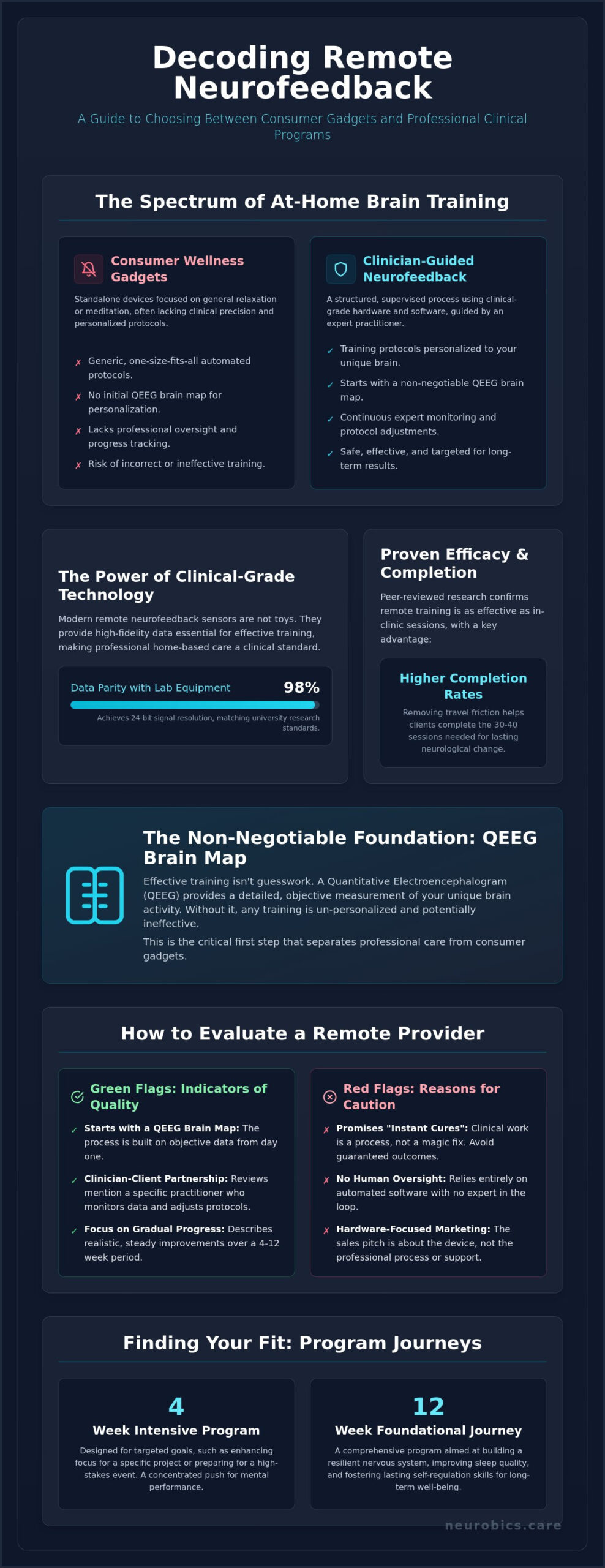
This article will clarify the clinical reality behind the data, helping you distinguish between generic “brain-training” apps and professional, supervised care. We will explore how modern home sensors now achieve 98% parity with university lab equipment and why a personalized QEEG map is the essential foundation for our 4-week and 12-week programs at Neurobics. By the end, you’ll have the evidence-based confidence to choose a path that leads to genuine, long-term neurological growth and better quality of life.
Key Takeaways
- Learn how to interpret remote neurofeedback reviews by distinguishing between professional, supervised protocols and standalone consumer gadgets.
- Discover the peer-reviewed evidence proving that remote, clinician-guided training is as effective as in-clinic sessions, often with higher completion rates.
- Understand why a professional QEEG brain map is the non-negotiable foundation for safe and effective self-regulation training.
- Identify the critical risks of unguided “DIY” brain training and why expert oversight prevents over-training or incorrect protocols.
- Compare the benefits of a 4-week intensive program versus a 12-week foundational journey to find the best fit for your mental performance goals.
Understanding Remote Neurofeedback Reviews: Beyond the Star Ratings
When you browse remote neurofeedback reviews, it is easy to get lost in simple star ratings. However, a five-star review for a meditation headband is not the same as one for a professional clinical program. Remote neurofeedback is a sophisticated, clinically supervised training model rather than just a standalone device you buy from a shelf. It represents a structured process of guided self-regulation. To grasp the foundational principles, it’s helpful to understand What is Neurofeedback and how it uses real-time displays of brain activity to teach self-regulation of brain functions.
In 2026, we see three distinct categories of online feedback. First, there are DIY consumers using basic headsets for general relaxation. Second, app-based users follow generic, automated protocols that lack individualization. Third, and most relevant for those seeking results, are clinically-guided clients who work directly with practitioners. The most valuable reviews come from this third group. They reflect the precision of medical-grade hardware combined with expert oversight, which is the standard we maintain at Neurobics.
The Evolution of At-Home Brain Training
A decade ago, home training was often viewed as a secondary option to in-clinic visits. Today, that hierarchy has dissolved. By 2026, modern home sensors have achieved 98% parity with the equipment used in university research labs, featuring 24-bit signal resolution. This technological leap means you don’t have to sacrifice data quality for the convenience of your own home. Professional remote training has moved from an experimental alternative to a clinical standard. Users now report that the ability to train in a familiar, low-stress environment actually improves their focus and consistency during sessions.
What to Look for in a Trustworthy Neurofeedback Review
Identifying a high-quality provider requires looking past marketing buzzwords. Trustworthy remote neurofeedback reviews usually focus on the process and the partnership rather than just the hardware. You should look for specific indicators of professional care:
- Red Flags: Be cautious of reviews claiming “instant cures” or “guaranteed outcomes.” Clinical work is a process, not a magic fix. If a review sounds like a sales pitch for a miracle, it likely is.
- Green Flags: Look for mentions of a “QEEG” or “Brain Map.” If a provider doesn’t start with a detailed measurement of your unique brain activity, the training isn’t truly personalized.
- The Human Element: Successful reviews often highlight the practitioner-client relationship. Even in a remote setting, having an expert monitor your data ensures that your protocols are adjusted as your brain changes.
Reliable reviews will describe a gradual shift in mental clarity, sleep quality, or stress regulation over a 4-week or 12-week period. This methodical, evidence-aware approach is what separates professional remote assisted neurofeedback from simple wellness gadgets. When the training is grounded in a QEEG-informed protocol, the reviews reflect a journey toward a more balanced and resilient nervous system.
Does Remote Neurofeedback Work? Analyzing the Efficacy Research
The most common question appearing in remote neurofeedback reviews is whether training at home can match the results of an in-clinic visit. Scientific evidence suggests that it can. A 2022 study published in European Child & Adolescent Psychiatry highlighted the feasibility and clinical utility of remote protocols, noting that home-based digital training is both accessible and effective. Interestingly, real-world data indicates that remote programs often boast higher completion rates than traditional clinic-based models. When the friction of commuting is removed, clients are more likely to finish the 30 to 40 sessions required for lasting neurological change.
Skeptics often ask about the placebo effect. This is where objective EEG data becomes vital. Unlike subjective self-help tools, professional remote systems provide a clear window into brain activity. By measuring electrical patterns in real-time, we see physical evidence of change as the brain learns to reach more balanced states. Extensive research on neurofeedback efficacy demonstrates that these shifts aren’t merely psychological; they represent a fundamental strengthening of the nervous system’s ability to self-regulate.
The Role of QEEG in Remote Success Rates
A “one-size-fits-all” approach is the primary reason for poor outcomes and disappointing reviews. At Neurobics, we treat the initial brain map as a non-negotiable GPS for your progress. You wouldn’t start a journey without knowing your starting coordinates; similarly, we don’t begin training without a Quantitative EEG (QEEG). This assessment identifies the specific areas of your brain that require support, ensuring every session is tailored to your unique neural signature. You can learn more about this process in our guide on At-Home QEEG Brain Mapping: Clinical Precision from Your Living Room.
Efficacy Across Different Conditions: From ADHD to Burnout
While the technology is the same, the application varies based on individual needs. For those managing ADHD, the training focuses on stabilizing the brain’s “arousal” levels to improve focus and reduce impulsivity. In cases of burnout or chronic stress, the goal is often to soothe an overactive “fight-or-flight” response. It’s vital to understand that we don’t “cure” conditions in a medical sense. Instead, we provide the brain with the tools it needs to regulate itself more efficiently. This shift toward internal balance is why so many remote neurofeedback reviews emphasize a newfound sense of calm and mental clarity. If you’re ready to see how this evidence-aware approach can support your specific goals, you can connect with our team to discuss the best path forward for your brain health.
Supervised vs. DIY: Why Clinical Guidance Impacts User Outcomes
A significant portion of remote neurofeedback reviews comes from individuals who have experimented with standalone consumer wearables. While these devices are often marketed as “brain training,” they are frequently closer to simplified meditation aids than clinical tools. There is a fundamental difference between a device that provides a generic relaxation sound and a clinical-grade system that adjusts to your specific neural patterns. Without professional oversight, the user is left to interpret complex data on their own, often leading to frustration rather than progress.
The risk of “DIY” neurofeedback is not just about a lack of results; it’s about the potential for training the wrong patterns. If you inadvertently reward a frequency that your brain already has in excess, you might experience increased irritability or disrupted sleep. This is why professional supervision acts as the essential safety net for effective brain training. A practitioner ensures that the protocol remains aligned with your initial QEEG map, making adjustments as your nervous system begins to shift and stabilize.
The Pitfalls of Standalone Neurofeedback Devices
Neurobics does not sell standalone hardware because we believe the clinical eye is indispensable for safety and efficacy. Generic protocols often lead to “non-responder” reviews where the user feels they’ve wasted their investment. Professional supervision is the safety net of brain training. By having an expert monitor your progress, you avoid the common pitfalls of over-training or applying protocols that don’t match your current mental state.
The Value of the Human-in-the-Loop Model
Our model prioritizes weekly live sessions where a professional reviews your data and talks through your experience. These check-ins help translate EEG readings into practical life changes. For those dealing with burnout or anxiety, the emotional support provided by a practitioner is just as important as the technology itself. It’s the difference between feeling confused by a graph and feeling supported on a journey toward better health. You can explore the mechanics of this process in What is Neurofeedback? A Comprehensive Guide. Having a partner in this process ensures that your remote neurofeedback reviews reflect a story of growth rather than a search for missing answers.
How to Evaluate a Remote Neurofeedback Provider in 2026
Selecting a clinical partner for your brain health is a decision that requires more than a glance at remote neurofeedback reviews. While testimonials offer insight into the user experience, they don’t always reflect the technical rigor of the program. To find a provider that offers genuine results, you must look for specific markers of professional accountability. Professional remote training is a clinical service delivered at a distance; it’s not a self-help product. This distinction is vital for your safety and for the eventual efficacy of the training.
Use the following checklist to vet any potential provider before you commit to a program:
- QEEG Requirement: Does the provider insist on a QEEG (Brain Map) before you start? If they offer “standard” protocols without measuring your brain first, they are guessing, not guiding.
- Live Support vs. Automation: Are your sessions purely automated by an app, or are they live-guided? At Neurobics, we prioritize the “human-in-the-loop” model because a practitioner can spot nuances in your data that an algorithm might miss.
- Practitioner Credentials: Check if the lead experts are registered with recognized bodies. For instance, our practitioners are registered with the NFG and RBCZ (Dutch Healthcare Federation), ensuring we meet high standards of clinical care.
- Transparent Pricing: A professional organization will be clear about what your investment covers, including hardware rental, software licenses, and practitioner time.
Transparency in Pricing and Program Structure
The market is often split between low-cost monthly subscriptions and fixed-term intensive programs. Subscriptions frequently offer automated tools with minimal support, while intensive programs, like our 4-week or 12-week options, provide a structured path toward a specific goal. You should expect your package to include the clinical-grade hardware, the specialized software, and the ongoing protocol adjustments based on your progress. For a deeper look at what drives these costs and how to find the best value, read our guide on Neurofeedback Therapy Cost in 2026: A Guide to Value.
Assessing International Support and Equipment Logistics
Since the equipment is shipped to your home, logistics are a critical part of the service. A reputable provider handles global shipping with care and provides technical troubleshooting if a sensor isn’t connecting properly. We offer specialized support across Europe, the UK, and regions like Dubai to ensure our international clients have a seamless experience. Clear return policies and responsive communication are “green flags” that indicate a professional organization. If you want to see how our expert-led approach fits your specific needs, you can book an introductory intake with our team to discuss your goals.
The Neurobics Remote Experience: Expert-Led Brain Self-Regulation
The philosophy at Neurobics is built on the belief that professional clinical precision should not be confined to a physical office. We bring the depth of a specialized clinic into the comfort of your home, ensuring that your environment supports your progress rather than adding to your stress. Many remote neurofeedback reviews highlight the relief of finally finding a program that combines high-fidelity technology with genuine practitioner care. This approach allows you to engage in deep neurological work without the logistical burden of travel, making consistency much easier to achieve.
Our process begins with the At-Home QEEG Brain Measurement. We ship medical-grade equipment directly to you, including the specialized sensors and caps needed to capture a high-resolution map of your brain activity. This isn’t a simplified consumer scan; it is the same level of data we would collect in person. Once we have this “neural blueprint,” we design your protocol. You can choose between our 4-week intensive program, which is ideal for international clients seeking a focused start, or our 12-week foundational program designed for deeper, long-term stabilization.
Beyond Training: Integrating Focus and Sleep
The ultimate goal of our work is to move beyond the training sessions and into a life of better regulation. Our protocols specifically target the modern challenges that drive people to seek remote neurofeedback reviews, such as ADHD paralysis, chronic sleep disturbances, and the cognitive fog of burnout. We draw on over 15 years of practitioner expertise to ensure that every session is meaningful. As you progress, you’ll notice that the “training” starts to become a natural part of how you navigate your day. You aren’t just learning to use a device; you are teaching your nervous system how to return to a state of balance on its own.
Taking the Next Step Toward Better Regulation
Choosing a remote provider is about finding a partner who values your long-term well-being as much as your immediate results. At Neurobics, we prioritize the human element of care, ensuring you feel supported from the initial equipment setup to your final session review. If you are ready to move past generic apps and experience the difference that QEEG-informed, expert-led training can make, we are here to guide you. We invite you to Contact Neurobics for a Professional Consultation to discuss your specific needs and learn which of our programs is the right fit for your journey toward a more resilient brain.
Starting Your Journey Toward Sustainable Mental Clarity
The evolution of at-home technology has made it possible to access world-class brain training without leaving your living room. The most positive remote neurofeedback reviews aren’t just about the hardware; they are a testament to the clinical precision of QEEG-informed protocols and the value of professional oversight. By choosing a program that prioritizes data-driven personalization over generic automation, you ensure that your training is safe, effective, and tailored to your unique nervous system.
Neurobics combines 15+ years of clinical expertise with the convenience of remote care, providing a bridge between advanced neuroscience and your daily life. Our programs are supervised by NFG and RBCZ registered practitioners, ensuring you receive the same level of care you’d expect in a high-end clinic. Whether you are seeking to manage burnout or improve focus, the right support makes all the difference in achieving lasting self-regulation. You don’t have to navigate this process alone.
Book Your Personalized Remote Neurofeedback Intake Today to discover how a structured, expert-led approach can help you reclaim your mental energy and build a more resilient brain. Better regulation is within your reach, and the first step is simply choosing the right partner for your growth.
Frequently Asked Questions
Is remote neurofeedback as effective as in-clinic sessions?
Remote neurofeedback is just as effective as in-clinic sessions when it’s clinically supervised and based on a professional QEEG map. Research indicates that the convenience of training at home often leads to higher completion rates, which is a major factor in achieving results. Modern home sensors have achieved 98% parity with university lab equipment, meaning you don’t lose data quality by training in your own environment.
How do I know if a remote neurofeedback provider is legitimate?
A legitimate provider will always require a QEEG brain map before designing your protocol. You should also verify that the practitioners are registered with professional bodies, such as the NFG or RBCZ. If a provider makes sensationalist claims about “curing” conditions or doesn’t offer live expert support, these are significant red flags to watch for when reading remote neurofeedback reviews.
What kind of results can I expect from a 4-week home program?
A 4-week intensive program is designed to provide initial nervous system stabilization and an introduction to self-regulation. While long-term neurological changes typically require 20 to 40 sessions, many clients report improvements in sleep quality and mental clarity within the first month. It serves as a powerful jumpstart for those seeking to address acute burnout or focus issues before moving into longer-term maintenance.
Do I need to buy my own neurofeedback equipment for the training?
You don’t need to purchase your own equipment when working with a professional provider like Neurobics. We ship clinical-grade hardware directly to your home as part of our structured programs. This ensures you are using high-fidelity sensors that are fully compatible with our specialized software and allows us to maintain the quality of the data we receive from your sessions.
Can remote neurofeedback help with ADHD symptoms in adults?
Remote neurofeedback is highly effective for managing ADHD symptoms by training the brain to maintain optimal arousal levels. Adults often find that consistent training helps improve executive function and reduces the “paralysis” associated with overwhelm. Many remote neurofeedback reviews from our adult clients highlight a significant shift in their ability to stay on task without feeling mentally exhausted by the end of the day.
How does the practitioner monitor my brain activity during a remote session?
Your practitioner monitors your progress using specialized software that captures your EEG data during every session. This information is reviewed before your weekly live check-in, allowing the expert to adjust your protocol as your brain patterns shift. This “human-in-the-loop” model ensures your training remains precise and responsive to your actual physiological changes rather than relying on an automated algorithm.
What happens if I don’t see results from the training right away?
It’s common for neurological shifts to happen gradually. If progress feels slow, your practitioner will analyze your session data to see if your brain is responding as expected or if a protocol adjustment is needed. Success in neurofeedback is built on the cumulative effect of multiple sessions, so we prioritize patience and consistency to help you reach the 30 to 40 session mark where lasting change occurs.
Is professional remote neurofeedback covered by international insurance?
Coverage for remote neurofeedback depends entirely on your specific insurance provider and your geographic location. In the Netherlands, some supplementary insurance packages offer partial reimbursement for sessions led by NFG and RBCZ registered practitioners. International clients should contact their insurer to see if “biofeedback” or “neurofeedback” is included under their specific mental health or alternative therapy benefits.
