


Why does it feel like an uphill battle against your own mind just to stay present for a single hour of work? If you’ve ever felt hijacked by a sudden wave of distraction or emotional reactivity, you’ve likely realized that willpower alone is rarely enough when learning how to improve brain self-regulation. It’s exhausting to constantly force a state of focus that your nervous system isn’t currently wired to sustain. Most of us treat mental discipline as a character trait, yet science shows it’s actually a physiological skill rooted in the electrical efficiency of our brain waves.
At Neurobics, we view this challenge through a different lens. We believe that sustainable mental clarity shouldn’t be a daily struggle, but a reliable state you can cultivate through precise, evidence-aware methods. This guide will help you bridge the gap between basic wellness habits and clinical-grade neuro-optimization. You’ll discover the physiological mechanics behind your cognitive performance and learn how data-driven tools, such as qEEG-informed training, can help you transition from feeling overwhelmed to achieving a state of calm, resilient focus.
Key Takeaways
- Understand that self-regulation is a physiological skill rather than a character trait, involving your brain’s ability to shift fluidly between different electrical frequencies.
- Learn why biological foundations like sleep hygiene and blood sugar stability are essential prerequisites for any successful neuro-optimization strategy.
- Discover how to improve brain self-regulation through a tiered approach that begins with stabilizing the autonomic nervous system using techniques like paced breathing.
- Explore how qEEG brain mapping identifies your unique neural patterns, allowing for a personalized plan that moves beyond generic self-help advice.
- See how professional, remote-assisted neurofeedback helps the brain transition from ‘knowing what to do’ to actually performing in an optimal state of focus and resilience.
What is Brain Self-Regulation and Why Does it Fail?
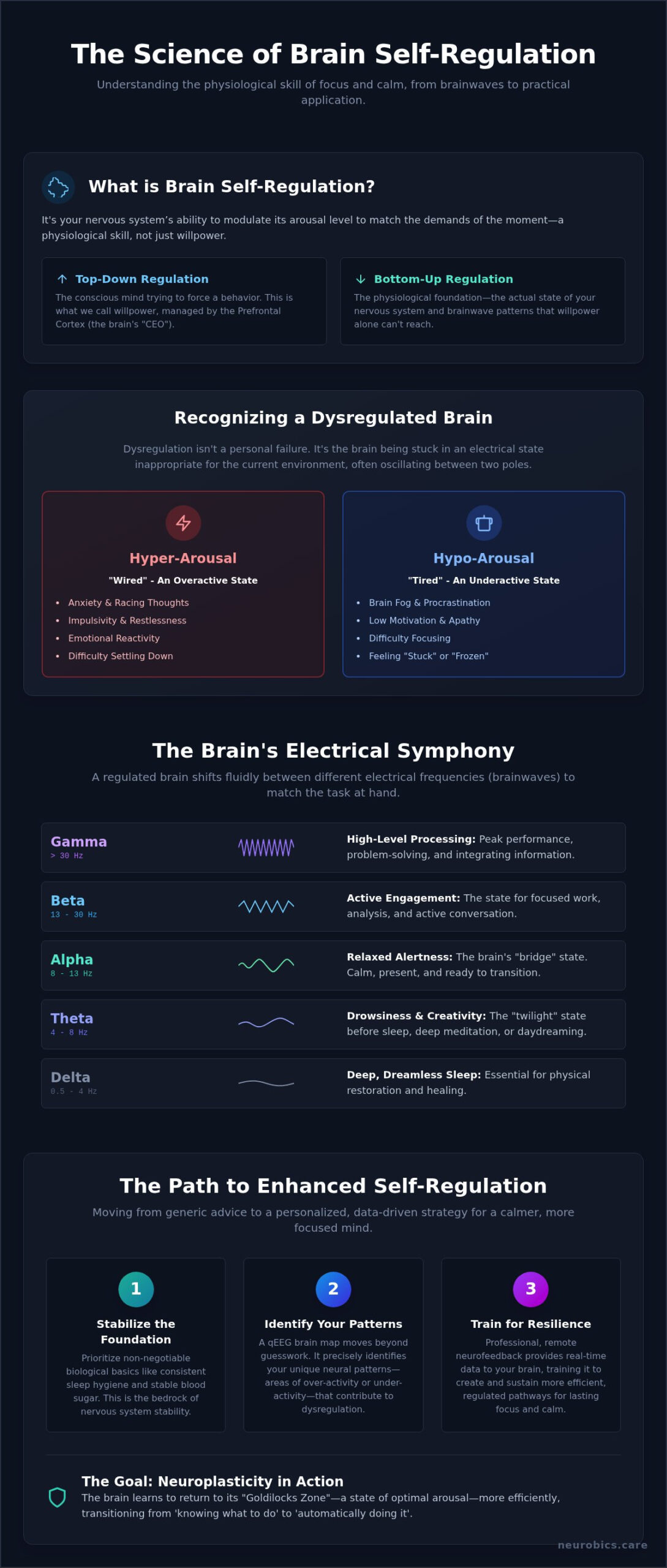
Brain self-regulation is the nervous system’s innate ability to modulate its arousal level to match the demands of the moment. It isn’t just about “staying calm”; it’s about being appropriately engaged. If you’re reading a complex report, your brain needs a specific focused state. If you’re playing with your children, it needs another. When we look at how to improve brain self-regulation, we must distinguish between top-down and bottom-up processes. Top-down regulation is what most people call willpower; it’s the conscious mind trying to force a behavior. Bottom-up regulation is the physiological foundation, the actual state of your nervous system.
The Prefrontal Cortex (PFC) acts as the brain’s “CEO.” It’s responsible for making decisions, managing emotions, and filtering out distractions. However, this CEO can only do its job if the rest of the organization is functioning well. Chronic stress, ADHD, or past trauma can disrupt these circuits, leaving the PFC underpowered and unable to govern effectively. This is why clinical tools like What is Neurofeedback? are so valuable; they address the underlying electrical patterns that willpower alone can’t reach.
The Executive Function Connection
Self-regulation relies on three core executive functions:
- Working memory: The ability to keep goals in mind while performing a task.
- Inhibitory control: The capacity to resist impulses and distractions.
- Cognitive flexibility: The skill to switch between thoughts or tasks fluidly.
When these circuits fail, we often see the “ADHD Freeze.” This isn’t laziness; it’s a state where the brain’s regulatory circuits are so overwhelmed they simply stop processing. You can read more about this in our guide on Understanding ADHD Paralysis.
Signs of a Dysregulated Brain
Dysregulation typically manifests in two ways. Hyper-arousal feels like anxiety, racing thoughts, or impulsivity. Hypo-arousal looks like brain fog, procrastination, or a lack of motivation. Many people find themselves oscillating between these two poles, feeling wired but tired. Dysregulation is often not a lack of effort, but a brain stuck in an inappropriate electrical state for the current environment. Learning how to improve brain self-regulation starts with recognizing these states for what they are: physiological signals rather than personal failures.
The Science of Neuro-Regulation: EEG Waves and Brain States
To understand how to improve brain self-regulation, we must first view the brain as a dynamic electrical organ. Every thought, emotion, and action is powered by electrical impulses firing across billions of neurons. These impulses occur at specific frequencies, measured in Hertz, which we categorize as brain waves. A regulated brain is one that can shift between these frequencies fluidly, much like a car changing gears to match the terrain. When this shifting mechanism becomes rigid or sluggish, we experience the mental inconsistency and exhaustion that many mistake for a lack of discipline.
Researchers studying the mechanisms of brain self-regulation have identified what is often called the “Goldilocks Zone” of neural activity. This is a state where the brain is neither over-aroused nor under-active, but perfectly tuned for the task at hand. Through the power of neuroplasticity, the brain isn’t stuck in its current patterns; it can actually learn to return to this zone more efficiently. By providing the brain with real-time data on its own electrical output, we can encourage the growth of more resilient regulatory pathways over time, effectively teaching the brain how to improve brain self-regulation from the inside out.
Understanding the 5 Types of EEG Waves
Our brain operates across five primary frequencies, each serving a distinct purpose. Delta waves dominate during deep sleep, while Theta is associated with creativity or the “twilight” state before falling asleep. Alpha provides a bridge of relaxed alertness, essential for transitioning between rest and work. Beta is our active, analytical state used for problem-solving, and Gamma handles high-level information integration. In many cases of dysregulation, such as ADHD, we see an overabundance of slow Theta waves in the frontal lobes during tasks that require fast Beta focus. You can find a deeper dive into these patterns in our guide on The 5 Types of EEG Brain Waves Explained Simply.
The Autonomic Nervous System (ANS) Bridge
Self-regulation isn’t confined to the skull; it’s a full-body process. The brain communicates with the body via the Vagus nerve, the primary component of the parasympathetic nervous system. This connection is often measured through Heart Rate Variability (HRV), which serves as a window into your brain’s regulatory health. A high HRV indicates a nervous system that is flexible and ready to recover from stress. This leads us to the concept of the “Window of Tolerance,” which is the range of emotional and physical intensity where we can effectively self-regulate without becoming overwhelmed or shutting down. Understanding where your window currently sits is the first step toward expanding it by exploring your brain’s unique map.
Lifestyle vs. Clinical Interventions: Which Strategy Works Best?
Building a resilient nervous system requires a multi-layered approach. We usually start with the “Big Three” foundations that provide the biological scaffolding for your mind:
- Consistent sleep hygiene: Allowing the brain to clear metabolic waste and consolidate learning.
- Blood sugar stability: Ensuring a steady supply of glucose to prevent “hangry” emotional spikes.
- Daily movement: Utilizing physical activity to regulate neurotransmitter levels and reduce cortisol.
These are the biological prerequisites for health. Without them, your brain lacks the fuel and recovery time it needs to function. For many people struggling with chronic dysregulation, these lifestyle changes feel like trying to paint a house while the foundation is still settling. They’re necessary, but often insufficient on their own to address deep-seated neural patterns that have become hardwired over years of stress or neurodivergence.
When exploring how to improve brain self-regulation, we must distinguish between passive and active strategies. Passive strategies, such as medication or dietary changes, provide external support to the system. Active strategies, like Cognitive Behavioral Therapy (CBT) or neurofeedback, involve training the brain to change its own internal processing. While CBT focuses on the “top-down” cognitive restructuring of thoughts, neurofeedback works “bottom-up” by training the brain’s electrical foundations directly. This physiological training provides the brain with the stability it needs to make psychological progress more permanent.
Why Mindfulness Isn’t Always Enough
Mindfulness is frequently recommended as a primary tool for emotional control. Yet, sitting in silence requires a baseline level of regulation that many people simply don’t have yet. If your brain is stuck in a state of hyper-arousal, attempting to meditate can lead to a “frustration loop” where you feel like you’re failing at being calm. We often view neurofeedback as a vital “pre-meditation” tool. It helps stabilize the brain’s baseline first. This makes later psychological work or mindfulness practices much more accessible and effective for the individual.
The Power of Data-Driven Feedback
The primary challenge with many self-help methods is that they are invisible. You don’t truly know if your effort is changing your brain until weeks or months later. Biofeedback changes this by making your internal physiology visible in real time. While generic brain-training apps offer some engagement, they lack the precision of professional-grade systems informed by a qEEG map. Understanding how to improve brain self-regulation effectively means moving toward clinical oversight and personalized data. You can learn more about the investment required for this level of precision in our guide on Neurofeedback Therapy Cost.
Practical Steps to Enhance Your Brain’s Regulatory Capacity
Developing a more resilient mind requires a structured hierarchy of intervention. We start with biology to provide the foundation, move to psychology to manage the moment, and finally utilize technology to refine the system. Understanding how to improve brain self-regulation involves more than just mental tricks; it requires a systematic approach to your internal environment. One of the most immediate tools at your disposal is paced breathing. By slowing your breath to roughly six cycles per minute, you can stabilize the Autonomic Nervous System in as little as 60 seconds, signaling to the brain that it’s safe to return to a regulated state.
Beyond immediate physiological shifts, we must protect the Prefrontal Cortex (PFC) from digital overstimulation. Modern environments often subject us to a constant stream of high-dopamine inputs that can fatigue our regulatory circuits. Implementing a “dopamine fast” or simply reducing screen time during the first hour of the day allows the PFC to maintain its filtering capacity. This prevents the mental exhaustion that often leads to a total collapse of focus by mid-afternoon. If you’re ready to move beyond these general habits toward a strategy tailored to your specific neural architecture, you can reach out to our team to discuss a personalized training plan.
Developing Metacognitive Awareness
Metacognition is the ability to think about your own thinking. It allows you to label your state before it spirals into a full-blown reaction. A classic but effective check-in is the HALT method. Before making a major decision or reacting to a stressor, ask yourself if you’re Hungry, Angry, Lonely, or Tired. These four states are the most common triggers for neural dysregulation. You can also look for physical cues: a tight chest, shallow breathing, or racing thoughts are early warning signs that your brain is moving out of its “Window of Tolerance.” When you notice these, try a simple grounding exercise, such as identifying five things you can see and four things you can touch, to bring your awareness back to the present moment.
Optimizing the ‘Biological Baseline’
Your brain’s ability to regulate is deeply influenced by its chemical environment. Minerals like magnesium play a role in modulating NMDA receptors, while Omega-3 fatty acids support the fluidity of neural membranes. These nutrients aren’t just for general health; they’re the building blocks of efficient neural transmission. Similarly, exposure to morning sunlight helps set your circadian rhythm, which governs the release of cortisol and melatonin. This is crucial because sleep pressure, the gradual buildup of adenosine in the brain throughout the day, significantly impacts your next-day executive function. Learning how to improve brain self-regulation means respecting these biological rhythms to ensure your brain has the energy it needs to stay in control.
For individuals whose cognitive challenges are linked to deeper physiological stressors like environmental toxins, Sunridge Medical provides advanced medical support to address toxic bio-accumulation and restore the body’s internal balance.
QEEG-Informed Training: The Future of Personalized Self-Regulation
While lifestyle adjustments and immediate grounding techniques provide essential support, they are often applied as one-size-fits-all solutions. To truly understand how to improve brain self-regulation for your specific nervous system, you need visibility into your unique neural architecture. This is where Quantitative EEG (qEEG) comes in. Think of it as a weather map for your brain; it doesn’t just show that it’s “raining” or “sunny” in terms of your mood, but identifies exactly which regions are experiencing electrical turbulence or sluggishness.
Generic advice often fails because it treats every brain as if it has the same requirements. An individual struggling with an overactive, anxious brain requires a fundamentally different training protocol than someone experiencing the low-arousal state of chronic brain fog or procrastination. Without data, any attempt at neuro-optimization is essentially guesswork. Expert guidance ensures that your training is precisely tuned to your needs, shifting your brain from a state of reactive survival to one of proactive regulation. This transition is the key to moving from temporary relief to a permanent shift in cognitive performance.
Why Data-Driven Training Matters
QEEG mapping allows us to identify specific “hubs” of dysregulation where the brain might be stuck in inefficient patterns. Instead of simply masking symptoms with temporary fixes, this data allows for the targeted training of underlying neural circuits. By addressing the root electrical cause of your challenges, you move beyond coping mechanisms and toward lasting change. This level of insight is now available outside of a laboratory setting, making it easier than ever to start your journey. You can explore this process further in our guide on At-Home QEEG Brain Mapping.
Bringing Clinical Precision Home with Neurobics
The tradition of neurofeedback once required frequent visits to a physical clinic, creating a barrier for many who need it most. At Neurobics, we’ve transitioned this clinical precision into a remote model. We provide professional-grade equipment and personalized protocols that you can use from the comfort of your own home. Whether you choose a 4-week intensive or a 12-week comprehensive program, you’re never training alone. Our experts monitor your progress and adjust your protocol based on real-time data. This partnership bridges the gap between “knowing” how to improve brain self-regulation and actually experiencing a more balanced, focused life. To see how professional remote training can fit into your life, visit our At-Home Neurofeedback guide.
Taking the Next Step in Your Neuro-Optimization Journey
Learning how to improve brain self-regulation is a journey that moves from general awareness to precise, data-driven action. We’ve explored how your brain’s electrical frequencies dictate your mental state and why willpower often falls short when your physiology is out of balance. By combining foundational biological habits with targeted neurofeedback, you can move beyond simply managing symptoms and start training your brain for lasting resilience. This shift from reactive coping to proactive training is what allows for sustainable mental clarity and emotional balance.
At Neurobics, we bring over 15 years of clinical expertise directly to your home. Our evidence-based protocols and professional remote guidance ensure that your training is never a matter of guesswork. You don’t have to navigate this complex process alone; expert support is always available to help you interpret your data and refine your approach. If you’re ready to stop guessing and start measuring, we invite you to Book a QEEG Intake Session to Map Your Brain’s Regulatory Patterns. Taking this step provides the clinical clarity needed to unlock your full cognitive potential. A more balanced, focused life is well within your reach.
Frequently Asked Questions
What is the fastest way to improve brain self-regulation in the moment?
Paced breathing is the most effective immediate tool for stabilizing your nervous system when you feel overwhelmed. By slowing your breath to approximately six cycles per minute, you stimulate the vagus nerve and signal the brain to shift from a “fight or flight” state to a regulated one. This physiological shift can happen in as little as 60 seconds, providing the prefrontal cortex with the stability it needs to regain cognitive control over your emotions and focus.
Can neurofeedback permanently improve my brain’s ability to self-regulate?
Neurofeedback facilitates long-term changes by leveraging neuroplasticity, which is the brain’s innate ability to reorganize its neural connections. Unlike temporary interventions, neurofeedback trains the brain to maintain efficient electrical patterns on its own through repeated reinforcement. Once the brain learns how to improve brain self-regulation through this data-driven feedback, these optimized pathways often become the system’s new default setting, leading to lasting improvements in mental performance.
Is brain dysregulation the same as having ADHD or anxiety?
Brain dysregulation is a broad physiological state rather than a specific clinical diagnosis. While conditions like ADHD and anxiety are often characterized by specific patterns of dysregulation, such as an overabundance of slow waves in the frontal lobes, anyone can experience a dysregulated state. Chronic stress, burnout, or lack of sleep can push a healthy brain into a dysregulated pattern where it struggles to match its arousal level to the environment’s demands.
How long does it take to see results from brain self-regulation training?
Most individuals begin to notice subtle shifts in their mental clarity and emotional resilience within the first four weeks of consistent training. However, achieving sustainable neuro-optimization typically requires a 12-week program to ensure the new neural pathways are deeply reinforced. This timeframe allows the brain to move through the stages of learning and consolidation, making the regulatory improvements a permanent part of your cognitive architecture.
Are there any side effects to neurofeedback or brain training?
Neurofeedback is a non-invasive, safe process that generally has very few side effects. Some people report feeling temporarily tired or “mentally taxed” after a session, which is a natural response to the brain working hard to learn new patterns. At Neurobics, we use qEEG-informed protocols and professional guidance to ensure the training is precisely adjusted to your current state, which prevents overstimulation and ensures a comfortable experience throughout the process.
Can children benefit from brain self-regulation techniques?
Children can significantly benefit from learning how to improve brain self-regulation, particularly if they struggle with impulsivity, sensory processing, or school-related focus. Because a child’s brain is highly plastic, they often respond very quickly to neurofeedback and biological stabilization. These tools provide them with a foundational sense of internal control that supports their emotional development and academic success without the need for invasive interventions.
Do I need a clinical diagnosis to start improving my brain regulation?
You don’t need a clinical diagnosis to benefit from neuro-optimization or brain training. Many high-performers, executives, and students use these methods to enhance their cognitive efficiency and stress resilience; for instance, founders often partner with Randy Belham to ensure their mental performance translates into effective leadership. A qEEG map provides a clear baseline of your current brain function, allowing for a personalized training plan that targets your specific goals, whether you’re looking to recover from burnout or simply reach a higher level of mental clarity.
What is the difference between biofeedback and neurofeedback for regulation?
Biofeedback is an umbrella term for the process of making any physiological signal visible so you can learn to control it, such as heart rate or muscle tension. Neurofeedback is a specialized form of biofeedback that focuses exclusively on the brain’s electrical activity. While heart rate variability (HRV) training is excellent for the autonomic nervous system, neurofeedback is the most direct way to learn how to improve brain self-regulation at the level of the central nervous system.
