


What if your brain could look into a digital mirror and learn to correct its own stress patterns without a single invasive procedure? You’ve likely felt the frustration of a mind that won’t settle, trapped in cycles of distraction or the heavy fog of burnout. It’s natural to feel skeptical about wellness claims that lack hard evidence, especially when you don’t have the time to spend hours in a clinic every week. This is where neurofeedback changes the conversation by turning brain activity into a tangible, trainable skill.
In this guide, you’ll discover how neurofeedback uses real-time brainwave data to help you improve focus, manage stress, and achieve lasting mental clarity. We’ll explain the biological mechanisms that allow your nervous system to self-regulate and provide clarity on the differences between professional qEEG-informed care and simple consumer devices. You’ll also learn how modern technology now makes it possible to bring this sophisticated, data-driven approach into your daily life through remote, at-home sessions with Neurobics.
Key Takeaways
- Understand how neurofeedback acts as a non-invasive mirror for your brain, allowing you to see and adjust your own electrical activity in real time.
- Learn why a qEEG brain map is essential for creating a personalized training plan that respects your unique neurological signature.
- Discover the shift toward remote assisted neurofeedback, where professional equipment and expert oversight are provided in the comfort of your home.
- Explore how targeted brain training can help you move past patterns of distraction and stress by improving your nervous system’s capacity for self-regulation.
- Gain clarity on the difference between clinical-grade protocols and consumer wellness apps to ensure your path to mental clarity is data-driven and effective.
What is Neurofeedback? Defining the Mirror for Your Brain
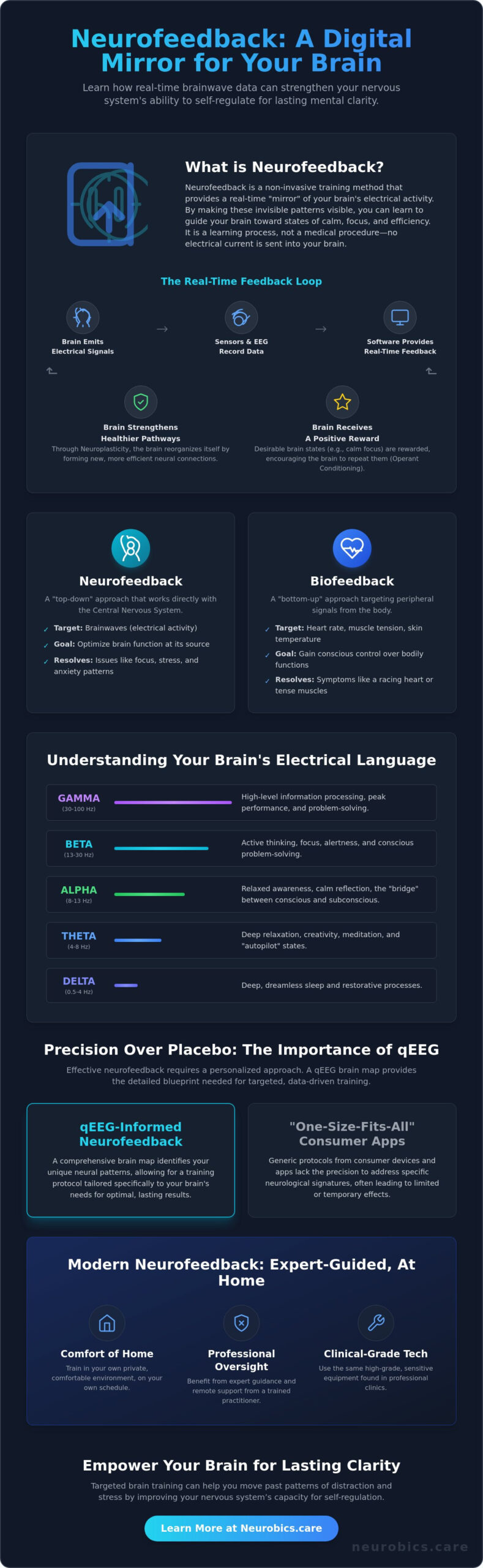
At its essence, What is Neurofeedback? It’s a specialized form of biofeedback that monitors the brain’s electrical activity in real time. Think of it as a sophisticated mirror. Usually, we can’t feel our brainwaves changing; we only feel the results, like a sudden spike in anxiety or a lapse in focus. Neurofeedback makes these invisible patterns visible. By using sensors to measure the micro-volts of electricity your brain produces, this method allows you to observe your internal state and learn how to shift it toward balance. It’s a non-invasive way to gain agency over your own mental landscape.
It’s vital to understand that this is a learning process, not a medical procedure. There’s no “zapping” or electrical current sent into your head. Instead, the sensors act like a stethoscope, simply listening to the brain’s natural language. When your brain produces a desired pattern, such as a state of calm focus, you receive a reward through visual or auditory cues, like a movie playing clearly or a pleasant tone. If your brain drifts into a stressed or distracted state, the feedback dims. This creates a continuous loop where the brain naturally seeks the reward, gradually strengthening healthier pathways through consistent practice.
The Core Principles of Brain Training
This transformation is possible because of neuroplasticity, which is the brain’s lifelong ability to reorganize itself by forming new neural connections. Through a psychological principle called operant conditioning, we reward the brain for “healthy” activity. Over time, these rewarded patterns become the brain’s new default setting. While basic consumer meditation headbands offer a glimpse into this world, professional neurofeedback provides the clinical precision needed for lasting change. At Neurobics, we prioritize systems that use high-grade sensors and specific protocols tailored to your unique neural architecture, rather than the “one-size-fits-all” approach found in many retail apps.
Biofeedback vs. Neurofeedback: What is the Difference?
While both methods aim to improve self-regulation, they target different levels of the nervous system. Traditional biofeedback often focuses on peripheral signals like heart rate, muscle tension, or skin temperature. In contrast, neurofeedback works directly with the central nervous system. You can explore a deeper comparison in our guide on Biofeedback vs. Neurofeedback. By training the brain directly, we take a “top-down” approach. When the brain learns to stay calm and regulated, it naturally sends better signals to the rest of the body, often resolving issues like a racing heart or shallow breathing at their source.
How Neurofeedback Works: The Science of Brain Waves
To understand how neurofeedback functions, we must first look at the electroencephalogram, or EEG. This technology acts as a high-fidelity listener for the brain’s electrical language. During a session, highly sensitive sensors are placed on the scalp to pick up micro-volts of activity. These sensors are entirely passive. They don’t send any current into your body; they simply record the rhythmic electrical pulses generated by billions of neurons communicating with each other. The Science of Brain Waves demonstrates how these recorded signals can be analyzed to provide a window into your internal mental state.
Once the EEG captures this data, sophisticated software translates the raw electrical signals into a visual or auditory format, such as a movie or a game. This is the bridge between biology and awareness. When your brain activity aligns with a specific goal, the movie plays smoothly or the music becomes clearer. If your brain drifts into a less optimal state, the feedback changes, signaling the brain to adjust. Neuroplasticity is the brain’s ability to reorganize itself by forming new neural connections throughout life. Through this constant feedback, your nervous system learns to build and strengthen these more efficient pathways.
Understanding Your Brain’s Electrical Language
Your brain operates across several frequencies, each associated with a different state of consciousness. Delta waves are dominant during deep sleep, while Theta waves often appear during “autopilot” moments or creative dreaming. Alpha waves represent a state of relaxed bridge-building between the inner and outer world. Beta waves are for active thinking and focus, and Gamma waves handle high-level information processing. You can find a detailed breakdown of these frequencies in our EEG Wave Guide.
Challenges often arise when these waves are out of balance. For example, an excess of slow Theta waves in the frontal lobe is frequently correlated with ADHD or persistent brain fog. In these cases, the brain is essentially “under-aroused” when it needs to be alert. Conversely, too much high-frequency Beta activity can feel like “tired but wired” anxiety. Neurofeedback helps the brain identify these imbalances and practice shifting back into a more appropriate state for the task at hand.
The Reward Mechanism: How the Brain Learns
The learning process relies on a simple but powerful reward mechanism. When your brain hits a “target” state, like producing more Alpha for relaxation, the screen brightens or the volume increases. Your brain naturally craves these positive cues and begins to repeat the patterns that trigger them. This happens subconsciously. It’s much like learning to ride a bike; you don’t think about which muscles to twitch, your nervous system simply finds the balance through trial and error. If you’re curious about how your specific patterns influence your daily life, you can contact us to discuss a personalized assessment.
The Importance of QEEG Brain Mapping: Precision over Placebo
Quantitative Electroencephalography (QEEG) represents the analytical engine behind effective, professional-grade brain training. While a standard EEG records raw electrical signals, a QEEG processes this information to create a detailed “brain map.” This map compares your unique activity to a normative database containing thousands of records from healthy individuals. This comparison reveals precisely where your brainwaves might be overactive or under-engaged. Without this foundational map, neurofeedback is essentially a guessing game. It’s the difference between a tailor-made suit and one bought off a generic rack.
Skeptics occasionally suggest that improvements in focus or mood are simply the result of a placebo effect. However, QEEG-informed training relies on objective, quantifiable data that moves beyond subjective feelings. We don’t just ask if you’re feeling better; we measure how your brain is physically changing at a functional level. What is Neurofeedback? At its most effective, it is a data-driven discipline. By comparing a follow-up map to your initial assessment, we can see the literal reorganization of neural pathways. This transparency ensures that your progress is rooted in physiological shifts rather than just a shift in mindset.
Personalized vs. Generic Neurofeedback
Generic protocols often focus on broad goals, such as increasing Alpha waves for relaxation. While this sounds beneficial, it can sometimes backfire. For a person whose brain is already producing too much slow-wave activity, adding more Alpha might lead to increased brain fog or lethargy. We use high-resolution maps to guide our Neurofeedback Treatment. This ensures that every session targets the specific bottleneck in your nervous system, providing a path to regulation that is as unique as your fingerprint.
What a QEEG Assessment Reveals
A professional QEEG assessment looks at several critical metrics. Power measures the energy of specific frequencies in different brain regions. Coherence tells us how well various parts of your brain are communicating with each other. Finally, processing speed reveals how efficiently information travels across your neural networks. At Neurobics, we provide these professional-grade assessments through our at-home qeeg brain mapping kits. This allows you to start your journey with the same clinical precision you’d find in a high-end facility, but with the convenience of your own environment.
The delivery of brain training has transformed significantly. Previously, accessing high-level neurofeedback required frequent, time-consuming trips to a specialized clinic. In 2026, the shift toward remote assisted neurofeedback has made it possible to bring clinical-grade technology directly into your home. This evolution isn’t about using simplified consumer gadgets. Instead, it involves shipping the same professional EEG hardware used in top-tier facilities to your door, allowing for a seamless transition from clinical care to the comfort of your living room.
A critical distinction in this modern approach is the role of the practitioner. Many people mistake home training for a self-guided app experience. However, professional remote training is a partnership. Your Neurobics expert designs your protocols based on objective data and monitors your progress remotely. This ensures that you aren’t just guessing with your mental health. The practitioner reviews your session data to refine your training, providing a level of sophistication that standalone wellness apps cannot match.
Frequency is perhaps the greatest advantage of training at home. Neuroplasticity thrives on consistency. While a once-a-week clinic visit is better than nothing, training three or four times a week significantly accelerates the brain’s ability to form new, healthier connections. Because the process is entirely non-invasive and passive, it’s perfectly safe to conduct these sessions in a familiar, low-stress environment. This increased dosage of training often leads to more robust and lasting results.
The Remote Training Process
- The QEEG brain map: Your journey begins with an at-home QEEG brain mapping session or a visit to a local office to establish your baseline.
- Specialized hardware: You receive a kit containing medical-grade sensors and the necessary software.
- Guided sessions: You perform your training while your Neurobics expert provides oversight and adjustments to your protocol.
Who Benefits Most from At-Home Training?
Busy professionals managing high-pressure environments find that integrating 20-minute sessions into their morning or evening routine is far more sustainable than mid-day clinic appointments. Parents of children with ADHD also benefit immensely, as it removes the sensory overwhelm and scheduling stress of traditional office visits. Additionally, individuals in regions like Dubai or remote areas can now access world-class Dutch and European expertise without geographical barriers. If you’re ready to start your journey, you can contact us to learn more about our remote programs.
Is Neurofeedback Right for You? Applications and Outcomes
The core philosophy of neurofeedback isn’t to “fix” a broken brain, but to support the nervous system in its natural quest for balance. When the brain is dysregulated, it often gets stuck in suboptimal patterns. This manifests as the symptoms many people struggle with daily. By improving self-regulation, we don’t just mask these issues; we help the brain find a more efficient way to operate. This shift naturally leads to a reduction in the mental and emotional friction you feel during your daily life.
For those struggling with focus, this approach addresses the root of what’s often called “ADHD paralysis.” This state occurs when the brain is under-aroused in areas responsible for executive function, making it feel impossible to start even simple tasks. By training the brain to shift out of slow-wave dominance and into more alert states, that “stuck” feeling begins to dissipate. Similarly, for individuals trapped in chronic stress, training helps move the nervous system out of a permanent “fight or flight” response. Instead of reacting to every minor stressor as a threat, the brain learns to maintain a calm, resilient baseline.
One of the most encouraging aspects of this process is the longevity of the results. Because neurofeedback is a form of learning, the changes tend to be lasting. Much like learning to swim or ride a bicycle, once the brain discovers a more efficient way to regulate its own states, it doesn’t easily forget. You aren’t dependent on a temporary external chemical; you’re building a permanent internal skill.
Real-World Applications for Performance and Wellness
- Improving sleep quality: Many sleep issues stem from a brain that can’t “downshift” from the day’s high-beta activity. Training helps the brain transition smoothly into the restorative delta and theta modes needed for deep rest.
- Emotional resilience: Recovery from burnout isn’t just about resting; it’s about teaching the nervous system how to recover from activation. Training supports the emotional stability needed to handle high-pressure environments without becoming overwhelmed.
Your Next Steps Toward a Regulated Brain
If you’re ready to move beyond “woo-woo” wellness claims and seek a data-driven path to mental clarity, the first step is an objective assessment. It’s vital to start with a professional qEEG map rather than a generic consumer gadget. This ensures your training is based on your specific neural signature, not a one-size-fits-all protocol. We invite you to contact Neurobics today for a consultation. Investing in your brain’s ability to self-regulate is an investment in your long-term health, performance, and peace of mind.
Empowering Your Brain for Lasting Clarity
You’ve seen how the invisible patterns of your brain can be made visible through the mirror of technology. By prioritizing qEEG-informed personalized protocols over one-size-fits-all solutions, you ensure that your training is as unique as your own neural signature. This shift toward self-regulation isn’t just about managing a single symptom; it’s about building a resilient nervous system that can handle the complexities of modern life with greater ease.
With over 15 years of expert experience, Neurobics makes this sophisticated science accessible by shipping professional equipment globally. This allows you to experience the benefits of clinical-grade neurofeedback with the frequency and comfort that only an at-home setting can provide. It’s a sustainable investment in your mental health, cognitive performance, and overall quality of life.
If you’re ready to move beyond temporary fixes and start your data-driven journey toward mental clarity, we’re here to guide you. Book a QEEG Brain Map Consultation with Neurobics to discover what your nervous system needs to thrive. Your path to a more balanced and focused life is closer than you think.
Common Questions About Brain Training
Is neurofeedback a permanent fix for ADHD or anxiety?
Neurofeedback is a learning process that leads to long-term changes in brain function. Much like learning a physical skill, once the brain discovers a more efficient way to regulate itself, it tends to maintain those patterns over time. It doesn’t “cure” conditions in a traditional medical sense. Instead, it provides the nervous system with the tools to stay balanced, often leading to lasting relief from symptoms without the need for ongoing intervention.
How many sessions are typically needed to see results?
Most individuals require between 20 and 40 sessions to achieve consolidated, long-term results. While some people notice subtle shifts in focus or sleep quality within the first 5 to 10 sessions, the brain needs consistent repetition to make these new neural pathways its default setting. Training frequency, such as the 3 to 4 times per week possible with Neurobics’ at-home programs, helps the brain integrate these changes more effectively than sporadic clinic visits.
Are there any side effects to neurofeedback training?
Because the process is non-invasive and does not involve electrical current, side effects are minimal and typically temporary. Some users report feeling “brain tired” or experiencing a mild headache after a session, similar to the fatigue felt after an intense study session or a new physical workout. These sensations usually dissipate quickly as the nervous system adapts to the training protocols and the new mental effort required.
Can I do neurofeedback while taking medication?
Yes, you can participate in training while taking medication. In many cases, neurofeedback is used as a complementary approach alongside existing treatments. It’s helpful to inform your practitioner about any medications you’re taking, as these can influence your EEG patterns. Over time, as your brain’s self-regulation improves, you might find it useful to discuss your progress and any potential adjustments with your prescribing physician.
What does a neurofeedback session actually feel like?
A session feels quite relaxing and mentally engaging. You sit comfortably while sensors on your scalp listen to your brainwaves, and you interact with a visual or auditory reward, like a movie that plays clearly when your brain is in the target state. There’s no physical sensation of electricity or pain. Most people find the process enjoyable, as it provides a quiet, dedicated space to focus on their internal wellbeing and mental performance.
Is neurofeedback covered by health insurance in Europe?
Insurance coverage in Europe varies significantly by country and individual provider. In some regions, like the Netherlands or Germany, certain private insurers may offer partial reimbursement if the training is part of a broader care plan. While it’s often an out-of-pocket investment, many clients find they can use Health Savings Accounts (HSA) or Flexible Spending Accounts (FSA) to cover the costs of professional at-home programs.
What is the difference between neurofeedback and meditation?
Meditation is a self-guided practice of mindfulness, whereas neurofeedback is a data-driven, targeted form of brain training. While meditation encourages general relaxation, brain training uses real-time EEG data to reward specific, individualized brainwave patterns. This precision allows you to address specific areas of dysregulation, such as an overactive stress response or a lack of focus, that might be difficult to reach through traditional mindfulness alone.
Can children and seniors both use neurofeedback safely?
Neurofeedback is safe and effective for both children and seniors. The brain maintains its capacity for neuroplasticity throughout life, meaning it can learn to self-regulate at nearly any age. For children, it’s often used to support focus and emotional regulation without the stress of a clinic environment; to see how early education environments also support these developmental milestones, you can read more. For seniors, it’s a valuable tool for maintaining cognitive clarity, improving sleep quality, and supporting overall brain health as they age.
