


You might assume that managing physical stress and improving cognitive performance require two completely different approaches, but they actually stem from the same root of self-regulation. When exploring biofeedback vs neurofeedback, it’s easy to get lost in a sea of technical terms and equipment lists. You’ve likely felt the frustration of trying to decipher which method actually addresses your symptoms and which is just “brain training” hype. It is a common hurdle for anyone looking to move beyond traditional options toward something more targeted and data-driven.
This article clarifies the distinct mechanisms of both tools so you can choose the right path for your brain health. We’ll explain how neurofeedback fits under the broader biofeedback umbrella and why focusing on the central nervous system is often the key to lasting change. From understanding the role of qEEG-informed care to the practical benefits of remote neurofeedback with Neurobics, you’ll gain the confidence to start your journey toward a more balanced, resilient mind. By the end, you will understand exactly how these technologies work together to help you regain control over your internal state.
Key Takeaways
- Understand the “umbrella” relationship where neurofeedback serves as a specialized branch of biofeedback focused entirely on brainwave modulation.
- Identify whether your symptoms require a “bottom-up” physical approach or a “top-down” cognitive strategy by comparing the mechanics of biofeedback vs neurofeedback.
- Learn how high-fidelity EEG sensors and remote assisted neurofeedback have made professional-grade brain training accessible from the comfort of your home.
- Discover why qEEG-informed measurement is considered the gold standard for moving beyond one-size-fits-all solutions to truly personalized care.
- Gain clarity on the specific equipment and measurement techniques, such as GSR and EMG, used to monitor the nervous system’s response to stress.
The Self-Regulation Umbrella: Defining Biofeedback and Neurofeedback
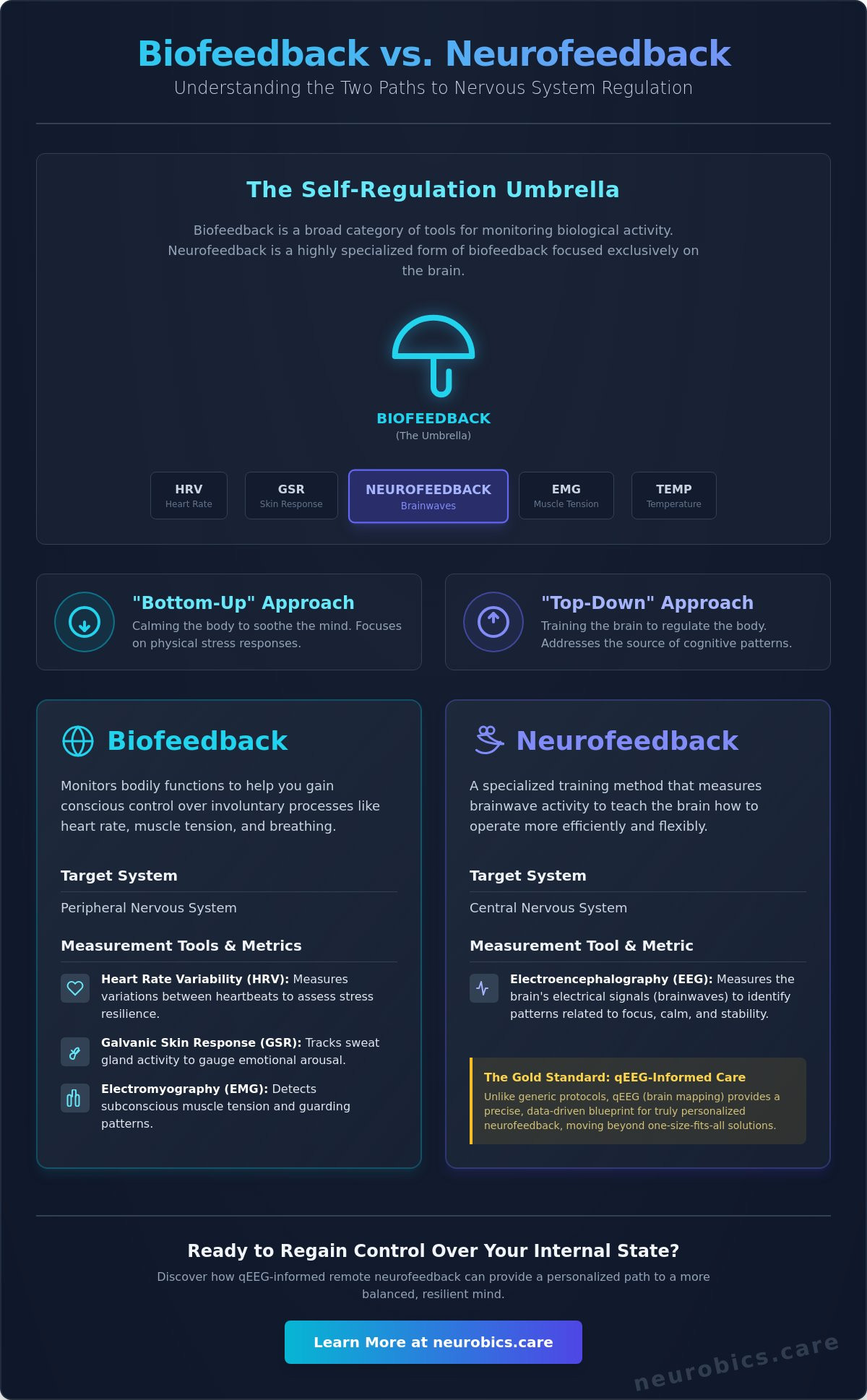
Understanding the relationship between biofeedback vs neurofeedback begins with a simple analogy. Imagine biofeedback as a large umbrella representing any technology that measures biological activity and “feeds” that information back to you in real time. Under this umbrella sits various specialized tools, with neurofeedback being perhaps the most sophisticated. At its heart, this approach transforms invisible internal processes into clear sensory cues, like a sound or a visual change on a screen. This feedback loop allows you to see exactly how your body or brain reacts to stress, focus, or relaxation.
The learning process relies on a psychological principle called operant conditioning. When the sensors detect a desired physiological state, such as a calm heart rate or balanced brainwaves, the system provides a “reward.” This might be a pleasant tone or a movie playing smoothly. Your nervous system naturally wants the reward, so it begins to repeat the patterns that produced it. Over time, these states become easier to access without the equipment. It’s not a passive treatment; it’s a form of active skill-building that strengthens your capacity for self-regulation.
What is Biofeedback in Psychology?
In the context of mental health and wellness, biofeedback usually targets the peripheral nervous system. This includes monitoring heart rate variability, muscle tension, and skin temperature to manage the body’s fight-or-flight response. For a deeper look at these methods, you can explore our guide on what is biofeedback in psychology. The primary goal here is often “bottom-up” regulation. By calming the body’s physical symptoms, you can eventually quiet a restless or anxious mind.
The Neurofeedback Distinction
When comparing biofeedback vs neurofeedback, the primary difference lies in the target of the measurement. While traditional biofeedback looks at the body, Neurofeedback focuses directly on the central nervous system. It uses EEG sensors to detect the tiny electrical voltages produced by your brain cells. Instead of measuring how fast your heart beats, it tracks your brainwave frequencies. This “top-down” approach addresses the source of regulation itself. At Neurobics, we view this as training the brain to be more flexible and resilient. It’s a precise way to address patterns related to focus, sleep, and emotional stability by working with the brain’s internal architecture rather than just its physical output.
Mechanics of Measurement: Body Signals vs. Brain Waves
The primary distinction in the conversation of biofeedback vs neurofeedback lies in the specific hardware used to listen to your body. Biofeedback focuses on the peripheral nervous system, capturing signals that originate outside the brain. These sensors act as high-precision mirrors, reflecting physiological changes you might not notice otherwise. While you might feel “stressed,” biofeedback quantifies that feeling into measurable data points like heart rhythm or skin conductance. It provides a tangible way to see how your body processes tension.
Biofeedback Sensors and Body Metrics
Biofeedback utilizes a variety of sensors to monitor the autonomic nervous system. One common tool is Galvanic Skin Response (GSR), which measures tiny changes in sweat gland activity to determine your level of emotional arousal. Another critical metric is Heart Rate Variability (HRV), often captured via Photoplethysmography (PPG) sensors. This measures the variation in time between each heartbeat, providing a window into how well your body recovers from stress. Finally, Electromyography (EMG) identifies subconscious muscle guarding, which is the tension we hold in our jaw or shoulders without realizing it. By seeing these signals on a screen, you can learn to release them at will.
Neurofeedback and the EEG Language
Neurofeedback shifts the focus from the body to the brain’s internal electrical environment. It uses Electroencephalography (EEG) sensors to detect micro-voltages produced by neural activity. This process allows practitioners to observe neural oscillations, often referred to as brainwaves. According to the International Society for Neuroregulation & Research (ISNR), this data is essential for understanding how the brain organizes itself. By monitoring specific EEG waves, such as the ratio between Theta and Beta waves, we can identify patterns associated with focus or relaxation. If you’re interested in exploring your own neural patterns, a professional at-home brain measurement can provide the baseline needed for a personalized training plan.
The magic of both methods happens during the feedback loop. Once the sensors capture your signals, the software processes that data in milliseconds. This real-time speed is vital for training. If your brain produces a focused Beta wave, a movie might get brighter or the music louder. If your mind wanders into a drowsy Theta state, the signal fades. This immediate response teaches the central nervous system to self-correct. While the sensors for biofeedback vs neurofeedback differ in their target, they share the same goal: providing the clear, objective data your nervous system needs to find its way back to balance.
Clinical Applications: When to Choose Biofeedback vs. Neurofeedback
Deciding between biofeedback vs neurofeedback usually depends on where your symptoms manifest most strongly. Biofeedback is often described as a “bottom-up” approach. It focuses on the body’s peripheral signals, such as heart rate or muscle tension, to eventually calm the mind. If your stress shows up as a racing heart or a tight jaw, training the body to relax sends a powerful signal to the brain that the environment is safe. Neurofeedback takes a “top-down” path by addressing the central nervous system directly. By training the brain to regulate its own electrical patterns, you influence the source of your cognitive and emotional experiences.
Scientific interest in these tools has grown as the technology becomes more accessible. For instance, the ADHD application segment accounted for 32% of the neurofeedback systems market in 2025, reflecting a significant shift toward neurological self-regulation. Research into the clinical effectiveness of neurofeedback and biofeedback suggests that while they overlap, they are most effective when matched to specific goals. At Neurobics, we prioritize the “top-down” approach because it strengthens the brain’s ability to manage the rest of the nervous system more efficiently.
Best Uses for General Biofeedback
Biofeedback is particularly effective for managing the physical “jitters” that accompany social anxiety or high-pressure situations. Athletes often use it to master breath and heart rate control, ensuring they remain in a state of “relaxed alertness” during competition. It’s also a trusted tool for those dealing with tension headaches or chronic physical pain. By learning to release subconscious muscle guarding, you can often reduce the frequency and intensity of discomfort without relying solely on external interventions.
Best Uses for Neurofeedback
Neurofeedback is the preferred choice for addressing deeper patterns of dysregulation. It’s widely recognized for its role in neurofeedback for ADHD, where the goal is to improve focus and reduce impulsivity by balancing brainwave ratios. Beyond focus, it’s used to improve sleep architecture and executive function. A 2025 meta-analysis of ten studies on portable EEG-based neurofeedback found that users showed significant improvements in managing symptom severity, making it a powerful tool for long-term emotional resilience. To understand the full scope of how this technology works, our comprehensive guide to neurofeedback and brain self-regulation provides an in-depth look at the biological mechanisms behind these improvements.
While these methods are distinct, they often work in synergy. A person might use biofeedback to lower their baseline physical tension while using neurofeedback to improve their mental clarity. It’s helpful to view these as skills rather than passive treatments. You aren’t just “receiving” a session; you’re learning how to navigate your own nervous system. This process takes patience and consistency, but the result is a more resilient version of yourself that can handle the complexities of modern life with greater ease, especially when supported by wellness tools like meetpureone.com to manage systemic inflammation.
Modern Accessibility: The Shift to Remote Training
For decades, the choice between biofeedback vs neurofeedback was often dictated by geography and budget rather than clinical need. While simple biofeedback tools like heart rate monitors became consumer-friendly early on, high-quality neurofeedback remained locked behind the doors of specialized clinics. These facilities required expensive, bulky amplifiers and frequent in-person visits that were difficult for many to sustain. The landscape has shifted dramatically. Today, the same medical-grade precision once reserved for elite institutions is available through remote programs, allowing you to train where you feel most comfortable.
Technological advancements have dismantled these old barriers. The global neurofeedback systems market was valued at $1.45 billion in 2025, and much of that growth comes from the rise of home-based solutions. By removing the commute and the sterile clinical environment, we’ve made it possible for more people to integrate brain training into their daily lives. This shift isn’t just about convenience; it’s about making effective self-regulation a practical reality for everyone.
This shift toward home-based wellness is also reflected in the growing availability of other advanced recovery technologies; for instance, many people now look for specialized PEMF devices for sale UAE to support cellular health and physical recovery in tandem with their brain training protocols.
The Clinical Quality of Home Equipment
The evolution of hardware is the primary driver of this change. Modern high-fidelity EEG sensors are now compact enough to fit into lightweight headbands without sacrificing the micro-voltage accuracy needed for effective training. These devices transmit data via secure software to a practitioner who can monitor your progress from afar. Training in your natural environment offers a distinct advantage known as generalization. When your brain learns to reach a state of calm focus while sitting in your own living room, it’s much more likely to maintain that state during a stressful work call or a busy family dinner.
Expert Guidance in a Remote World
Autonomous training without professional oversight carries risks of stagnation or incorrect protocol application. This is why the human element remains vital. Remote assisted neurofeedback bridges the gap by pairing advanced technology with expert guidance. This setup provides the consistency required for neural change. Instead of commuting to a clinic once a week, you can train more frequently, which often accelerates the learning process. If you have questions about how these tools can support your specific goals, we invite you to contact us to discuss your options.
A common concern is whether remote training matches the efficacy of in-clinic sessions. Current data suggests that the increased frequency and reduced stress of home training often lead to better outcomes. By addressing the source of dysregulation in your own space, you’re training your nervous system to handle real-world challenges in real time. When evaluating biofeedback vs neurofeedback for your own health, the ability to train consistently at home is often the deciding factor in achieving long-term success.
Precision Regulation: Why qEEG-Informed Neurofeedback is the Gold Standard
The journey into self-regulation often begins with a simple question about biofeedback vs neurofeedback, but it truly matures when we look at the specific data of your own brain. While we’ve explored how these tools monitor different parts of the nervous system, the highest level of precision comes from Quantitative EEG (qEEG). This process is commonly referred to as a “brain map.” It moves beyond simply observing signals to analyzing the entire landscape of your neural activity in a way that traditional biofeedback cannot match.
Standard biofeedback often uses general protocols for relaxation that apply to almost everyone. However, your brain’s architecture is unique to you. Without a map, training can sometimes feel like a guessing game. By comparing your brainwave patterns to a database of healthy activity, qEEG-informed training allows us to pinpoint exactly where dysregulation occurs. This data-driven approach is what elevates the practice from a general wellness tool to a sophisticated, clinical-grade intervention.
The Neurobics approach centers on this precision. We utilize at-home brain measurement to build a training protocol tailored specifically to your neural signature. We don’t believe in one-size-fits-all solutions because your brain doesn’t work that way. Instead, we use the map to target the source of your symptoms. This shift moves the focus from temporary symptom management to systemic, long-term regulation of the central nervous system.
What a Brain Map Reveals
A brain map reveals the “why” behind your daily challenges. It allows us to visualize the electrical patterns that govern your moods, focus, and energy levels. By identifying specific areas of the brain that are over-active or under-active, we can understand why certain cognitive tasks feel so difficult. This visual data helps identify:
- Areas of high-frequency activity that may contribute to restlessness.
- Slow-wave dominance that often correlates with “brain fog” or focus issues.
- Communication gaps between different brain regions.
For a detailed look at how this data informs your specific care plan, you can read more about neurofeedback treatment and the mapping process.
Starting Your Self-Regulation Journey
Transitioning from general curiosity to your first assessment is the most important step in your journey. An at-home brain measurement provides the objective baseline needed to understand your nervous system’s current capacity. Investing in this process is a commitment to your long-term mental clarity and resilience. It’s about building a brain that can return to a state of balance no matter what life throws your way. If you’re ready to see what your brain map reveals and begin a tailored program, we invite you to contact us to discuss your personalized brain training path.
Empowering Your Brain’s Natural Potential
Selecting the most effective tool for self-regulation is an empowering step toward lasting brain health. As we’ve explored, the decision between biofeedback vs neurofeedback often comes down to where your symptoms are most prominent. While biofeedback helps you master the body’s physical stress responses, neurofeedback allows you to train the brain’s internal electrical patterns at the source. Both methods offer powerful pathways to resilience, but the most effective results come from a personalized, data-driven strategy.
At Neurobics, we bring over 15 years of clinical expertise directly to your home. We provide high-fidelity remote equipment shipped globally, ensuring that professional-grade care is no longer limited by geography. By utilizing personalized qEEG-informed protocols, we move past generic solutions to create a training path that respects your unique neural signature. The capacity for growth exists within your own nervous system. If you’re ready to start your journey, we invite you to Book an Intake Assessment with Neurobics. A more balanced and focused mind is within your reach.
Frequently Asked Questions
Is neurofeedback better than biofeedback for ADHD?
Neurofeedback is generally more effective for ADHD because it trains the brain to regulate attention and impulsivity at the source. While biofeedback helps manage physical restlessness, neurofeedback focuses on the electrical patterns in the central nervous system. A 2025 meta-analysis showed significant symptom improvement using portable EEG systems, making it a primary choice for those seeking cognitive regulation rather than just physical relaxation.
Can I do biofeedback and neurofeedback at the same time?
Yes, these methods are highly synergistic and often yield better results when used together. By combining the “bottom-up” regulation of biofeedback with the “top-down” approach of neurofeedback, you address the entire nervous system. This duality helps calm the body’s stress response while simultaneously improving the brain’s executive functions, creating a more comprehensive foundation for long-term mental well-being.
How many sessions are typically needed to see results?
Most individuals require between 30 and 40 sessions to achieve stable, long-term changes in brain function. While some people notice subtle improvements in sleep or mood within the first few weeks of training, the brain needs repeated practice to solidify new neural pathways. Consistency is the most important factor in moving from temporary shifts to lasting, habitual self-regulation.
Are the results of neurofeedback permanent?
The results are considered long-lasting because the training is essentially a skill-building process. Once your brain learns a more efficient way to regulate itself through operant conditioning, it tends to retain that ability, much like learning to swim or ride a bicycle. Some clients choose to do occasional “tune-up” sessions during periods of intense life stress to maintain their peak performance levels.
Does insurance cover at-home neurofeedback training?
Insurance coverage for biofeedback vs neurofeedback remains inconsistent and varies significantly between providers. Many plans still categorize neurofeedback as “investigational,” though biofeedback is more frequently covered for specific conditions like chronic pain or migraines, often between 20% and 50% of the cost. It’s best to check with your specific provider regarding their policies on remote assisted neurofeedback programs.
Are there any side effects to biofeedback or neurofeedback?
Both methods are non-invasive and generally very safe, though some users may experience mild, temporary fatigue. Since the brain is effectively “working out” during a session, you might feel tired or experience a slight headache afterward. These sensations are usually short-lived and resolve quickly as your nervous system adjusts to the new training patterns and becomes more resilient.
What equipment do I need for remote neurofeedback training?
For a professional remote program, you need a high-fidelity EEG headband or sensors and a portable, medical-grade amplifier. These devices connect to a computer or tablet running specialized training software that provides real-time feedback. When you work with Neurobics, we provide the necessary hardware and guide you through the initial setup to ensure your home training environment matches clinical standards.
