


What if the restless energy you feel isn’t a lack of willpower, but a specific signature of your nervous system? While we often talk about the different types of hyperactivity in children, the reality for the 6.76% of adults globally living with persistent ADHD is often a silent, internal storm. You might know the exhausting sensation of being “driven by a motor” while your body feels depleted, or the frustration of racing thoughts that prevent a good night’s sleep. These experiences often lead to social shame, especially when you find yourself fidgeting or interrupting others during important conversations.
It’s important to realize that these behaviors aren’t character flaws; they’re reflections of how your brain is wired. This article will help you move beyond tired stereotypes to understand the brain-based causes of your restlessness. We’ll look at how these patterns manifest physically, mentally, and emotionally. You’ll also learn how Neurobics uses qEEG-informed insights to help you regulate your nervous system for a more balanced, focused life.
Key Takeaways
- Redefine hyperactivity as a nervous system seeking regulation rather than a simple behavioral issue or a lack of self-control.
- Identify the three clinical types of hyperactivity to better understand if your restlessness is predominantly physical, impulsive, or a combined pattern.
- Learn to distinguish between physical motor restlessness and mental hyperactivity, which often presents as racing thoughts and is frequently misidentified as generalized anxiety.
- Discover how qEEG brain mapping visualizes specific neural patterns like the Sensory Motor Rhythm (SMR) to pinpoint the source of your internal “noise.”
- Understand how remote neurofeedback acts as a mirror for your brain, helping you train your nervous system toward lasting self-regulation and calm.
What is Hyperactivity? Beyond the “Busy Child” Stereotype
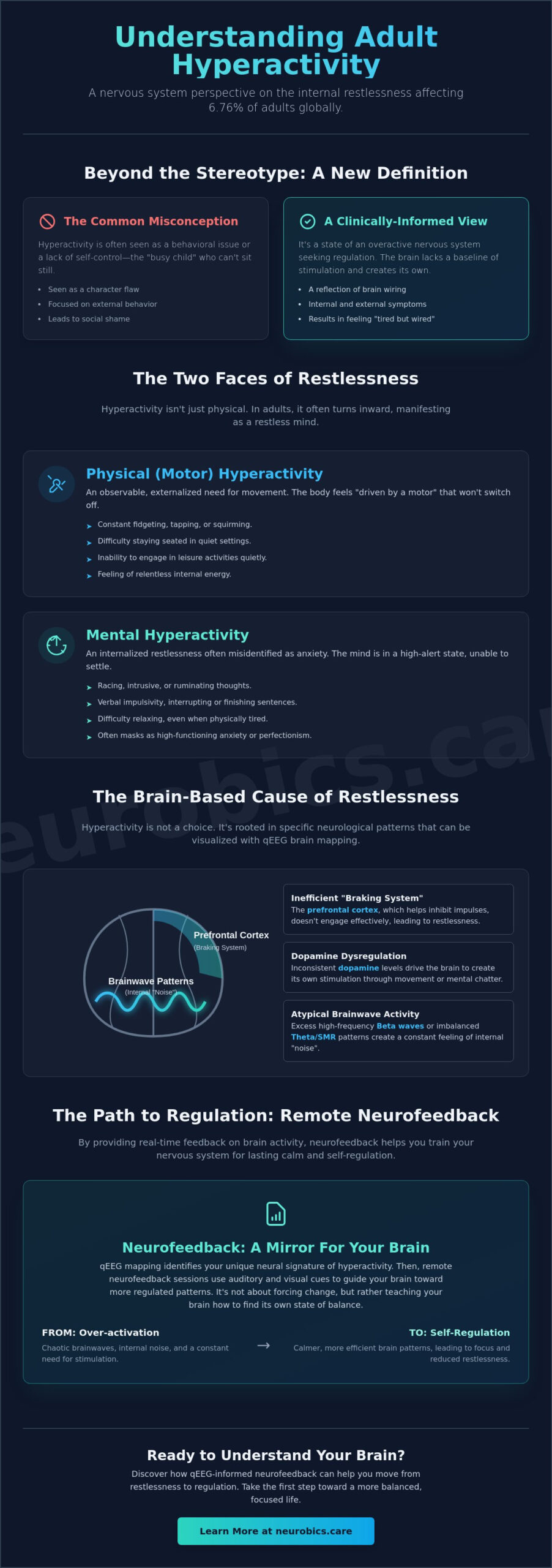
Many people still view hyperactivity through a narrow lens: the young boy running around a classroom or climbing furniture. This stereotype is misleading because it focuses only on the external behavior. At its core, hyperactivity is a state of an overactive nervous system that’s constantly seeking regulation. Whether it’s through physical movement or a stream of intrusive thoughts, the brain is trying to find a baseline of stimulation it lacks. To help provide this regulation through movement, you might explore Private Personal Training as a structured way to ground your system. This is why many people feel “tired but wired.” You might be physically exhausted after a long day, yet your mind remains in a high-alert state, unable to settle.
The Biological Root of Restlessness
Understanding the different types of hyperactivity requires looking beneath the surface at brain function. The prefrontal cortex acts as the brain’s braking system, helping us inhibit impulses and stay still. In a hyperactive brain, these “brakes” don’t always engage effectively. This often links back to dopamine, a neurotransmitter that drives our search for reward and stimulation. When dopamine levels are inconsistent, the brain creates its own stimulation through movement or mental chatter. From a clinical perspective, we often see this reflected in brain wave patterns, such as an excess of high-frequency Beta waves or a specific imbalance in Theta waves, which creates a constant feeling of internal “noise.”
How Hyperactivity Presents Across the Lifespan
As we age, the way we express restlessness changes significantly. Children often exhibit “externalized” hyperactivity, which is easily visible. However, as we reach adulthood, this energy often turns inward. For many, the physical need to run becomes a chronic sense of internal tension or an inability to relax even during downtime. This is particularly true in the symptoms of ADHD in women, where hyperactivity often masks as high-functioning anxiety or perfectionism. Instead of pacing a room, an adult might struggle with verbal impulsivity, interrupting others, or a mind that ruminates on a loop. Recognizing these internalized types of hyperactivity is the first step toward finding effective regulation strategies. This shift is part of the broader clinical picture of Attention deficit hyperactivity disorder, which manifests differently depending on an individual’s unique neural architecture and life stage.
The 3 Clinical Types of Hyperactivity in ADHD
Clinically, the way we categorize restlessness depends on how it interacts with other cognitive functions like focus and impulse control. Professionals typically recognize three types of ADHD, each with its own unique signature. Understanding these types of hyperactivity helps you move away from vague labels toward a more precise understanding of your own neural architecture. This clarity is essential for anyone exploring the broader types of ADHD to find support that actually addresses the root cause of their symptoms.
Predominantly Hyperactive-Impulsive Presentation
Combined Presentation: The “All of the Above” Experience
The combined presentation is the most frequent diagnosis. It involves a complex blend of inattentiveness and hyperactivity. Imagine your mind feeling like it’s in a thick fog while your body is trying to move at maximum speed. This contradiction is exhausting. When the nervous system becomes overwhelmed by these competing demands, it can lead to ADHD paralysis, where you feel completely unable to start a task despite a racing mind. In this state, the brain is essentially short-circuiting between the need for stimulation and the inability to process the information it’s receiving.
Impulsivity isn’t just a lack of discipline. It’s a physiological subset of the hyperactive profile where the brain’s inhibitory signals are delayed. While standard diagnostics focus on observable actions, qEEG data often reveals the underlying neural “noise” behind these types of hyperactivity. For instance, those with a combined presentation might show high Theta waves in the frontal lobes, which creates a feeling of being “under-aroused” or foggy. To compensate, the brain generates High Beta spikes, leading to that familiar sense of restlessness. This unique neural signature explains why traditional management techniques don’t always work for everyone. If you’re looking for a clearer picture of your own neural patterns, an at home brain measurement can provide the objective data needed to understand your restless system.
Physical vs. Mental Hyperactivity: Identifying Your Pattern
Distinguishing between the visible and invisible types of hyperactivity is a vital step in understanding how your nervous system operates. While physical restlessness is often the easiest to spot, mental and emotional manifestations can be just as disruptive to your quality of life. The National Institute of Mental Health provides a detailed look at the symptoms of hyperactivity and impulsivity, highlighting how these traits often morph as we move into adulthood. For many, the “busy-ness” simply moves from the limbs to the mind.
Mental hyperactivity is frequently misidentified as Generalized Anxiety Disorder (GAD). However, there is a distinct difference. While anxiety usually centers on specific worries or fears, mental hyperactivity is a process-based restlessness. It’s the brain’s inability to filter out irrelevant stimuli or slow down its own processing speed. This often extends into “verbal hyperactivity,” where the internal pressure to share thoughts leads to excessive talking or frequent interruptions. Additionally, “emotional hyperactivity” can cause intense, rapid shifts in mood, as the brain struggles to regulate the speed of its emotional responses.
Mental Hyperactivity: The Racing Brain
Living with a racing brain feels like a never-ending game of mental ping-pong. Thoughts bounce from one topic to another without a clear resolution, making it nearly impossible to find a sense of quiet. This internal noise can sometimes include unwanted mental images, making an accurate intrusive thoughts definition essential for distinguishing between OCD-like symptoms and a hyperactive neural state. This pattern is particularly intrusive at night. When the world goes quiet, the hyperactive brain often speeds up, leading to “revenge bedtime procrastination” where you stay up late just to feel a sense of control over your time, despite being physically exhausted.
Physical Hyperactivity: The Body in Motion
In adults, physical restlessness rarely looks like running or climbing. Instead, it manifests in subtle, repetitive movements like leg shaking, skin picking, or constant pen clicking. These aren’t just “bad habits”; they’re often forms of sensory seeking, where the body uses small motor movements to provide the stimulation the brain requires to stay alert. Some people find that body doubling adhd techniques help ground this physical energy. Having another person present, even virtually, can provide a “social prosthetic” that calms the nervous system and makes it easier to stay still and focused on a single task. Recognizing these types of hyperactivity in your daily life allows for more targeted, effective regulation strategies.
The Role of QEEG in Mapping Hyperactive Brain Patterns
While observing behaviors helps identify potential types of hyperactivity, it doesn’t reveal the specific electrical imbalances driving them. A Quantitative EEG (qEEG) provides this missing link. By measuring the electrical activity at the scalp, we can move beyond subjective checklists to objective data. This process allows us to see exactly where the nervous system is struggling to maintain a state of calm and focus. It provides a window into the brain’s internal environment, showing whether the restlessness is a result of an under-active “braking” system or an over-stimulated “engine.”
Every brain is as unique as a fingerprint, and there’s no single “hyperactive brain” profile. Some individuals show a pattern of high-frequency power across the entire cortex, while others have very localized areas of dysregulation. This is why two people with the same clinical diagnosis can have such different daily experiences. One might struggle with physical stillness, while the other feels trapped in a cycle of mental racing. Understanding these types of hyperactivity through the lens of electrophysiology removes the guesswork from regulation.
Visualizing the “Noise” in the Brain
Brain mapping identifies areas of over-arousal by looking at the “power” or volume of specific frequencies. For instance, the frontal lobes are responsible for executive function and our ability to inhibit impulses. If a map shows excessive power in fast waves, such as High Beta, it often correlates with the mental racing and anxiety-driven restlessness we’ve discussed. Conversely, the Sensory Motor Rhythm (SMR) is a specific frequency linked to physical stillness and motor control. A deficiency in SMR is a common marker for those who find it impossible to keep their bodies quiet. Essentially, a QEEG is a non-invasive assessment that transforms electrical brain activity into a visual map of regulation, making the invisible patterns of your nervous system visible.
Why a Personalized Protocol Matters
Treating a general diagnostic label is often less effective than training the specific neural pattern revealed on your map. One person’s restlessness might be driven by frontal “fogginess” that they try to overcome with movement, while another’s is caused by a global state of over-arousal. Neurobics uses these detailed maps to create tailored remote training programs that address your specific neural signature. Instead of applying a broad solution, we use your data to guide the training process. This precision is especially helpful for adults who have seen their symptoms shift from childhood physical energy to adult mental tension. If you’re ready to see the patterns behind your own experience, you can contact us to schedule an at-home QEEG brain measurement and begin your journey toward better self-regulation.
Regulating Hyperactivity with Remote Neurofeedback
Understanding your specific neural signature is a breakthrough, but the real transformation happens when you begin to train your brain toward a state of balance. Neurofeedback at home acts as a sophisticated mirror for your nervous system. When your brain waves shift into the dysregulated patterns we identified in your qEEG map, the system provides immediate feedback. This allows the brain to recognize its own “noisy” states and naturally shift toward more regulated frequencies. It’s a process of operant conditioning where the brain learns to inhibit the specific types of hyperactivity that cause you the most distress.
This training doesn’t aim to “cure” a diagnosis or flatten your personality. Instead, it focuses on strengthening the brain’s inhibitory pathways. If your restlessness is driven by a weak “braking” system in the frontal lobes, we target those areas to improve impulse control. If your mind is constantly racing due to high-frequency Beta waves, the protocol helps the brain find a slower, more rhythmic pace. By providing the nervous system with better “brakes,” you gain the ability to choose your response to internal and external stimuli rather than being driven by them.
The Neurobics Approach to At-Home Training
Remote neurofeedback offers a unique advantage because it allows you to train in the natural environment where your hyperactivity is most disruptive. Whether it’s your home office or your living room, these are the spaces where you need regulation the most. Neurobics provides a seamless remote setup, delivering high-grade equipment to your door and pairing you with a dedicated expert for weekly sessions. We offer structured programs, including a 4-week introductory block and more comprehensive 12-week protocols, to ensure consistent progress. This assisted model combines the precision of clinical care with the comfort and flexibility of your own home.
What Real Progress Looks Like
Progress in brain training is rarely an overnight shift. Instead, it’s a series of small, meaningful changes that accumulate over time. You might find that the “internal noise” that once made focus impossible begins to quiet down. Many of our clients report that they can finally sit through a meeting without the constant urge to fidget, or that they fall asleep more easily because their thoughts have stopped racing. These improvements in self-regulation lead to a better quality of life and reduced social shame. Because every session is expert-guided, we can adjust your protocol based on your real-world feedback, ensuring the training addresses your specific types of hyperactivity. If you feel ready to move beyond managing symptoms and start building a more regulated brain, book your intake session today to begin your personalized journey.
Moving Toward a Regulated Nervous System
Recognizing that your restlessness is a physiological state rather than a personal failing is a powerful shift in perspective. Whether you experience the racing thoughts of mental hyperactivity or the subtle physical fidgeting often seen in adults, these types of hyperactivity are unique signatures of your nervous system. By moving beyond behavioral labels and looking at the electrical activity in your brain, you can begin to train for lasting calm and improved focus. It’s about understanding your brain’s specific needs to find a sustainable sense of balance.
At Neurobics, we bring 15+ years of clinical expertise directly to your home. Our remote expert-guided training is built on personalized QEEG-informed protocols, ensuring that your brain training is as unique as your neural map. You don’t have to navigate this process alone. We provide the professional guidance and technology needed to help you develop the internal “brakes” you’ve been looking for. Start your brain-regulation journey with a professional QEEG assessment and discover how a more balanced nervous system can improve your daily quality of life. You have the capacity for growth and change, and we’re here to support you every step of the way.
Frequently Asked Questions
Can you have hyperactivity without being physically active?
Yes, hyperactivity can manifest entirely within the mind, a state often called internalized hyperactivity. While the common image involves constant physical movement, many adults experience a “racing brain” where thoughts move too quickly to manage. This internal restlessness feels like a motor that won’t stop, even when your body is sitting perfectly still. It’s a frequent experience for those who have learned to mask their physical symptoms over time.
How does mental hyperactivity differ from anxiety?
The primary difference lies in the source of the internal “noise.” Anxiety is typically driven by fear, specific worries, or a sense of dread about future events. Mental hyperactivity is process-based, meaning the brain simply lacks the inhibitory “brakes” to slow down its own processing speed. You might have racing thoughts about mundane topics or no specific topic at all, simply because your nervous system is stuck in a high-alert state.
Is hyperactivity always a symptom of ADHD?
Hyperactivity is a core component of certain ADHD presentations, but it can also stem from other physiological sources. Chronic stress, significant sleep deprivation, or even thyroid imbalances can create a restless nervous system. Identifying the specific types of hyperactivity through objective tools like qEEG brain mapping helps determine if the pattern is a neurodevelopmental trait or a temporary response to your environment.
Can neurofeedback help with racing thoughts at night?
Neurofeedback is highly effective for quietening a racing mind at night. By providing the brain with real-time feedback, it helps the nervous system learn how to shift from high-frequency “active” waves into the calmer states required for sleep. Many Neurobics clients find that once they train their brain to inhibit over-arousal, the internal chatter subsides, allowing for a more natural transition into deep, restorative rest.
What is the most common type of hyperactivity in adults?
Internalized or mental hyperactivity is the most frequent form seen in the adult population. As people grow older, the gross motor movements seen in childhood, such as running or climbing, often transform into subtle fidgeting or cognitive restlessness. This internalized energy is one of the most common types of hyperactivity we see in high-functioning professionals who struggle to “switch off” after a long day of work.
How do I know if my child has physical or emotional hyperactivity?
Physical hyperactivity is usually easy to spot through constant movement, squirming, or an inability to stay in a seat. Emotional hyperactivity is more about the speed and intensity of their reactions. If your child experiences rapid mood shifts or struggles to “come down” after an exciting event, their nervous system may be struggling with emotional regulation. Both patterns reflect a brain seeking stimulation or struggling to find its baseline.
Is hyperactivity permanent, or can the brain learn to regulate it?
The brain is remarkably neuroplastic and can learn to regulate restlessness at any age. Hyperactivity isn’t a permanent “broken” state; it’s a pattern of dysregulation that can be retrained. Through methods like remote neurofeedback, the brain strengthens its own inhibitory pathways. Over time, this makes the state of calm and focus more accessible and easier to maintain without the constant need for external stimulation.
How much does it cost to get a brain map for hyperactivity?
Pricing for a quantitative EEG assessment varies across the industry based on the provider’s location, the technology used, and the level of expert analysis included. Some clinical settings offer mapping as part of a comprehensive intake, while others provide it as a standalone service. Because insurance coverage is often inconsistent for these assessments, it’s advisable to check with individual providers for their specific rates and whether they offer remote, at-home options.
