


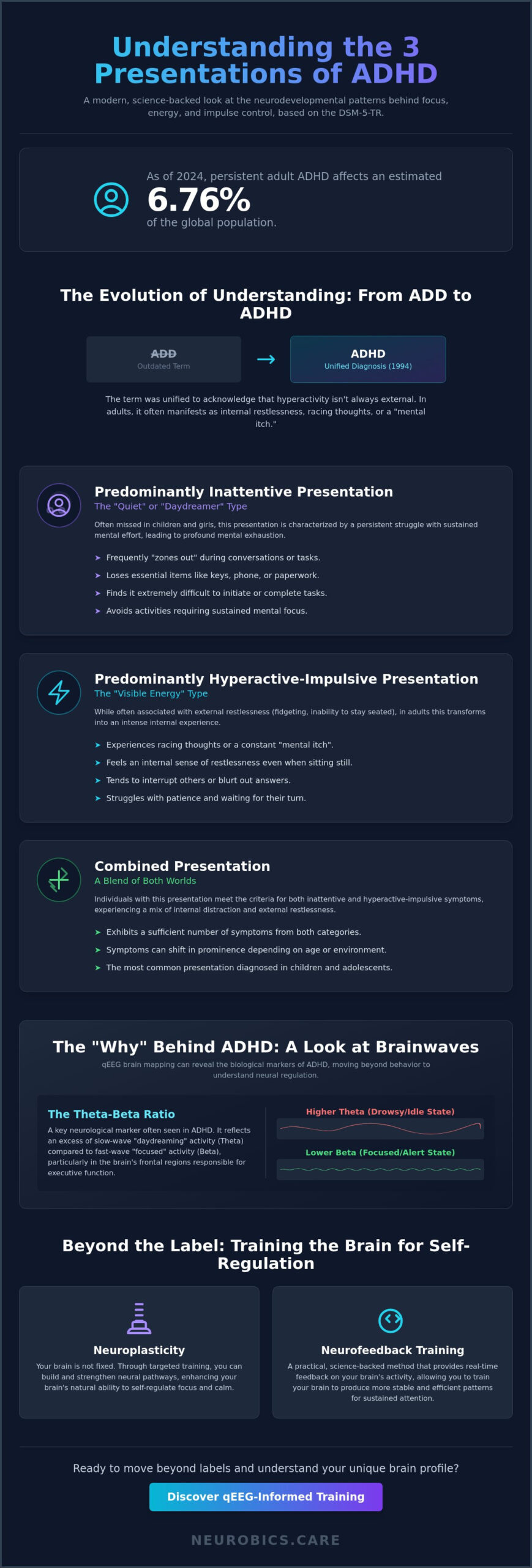
What if the restless energy you feel isn’t a lack of discipline, but a specific signature written in your brain’s electrical patterns? If you’ve ever felt that “hyperactivity” doesn’t quite describe your internal experience, you aren’t alone. With global research as of 2024 showing that persistent adult ADHD affects roughly 6.76% of the population, it’s clear that the way we talk about the different types of adhd needs to catch up with our scientific understanding. Many people still struggle with the confusion between ADD and ADHD, or find it nearly impossible to explain their unique symptoms to those around them.
At Neurobics, we believe that clarity comes from looking beneath the surface of behavior to the neural regulation patterns that drive it. This guide provides a comprehensive look at the clinical presentations defined in the DSM-5-TR, the neuroscience of how your brain processes information, and how understanding these patterns leads to more effective management. We’ll explore the three main presentations and discuss how qEEG-informed training offers a path toward greater mental flexibility and focus without relying solely on traditional methods.
Key Takeaways
- Learn why the term “ADD” was retired and how modern science now views these patterns as a spectrum of neurodevelopmental regulation.
- Identify the specific characteristics of the three clinical types of adhd, including how hyperactivity often transforms into internal restlessness in adults.
- Discover how qEEG brain mapping reveals the “Theta-Beta ratio,” a neurological marker that explains the biological “why” behind focus and impulse challenges.
- Understand how neuroplasticity allows you to go beyond labels by training your brain to develop more efficient and resilient self-regulation patterns.
- Explore how neurofeedback offers a practical, science-backed way to strengthen the neural pathways responsible for sustained attention and mental calm.
The Evolution of ADHD: From ADD to the Three Modern Presentations
ADHD is more than a simple struggle with focus or energy. It’s a complex neurodevelopmental condition defined by specific patterns of inattention, hyperactivity, and impulsivity that affect how the brain processes information. For decades, many people used the term “ADD” to describe those who were quiet but easily distracted. However, in 1994, the DSM-IV officially replaced this with a unified umbrella term: ADHD. This wasn’t just a minor change in terminology. It reflected a major shift in our understanding of the brain’s regulatory systems and how different types of adhd manifest across different people.
Understanding the distinction between a “type” and a “presentation” is vital for modern clinical care. We now use the word “presentation” because ADHD symptoms aren’t static. They can change as you age or as your environment shifts. Identifying your specific presentation is the first step toward finding the right support. It moves the conversation away from character flaws and toward biological reality. When you have a clear label, you can finally stop asking why you can’t “just do it” and start looking at how your brain actually manages its resources.
Why is it all called ADHD now?
The move toward a unified framework happened because researchers realized that hyperactivity isn’t always visible to the naked eye. In many adults and women, hyperactivity is internalized. It feels like racing thoughts, a “mental itch,” or a persistent sense of inner restlessness rather than a need to run around. By grouping these experiences under ADHD, the medical community acknowledged that the underlying neurological mechanism is often the same. Today, we recognize three main presentations of ADHD: predominantly inattentive, predominantly hyperactive-impulsive, and combined. This shift has been particularly helpful for women and adults who were previously overlooked because they didn’t fit the “hyperactive little boy” stereotype.
The Role of Executive Function in All Types
Regardless of which presentation an individual has, the core challenge usually involves executive function. Think of executive function as your brain’s internal management system or its “CEO.” Executive function is the cognitive process of managing thoughts, actions, and emotions to achieve goals. When this system isn’t regulating efficiently, it leads to the symptoms we associate with ADHD. At Neurobics, we focus on these management challenges by looking at the brain’s electrical activity. Whether you struggle with starting a task or staying in your seat, the root is often a struggle with neural self-regulation. Understanding this “why” is the key to moving toward a more balanced and focused life.
Predominantly Inattentive, Hyperactive, and Combined ADHD: A Detailed Breakdown
While the clinical label remains the same, the daily reality for individuals depends heavily on which symptoms are most prominent. These types of adhd represent different ways the nervous system struggles to regulate attention and arousal. It’s helpful to view these not as rigid boxes, but as descriptions of how a person currently interacts with their world. Because symptoms can morph as we age, a child who seems primarily hyperactive might grow into an adult who appears primarily inattentive, though the underlying neural signature often remains consistent.
Predominantly Inattentive ADHD (The “Quiet” Type)
This presentation is frequently misunderstood because it lacks the disruptive physical energy people usually associate with the condition. It’s characterized by a persistent struggle with sustained mental effort. People with this type might often “zone out” during conversations, lose essential items like keys or phones, and find task initiation nearly impossible. Because these individuals aren’t disruptive in a classroom or office, they’re often missed during childhood. This is especially true for girls, who may be labeled as “daydreamers” rather than receiving the support they need. According to NIMH on ADHD research, the lack of overt hyperactivity doesn’t mean the internal struggle is any less taxing; the effort required to stay “on task” can lead to profound mental exhaustion by the end of the day.
Hyperactive-Impulsive and Combined Presentations
The hyperactive-impulsive presentation is often described as being “driven by a motor.” In adults, this rarely looks like running or jumping. Instead, it manifests as a constant need for stimulation, verbal impulsivity, or an inability to sit through a long meeting without fidgeting. Combined presentation is the most frequent diagnosis, where an individual experiences a significant mix of both inattentive and hyperactive symptoms. It’s often a delicate balance between the “fog” of inattention and the “fire” of impulsivity. This combination can make social interactions particularly challenging, as the person may struggle to follow the thread of a conversation while simultaneously feeling an urgent need to interrupt. To better understand how this restlessness shows up across different dimensions of experience, it helps to explore the types of hyperactivity including physical, mental, and emotional restlessness that can accompany these presentations.
Environmental factors play a massive role in how these symptoms surface. A high-stress job or a chaotic home life can exacerbate impulsivity, while a repetitive, under-stimulating environment might trigger deep inattentiveness. At Neurobics, we help individuals identify these specific patterns through objective measurement, allowing for a more tailored approach to self-regulation. If you’re curious about how your specific brain patterns influence your daily life, you can reach out to our team for a deeper conversation about your unique needs.
The Neuroscience of ADHD: qEEG Patterns and Brain Wave Regulation
Most discussions about the types of adhd focus on what a person does, such as fidgeting, forgetting, or interrupting. At Neurobics, we prefer to look at what the brain is doing. Using quantitative EEG (qEEG), we can observe the electrical rhythms that govern attention and emotional control. This technology provides a clear window into the nervous system, revealing the biological “why” behind the behaviors we see on the surface. It shifts the focus from a list of perceived deficits to a map of neural regulation.
A hallmark of many ADHD brains is a high Theta-Beta ratio. Theta waves are slow rhythms, often associated with daydreaming or the moments just before we fall asleep. Beta waves are fast, linked to active problem-solving and focused attention. When a person has an excess of Theta and a deficit of Beta in the prefrontal cortex, their brain is in a state of “under-arousal.” It’s essentially trying to perform high-demand tasks while the “engine” is in an idling state. This under-arousal explains why someone might seek out intense stimulation or high-stakes situations; they’re unconsciously trying to “wake up” their frontal lobes to feel more alert and present.
Brain Wave Signatures: Theta, Alpha, and Beta
Theta waves are the dominant frequency in the predominantly inattentive presentation. This creates a “dreamy” or “foggy” state where the world feels slightly out of focus, making it hard to process information quickly. Beta waves are what we need for sustained concentration, but in many ADHD presentations, the brain struggles to maintain these fast frequencies. Some individuals also show high Alpha activity. Alpha usually acts as a relaxed, “resting” state. If your brain stays in Alpha when you’re trying to work, you might feel physically present but mentally distant, as if there’s a glass wall between you and your tasks. These slow-wave patterns often lead to “seeking” behaviors, where the individual uses movement or external chaos to generate the internal stimulation their brain isn’t producing on its own.
qEEG-Informed Care: Mapping Your Unique Profile
Behavioral checklists are a starting point, but they can’t capture the nuance of an individual’s nervous system. Two people might both be diagnosed with the “Combined” presentation, yet their neural maps could be opposites. One person might have a brain that is “too slow” in the frontal regions, while another might have a brain that is “too fast,” leading to racing thoughts and chronic anxiety. This is why objective brain measurements are so vital. At Neurobics, we use these individual signatures to build personalized protocols. By understanding your specific neural map, we can move away from general assumptions and toward a training plan that supports your brain’s unique way of processing the world. This precision is what allows for meaningful, long-term improvements in self-regulation and mental flexibility.
How ADHD Types Manifest in Daily Life: Adults and Internalized Symptoms
As we grow older, the outward expression of the different types of adhd often undergoes a significant transformation. With 55.9% of adults with a current ADHD diagnosis receiving that diagnosis at age 18 or older, it’s clear that many people live for years without realizing their internal struggles have a biological name. While a child might be physically unable to stay in their seat, an adult with the same neural signature might sit perfectly still while their mind travels at a hundred miles per hour. This is the reality of internalized hyperactivity. It’s an invisible struggle that feels like a persistent “mental itch” or a background hum of chronic anxiety that traditional relaxation techniques don’t seem to reach. For many, this internal chaos is far more exhausting than physical restlessness because there’s no easy way to turn it off. Recognizing that there are distinct types of hyperactivity that manifest physically, mentally, and emotionally can help adults finally put language to experiences they’ve struggled to describe for years.
This transition often leads to a phenomenon where individuals feel like they’re failing at the basic requirements of adult life. They might compare their internal mess to the external order of others, not realizing their brain is simply working with a different set of regulatory rules. Instead of outward disruption, the symptoms become private. This includes racing thoughts that prevent sleep, a sense of being overwhelmed by simple daily choices, or the constant feeling that you’ve forgotten something important. Understanding these adult manifestations is crucial for moving past the shame and toward effective strategies for daily life.
ADHD Paralysis and the Freeze Response
ADHD paralysis isn’t a lack of willpower or a sign of laziness. It’s a neurological shutdown that occurs when the brain’s executive functions are overwhelmed by too much information or emotional pressure. You might find yourself staring at a to-do list for hours, unable to pick up a pen, even though the consequences of delay are clear. This is the brain’s way of trying to protect itself from perceived stress by entering a state of “freeze.” By understanding ADHD paralysis through a neurological lens, you can begin to see it as a signal that your nervous system needs regulation rather than more “discipline.” Breaking this cycle often starts with lowering the stakes and giving the brain a chance to reset its arousal levels through grounding techniques or sensory reduction.
ADHD in Women and Internalized Experience
In women, ADHD is frequently misdiagnosed as anxiety or mood disorders because the symptoms are so deeply hidden. Societal expectations often lead girls to “mask” their difficulties, which creates a significant burden on their mental well-being over time. Many women present with the inattentive type, where the struggle is quiet and internal. It’s also important to recognize that biological factors, such as estrogen levels, directly influence dopamine regulation. This means that the symptoms of ADHD in women can fluctuate in intensity throughout the month. If you’re ready to move beyond masking and find a more sustainable way to manage your focus, you can book an intake with Neurobics to explore how remote neurofeedback can support your unique brain pattern.
Beyond the Label: Training the Brain for Self-Regulation
Labels provide clarity, but they shouldn’t be the end of the journey. Once you understand the specific types of adhd and how they relate to your own brain activity, the focus shifts to what you can do about it. The most exciting discovery in modern neuroscience is neuroplasticity. This is the brain’s innate ability to reorganize itself by forming new neural connections throughout life. It means your brain isn’t a static machine; it’s a dynamic system capable of learning more efficient ways to regulate its own state. You aren’t stuck with a “broken” focus; you’re working with a nervous system that needs different training.
Neurofeedback training leverages this plasticity. Instead of just managing symptoms with external tools, you’re teaching your brain to maintain the right level of arousal for the task at hand. If your neural signature shows an excess of slow-wave activity, training helps the brain practice staying in a more alert, focused state. Over time, these sessions strengthen the pathways responsible for self-regulation. This makes focus feel less like a forced effort and more like a natural state of being. It’s about moving from a state of constant reaction to a state of conscious regulation.
The Neurobics Approach: qEEG-Informed Remote Training
True progress starts with an objective starting point. At Neurobics, we begin every journey with an at-home brain measurement. This qEEG assessment allows us to see exactly how your brain is currently regulating itself. Because we offer remote assisted neurofeedback, you don’t have to commute to a clinic to receive professional-grade care. You can train from the comfort of your own home while receiving expert guidance from our team. This consistency is vital for nervous system regulation, as the brain learns best through regular, repeated practice in a low-stress environment. Our goal is to empower you with the tools to balance your own neural activity.
Complementary Strategies: Body Doubling and Lifestyle
Training the brain’s internal regulation works best when supported by effective external strategies. One such tool is body doubling for ADHD, which uses the presence of another person to anchor your attention and reduce the friction of task initiation. When you combine these social prosthetics with a focus on sleep hygiene and stress management, you create a stable foundation for your nervous system. Remember that your ADHD presentation is a part of how you process the world, not a defect to be erased. By embracing your brain’s unique type while working toward its optimal balance, you can unlock a higher quality of life and a deeper sense of mental harmony. If you’re ready to start your journey toward better regulation, we invite you to contact us today to learn more about our remote training programs.
Embracing Your Neural Path to Focus
Understanding the various types of adhd is a significant first step toward reclaiming your mental energy and confidence. By moving beyond behavioral checklists and looking at the underlying neural patterns, you replace confusion with clinical clarity. We’ve explored how inattentive, hyperactive, and combined presentations are actually visible signatures of brain regulation that can be mapped and trained through the power of neuroplasticity.
At Neurobics, we bring 15+ years of clinical experience directly to your living room. We provide professional-grade equipment for your at-home brain measurement and follow up with personalized protocols designed specifically for your unique qEEG data. This approach isn’t about fixing a “broken” brain; it’s about supporting your nervous system as it learns to find its own optimal balance and mental flexibility. You deserve a management strategy that is as individual as your own neural map.
Ready to understand your unique brain signature? Book a qEEG assessment with Neurobics today.
You don’t have to navigate your neurodivergent journey alone. With the right data and expert support, a more focused, calm, and harmonious life is well within your reach.
Frequently Asked Questions
Is there a difference between ADD and ADHD?
ADD is an outdated clinical term that was officially replaced by ADHD in 1994. Today, what people once called ADD is known as the Predominantly Inattentive presentation. This shift in terminology acknowledges that even if a person doesn’t show outward physical hyperactivity, the underlying neurodevelopmental mechanism is the same.
Can you have both Inattentive and Hyperactive ADHD?
Yes, this is categorized as the Combined presentation. It is the most common diagnosis among both children and adults. Individuals with this profile meet the criteria for both inattention and hyperactivity-impulsivity, often experiencing a mix of mental fog and a restless, “driven by a motor” internal feeling.
What happens if ADHD is left untreated in adults?
Untreated ADHD often leads to chronic burnout, low self-esteem, and significant challenges in professional and personal life. Research from 2024 indicates that roughly 80% of adults with the condition have at least one co-occurring psychiatric issue, such as anxiety or depression. Without proper regulation strategies, the persistent effort to “mask” symptoms can lead to profound mental exhaustion.
Can my ADHD type change over time?
Your clinical presentation can indeed shift as you age or as your life circumstances evolve. While your core neurological patterns remain relatively stable, the outward symptoms often transform. Many people who are diagnosed with the hyperactive presentation in childhood find that their symptoms become more inattentive or internalized as they reach adulthood.
How do I know if I have the Inattentive or Combined type of ADHD?
Distinguishing between these profiles requires a professional evaluation of your current symptoms and their impact on your life. If your primary struggles are forgetfulness and organization without a sense of impulsivity, you likely lean toward the inattentive type. Those with the combined type feel a persistent need for stimulation alongside their focus challenges.
Is neurofeedback effective for all types of ADHD?
Neurofeedback is a highly flexible tool because it addresses the specific brain wave dysregulation present in all types of adhd. Whether your brain shows an excess of slow Theta waves or a deficit of focused Beta waves, the training is customized to your neural map. At Neurobics, we use qEEG data to ensure the training supports your brain’s unique regulation needs.
Can ADHD types be diagnosed through a brain scan?
Brain measurements like qEEG provide objective data on neural activity, but they are not a substitute for a medical diagnosis. At Neurobics, we use at-home brain measurement to create personalized training protocols rather than to provide clinical labels. A formal diagnosis must still be performed by a licensed healthcare professional through a comprehensive clinical interview.
What is the rarest type of ADHD?
The Predominantly Hyperactive-Impulsive presentation is the least common of the three types of adhd, particularly in the adult population. Most individuals who exhibit significant hyperactive or impulsive behaviors also meet the criteria for inattention. Pure hyperactivity without focus issues is most frequently observed in very young children before academic demands increase.
