


The most sophisticated headset in the world is essentially a paperweight if it isn’t guided by a deep understanding of your unique brain activity. You might feel exhausted by the logistical dance of commuting to a clinic twice a week, or perhaps you’re tired of traditional therapies that talk around your symptoms without addressing the underlying nervous system patterns. If you’ve found yourself confused by the gap between a basic meditation headband and a professional system, you aren’t alone. High-quality neurofeedback therapy at home is no longer about buying a standalone gadget; it’s about establishing a clinical-grade protocol tailored to your specific needs.
We believe that true progress requires more than just a device; it requires a partner who understands the science of self-regulation. This guide reveals how to move beyond simple relaxation tools to a professional, QEEG-informed system that actually changes how your brain functions. You’ll learn how Neurobics bridges the gap between high-end technology and empathetic, expert-led care. We’ll explore the critical difference between consumer wearables and expert-led remote training, showing you how a personalized protocol can finally deliver the lasting focus, restorative sleep, and emotional balance you deserve.
Key Takeaways
- Understand why professional remote training is a practitioner-led service rather than a standalone app or automated device.
- Learn to distinguish between consumer-grade meditation tools and professional neurofeedback therapy at home by evaluating signal quality and clinical oversight.
- Discover why a QEEG brain map is the essential foundation for creating a personalized training protocol based on your unique brain activity.
- Explore the structured journey of a remote program, from the initial diagnostic intake to setting up clinical equipment in your own space.
- Find out how the Neurobics approach prioritizes clinical depth and expert guidance to help you achieve lasting improvements in focus, sleep, and emotional regulation.
What Is Professional Neurofeedback Therapy at Home?
Professional neurofeedback therapy at home is a sophisticated, practitioner-led clinical service delivered outside traditional clinic walls. In 2026, the distinction between “at home” and “on your own” has never been more important. While consumer devices often promise quick fixes, professional remote training involves high-fidelity EEG sensors and a dedicated specialist who monitors your progress. The core mechanism remains the same as in-office treatment: real-time feedback loops. These loops reward your brain for reaching optimal states, helping it learn to self-regulate more effectively over time. To understand the foundations of this science, it’s helpful to look at What Is Neurofeedback Therapy and how it has transitioned from research labs to the living room. It’s a collaborative process where technology and human expertise meet to foster long-term neurological change.
The Evolution of Remote Brain Training
The year 2026 marks a major turning point for the industry. Telehealth advancements have finally made clinical-grade EEG sensors truly portable without sacrificing signal quality. In the past, home training was often limited to passive monitoring or simple relaxation apps. Today, active neurofeedback training targets specific brainwave patterns with the same precision once reserved for academic settings. This shift means you no longer have to choose between the high standards of a physical clinic and the comfort of your home. The home-use segment now accounts for approximately 30% of the total neurofeedback market, reflecting a massive move toward accessible, professional care. This trend toward high-quality remote solutions is visible across various professional sectors; for example, many experts now utilize Remote Podcast Recording and Production to maintain studio-level standards from any environment. At Neurobics, we use similar technological advancements to bridge the gap; providing the same level of care you’d expect in person but without the logistical stress of a commute.
Who Benefits Most from Home-Based Therapy?
This remote model is particularly transformative for individuals managing ADHD, chronic stress, or anxiety patterns. A 2022 peer-reviewed study on remote systems found that therapist-guided neurofeedback can significantly improve mental health and cognitive performance. For those with sensory sensitivities, the ability to train in a familiar, quiet environment is often the difference between success and burnout. It’s also a vital tool for high-performing professionals who need to sharpen their executive function but can’t fit twice-weekly clinic visits into their schedules. Whether you’re looking for better sleep or improved emotional regulation, the convenience of neurofeedback therapy at home makes consistency much easier to achieve. By removing the friction of travel, clients are more likely to complete their protocols, which is the most important factor in seeing real results. For a comprehensive overview of how this remote-first model works in practice, our at home neurofeedback complete guide for 2026 walks through every stage of the process in detail.
Consumer Gadgets vs. Clinical Programs: Making an Informed Choice
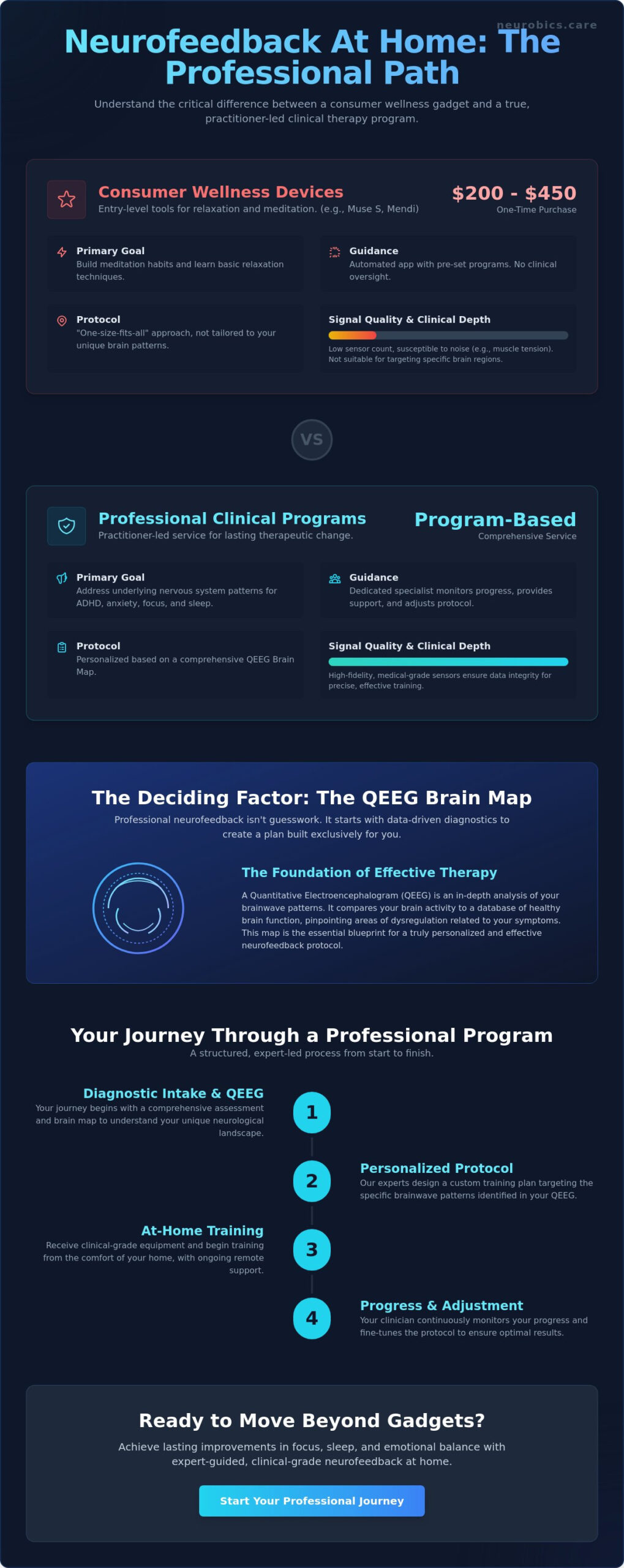
Many people begin their search for neurofeedback therapy at home by browsing consumer electronics sites. It’s easy to fall into the “Gadget Trap.” A $200 or $450 headband might look like a medical device, but there’s a world of difference between a wellness tracker and a clinical instrument. True therapeutic neurofeedback requires high signal quality and precise sensor placement. If the equipment can’t differentiate between your muscle tension and your actual brainwaves, the feedback you receive is essentially noise. Professional systems prioritize high sampling rates and medical-grade sensors to ensure that every session is meaningful and accurate.
Wellness Devices: The Entry Level
Popular devices like the Muse S ($450) or the Mendi ($299) have made brain monitoring accessible to a wider audience. These tools are excellent for building a consistent meditation habit or learning basic relaxation techniques. However, they’re often limited for addressing complex clinical symptoms like ADHD or chronic anxiety patterns. Most consumer gadgets use a “one-size-fits-all” approach. They don’t offer the multi-channel depth needed to target specific regions of the brain identified in a QEEG map. You can read more about Choosing a Neurofeedback Device: Gadgets vs. Clinical-Grade Training to understand these technical trade-offs more deeply.
Clinical-Grade Remote Systems
When you step up to a professional program, the hardware and software change significantly. Clinical systems provided by organizations like Neurobics prioritize data integrity. Instead of just two sensors on the forehead, professional kits often use multi-channel configurations that can be placed exactly where your brain needs support. This allows us to train the specific areas responsible for emotional regulation, executive function, or sleep quality. The real power, however, lies in the software. Professional platforms allow a practitioner to adjust your protocol as you progress. If you’re feeling overstimulated, we can dial back the intensity. This oversight prevents the common issue of “training into a headache,” which can happen when users try to push their brains too hard without expert guidance.
A guided program ensures that your training evolves as your brain does. Without a professional at the helm, you’re essentially flying blind. We believe that technology should serve the individual, not the other way around. If you’re unsure which path is right for your nervous system, you might find it helpful to speak with a specialist about your specific goals.
The Essential Role of QEEG Brain Mapping in Home Therapy
Imagine trying to navigate a complex, unfamiliar city without a GPS or a map. In the world of brain regulation, training without a Quantitative Electroencephalogram (QEEG) is much the same. While consumer gadgets often rely on a one-size-fits-all approach, professional neurofeedback therapy at home begins with this rigorous diagnostic phase. We believe that training without a map is like taking powerful medicine without a blood test; it’s imprecise and potentially counterproductive. QEEG provides a data-driven snapshot of how your brain functions, allowing us to see the unique electrical patterns that drive your daily experience.
For our international clients, Neurobics facilitates at-home QEEG measurements using specialized, clinical-grade kits. We don’t just send a headset. We provide the tools and expert guidance needed to capture high-fidelity data from your own environment. This raw data is then analyzed by our practitioners to identify where your nervous system might be stuck in patterns of over-arousal or under-arousal. This step is what transforms a simple exercise into a clinical intervention.
Visualizing Brain Activity
A QEEG map identifies specific patterns across the scalp. For example, individuals struggling with attention might show excess slow-wave activity in the prefrontal cortex, the area responsible for executive function. By visualizing these patterns, we can create a targeted plan that addresses the root of the symptom. You can explore this process further in our Neurofeedback for ADHD: A Science-Backed Guide. This precision ensures we’re training the right areas to support better focus and emotional balance.
Data-Driven Protocol Design
Our brains operate across various frequency bands, including Delta, Theta, Alpha, Beta, and Gamma. A professional protocol adjusts the reward thresholds based on your unique baseline. If your Theta waves are too high during the day, the system gently rewards your brain when it produces more focused Beta waves. This constant, subtle adjustment is what leads to lasting change.
QEEG is the clinical cornerstone of effective neurofeedback.
By grounding your neurofeedback therapy at home in hard data, we remove the guesswork. This scientific foundation allows us to build a 4-week or 12-week program that is as unique as your fingerprint. If you are ready to see what your brain map reveals, we invite you to reach out to our team for an initial consultation.
What to Expect: Your Journey Through an At-Home Program
Embarking on professional neurofeedback therapy at home is a structured, collaborative process that prioritizes your safety and progress. It doesn’t start with a box on your doorstep; it starts with a deep understanding of your nervous system. Your journey follows a clear clinical path designed to ensure you’re training effectively and safely from your own environment. This isn’t a “plug-and-play” experience, but a guided transformation supported by expert oversight at every milestone.
- Step 1: The Initial Intake and Diagnostic Assessment. We begin with a comprehensive consultation to discuss your history, challenges, and goals. This ensures the program is the right fit for your needs.
- Step 2: Receiving and setting up your clinical-grade equipment. Once your protocol is designed, we ship a professional-grade neurofeedback kit to your home, including high-fidelity sensors and the necessary software.
- Step 3: The first guided session with your Neurobics practitioner. You won’t be left to figure out the technology alone. Your first session is conducted via a live video call where we walk you through sensor placement and software navigation.
- Step 4: Consistent training with remote monitoring. You’ll typically train 2 to 3 times per week. As you train, your data is securely uploaded, allowing your practitioner to monitor your progress and make subtle adjustments to your protocol.
- Step 5: Periodic re-mapping to track physiological changes. Every few weeks, we conduct a follow-up assessment to visualize how your brain activity is shifting and update your training plan accordingly.
Setting Up Your Home Training Space
Creating the right environment is vital for optimal nervous system regulation. You don’t need a dedicated clinic room, but you do need a quiet, comfortable space where you won’t be interrupted for 30 to 45 minutes. The technical setup involves applying a small amount of conductive paste to specific points on your scalp and connecting the sensors to the amplifier. While it might feel unfamiliar at first, most clients become proficient in under five minutes. For a deeper look at the technical requirements, you can explore our Remote Neurofeedback Training: The Professional Guide.
The Experience of a Session
During a session, you aren’t “doing” anything in the traditional sense. You might watch a movie or listen to music while the software monitors your brainwaves. When your brain enters the desired state, the movie plays clearly or the volume stays steady. If your brain drifts into an old pattern, the feedback dims or fades. This subtle reward system is how the brain learns to self-regulate. It’s a marathon, not a sprint; lasting neurological change happens through the steady accumulation of these successful sessions. If you’re ready to begin this process, we invite you to book your initial intake assessment today.
The Neurobics Approach: Expert-Guided Regulation
We believe that mental well-being is too important to be left to an automated algorithm. While some platforms prioritize high-volume automation, the Neurobics approach is rooted in clinical depth and individual attention. Our goal is to provide a bridge between the high standards of a physical clinic and the convenience of neurofeedback therapy at home. We don’t just provide equipment; we provide a structured 4-week or 12-week program that adapts to your nervous system’s specific needs. This duration allows your brain the time it needs to consolidate new patterns of regulation, turning temporary shifts into lasting habits.
One of the most significant barriers to professional training has historically been the cost of clinical-grade hardware. Professional systems often carry a price tag of $5,000 or more, making ownership out of reach for many. Our model removes this hurdle by providing high-end equipment as part of a rental-based program. This ensures you’re training with the same technology used in top-tier clinics worldwide, supported by our headquarters in the Netherlands. Whether you’re in Europe, the Middle East, or beyond, our remote assisted model brings expert care directly to your living room.
Bespoke Protocols vs. Generic Training
Generic apps often treat every user the same, but your brain activity is unique. At Neurobics, our practitioners monitor your data remotely to ensure your safety and progress. This isn’t just about looking at numbers; it’s about listening to your subjective experience. If you find a particular protocol leaves you feeling tired or over-focused, we adjust the settings. This level of personalization is what defines professional neurofeedback therapy at home. You can learn more about how our equipment and oversight compare to other options in our Home Neurofeedback Training Program with Equipment included comparison guide.
Your Next Steps to Better Regulation
The first step toward a more regulated life is determining if this approach is right for you. Every journey begins with a comprehensive intake session. This allows us to understand your goals and ensure that our remote assisted model can meet them. Following the intake, we arrange for a QEEG measurement, which can be done at our office or in the comfort of your home using our specialized kits. This data becomes the foundation for everything that follows.
Taking the first step toward a more regulated nervous system is a significant decision. We’re here to act as your partner in this process, providing the technology and expertise needed to reach your goals. We invite you to contact our team to schedule your initial consultation and begin your path toward improved focus, sleep, and emotional balance.
Taking the Next Step Toward Lasting Brain Regulation
Choosing professional neurofeedback therapy at home is a commitment to your long term mental clarity and emotional resilience. You now understand that effective training requires more than a simple wellness gadget; it demands the precision of a QEEG-informed protocol and the steady hand of an experienced practitioner. By prioritizing clinical depth over automated apps, you ensure that your brain receives the specific rewards it needs to thrive. This structured approach moves you beyond temporary relief toward a fundamentally more regulated nervous system.
Neurobics brings over 15 years of clinical experience in brain regulation to our international clients. As a practice registered with the Dutch Healthcare Federation (NFG) and RBCZ, we provide a level of professional accountability that goes beyond typical consumer offerings. Our personalized protocols are designed to turn these technological possibilities into tangible improvements in your focus, sleep, and overall quality of life. You don’t have to settle for generic solutions when clinical-grade care is available in your own living room.
A more balanced mind starts with a single, informed decision. We invite you to book a professional intake session with Neurobics today and discover how a personalized approach to brain training can support your journey. Your path to better self-regulation is ready whenever you are.
Frequently Asked Questions
Is neurofeedback therapy at home as effective as in-clinic sessions?
Remote training is just as effective as in-clinic sessions when you use professional-grade equipment and follow a QEEG-informed protocol. The primary driver of success is consistency. Training neurofeedback therapy at home allows for a more regular schedule without the stress of commuting. A 2022 study confirmed that digital, therapist-guided neurofeedback is a feasible and effective way to improve mental health markers and cognitive performance.
How much does professional at-home neurofeedback therapy cost?
The cost of a professional program depends on the length of the protocol and the level of practitioner support required. Most comprehensive programs include an initial diagnostic assessment, equipment rental, and ongoing remote monitoring. This model makes high-end technology accessible without the significant upfront investment of purchasing a clinical system. We recommend a consultation to determine which structured program fits your specific goals and requirements.
Do I need a medical diagnosis to start at-home neurofeedback?
You don’t need a medical diagnosis to begin training with us. Neurobics focuses on nervous system regulation and self-regulation skills rather than medical diagnosis or traditional psychotherapy. We use QEEG brain mapping to identify patterns of activity that contribute to stress or lack of focus. If you have a pre-existing medical condition, we suggest coordinating with your healthcare provider to ensure neurofeedback is a supportive addition to your wellness plan.
Can I use my own device, like a Muse or Emotiv, with Neurobics?
We generally don’t use consumer-grade devices like Muse or Emotiv for our professional protocols. While these tools are excellent for basic relaxation, they often lack the signal precision and sensor flexibility required for targeted clinical training. Neurobics provides medical-grade hardware specifically designed for remote assisted neurofeedback. This ensures that the data we collect is accurate and that your personalized protocol is based on high-fidelity brainwave measurements.
How many sessions are typically required to see results at home?
Most clients begin to notice subtle shifts in their sleep or emotional regulation within the first 10 to 15 sessions. However, lasting neurological change typically requires a more extended commitment, such as our 4-week or 12-week programs. Consistency is the most important factor in seeing results. We recommend training two to three times per week to help the brain consolidate new patterns of self-regulation effectively and permanently.
Is at-home neurofeedback therapy covered by health insurance?
Insurance coverage for neurofeedback therapy at home varies significantly by provider and region. While many traditional plans don’t yet cover remote training, some clients are able to use Health Savings Accounts (HSA) or Flexible Spending Accounts (FSA) to fund their programs. We suggest contacting your insurance provider directly to inquire about their specific policies for biofeedback. We provide the necessary documentation to support your reimbursement requests where applicable.
What happens if I have technical issues with the equipment at home?
We provide full technical support to ensure your home setup runs smoothly. If you encounter issues with sensor connection or software synchronization, our team is available to guide you through a resolution. Most challenges are easily fixed during your initial guided session. We monitor the quality of your data remotely; if we notice a signal drop or interference, we’ll reach out to help you adjust your setup for the best possible results.
Are there any side effects to training your brain at home?
Neurofeedback is a non-invasive process, but some users may experience temporary fatigue or a mild headache after a session. This is often a sign that the brain is working hard, much like muscle soreness after a workout. Because Neurobics practitioners monitor your progress and adjust your protocol in real-time, we can minimize these effects. If you feel overstimulated, we simply dial back the intensity of the feedback to keep your training comfortable.
