


What if the key to overcoming burnout or sharpening your focus isn’t a new habit, but a high-definition map of your own unique neural architecture? You’ve likely felt the frustration of trying generic wellness solutions only to find they don’t quite stick. It’s natural to feel overwhelmed by neurological jargon or to worry whether a remote qeeg assessment can truly offer the same precision as an in-clinic visit. At Neurobics, we believe that clarity is the first step toward genuine change, and that starts with seeing exactly how your brain is currently communicating.
This guide will demystify the entire process, showing you how a professional qeeg assessment provides the essential blueprint for personalized neurofeedback and lasting mental regulation. You’ll gain confidence in a data-driven approach that moves beyond guesswork. We’ll walk through exactly what happens during a session, how the latest global standards ensure accuracy for those training at home, and the clear roadmap you need to transition from measurement to effective brain training.
Key Takeaways
- Understand how a qeeg assessment acts as a high-precision blueprint, moving beyond qualitative symptoms to measure your brain’s unique electrical architecture.
- Learn the critical differences between a standard intake and a full brain map to determine which starting point aligns with your cognitive needs.
- Discover how to interpret the colors and patterns of your report, including common neural signatures for focus and stress regulation.
- See how Neurobics brings clinical-grade precision to your home through guided, remote brain measurement and expert-led setup.
- Explore the transition from data to training, where your individual results are translated into a customized neurofeedback protocol for lasting self-regulation.
What is a QEEG Assessment? Understanding the ‘Brain Map’
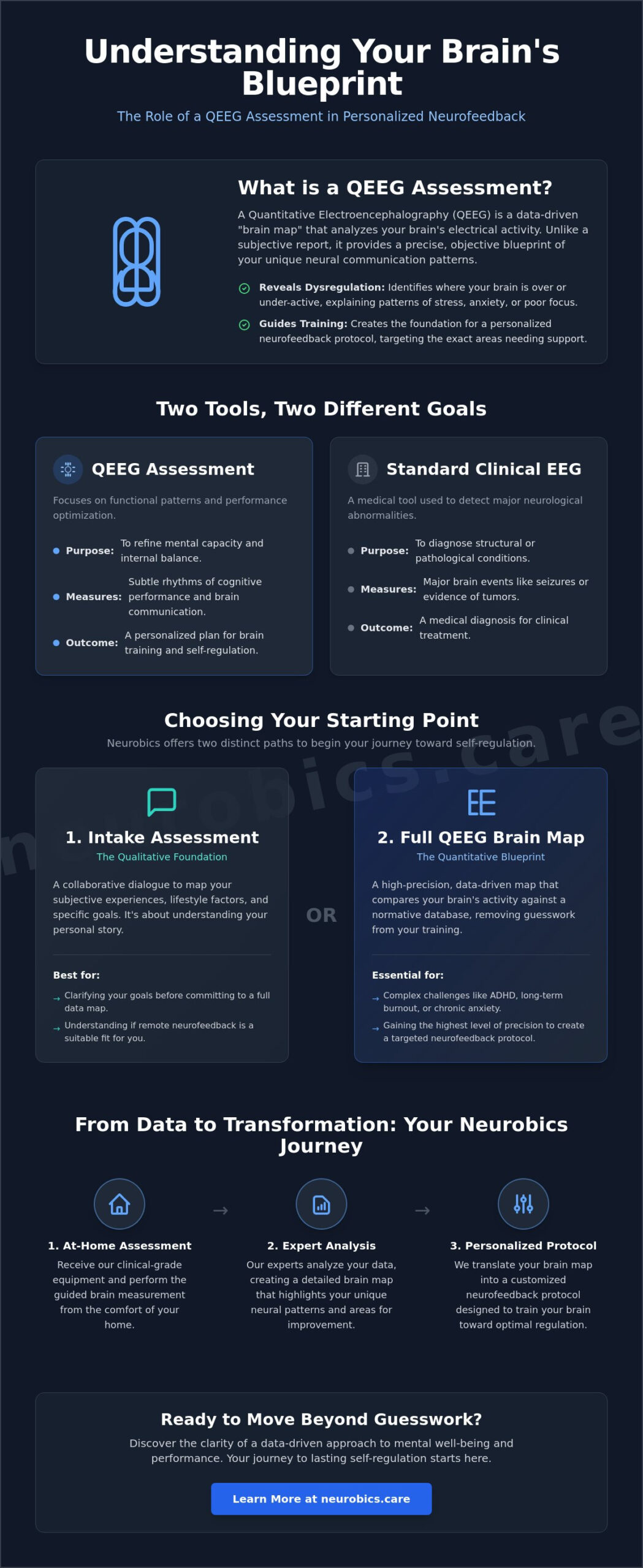
A Quantitative electroencephalography (QEEG) assessment is a sophisticated method of recording and analyzing the brain’s electrical activity. While a traditional EEG provides a raw wave for a clinician to read, a qeeg assessment uses advanced digital processing to turn those waves into a visual map. This map isn’t just a picture; it’s a data-driven blueprint that reveals how your nervous system is managing its resources. Instead of focusing on a medical diagnosis, we look for patterns of dysregulation. These patterns often explain why you might feel stuck in a state of high anxiety or struggle to maintain focus during a long workday.
By using a normative database, we compare your unique brain wave patterns against thousands of healthy, age-matched individuals. This comparison helps us see where your brain is working harder than it needs to or where it isn’t engaging enough. It’s this level of precision that makes the process the gold standard for creating personalized neurofeedback protocols. At Neurobics, we use this information to ensure every training session is targeted exactly where your brain needs support, helping you move toward a more balanced internal state.
The Science of Quantitative EEG
The process begins by measuring microvolts of electrical activity across multiple scalp locations. These tiny signals are sorted into five primary frequencies: Delta, Theta, Alpha, Beta, and Gamma. Each frequency correlates with a different state of mind, from deep sleep to high-level problem solving. We also look at “coherence,” which tells us how well different regions of your brain are communicating. If two areas are too tightly linked, or not linked enough, it can lead to issues with emotional regulation or cognitive flexibility. Neurobics relies on these metrics to ensure your training is clinically informed and deeply personalized.
QEEG vs. Standard Clinical EEG
It’s helpful to distinguish between these two approaches. A standard clinical EEG is primarily used in medical settings to detect major abnormalities like epilepsy, seizures, or tumors. It’s a vital tool for finding what is “wrong” in a structural or pathological sense. In contrast, a qeeg assessment is about optimization. We aren’t looking for disease; we’re looking at the subtle rhythms of cognitive performance. We analyze how your brain functions in real-time, shifting the focus from identifying a condition to refining your mental capacity and internal balance.
Intake Assessment vs. Full QEEG: Choosing Your Starting Point
Deciding how to begin your journey into brain training can feel confusing. You might wonder if you need a deep-dive qeeg assessment right away or if a simpler conversation is enough to get started. At Neurobics, we view the initial intake as the qualitative foundation and the full QEEG as the quantitative blueprint. Most people find that starting with an intake helps clarify their goals before they invest in the detailed data of a full map. This phased approach ensures that we aren’t just collecting data, but rather building a path that makes sense for your specific life situation.
While the intake provides essential context, the qeeg assessment provides the hard data. It’s interesting to look at Aetna’s clinical policy on QEEG, which discusses how this technology is evaluated in various clinical contexts. While insurance providers often look for specific medical necessity, we use the data to build a bridge between your symptoms and a precise training protocol. This data-driven clarity removes the guesswork from your self-regulation journey.
The Clinical Intake Process
This phase is about your story. We look at lifestyle factors, sleep hygiene, and the specific stress triggers that disrupt your day. It’s a collaborative dialogue where we map your subjective experiences to potential neurological patterns. This conversation is essential for determining if you are a suitable candidate for remote neurofeedback training. We want to ensure that the methods we use align with your actual life constraints and your desires for change.
When a Full QEEG is Essential
In certain situations, skipping the map is like trying to navigate a new city without GPS. If you are dealing with complex challenges like ADHD, long-term burnout, or chronic anxiety, the precision of a full map becomes non-negotiable. It allows us to see exactly where brain waves are out of sync. This deep-dive is also the standard for peak performance training. For those who prefer an in-person experience, we offer a specialized QEEG assessment in Groningen, providing the same analytical depth as our remote services.
Choosing the right path doesn’t have to be a solo decision. We’re here to help you weigh these options based on your history and goals. If you aren’t sure where to begin, you can always reach out to our team for a brief conversation about which assessment fits your current needs.
Deciphering the Data: What Your Brain Map Reveals
When you receive the results of your qeeg assessment, you’ll see a series of topographical maps, often referred to as “brain maps.” These maps use a color-coded system to show how your brain’s electrical activity compares to a normative database of healthy peers. Green areas indicate activity within the typical range, while red and orange signify over-arousal, and blue represents under-arousal. This visual representation is powerful because it turns abstract feelings into objective data. It allows us to see the difference between a brain that is simply tired and one that is struggling with deep-seated dysregulation patterns.
Professional interpretation is what gives this data its value. While automated software can flag deviations, an expert looks at the relationships between different brain regions. For example, a high Theta/Beta ratio in the frontal lobes is a well-documented signature often associated with attention challenges. On the other hand, a brain that can’t “down-regulate” often shows excessive High Beta activity, which is frequently seen in those struggling with chronic anxiety. Research into neuropsychiatric disorders confirms that these biomarkers provide a reliable window into the functional state of the nervous system, far beyond what a standard clinical interview can reveal.
Identifying Biomarkers for Focus and Calm
We look for specific “hot spots” where the brain is stuck in a state of high electrical tension. These areas often correlate with intrusive thoughts or an inability to relax. Conversely, “cold spots” of low activity can explain persistent brain fog or a lack of drive. These neural markers are often the underlying cause of ADHD paralysis, where the brain’s executive centers become so overwhelmed by competing signals that they essentially freeze, making even simple tasks feel impossible to start.
Measuring Cognitive Load and Burnout
A qeeg assessment is also an excellent tool for measuring the neurological cost of your daily life. We can see if your brain is “working too hard” to perform basic cognitive tasks, a common sign of impending burnout. Chronic stress often shows up as a depletion of restorative Alpha waves or an unusual presence of Delta waves during the day, which suggests the nervous system is trying to force a state of rest because it’s exhausted. Identifying these patterns helps us set a realistic timeline for your recovery and adjust your training protocol to prioritize nervous system stability.
The At-Home QEEG Experience: Precision in Your Living Room
The shift toward remote care has made a professional qeeg assessment more accessible than ever. You no longer need to travel to a specialized clinic to get high-fidelity data about your neural health. At Neurobics, we ship a medical-grade brain wave monitor directly to your doorstep. This isn’t a consumer gadget; it’s a sophisticated piece of technology used to capture the subtle electrical rhythms of your cortex. Once the kit arrives, we guide you through every step to ensure the sensors have perfect contact with your scalp, achieving the high-quality signal impedance required for clinical accuracy.
The actual recording is a quiet, meditative process that usually takes less than an hour. We capture data in two primary states: eyes open and eyes closed. These different conditions reveal how your brain transitions from active processing to internal rest, providing a complete picture of your regulatory capacity. Throughout the session, a Neurobics practitioner is with you via a secure video link. They monitor the data feed in real-time, checking for “artifacts” like muscle tension or eye blinks that could skew the results. Once the recording is complete, the data is encrypted and sent to our team for exhaustive analysis.
Preparing Your Environment for Success
To get the best results, you’ll need a calm space free from distractions. Electrical noise from nearby appliances or charging cables can sometimes bleed into the recording, so we help you identify the best spot in your home. Simple preparation steps, like ensuring your hair is clean and free of styling products, significantly improve sensor conductivity. These small details ensure your qeeg assessment is as accurate as any performed in a traditional office setting.
The Role of Remote Expert Supervision
Many people worry that “at-home” means “do-it-yourself,” but that isn’t how we operate. DIY brain mapping is prone to error because without expert oversight, it’s easy to record “noise” instead of clean brain waves. Our practitioners act as your partners, answering questions in real-time and adjusting the process as needed. This live supervision provides the safety and clinical rigor necessary for a successful training blueprint. We don’t just send you equipment; we walk the path with you.
If you’re ready to see the data-driven blueprint of your own brain activity, you can book your at-home brain measurement with our expert team today.
From Data to Transformation: Your Neurobics Journey
The journey from a qeeg assessment to actual mental regulation is where the data truly comes to life. Once we have analyzed your brain map, we don’t just hand you a report; we use it as a living blueprint for your training. This ensures that every minute you spend training is focused on the specific areas where your nervous system shows dysregulation. It’s a shift from general wellness to precision care, allowing for a more efficient path toward your goals. We believe that when you can see the data, the process of change becomes much more manageable and less mysterious.
Many people consider the neurofeedback therapy cost an investment in their long-term health and cognitive resilience. By starting with objective data, you avoid the expense and frustration of “trial and error” approaches that often lead to abandoned efforts. As your brain begins to shift and create new pathways, professional support becomes vital. Our practitioners at Neurobics monitor your data and adjust your protocols in real-time, ensuring that your training remains as effective on session twenty as it was on session one. Your brain is a dynamic system, and your training should be just as adaptable.
When considering the financial aspect of long-term health, it can be helpful to compare various high-tech diagnostic tools. For example, you can explore the Professional fees for bio-scan assessments and personalized quantum frequency protocols to understand how holistic clinics price their advanced frequency-based evaluation services.
Personalized Protocol Design
A “one-size-fits-all” approach to brain training often fails because it ignores the unique nuances of your neural architecture. For instance, two people might both struggle with focus, but their qeeg assessment might show completely different causes. One might have an excess of slow-wave Alpha activity in the frontal lobes, requiring an excitatory protocol to “wake up” those regions. Another might have too much high-frequency Beta activity, meaning their brain is too “noisy” to focus. In that case, we design an inhibitory protocol to calm the system down. This level of customization is what makes Neurobics training so effective and relevant to your daily life.
Monitoring Progress Over Time
We don’t just measure at the beginning. After a set period of training, we often recommend a follow-up “re-map.” This allows us to visualize the neuroplastic changes occurring in your brain. It’s incredibly rewarding to see your subjective improvements, like better sleep, sharper focus, or reduced anxiety, reflected in objective brain wave shifts. For those committed to achieving permanent neuroplasticity, understanding the full scope of one year neurofeedback at home can help set realistic expectations for how long lasting change truly takes. This feedback loop between how you feel and what the data shows provides the confidence needed to maintain long-term progress. If you’re ready to start building your own roadmap for mental regulation, please contact us to discuss your personalized assessment plan.
Your Roadmap to Neural Clarity and Balance
A qeeg assessment is more than a technical measurement; it is the first step toward a deeper understanding of your own mental capacity. By moving away from generic solutions and focusing on the specific electrical architecture of your brain, you create a foundation for lasting change. We’ve seen how modern technology and expert supervision bring this level of precision directly into your living room, removing the traditional barriers to high-quality neurological care.
At Neurobics, we combine evidence-aware protocols based on over 15 years of experience with the convenience of remote support. Our practitioners are Dutch Healthcare Federation (NFG) registered, ensuring you receive professional, expert-led guidance throughout your journey. We ship clinical-grade equipment globally, so you can begin your training with the same rigor found in the world’s leading clinics. This data-driven approach doesn’t just measure where you are; it shows you exactly where you can go.
Ready to transform your data into a personalized roadmap for growth and regulation? Book your clinical intake or QEEG assessment with Neurobics today. Your journey toward a more resilient and balanced nervous system starts with a single, clear map.
Frequently Asked Questions
Is a QEEG assessment safe and does it hurt?
A QEEG assessment is entirely non-invasive and painless because it only records the electrical activity your brain is already producing. Unlike some other procedures, it doesn’t send any electricity or signals into your body. You’ll simply wear a comfortable cap with sensors that listen to your brain waves. Most clients find the experience relaxing, similar to a quiet meditation session in their own home.
How long does a full QEEG brain mapping session take?
A standard recording session usually takes between 45 and 60 minutes from start to finish. This timeframe includes the setup of the sensors, ensuring high-quality signal impedance, and the actual recording of both eyes-open and eyes-closed conditions. We prioritize a calm, unhurried pace to ensure the data captured is clean and representative of your typical neural state without causing fatigue.
Do I need to stop my medications before having a QEEG?
You shouldn’t stop taking prescribed medications before your session without first consulting your prescribing physician. While certain substances can influence brain wave patterns, we prefer to see how your brain is functioning in its current daily state. During your intake, we’ll document any medications you’re taking to ensure our interpretation of the qeeg assessment data accounts for these factors accurately and professionally.
What is the difference between a QEEG and an MRI or CT scan?
The primary difference is that a qeeg assessment measures how your brain functions, while an MRI or CT scan looks at its physical structure. An MRI can identify a tumor or injury, but it won’t show how your brain waves are dysregulated. QEEG provides a dynamic view of your brain’s communication patterns, which is essential for designing the effective, personalized neurofeedback protocols offered by Neurobics.
Can a QEEG assessment diagnose ADHD or Autism?
A QEEG is not used to provide a formal medical diagnosis for conditions like ADHD or Autism. Instead, it identifies the functional biomarkers and neural patterns associated with the symptoms you’re experiencing. This information helps us understand your unique neurological signature so we can create a training plan that supports better self-regulation and cognitive performance. We focus on optimization and function rather than clinical labeling.
How often should I have a QEEG re-map during my training?
We typically recommend a follow-up re-map after approximately 20 to 30 neurofeedback sessions. This interval allows enough time for neuroplastic changes to take root and become visible in the data. Comparing your new map to your initial baseline helps us objectively track your progress and refine your training protocol to match your brain’s evolving needs and capabilities as you move toward your goals.
Is the at-home QEEG as accurate as one done in a clinic?
At-home assessments are just as accurate as in-clinic versions when conducted with professional-grade equipment and expert supervision. At Neurobics, we use the same high-fidelity sensors found in top-tier clinics and provide real-time remote guidance via video link. This ensures that the data recorded in your living room meets the strict technical standards required for precise clinical analysis and the creation of targeted training blueprints.
