


What if the most sophisticated neurological assessment you’ve ever received didn’t require a trip to a specialized clinic, but simply a quiet hour in your own living room? For many people struggling with ADHD paralysis or the heavy fog of burnout, the prospect of traveling to a far-off facility often feels like an insurmountable barrier. Fortunately, clinical-grade qeeg brain mapping at home has bridged the gap between professional expertise and personal convenience. It allows you to move past the limitations of generic meditation apps by capturing the unique electrical signatures of your own nervous system without leaving your front door.
At Neurobics, we understand that you’re likely tired of “one size fits all” solutions that don’t seem to touch the root of your stress or lack of focus. We believe that effective mental self-regulation begins with objective data rather than guesswork. In this guide, you’ll discover how a remote assessment provides a clear visual map of your brain activity and serves as the foundation for a personalized training protocol. We’ll explore the transition from feeling mentally stuck to having a data-driven path toward improved focus and lasting resilience.
Key Takeaways
- Understand why a QEEG serves as a sophisticated “weather map” of your brain’s activity, identifying the specific patterns behind feelings of burnout or lack of focus.
- Learn how advanced noise-canceling sensors ensure that qeeg brain mapping at home provides the same clinical accuracy as a traditional in-office assessment.
- Discover the seamless process of using a professional EEG kit with live, remote guidance from a Neurobics expert to ensure high-quality data collection.
- Explore how objective brain data creates a personalized roadmap for neuroplasticity, moving your progress beyond the limitations of generic wellness apps.
- Find out how weekly expert reviews allow your training protocols to be adjusted in real-time based on your brain’s unique response and evolving needs.
Demystifying QEEG Brain Mapping at Home: Beyond Consumer Gadgets
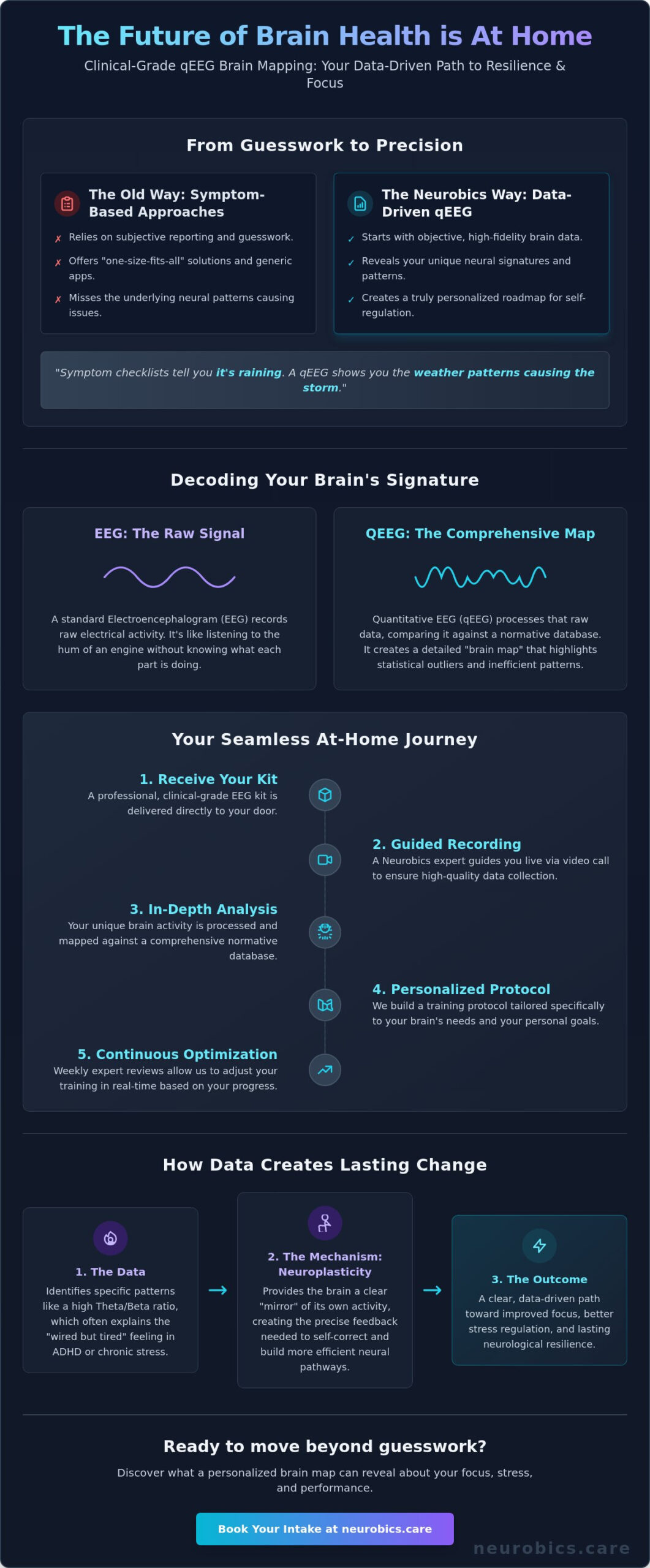
Think of Quantitative electroencephalography (QEEG) as a sophisticated weather map for your mind. While a traditional symptom checklist tells us that it’s raining, a QEEG shows us the high-pressure systems and wind patterns causing the storm. In the past, this level of insight was locked behind the doors of specialized clinics. However, by 2026, the landscape has shifted toward remote-first assessments. This evolution means that qeeg brain mapping at home is no longer a watered-down version of clinical care; it’s a professional-grade tool designed for your natural environment.
Relying solely on a list of symptoms for ADHD, sleep issues, or burnout can be misleading. Symptoms are often the brain’s final cry for help, but the underlying patterns, the “why” behind the “what,” are hidden in your neural rhythms. By capturing this data directly, we move away from guesswork and toward a foundation of objective truth. This data-driven approach is essential because two people might both experience “brain fog,” but one’s brain might be under-aroused while the other’s is over-stimulated. A checklist can’t see that difference, but a map can.
The Difference Between EEG and QEEG
A standard EEG records raw electrical activity, similar to listening to the hum of a distant crowd. QEEG takes that raw data and processes it into a comparative map. It compares your specific brain wave activity, such as Alpha, Beta, and Theta waves, against a normative database of thousands of healthy individuals. This process highlights statistical outliers. If your brain shows an unusual spike in high-frequency Beta waves during rest, it might explain why you feel “wired but tired” or stuck in a cycle of burnout. We use these outliers to pinpoint exactly where your nervous system is struggling to regulate itself.
Why ‘At Home’ Does Not Mean ‘On Your Own’
It’s vital to distinguish between clinical-grade qeeg brain mapping at home and the consumer-grade wellness headbands found in tech stores. While those gadgets can be fun for basic meditation, they lack the precision required for professional neurofeedback protocols. At Neurobics, we ensure data integrity by providing professional oversight throughout the measurement process. You aren’t just wearing a device; you’re participating in a guided clinical assessment. Our experts monitor the signal quality in real-time to ensure the data is clean and actionable. If you’re ready to see what’s actually happening beneath the surface, you can connect with our team to begin the process. This partnership ensures that your home environment becomes a controlled space for genuine neurological insight.
The Science of Brain Mapping: How Data Informs Self-Regulation
The human brain possesses an incredible capacity for change known as neuroplasticity. This isn’t just a theoretical concept; it’s the biological mechanism that allows your nervous system to reorganize itself in response to new information. For this process to be effective, the brain requires a clear mirror to see its own current state. While a standard Electroencephalogram (EEG) provides the raw electrical signal, the quantification of that data is what creates this mirror. By using qeeg brain mapping at home, we provide the brain with the precise feedback it needs to recognize and correct its own inefficiencies.
When you view your brain map, you’re looking at the crossroads of biology and behavior. Many individuals struggling with chronic stress or focus issues feel like they’re fighting an invisible battle. Data changes that. It transforms a vague sense of “feeling off” into a visible pattern of neural activity. This objective foundation is what allows us at Neurobics to move away from general advice and toward a sophisticated, data-driven path for self-regulation. If you’ve ever wondered why your mind feels stuck in a loop, you might find it helpful to speak with a practitioner about what a personal map could reveal.
Mapping the ADHD and Anxiety Brain
In cases of ADHD and anxiety, the brain often shows distinct signatures. A common pattern involves the ratio between Theta waves, which are associated with daydreaming or sleep, and Beta waves, which handle active processing. A high Theta/Beta ratio often correlates with executive function struggles and the “freeze” response known as ADHD paralysis. This creates a “wired but tired” state where the mind is racing but the person cannot take action. You can learn more about how neurofeedback for ADHD uses these maps to target these specific ratios and restore balance.
From Data to Protocol: The Blueprint for Training
Your map serves as a blueprint for your entire training journey. It dictates which areas of the brain require “rewarding” to increase activity and which need “inhibiting” to quiet down. We complement this data with an “Oral Report,” a detailed discussion where we align the map’s findings with your lived experience. This ensures the protocol isn’t just statistically accurate but also personally relevant. Generic protocols often fail because they treat every brain the same. In contrast, qeeg brain mapping at home ensures your training is as unique as your own neural signature, providing a direct route to lasting calm and focus.
Clinical Accuracy in Your Living Room: Home vs. In-Office Measurements
A common question many people ask is whether qeeg brain mapping at home can actually match the data quality of a high-end clinic. It’s a valid concern. In the past, electrical interference from household appliances or poor sensor contact often made remote readings difficult to interpret. However, by 2026, technology has evolved significantly. Modern remote systems now utilize active shielding and noise-canceling EEG sensors that filter out the “background hum” of a typical house. This ensures the raw signal we capture is just as clean as what you’d expect from a sterile, professional lab.
There’s also a distinct psychological advantage to measuring your brain in its natural habitat. Clinical settings can be intimidating. Just as some patients experience “white coat hypertension” where their blood pressure spikes at a doctor’s office, your brain waves can shift when you’re in an unfamiliar, clinical environment. By conducting the assessment in the space where you actually live and work, we get a much more authentic baseline of your nervous system’s default state. This comfort allows for a more accurate representation of how your brain handles daily stressors and focus demands.
You aren’t left to navigate this technology by yourself. During the measurement, a Neurobics expert joins you via a live video link to guide every step of the process. We monitor the signal quality in real-time, checking for “artifacts” like muscle tension or eye blinks that could skew the data. We won’t begin the official recording until we’re certain the sensor placement is perfect. This partnership ensures that the data integrity remains high, regardless of your physical location.
Comparing the Assessment Environments
In a traditional clinic, you benefit from a controlled space, but the travel and the environment itself can act as a stressor for those already dealing with burnout or ADHD. At home, you’re in control of your surroundings. This psychological safety often leads to better data because your brain isn’t in a state of high alert simply because of the location. It’s about understanding the value and outcomes of this investment in your long-term mental health. We’ve found that when clients feel relaxed, their brain maps provide a much clearer picture of their true regulatory capacity.
The Equipment: Clinical-Grade vs. Consumer Headbands
It’s vital to distinguish between a professional qeeg brain mapping at home kit and the simple headbands sold for meditation. Consumer gadgets often use “dry” sensors and only measure a few points on the forehead. While these are fine for basic wellness, they can’t create a full topographic map. For a professional assessment, 19-channel caps are the gold standard. They provide a 360-degree view of your brain’s activity across all lobes. Neurobics uses this clinical-grade hardware for all remote assessments to ensure your training protocol is based on a complete neurological picture.
The Step-by-Step Process of Remote QEEG Assessment
The process of qeeg brain mapping at home is designed to be as seamless as it is scientifically rigorous. We’ve refined the logistics to ensure that physical distance never compromises clinical quality. Your journey begins when we ship a professional EEG assessment kit directly to your door. This isn’t a simplified consumer device; it’s the same high-fidelity hardware used in top-tier research institutions, carefully packed to maintain its calibration during transit.
Once the kit arrives, you aren’t expected to become a technician overnight. We schedule a live video session where a Neurobics expert guides you through the entire setup. We’ll help you place the sensors with precision, checking the impedance levels in real-time to ensure the connection is crystal clear. This guided approach eliminates the anxiety of “doing it wrong” and guarantees that the data we collect is accurate and actionable. If you’re ready to begin this structured journey, you can book your initial intake session to discuss the logistics of your remote assessment.
The actual recording typically takes about 20 to 30 minutes. We capture your brain’s activity in two distinct states, which are “Eyes Open” and “Eyes Closed.” The “Eyes Open” portion shows how your brain handles external stimuli and processing demands. In contrast, the “Eyes Closed” state reveals your nervous system’s resting baseline. After the recording, our team of specialists analyzes the raw data, comparing it against normative databases to identify the specific neural signatures behind your symptoms.
Preparing Your Space for a Success Map
To get the best results, your environment should be a quiet sanctuary. We ask you to choose a comfortable chair in a room with minimal electronic interference, ideally away from humming refrigerators or large computer clusters. Your mental state is equally important. We want to see your brain in its “normal” state. This means being adequately hydrated and alert, but not hyper-caffeinated. Our technician monitors the signal quality throughout the session. They watch for muscle tension or eye flutters that might cloud the data, ensuring the final map is a true reflection of your neurobiology.
The Oral Report: Understanding Your Brain’s Story
We believe that data is only valuable if it’s understood. After the analysis is complete, we hold a collaborative review session called the Oral Report. This is where the graphs and topographical maps are translated into a human story. We don’t just show you where your brain waves are out of sync; we explain how those patterns relate to your daily struggles with ADHD paralysis, sleep, or burnout. This session identifies the “low-hanging fruit,” the specific areas where targeted training can provide the most immediate relief. It’s a deeply personal conversation that turns complex neurology into a clear, hopeful roadmap for your growth.
Personalized Protocols: How Neurobics Translates Data into Performance
The completion of your brain map is the moment where insight turns into action. At Neurobics, we don’t simply hand you a report and leave you to figure out the next steps. We use the data from your qeeg brain mapping at home to build a sophisticated training plan that evolves with you. This transition marks the start of your at-home neurofeedback journey, where we move from observing your brain’s patterns to actively helping it find a more balanced state.
Our approach is rooted in over 15 years of clinical expertise. This experience allows us to see beyond the numbers and understand the nuances of how a nervous system responds to training. Every week, our senior practitioners review your progress data. If your brain shows it’s ready for a more challenging protocol, or if it needs a gentler approach to manage stress, we adjust your settings remotely. You’re never training on a static, “pre-set” program. Instead, you’re benefiting from a dynamic, expert-led process that respects your individual pace of change.
Support Beyond the Sensors
Success in neurofeedback isn’t just about the time you spend with the sensors on. It’s about how that training integrates into your daily life. During your 4-week or 12-week program, you’ll have a dedicated coach to help you navigate the process. We work with you to align your brain training with lifestyle adjustments, such as optimizing your sleep hygiene or managing the sensory demands of your work environment. We also handle the practicalities of international shipping and equipment rentals, so you can focus entirely on your progress. We manage the logistics and security details to ensure the clinical-grade hardware is always ready when you are.
Your Path to Self-Regulation Starts Here
Choosing qeeg brain mapping at home is an investment in your long-term mental resilience. By starting with objective data, you’re giving yourself the best possible chance to achieve lasting emotional stability and mental clarity. There’s a profound peace of mind that comes from knowing your training is informed by science and guided by professionals who’ve spent more than a decade helping people reclaim their focus. If you’re ready to move past generic solutions and see what your brain is truly capable of, the first step is a conversation. Contact Neurobics today to schedule your remote brain map and begin your journey toward a more regulated life.
Your Roadmap to a More Regulated Mind
The journey toward mental clarity doesn’t have to be a series of guesses. By choosing qeeg brain mapping at home, you’re opting for a data-driven foundation that respects your time and your natural environment. You’ve seen how modern clinical-grade hardware and expert guidance turn your living room into a space for professional neural assessment. This process provides the essential “mirror” your brain needs to begin the work of self-regulation and lasting neuroplastic change.
At Neurobics, we bring more than 15 years of clinical experience to every remote assessment. Our NFG and RBCZ registered practitioners ensure that your data is handled with the highest standards of professional care. With clinical-grade hardware delivered globally, we’ve removed the geographical barriers to high-quality neurofeedback. It’s time to stop feeling stuck in cycles of burnout or focus struggles and start understanding the unique rhythms of your own nervous system.
Book your remote QEEG intake and begin your journey to self-regulation. We’re here to partner with you as you build a more resilient, focused, and balanced life. Your path to a better quality of life starts with a single, data-informed step.
Frequently Asked Questions
Is QEEG brain mapping at home as accurate as in a clinical setting?
Yes, modern systems for qeeg brain mapping at home utilize active shielding and noise-canceling sensors to ensure the data is just as clean as a clinic’s. Because we provide live professional oversight during the entire recording, we can monitor signal quality in real-time. This partnership ensures that environmental noise is filtered out, providing a high-fidelity map of your neural activity from the comfort of your own living room.
Do I need to have a medical diagnosis to get a brain map?
No, you don’t need a formal medical diagnosis to benefit from a brain assessment. Our goal is to identify specific patterns of neural dysregulation that might be contributing to your struggles with focus, sleep, or burnout. While we don’t provide medical diagnoses—a service typically handled by clinical specialists such as Pand Health for comprehensive evaluations of thought disorders and autism—we use the data to create a personalized roadmap for self-regulation, helping you understand the biological “why” behind how you feel.
How long does the at-home QEEG recording session take?
The actual recording of your brain waves typically takes between 20 and 30 minutes. However, you should set aside approximately 90 minutes for the entire appointment. This extra time allows for the guided sensor setup, ensuring every electrode has a clear connection, and gives us space to capture both “Eyes Open” and “Eyes Closed” states without rushing the process.
What kind of equipment will be sent to me for the measurement?
We ship a clinical-grade 19-channel EEG cap and a professional amplifier directly to your home. This is the same high-fidelity hardware used in research labs, not a simplified consumer headband. The kit includes everything you need for a successful measurement, including conductive gel and cleaning supplies, all designed to ensure we capture a full, 360-degree topographic map of your brain’s activity.
Can I do the brain mapping and neurofeedback training without a technician?
No, Neurobics does not offer DIY neurofeedback without supervision because professional guidance is essential for safety and efficacy. A trained technician monitors your initial qeeg brain mapping at home to ensure data integrity. Following the assessment, a practitioner reviews your training data every week, adjusting your protocols based on your brain’s unique response to ensure you’re making steady, sustainable progress toward your goals.
Will the brain map tell me if I have ADHD or anxiety?
A brain map reveals the neural signatures often associated with ADHD or anxiety, such as specific Theta/Beta ratios, but it isn’t a standalone diagnostic tool. Instead of a label, it provides a functional look at how your brain processes information and regulates stress. This allows us to target the underlying electrical patterns rather than just managing the symptoms themselves.
Is the QEEG measurement painful or invasive?
Not at all. The process is entirely non-invasive and passive. The sensors in the cap act like tiny microphones that only “listen” to the electrical hum your brain is already producing. No electricity or stimulation is sent into your body during the measurement. Most clients find the session quite relaxing, as it simply requires sitting still in a comfortable chair while the equipment records your natural rhythms.
What happens if I have trouble setting up the sensors on my own?
You won’t have to navigate the setup alone. A Neurobics expert will be with you via a live video link throughout the entire process. We’ll guide your hands as you place the sensors and check the connection quality on our screen in real-time. We don’t start the recording until we’re certain every sensor is perfectly positioned, ensuring you get clinical-grade results regardless of your technical experience.
