


What if the constant struggle to “just focus” isn’t a lack of willpower, but a physiological pattern that your brain simply hasn’t learned to shift yet? For many, the daily reality of ADHD involves a heavy mental tax, where “masking” in professional environments leads to deep exhaustion and “ADHD paralysis” makes even simple tasks feel insurmountable. You’ve likely tried the standard routes, perhaps finding that stimulant medications offer inconsistent results or side effects that leave you feeling disconnected from yourself. It’s a tiring cycle that often feels like you’re running a marathon just to stay at the starting line.
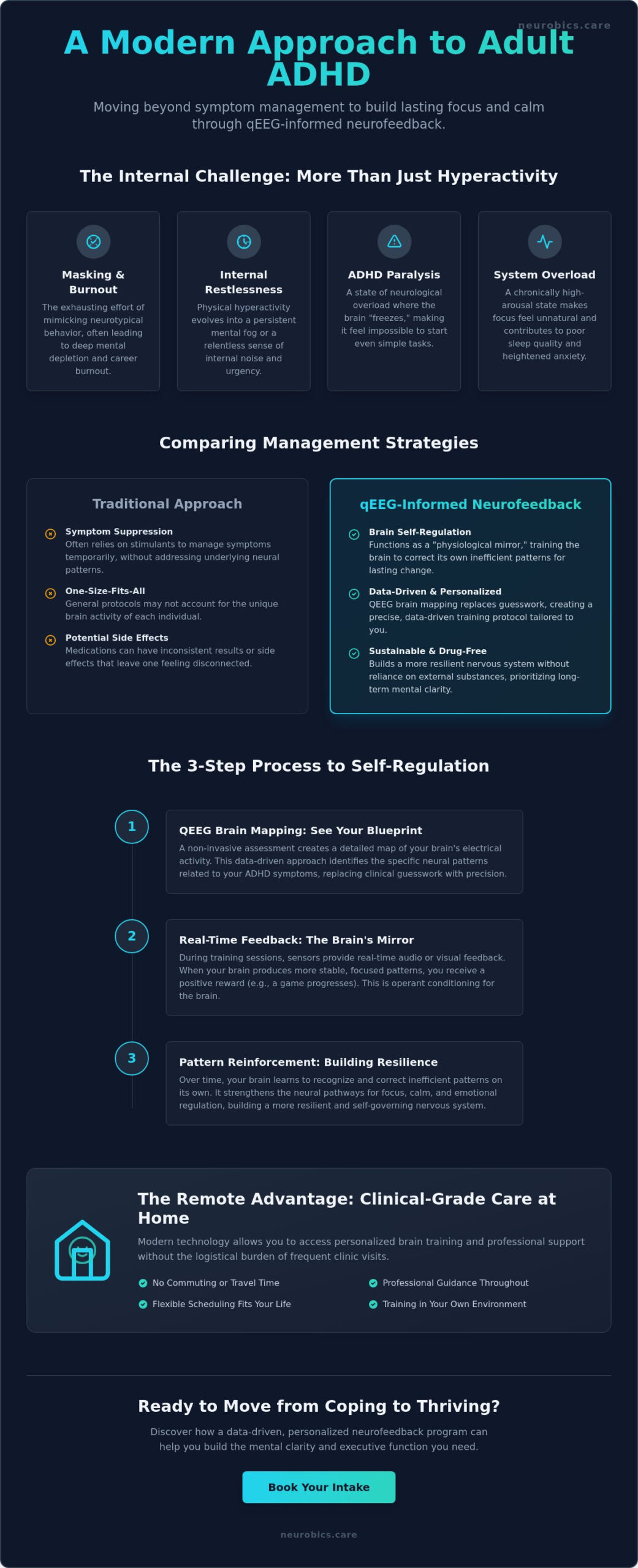
At Neurobics, we believe that managing these symptoms shouldn’t feel like a second full-time job. This is why neurofeedback for adhd adults has become such a vital tool in 2026, offering a bridge between clinical science and daily well-being. By using qEEG-informed data to create a personalized map of your brain’s activity, it’s possible to move beyond temporary symptom management and toward lasting mental clarity. This guide explores how remote neurofeedback provides a sophisticated, drug-free way to improve your executive function and emotional regulation from the comfort of your own home. We’ll preview the process of brain self-regulation and show you how modern technology can help you finally master your own mental state.
Key Takeaways
- Understand how adult ADHD often manifests as internal restlessness and “ADHD paralysis” rather than external hyperactivity, requiring a specialized approach to regulation.
- Learn how neurofeedback for adhd adults functions as a physiological mirror, enabling the brain to strengthen its own self-regulation through real-time feedback.
- Discover the precision of QEEG brain mapping, which replaces clinical guesswork with a data-driven understanding of your unique neural patterns and “phenotype.”
- Explore the evolution of remote technology in 2026, which allows you to access clinical-grade training and professional support without the logistical burden of frequent clinic visits.
- Identify the steps to building a sustainable, drug-free routine that prioritizes long-term mental clarity and executive function through personalized brain training.
Beyond the Diagnosis: Why ADHD in Adults Requires a Different Approach
Adult ADHD rarely looks like the stereotypical image of a child who cannot sit still. For most, the condition evolves into a quiet, relentless internal noise that persists long after the school years end. As we age, physical hyperactivity often retreats inward, transforming into a chronic sense of restlessness or a persistent mental fog. This internal pressure makes it difficult to navigate the high-stakes demands of professional life and personal responsibilities. Traditional management often focuses on suppressing these symptoms through external means, but this “one-size-fits-all” approach fails to address the underlying physiological patterns that drive the experience.
Many adults spend decades perfecting the art of “masking,” which is the exhausting process of mimicking neurotypical behavior to fit into corporate or social structures. While masking might help you survive a board meeting or a social gathering, the long-term cost is frequently mid-career burnout. When your brain is constantly working overtime just to appear focused, your mental reserves eventually deplete. This is where what is neurofeedback? becomes a vital question. It shifts the focus from pretending to be regulated to actually training the brain to find its own physiological balance.
Self-regulation is the true core challenge for the adult brain. It isn’t just about the ability to “pay attention” to a single task; it’s about the brain’s capacity to manage its energy, emotions, and responses to environmental stress. For those exploring neurofeedback for adhd adults, the goal is to move beyond temporary coping mechanisms and build a more resilient, self-governing nervous system. With approximately 3.4% to 4.4% of adults worldwide navigating these challenges, moving toward data-driven, individualized care is no longer a luxury, it’s a necessity for sustainable well-being.
Understanding the ‘Freeze’ Response and ADHD Paralysis
Have you ever found yourself staring at a simple to-do list, knowing exactly what needs to be done, yet feeling physically unable to take the first step? This state of neurological overload is known as ADHD paralysis. It happens when the brain’s executive centers become overwhelmed by competing signals, causing the system to “freeze” rather than prioritize. By understanding ADHD paralysis as a physiological event rather than a lack of motivation, we can stop viewing it as a character flaw. Neurofeedback for adhd adults helps train the brain to navigate these high-pressure states without defaulting to a total system shutdown.
The Role of the Nervous System in Adult Focus
Focus isn’t a product of pure willpower; it’s a byproduct of a well-regulated nervous system. If your brain is stuck in a state of chronic high-arousal, sustained attention becomes nearly impossible because the body believes it’s under constant threat. This is why ADHD is so frequently linked with poor sleep quality and heightened anxiety. At Neurobics, we view focus through the lens of “brain fitness.” This is a long-term strategy where we improve the brain’s flexibility and resilience. Instead of forcing concentration through sheer effort, we use technology to help the nervous system return to a calm, alert state that makes focus feel natural.
The Science of Self-Regulation: How Neurofeedback Retrains the Adult ADHD Brain
Neurofeedback is a non-invasive method of operant conditioning that focuses on training brain wave patterns to function more efficiently. Unlike passive interventions that rely on external substances, this process encourages the brain to take an active role in its own regulation. It works by providing a “Mirror Effect,” where real-time data about neural activity is reflected back to the individual. When the brain sees its own dysregulation in real time, it can begin to recognize and correct these patterns. Neurofeedback for ADHD serves as a foundational tool for strengthening the brain’s inhibitory control, allowing for better management of impulsive responses and internal distractions.
A common misconception is that the adult brain is “hard-wired” and incapable of significant change. However, modern neuroscience in 2026 continues to confirm the power of neuroplasticity in adults. The mature brain remains remarkably capable of forming new, more efficient neural pathways when provided with the right stimulus and consistent feedback. By repeatedly reaching more regulated states during training, these temporary shifts eventually consolidate into permanent traits. This means the improvements in focus and emotional stability aren’t just fleeting moments; they become a new baseline for how your brain operates.
Brain Waves and the ADHD Pattern
In the context of adult ADHD, we often look at the relationship between slow-wave (Theta) and fast-wave (Beta) activity. Many adults with ADHD exhibit a pattern of “under-arousal,” where an excess of Theta waves during tasks leads to daydreaming, distractibility, and a sense of being “foggy.” The goal of understanding brain self-regulation is to learn how to reduce this excess Theta while increasing Beta power. Higher Beta activity is associated with sustained cognitive engagement and the ability to process information without becoming overwhelmed by the environment.
Operant Conditioning: Training Your Brain Like a Muscle
The training process relies on a simple reward mechanism. During a session, visual or auditory cues signal your brain when it’s “on track.” For example, a movie might play clearly when your brain produces the desired focus-related waves and dim when it wanders. This immediate feedback loop is how the brain learns through operant conditioning. It isn’t a passive experience; it’s an active workout for your nervous system. Repetition is vital here. Just as you wouldn’t expect a single gym session to transform your physical health, consistent neurofeedback for adhd adults is what builds the long-term resilience needed for daily life.
If you’re curious about how your specific neural patterns influence your daily focus, reaching out for expert guidance can help you determine if this physiological approach is the right fit for your goals.
QEEG Brain Mapping: The Precision Difference in ADHD Management
Many standardized approaches to ADHD management rely on subjective checklists or observational reports. While these are useful starting points, they often lack the precision needed to understand why a specific individual struggles with executive function. Quantitative Electroencephalography, or QEEG, changes this by providing a data-driven look at your neural activity. It moves the conversation away from clinical guesswork toward a precise understanding of your unique brain signature. When we implement neurofeedback for adhd adults, the QEEG acts as our primary diagnostic compass, ensuring that every training session is tailored to your specific needs.
ADHD isn’t a monolith. Some adults present with an “under-aroused” phenotype, characterized by excessive slow-wave activity that feels like mental fog. Others may have an “over-aroused” pattern, where the brain is constantly on high alert, leading to impulsivity and internal restlessness. Without a QEEG, a practitioner might apply a protocol that accidentally increases arousal in an already over-active brain, leading to agitation. A personalized map identifies these specific phenotypes, allowing for a more nuanced and safer approach to training.
Visualizing Your Brain’s Activity
The data collected during a QEEG measurement is transformed into a visual brain map. This map highlights specific nodes and networks that may be out of balance, particularly those responsible for emotional control and decision-making. For many of our clients at Neurobics, seeing this map for the first time is a powerful experience. It provides objective validation that their struggles with focus or “ADHD paralysis” aren’t a matter of character, but a measurable physiological reality. This visualization helps bridge the gap between how you feel and what your brain is actually doing.
Why Personalized Protocols Matter for Adults
Adults often present with a complex mix of symptoms, including co-occurring anxiety or sleep disturbances. A standardized protocol might ignore these nuances. By using a personalized map, we can integrate protocols that address both the core ADHD patterns and these secondary challenges. It’s also why expert interpretation is essential. While automated algorithms have their place, they cannot replace the nuanced judgment of a clinical professional who understands the context of your life and goals. At Neurobics, we use these maps to build a bespoke roadmap for your remote training journey, ensuring that your path toward self-regulation is both safe and effective.
Remote vs. In-Clinic Neurofeedback: Navigating Options for 2026
The landscape of brain training has transformed significantly over the last few years. Previously, accessing high-quality care meant traveling to a specialized clinic multiple times a week, a logistical hurdle that often felt impossible for adults already struggling with time management. In 2026, the evolution of remote technology has brought clinical-grade EEG hardware directly into the home. This shift isn’t just about convenience; it’s about making neurofeedback for adhd adults a sustainable part of a busy professional life. By removing the “ADHD tax” of travel time and rigid scheduling, home-based programs allow for the consistency that neural change requires.
However, as remote options proliferate, a clear divide has emerged between consumer-grade gadgets and professional-grade training. You might see “meditation headbands” or simple apps marketed for focus, but these rarely offer the medical-grade sensors or the medically informed protocols found in a clinical setting. Professional remote training uses the same medical-grade amplifiers you’d find in a top-tier facility, ensuring the data being used to train your brain is accurate and reliable. When evaluating the long-term value, it’s helpful to consider the neurofeedback therapy cost in the context of lasting self-regulation versus the recurring mental and financial toll of unmanaged symptoms.
What Makes Professional Remote Training Effective?
High-quality remote training succeeds because it combines sophisticated hardware with expert oversight. At Neurobics, we use medical-grade sensors that provide a clean signal, which is essential for the brain to learn effectively. A remote practitioner monitors your progress behind the scenes, adjusting your protocols based on the data your brain produces during each session. This professional guidance is what turns a simple device into a therapeutic tool. Because you can train 3 or 4 times a week without leaving your house, your brain receives the frequent reinforcement it needs to consolidate new, healthier patterns much faster than it would with occasional clinic visits.
Criteria for Choosing a Remote Provider
Selecting the right provider is critical for your success and safety. A reputable remote program should always begin with a QEEG brain map to ensure the training is tailored to your specific neural phenotype. If a provider offers a “one-size-fits-all” headset without an initial measurement, it’s a significant red flag. You should also look for clinical support; you shouldn’t be left to interpret your own data or troubleshoot the technology alone. International trust is often built on rigorous standards, which is why we prioritize professional accreditation and evidence-aware protocols in every journey we support.
If you’re ready to see how a tailored home program can fit into your daily routine, you can speak with our team about remote assisted neurofeedback to explore the best path forward for your specific goals.
Implementing a Sustainable Protocol: The Neurobics Remote Model
Moving from the theory of brain training to daily practice requires a structured, supportive framework. The Neurobics remote model is designed to make neurofeedback for adhd adults accessible without sacrificing the clinical depth found in traditional settings. Our journey begins with an at-home QEEG brain measurement, which provides the objective data needed to build your custom protocol. Once your unique neural signature is mapped, we provide the professional-grade equipment and guidance necessary to begin your sessions. This approach bridges the gap between high-level expertise and the quiet comfort of your own living room, ensuring that your training fits seamlessly into your life.
A typical program usually spans 12 weeks, though many individuals begin to notice subtle shifts in their internal state within the first 4 weeks of consistent training. During this time, your brain is learning to sustain states of focus and calm that previously felt out of reach. The ultimate goal isn’t to stay in training forever. Instead, we aim for “graduation,” a point where your brain has integrated these self-regulation skills so deeply that it can maintain its own balance. This results in a “self-tuning” brain that no longer requires the constant reinforcement of a training device to navigate the demands of a professional environment.
Your Training Experience at Home
Setting up your training space is a straightforward process. The remote equipment provided by Neurobics is designed for ease of use, allowing you to focus on the mental workout itself rather than the technology. You’ll participate in live weekly sessions with an expert who reviews your data and refines your technique. These interactions ensure that you’re never training in a vacuum and that your protocol is always evolving alongside your progress. We also help you track real-world improvements across three key pillars: sustained focus during the workday, more stable emotional regulation, and improved sleep quality. By monitoring these metrics, we ensure the training translates into a tangible increase in your quality of life.
Taking the First Step Toward Regulation
The intake assessment is the most critical part of this journey. It’s where we listen to your history, understand your specific challenges with “ADHD paralysis” or professional burnout, and determine if our model is the right fit for your nervous system. If you’re currently working with a care team or a therapist, we encourage open communication. You can explain that you’re looking into neurofeedback for adhd adults as a physiological tool to support the cognitive or behavioral work you’re already doing. It’s a complementary approach that focuses on the biological foundation of your focus and emotional state.
If you’re ready to move beyond managing symptoms and start building a more regulated brain, we invite you to book an intake assessment or contact our team to learn more about our remote assisted neurofeedback programs. Making an informed, data-driven decision is the first step toward achieving a more clear and balanced mental state.
The Path Toward Sustainable Self-Regulation
Recognizing that adult ADHD is a physiological pattern rather than a character flaw is the first step toward meaningful change. By moving beyond the cycle of masking and burnout, it’s possible to work directly with your brain’s unique neural signatures. We’ve seen how QEEG mapping removes the guesswork, offering a level of precision that traditional management often overlooks. In 2026, neurofeedback for adhd adults has become a sophisticated, accessible bridge between clinical science and the practical demands of your daily life.
At Neurobics, we combine over 15 years of clinical expertise with personalized, QEEG-informed protocols. We ship professional equipment globally and provide the expert remote guidance necessary to ensure your training is both safe and effective. You don’t have to navigate these challenges alone; the technology and support are now available to help you build a more resilient, self-governing brain. Ready to see what your brain is doing? Book an at-home QEEG assessment with Neurobics today and begin your journey toward lasting mental clarity. You have the capacity for growth, and we’re here to help you unlock it.
Frequently Asked Questions
Is neurofeedback for ADHD adults permanent?
The improvements gained through neurofeedback are typically long-lasting because the process involves operant conditioning, which is a form of deep learning. Just as your brain doesn’t forget how to ride a bicycle, it tends to retain the self-regulation skills developed during training. While some individuals choose to do occasional tune-up sessions after their initial program, the structural changes in neural pathways often provide a lasting shift in how the brain manages focus and stress.
How many neurofeedback sessions are needed for ADHD in adults?
A typical course of neurofeedback for adhd adults involves between 20 and 40 sessions to achieve significant and sustainable results. Some individuals with more complex neural patterns or co-occurring conditions might benefit from 75 or more sessions. Consistency is the most important factor, which is why we often recommend training three to four times per week during the active phase of your program to reinforce new neural habits.
Can I do neurofeedback at home without a doctor?
While consumer-grade devices are available, clinical-grade results require professional supervision and a QEEG-informed protocol. At Neurobics, we offer remote assisted neurofeedback, which provides the convenience of home training with the oversight of an expert practitioner. This ensures your sessions are safe and adjusted based on your actual brain data rather than a generic algorithm, which is essential for effective self-regulation.
Does insurance cover neurofeedback for ADHD in 2026?
Insurance coverage for neurofeedback remains inconsistent and isn’t guaranteed by most providers in 2026. Many clients choose to pay out-of-pocket or utilize Health Savings Accounts (HSA) and Flexible Spending Accounts (FSA) to manage the costs. It’s always best to contact your insurance provider directly to check for any specific coverage options or reimbursement possibilities available for neurofeedback services in your region.
What are the side effects of neurofeedback for adults?
Side effects are generally mild and temporary, often described as a “mental workout” fatigue. Some people experience a slight headache or a sense of tiredness immediately after a session as the brain adapts to new patterns. These sensations usually resolve quickly on their own. Because the process is non-invasive and doesn’t involve chemicals, it doesn’t carry the systemic side effects often associated with traditional stimulant medications.
How does neurofeedback compare to ADHD medication?
Medication works by temporarily altering brain chemistry to manage symptoms, whereas neurofeedback focuses on training the brain’s underlying physiology for long-term change. While medication is effective for many, its benefits typically stop when the dose wears off. Neurofeedback aims to build the brain’s natural capacity for self-regulation, providing a drug-free alternative or a complementary tool that addresses the root neural patterns of ADHD.
Can neurofeedback help with ADHD-related anxiety and burnout?
Yes, neurofeedback is effective at addressing the nervous system dysregulation that leads to anxiety and burnout. Many adults with ADHD suffer from “over-arousal” patterns where the brain is stuck in a high-stress state. By training the brain to shift into a more calm and alert rhythm, we can reduce the internal noise that contributes to chronic overwhelm and the mental tax of masking in professional environments.
What is the success rate of neurofeedback for adult ADHD?
While outcomes vary based on individual physiology and consistency, many practitioners and patients report high satisfaction with the improvements in focus and emotional regulation. Success in neurofeedback for adhd adults is often measured by a reduction in “ADHD paralysis” and an increased ability to handle complex tasks without feeling overwhelmed. A QEEG-informed approach significantly improves these outcomes by ensuring the training is precisely matched to your brain’s specific needs.
