


What if the most sophisticated brain training technology didn’t require a commute to a clinic, but simply a comfortable chair in your own living room? For many, the idea of starting a neurofeedback session at home process feels both promising and slightly intimidating. You might worry about placing sensors correctly or wonder if you can achieve clinical results without a practitioner standing right next to you. At Neurobics, we understand that professional care is about the partnership between expert guidance and advanced technology, no matter where you’re sitting.
It’s completely normal to feel a bit of technical anxiety or skepticism about remote effectiveness. However, you don’t need to be a neuroscientist to succeed with this method. This article will show you exactly how our clinically supervised approach works, from the very first brain map to the real-time feedback you’ll receive during your daily sessions. We’ll explore the structured routine that makes progress visible and explain how we ensure your training remains precise, safe, and deeply personalized to your unique nervous system. By the end of this guide, you’ll have a clear, jargon-free roadmap for your journey toward better mental clarity and balance.
Key Takeaways
- Learn why professional-grade EEG equipment and qEEG brain mapping are essential for achieving clinical results that basic consumer headbands cannot provide.
- Master the neurofeedback session at home process by following a clear, step-by-step guide on sensor placement and signal verification for accurate training.
- Discover how the “Remote Assisted” model ensures your safety, as Neurobics practitioners review your brainwave data to maintain protocol precision.
- Understand the importance of weekly clinical check-ins for tracking your progress and making the necessary adjustments for long-term nervous system regulation.
- Gain a realistic perspective on the 20 to 40 session timeline typically required to move from professional support to independent, lasting brain self-regulation.
Understanding the Professional At-Home Neurofeedback Process
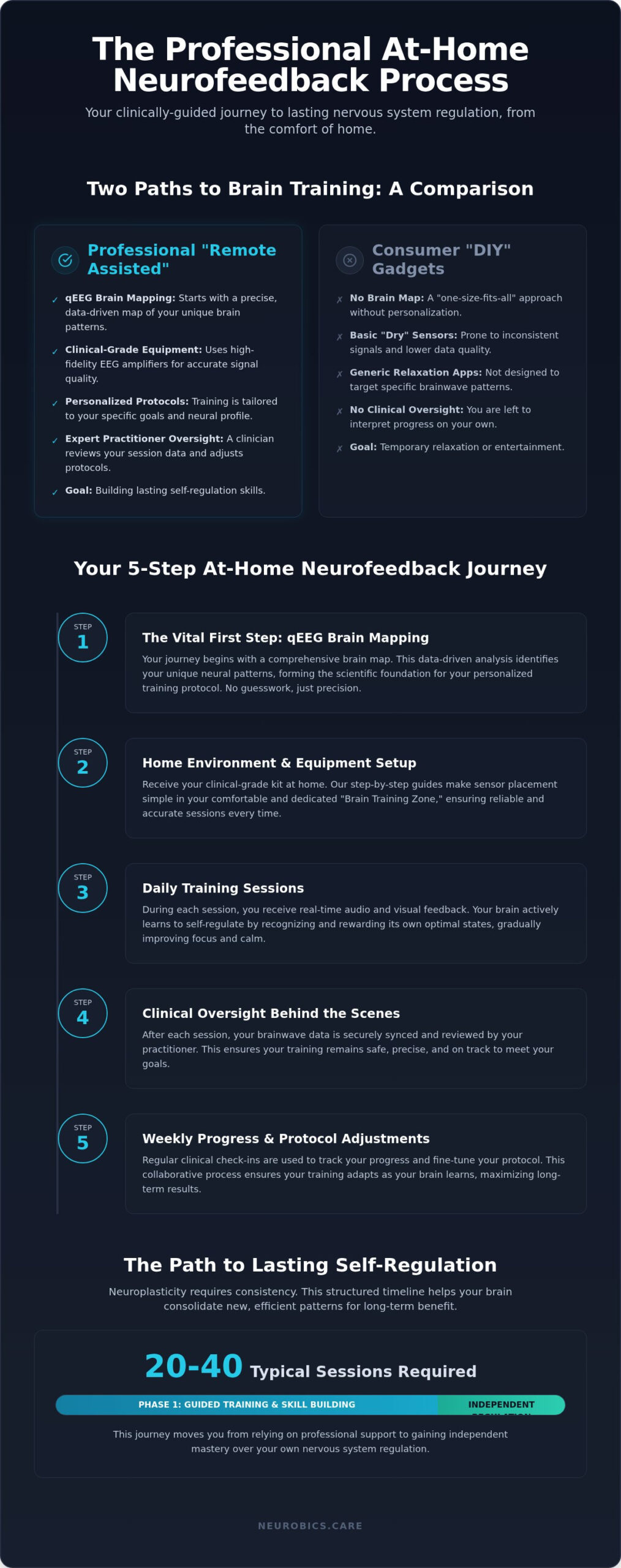
Professional at-home neurofeedback is far more than a simple wellness app or a gadget you find in a tech store. It’s a sophisticated, clinically guided method of brain self-regulation that brings the precision of a high-end clinic directly to your living room. When we talk about the neurofeedback session at home process, we’re describing a partnership between modern technology and human expertise. This isn’t about passive listening; it’s about active learning. Your brain is incredibly adaptable, a quality known as neuroplasticity. Through real-time feedback, your nervous system learns to recognize and reward its own optimal states, gradually improving focus, emotional balance, and stress regulation.
To understand the foundations of this work, it’s helpful to look at What is Neurofeedback in a clinical context. Unlike consumer-grade devices that offer generic relaxation, the professional EEG systems used by Neurobics capture a high-resolution picture of your brain’s electrical activity. This data allows us to target specific patterns rather than applying a “one size fits all” approach. The goal is to move beyond temporary relief and build lasting mental capacity.
The Vital First Step: QEEG Brain Mapping
Every successful journey starts with a map. Before you ever begin a training session, we conduct a Quantitative EEG (QEEG). This process identifies your unique brainwave patterns, highlighting areas where your nervous system might be stuck in “high alert” or “low energy” modes. This data is the cornerstone of your experience. It informs a custom-tailored protocol designed specifically for your goals, ensuring that every minute you spend training is purposeful. Without this initial map, training is merely guesswork; with it, we can address the root of your symptoms with clinical precision.
Remote Assisted vs. DIY Training
There is a significant difference between “doing it yourself” and being “remote assisted.” Most consumer headbands are designed as standalone toys with limited clinical utility. At Neurobics, we provide professional-grade equipment as part of a structured program. The neurofeedback session at home process is overseen by experienced practitioners who interpret your data after every session. We don’t just give you a device and hope for the best. We provide the expert oversight needed to ensure you’re training safely and effectively, adjusting your protocol as your brain begins to shift and stabilize. This clinical precision is what transforms a simple exercise into a life-changing development in self-regulation.
Preparing Your Home Environment and Equipment
Consistency in your physical space is a powerful ally in brain training. By establishing a dedicated “Brain Training Zone,” you leverage associative learning. Over time, simply sitting in your designated chair signals to your nervous system that it’s time to transition into a state of focused regulation. Technical reliability is equally essential. A stable internet connection ensures that your session data syncs seamlessly with our servers, allowing your practitioner to review your progress and maintain the clinical integrity of your protocol.
The Hardware: Clinical-Grade Sensors at Home
The quality of your training depends entirely on the quality of the signal. While many consumer headbands use “dry” sensors for convenience, these often struggle to maintain a consistent connection through hair. We prioritize precision, using sensors that often require a small amount of conductive gel or saline to ensure a clear, high-resolution reading. Although this sounds technical, our step-by-step tutorials make the placement process easy to master within your first few tries. At the center of this setup is the EEG amplifier; think of it as the essential “translator” that converts your brain’s microvolt signals into a language the software can interpret and reward.
Creating the Ideal Training Atmosphere
Your brain is highly sensitive to sensory input during a session. To maximize neuroplasticity, you should minimize external distractions like harsh lighting, sudden noises, or interruptions from family members. Your physical comfort is also a clinical requirement. We encourage a relaxed but upright posture to prevent muscle tension. Clenching your jaw or shrugging your shoulders creates “artifacts,” which is essentially electrical noise that can drown out your actual brainwaves. Finding a quiet window in your schedule when you feel alert but not rushed allows your nervous system to be at its most receptive. If you’re unsure how to optimize your specific living space for training, you can always contact us for practical tips from our experienced team.
A Step-by-Step Walkthrough of a Typical Session
Once you’ve established your dedicated training space, the daily neurofeedback session at home process becomes a rhythmic, calming part of your routine. It typically begins with a simple hygiene step: using a small alcohol swab to clean the specific areas of your scalp and ears where the sensors will rest. This ensures the best possible electrical contact. You’ll then apply a tiny amount of conductive paste to the sensors and place them according to the personalized protocol derived from your initial qEEG map. While this might feel unfamiliar at first, most Neurobics clients find they can complete this preparation in under five minutes after just a few practice runs.
Before the actual training begins, the software performs a signal check. This is a vital moment where you’ll see a visualization of your raw brainwaves on the screen. The goal here is to ensure “clean” data, meaning the sensors are picking up your brain activity rather than “noise” from blinking eyes or tensed jaw muscles. Once the software confirms a stable connection, you simply select your preferred feedback medium, such as a gentle piece of music, a nature documentary, or a simple game, and begin the training phase.
The Feedback Loop: How Your Brain Learns
The core of the session is a sophisticated feedback loop. As you watch a movie or listen to audio, the software monitors your brainwaves in real-time. When your brain activity meets the specific targets set in your protocol, you’re rewarded. The screen might become brighter, the volume might increase, or a game character might move forward. If your brain drifts away from these targets, the feedback subtly fades. This is a passive learning experience; you don’t need to “will” your brain to change. You simply relax and observe. Your brain, naturally seeking the reward of the clear image or sound, begins to reorganize itself to stay in those optimal states. The software adjusts the difficulty thousands of times per second, ensuring your nervous system stays challenged without becoming frustrated.
Duration and Frequency
A typical session involves about 30 to 45 minutes of active training. While you might feel a sense of mental relaxation immediately, lasting change comes from consistency. We generally recommend training three to five times per week to build the neuroplastic momentum necessary for permanent shifts in self-regulation. To understand how these sessions fit into a broader clinical framework, you can explore our At-Home Neurofeedback: The Complete Guide to Professional Remote Brain Training in 2026. At the end of every session, you simply remove the sensors and close the app. Your data is then automatically and securely uploaded, allowing your Neurobics practitioner to review the nuances of your progress before your next check-in.
Clinical Oversight: What Happens Behind the Scenes
Many people hesitate to start a remote program because they fear being “on their own” with complex technology. The Neurobics remote assisted model removes this uncertainty entirely. Every time you conclude a neurofeedback session at home process, your training data is securely and automatically uploaded to our clinical dashboard. This isn’t just a storage step; it’s an active handoff. Your dedicated practitioner reviews the session’s nuances to ensure the EEG signal remained clean and that you were training within the target parameters. This continuous oversight maintains the same high clinical standards you’d expect from an in-office visit, providing a safety net that generic consumer apps simply cannot offer.
Data Analysis and Progress Tracking
We use objective metrics to track your progress with surgical precision. By comparing your current session data against your initial baseline QEEG, we can see exactly how your nervous system is adapting to the training. We look for specific markers that indicate progress, such as:
- Amplitude shifts in targeted brainwave frequencies
- Improved coherence and connectivity between brain regions
- Consistency of signal quality across multiple sessions
This data-driven approach allows us to see progress even before you might notice it yourself. It’s a proactive way to manage your brain health. Crucially, protocol adjustments are made frequently to prevent “over-training” or mental fatigue, keeping your brain in a state of optimal learning without pushing it toward exhaustion. We treat your brain with the care and precision it deserves.
Communication with Your Neurobics Specialist
The weekly video or audio call is the heart of our 4-week and 12-week programs. During these sessions, we bridge the gap between technical data and your lived experience. During our weekly calls, we discuss how the neurofeedback session at home process is integrating into your daily life. We want to hear about your “real-world” changes. Perhaps you’re finding it easier to stay calm during a stressful workday, or your sleep has become deeper and more restorative. These subjective reports are just as important as the EEG readings. They help us fine-tune your training to ensure the technical protocol translates into tangible quality-of-life improvements. To dive deeper into how this process supports nervous system health, explore our guide on What is Neurofeedback? A Comprehensive Guide to Brain Self-Regulation in 2026.
If you’re ready to start your own clinically supervised journey toward better brain performance, you can book an intake session today to discuss your specific needs with our expert team.
Your Journey Toward Lasting Self-Regulation
The neurofeedback session at home process is designed to build a foundation for long-term mental resilience. While some clients feel subtle shifts in their first few weeks, the true power of this work lies in the cumulative effect of repeated training. Typically, it takes between 20 to 40 sessions to consolidate the neuroplastic changes necessary for permanent shifts in brain function. During this time, your brain isn’t just reacting to feedback; it’s learning to maintain those optimal states of focus and calm on its own. This transition from clinical support to independent regulation is the ultimate goal of every Neurobics program.
As you progress through your personalized protocol, you’ll likely notice these internal shifts translating into your external life. For many of our clients, this looks like a significant reduction in the mental fog associated with burnout or a newfound ability to stay on task at work or school without the typical struggle. These improvements aren’t temporary fixes. Because we’re training the brain’s underlying self-regulation capacity, the benefits tend to stay with you long after the active training phase ends. Once you’ve reached your goals, you can simply return the equipment or discuss a long-term maintenance plan to keep your cognitive performance at its peak.
Investing in Your Cognitive Health
Choosing to engage in the neurofeedback session at home process is a significant investment in your long-term well-being. It offers a non-invasive, drug-free intervention that addresses the root electrical patterns of the brain rather than just managing symptoms. For individuals navigating the complexities of ADHD or the exhaustion of chronic burnout, this approach provides a path toward sustainable recovery and growth. To better understand the financial and clinical value of this journey, you can read our detailed guide on Neurofeedback Therapy Cost in 2026: A Guide to Value and Outcomes.
Next Steps with Neurobics
If you feel ready to take the first step toward better brain performance, the process begins with a conversation. We offer initial intake sessions to determine if our remote assisted model is the right fit for your specific needs. While the training happens in your living room, we provide local support in major European cities for your initial QEEG brain map. This ensures your baseline data is captured with clinical precision by a professional. This initial measurement is a vital part of the journey, as it allows us to build the roadmap for your success. We invite you to contact Neurobics today to begin your personalized brain training journey and discover what your brain is truly capable of achieving.
Empowering Your Brain’s Potential from Home
The transition toward better mental clarity and emotional balance is a journey of consistent, small steps. By choosing a remote assisted model, you gain the convenience of training in your own environment without sacrificing the precision of clinical oversight. The neurofeedback session at home process ensures that every minute you spend training is backed by objective qEEG data and the expertise of registered Dutch healthcare practitioners. This structured approach, refined over 15 years of practitioner experience, transforms your living room into a space for profound cognitive growth and lasting nervous system regulation.
Lasting self-regulation is not an overnight achievement, but a skill your brain develops through persistence and expert guidance. Whether you’re seeking relief from burnout or looking to sharpen your focus, you’re never alone in this process. Our team is here to ensure your protocols are always safe, effective, and perfectly aligned with your unique nervous system. If you’re ready to move beyond temporary solutions and invest in your brain’s long-term health, we invite you to book your initial intake and QEEG brain map with Neurobics. Your path toward a more resilient, balanced mind begins with this first, vital step.
Frequently Asked Questions
Is at-home neurofeedback as effective as in-clinic sessions?
Yes, remote training can be just as effective as in-clinic visits when you use professional-grade equipment and qEEG-informed protocols. Training in your own environment often allows your nervous system to be more relaxed, which can actually accelerate the learning process. The key is the clinical oversight; as long as a practitioner is monitoring your data and adjusting your plan, the location doesn’t change the quality of the neuroplastic shift.
How long does a single at-home neurofeedback session take?
You should set aside approximately 45 minutes for the entire neurofeedback session at home process. This includes about five minutes for sensor placement and signal checking, 30 minutes of active brain training, and a few minutes for cleanup and data upload. Most clients find it easy to integrate this routine into their morning or evening schedule, as it doesn’t require any travel time.
What equipment do I need to start neurofeedback training at home?
Neurobics provides the specialized clinical hardware you need, including a high-fidelity EEG amplifier and professional sensors. You’ll also receive conductive paste or saline to ensure a clear signal. The only things you need to provide are a comfortable chair and a compatible tablet or mobile device to run the training software and display your visual feedback.
Can I do neurofeedback at home without a professional practitioner?
While you can buy consumer-grade headbands for basic meditation, true clinical neurofeedback requires professional guidance. A practitioner is essential for interpreting your initial qEEG map and designing a protocol that targets your specific brain patterns. Without this expert oversight, you risk training the wrong areas or failing to see any meaningful, long-term results in your self-regulation skills.
Is the at-home neurofeedback process safe for children with ADHD?
Yes, it’s a non-invasive and drug-free intervention that’s very well-suited for children. The process simply mirrors the brain’s own activity back to the child through games or movies, helping them build the focus and regulation skills they need. Since our practitioners review all data remotely, we ensure the training remains within safe, therapeutic boundaries tailored to the child’s developing nervous system.
How many sessions will I need before I see real-world results?
What happens if I set up the sensors incorrectly during a session?
You don’t need to worry about doing it “wrong” because the software includes a built-in signal quality check. If a sensor isn’t making good contact, the system will alert you before the training starts. Additionally, your Neurobics specialist reviews the data from every neurofeedback session at home process. If we see excessive “noise” in your readings, we’ll reach out during your weekly check-in to help you refine your technique.
Does insurance typically cover the at-home neurofeedback process?
Coverage varies significantly depending on your specific provider and geographic location. While some international health plans are beginning to recognize neurofeedback as a valid intervention for stress and focus, many clients pay for the program as an out-of-pocket investment in their long-term cognitive health. We recommend contacting your insurance carrier directly to ask about reimbursement for remote biofeedback or neurofeedback services.
