


What if the most effective place to recalibrate your nervous system isn’t a sterile clinic, but your own living room? For many, the stress of navigating traffic and clinical environments works against the very calm they’re trying to achieve. It’s difficult to train your brain for peace when you’re checking your watch or worrying about the drive home. Understanding the benefits of remote neurofeedback starts with realizing that the brain often learns best when it’s in a familiar, comfortable environment.
At Neurobics, we believe that professional-grade brain training shouldn’t be a logistical burden. We’ve combined clinical precision with the convenience of modern technology to help you achieve mental clarity and nervous system regulation on your own terms. This article explains how qEEG-informed protocols and expert guidance provide a sustainable way to improve focus and manage stress. You’ll learn why training at home is no longer a compromise, but a sophisticated path toward lasting cognitive performance and emotional balance.
Key Takeaways
- Discover why “contextual learning” makes training at home more effective by teaching your brain to regulate itself in the exact environment where you live and work.
- Learn how the benefits of remote neurofeedback are anchored in clinical precision through personalized at-home QEEG brain mapping, ensuring your protocol is tailored to your unique neural patterns.
- Understand how removing the stress of clinical commutes allows your nervous system to remain in a receptive state, accelerating your progress toward mental clarity.
- Explore the step-by-step process of receiving professional-grade equipment and expert-led support without the need for frequent office visits.
- Identify if a remote-assisted program is the right fit for your lifestyle, especially if you are a busy professional or student seeking sustainable focus and stress regulation.
What is Remote Neurofeedback? Bridging the Gap Between Clinic and Home
Remote neurofeedback is a professional-grade brain training modality that brings clinical precision into the comfort of your own home. It isn’t a simplified version of clinic work; rather, it’s the same sophisticated technology adapted for a more flexible environment. To understand the foundation of this practice, one might first ask: What is Neurofeedback? At its core, it’s a process where your brain learns to self-regulate by receiving real-time feedback on its electrical activity. In a remote setting, you use high-fidelity EEG sensors to monitor these brainwaves while engaging with specialized software.
The transition from bulky, stationary clinic machines to portable sensors has been a significant shift in the field. Modern hardware is now sleek and user-friendly, yet it maintains the clinical-grade accuracy required for meaningful change. This evolution is one of the primary benefits of remote neurofeedback, as it allows for high-quality data collection without the need for a laboratory setting. At Neurobics, we emphasize that “remote” does not mean “unsupervised.” Every session is backed by practitioner expertise, where we monitor your data and adjust your protocols to ensure you’re training safely and effectively.
Every successful training program begins with a map. We use at-home QEEG (Quantitative EEG) brain measurement as the essential starting point. This initial assessment identifies your unique neural patterns, such as areas of over-arousal or under-activity. By starting with a data-driven map, we ensure that your home sessions are specifically targeted to your nervous system’s needs, moving away from a one-size-fits-all approach toward true personalized care.
The Evolution of At-Home Brain Training
Wireless EEG technology has reached a level of clinical accuracy that was once restricted to specialized hospitals. By 2026, the integration of cloud-based data analysis has allowed practitioners to review client sessions and provide feedback almost instantly. This technological leap means that your training is dynamic. We can see how your brain responds to each session and refine the protocol accordingly. This era represents a gold standard for remote nervous system regulation, where precision meets the ease of portability.
Remote vs. In-Office: A Modern Comparison
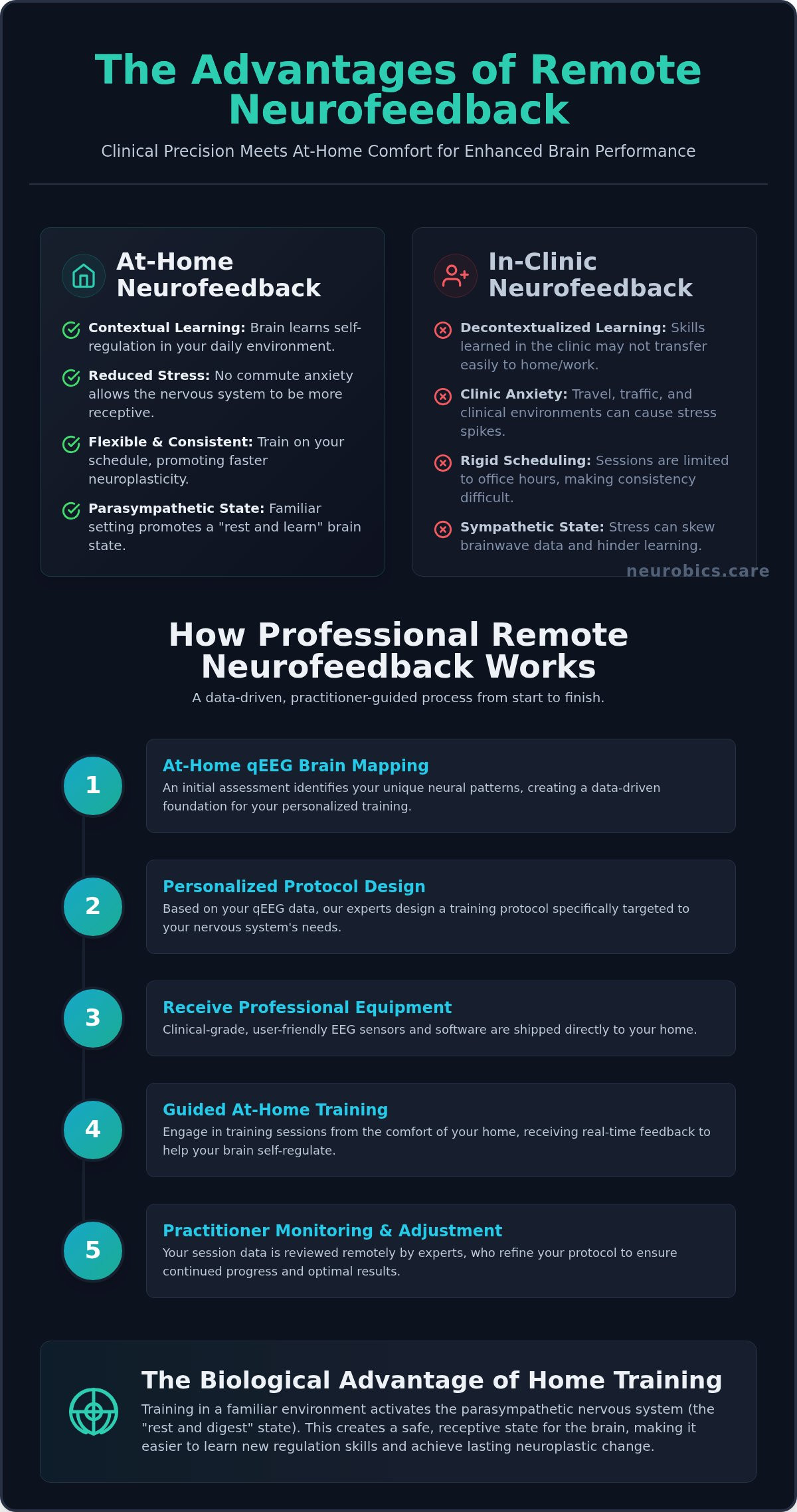
Research indicates that for many conditions, remote training yields equivalent, and sometimes superior, outcomes to in-clinic sessions. One major reason is the elimination of “clinic anxiety.” When you commute through traffic to a clinical setting, your nervous system is often in a state of high alert. This stress can skew the brainwave data. Training with at-home neurofeedback removes this variable. Your brain is in its natural environment, making it easier to integrate new regulation skills into your daily life. It also ensures the consistency required for neuroplasticity, as training no longer depends on your ability to reach an office during business hours.
The Biological Advantage: Why Training at Home Enhances Self-Regulation
While many people focus on the convenience of avoiding a commute, the most profound benefits of remote neurofeedback are actually biological. The human brain does not learn in a vacuum; it is deeply influenced by its surroundings. This principle, known as contextual learning, suggests that the skills your brain acquires are most easily accessed in the environment where they were first learned. When you train in a clinical office, your brain may associate a state of calm or focus with that specific room, white noise machine, and practitioner. By training at home, you are teaching your nervous system to regulate itself exactly where your life happens.
A familiar environment encourages the activation of the parasympathetic nervous system, the “rest and digest” state. For neuroplasticity to occur effectively, the brain needs to feel safe. In a clinic, a subtle “stress spike” often occurs due to the pressure of being on time, navigating traffic, or the clinical atmosphere itself. At home, you can eliminate these variables. This allows the brain to enter a more receptive state for learning How Remote-Assisted Neurofeedback Works, ensuring that the neural changes you’re working toward are built on a foundation of genuine physiological ease.
Nervous System Regulation in Context
Training where your triggers exist is particularly vital for those managing ADHD or anxiety. If your home office is where you usually feel overwhelmed, that is exactly where your brain needs to learn a new response. This leads to a stronger “generalization” effect, where the progress you make during a session transfers directly into your real-world scenarios, such as staying focused during a meeting or remaining calm during family chaos. Neuroplasticity is the brain’s ability to reorganize itself by forming new neural connections in response to consistent, repetitive training within your daily environment.
For individuals who also struggle with physical nerve issues, you can learn more about Boundless Full Body Chiropractic & Rehab and their approach to non-surgical nerve pain relief.
Comfort as a Catalyst for Change
Home-based sessions also help bypass “White Coat Syndrome,” a phenomenon where a person’s physiological readings are higher or more erratic simply because they’re being monitored in a medical setting. By taking your baseline measurements in your living room, we get a more accurate reflection of your true neural state. You have total control over your training space, including the lighting, seating, and temperature. This level of comfort doesn’t just make the experience more pleasant; it makes it more effective. Consistency is naturally higher when the “clinic” is only a few steps away, making it easier to maintain the momentum necessary for long-term brain performance. If you’re ready to see how this fits into your lifestyle, you can reach out to our team to discuss your specific goals.
Top 5 Benefits of Professional Remote Neurofeedback
Professional remote neurofeedback represents a significant shift from generic consumer gadgets to personalized clinical care. The Top 5 Benefits of Professional Remote Neurofeedback stem from the ability to maintain high standards of care while adapting to the realities of modern life. By prioritizing both clinical integrity and user experience, this model offers a unique path to cognitive improvement.
- Unmatched Flexibility: You don’t have to choose between your career and your cognitive health. Training at home allows you to fit sessions around a professional or family schedule without the stress of a rigid appointment window.
- Clinical Precision: We use at-home QEEG brain mapping to ensure every session is tailored to your specific neural patterns. This level of detail is the same as what you’d receive in a high-end clinic.
- Enhanced Privacy: For many, the anonymity of home training is a significant relief. You bypass waiting rooms and clinical environments, keeping your mental health journey entirely private within your own space.
- Global Expert Access: Your location no longer limits the quality of care you receive. You can work with specialists who have over 15 years of experience, regardless of where you are in the world.
- Cost-Effectiveness: Over a full program, the Neurofeedback therapy cost is often more manageable when you remove the recurring overhead of office visits and travel expenses.
Access to Global Expertise
Many individuals find themselves limited by a lack of local specialists who understand complex regulation patterns. At Neurobics, our model bridges this gap by serving clients globally, from Dubai to the Netherlands. One of the primary benefits of remote neurofeedback is that geography no longer dictates your potential for growth. You aren’t just buying a device; you’re gaining a partnership with a dedicated expert who reviews your data weekly. This expert oversight ensures that your training remains safe and effective as your brain begins to shift toward better self-regulation.
Long-term Sustainability and Consistency
Meaningful brain change typically requires 20 to 40 sessions to become a permanent part of your neural architecture. In a clinic, this might mean months of disruptive travel that eventually leads to burnout. Home-based care makes this duration achievable by integrating training into your existing routine. There’s also a deep psychological advantage to this approach. When you train at home, you take active ownership of your brain health. This empowerment often leads to better engagement and more sustainable outcomes. Consistency is the primary driver of neuroplasticity, and home training provides the most reliable path to achieving it.
This focus on lasting change is common across many high-level wellness practices. For those seeking permanent solutions in other areas of personal care, North Bay Electrology offers expert electrolysis services that prioritize long-term results and client confidence.
How Remote-Assisted Neurofeedback Works: From QEEG to Results
The path to better self-regulation is a methodical journey that starts with gathering high-quality data. Unlike hybrid models that require you to visit a physical office to pick up hardware or drop off a computer, our process is designed to be fully remote from day one. This structured approach ensures you have the clinical tools and the professional expertise needed for lasting change, regardless of your location. It’s a partnership that prioritizes your progress through five clear steps.
- Step 1: The Initial Intake and QEEG Brain Mapping. We begin with a comprehensive online consultation followed by an at-home QEEG measurement to establish your neural baseline.
- Step 2: Professional Equipment Delivery. We ship high-fidelity EEG sensors and the necessary hardware directly to your door, providing the same quality used in top-tier clinics.
- Step 3: Personalized Protocol Design. Our practitioners, drawing on over 15 years of experience, create a training plan tailored to your unique brain map.
- Step 4: Regular Training with Live Guidance. You perform your sessions at home, supported by weekly live check-ins to ensure you’re training effectively.
- Step 5: Progress Tracking and Refinement. We continuously review your data and adjust your protocols to optimize your outcomes as your brain evolves.
One of the primary benefits of remote neurofeedback is that it allows for this iterative, expert-led process without the friction of travel. You aren’t just using a device; you’re following a clinically informed roadmap designed specifically for your nervous system’s needs.
The Role of the QEEG in Remote Success
A generic, “one-size-fits-all” headset cannot provide the level of care required for professional brain training. We use the QEEG to see the specific electrical patterns behind your daily challenges. For example, understanding ADHD paralysis requires looking at how different brain regions communicate. Without a map, you’re essentially training in the dark. By starting with data, we can target the “why” behind your symptoms, making your home sessions far more effective than any unguided app could be.
Expert Support: You Are Never Training Alone
There’s a vast difference between “DIY” brain training and professional remote-assisted sessions. Weekly live check-ins are a core part of our model at Neurobics. These sessions ensure you’re placing sensors correctly and interpreting the feedback accurately. Professional data interpretation is vital to avoid “over-training,” a common risk when people try to navigate neurofeedback without expert oversight. Our practitioners act as your partners, providing the calm, expert guidance needed to turn technology into a life-changing tool. If you’re ready to start this process, you can schedule an intake session with our team today.
Is Remote Neurofeedback Right for You? Selecting a Program
Deciding to invest in your brain health is a significant step, and the success of your journey depends on choosing a framework that matches your goals. Remote neurofeedback is particularly well-suited for individuals who value clinical excellence but cannot commit to the logistical demands of a physical clinic. It’s an ideal path for busy professionals managing high-stress environments, students looking to optimize cognitive performance, or parents seeking drug-free support for ADHD and sensory processing challenges. To complement these efforts, a Professional Psychology Service can provide evidence-based clinical care for children and adults. If you value privacy and want to train in an environment where you feel most at ease, this modality offers a clear advantage.
When you’re evaluating a provider, it’s vital to look beyond the hardware. Professional brain training requires more than just a headset; it requires clinical credentials and data-driven protocols. One of the primary benefits of remote neurofeedback is the ability to access high-level expertise from anywhere, but you must ensure your provider uses QEEG mapping and offers live, expert-led support. At Neurobics, we bring over 15 years of practitioner experience to every client. Our registration with the Dutch Healthcare Federation (NFG) and RBCZ reflects our commitment to professional standards and ethical care, ensuring you’re never training in a vacuum.
The Neurobics Remote Programs
We’ve designed our programs to meet different levels of need, ranging from short-term resets to long-term neural building. Our 4-week intensive program is an excellent starting point for those who want to experience the immediate effects of regulation. For those seeking to establish more permanent neural pathways, the 12-week foundational program provides the necessary duration for lasting neuroplasticity. We also offer an annual subscription, which is our most comprehensive option. This program includes a complimentary device and weekly live support, making it the gold standard for maintaining nervous system resilience throughout the year. We handle all equipment rental and international shipping, so your focus remains entirely on your progress.
Conclusion: Empowering Your Brain from Within
The transition toward at-home brain training represents a shift in how we view mental well-being. It’s no longer about passive treatment in a doctor’s office; it’s about taking active ownership of your cognitive health. By combining the efficacy of clinical neurofeedback with the comfort of your own home, you create the perfect conditions for your brain to learn the vital skill of self-regulation. This ability to return to a state of calm and focus is a skill that can be developed at any age. We invite you to Contact Neurobics today to schedule an intake and discover if your unique brain patterns are a match for our remote-assisted training.
Your Path to a More Regulated Brain Starts at Home
The shift toward home-based care represents a significant leap in how we approach brain performance. By training in the spaces where your daily life happens, you allow new neural patterns to take root more deeply and naturally. The core benefits of remote neurofeedback lie in this unique combination of clinical precision and physiological comfort. You don’t have to navigate the stress of a clinical commute to access world-class care that truly understands your nervous system.
At Neurobics, we bring 15+ years of clinical expertise directly to your living room. Our personalized QEEG-informed protocols and weekly live sessions with professional practitioners ensure that your training is safe, effective, and specifically tailored to your needs. This expert-guided approach provides the structure required for lasting cognitive growth and emotional balance.
To complement your cognitive training with physical resilience, specialized neck training and strengthening equipment can provide a solid foundation for overall stability; learn more about the professional tools available to support this aspect of wellness.
Ready to optimize your brain from home? Book your QEEG assessment with Neurobics today.
Taking ownership of your brain health is an empowering choice that yields benefits across every area of your life. We’re here to provide the tools and guidance you need to reach your full potential with confidence and ease. Just as remote neurofeedback offers mental clarity, those seeking intuitive guidance can connect with professionals at Breeve for personalized support.
To further support this journey toward peak performance, many individuals also explore functional health optimization through 5280 Restorative Medicine, ensuring their physical vitality matches their cognitive clarity.
Furthermore, maintaining a worry-free environment is essential for mental clarity; for advanced systems that monitor critical home equipment like HVAC units and pumps, learn more about inTouch R&B.
Frequently Asked Questions
Is remote neurofeedback as effective as in-person sessions?
Remote neurofeedback provides outcomes equivalent to in-person sessions because the underlying technology and protocols remain the same. In many cases, it’s actually more effective because the brain learns in its natural environment. This removes the stress of commuting and clinical settings, allowing your nervous system to stay in a receptive state. Training at home ensures that the self-regulation skills you develop are directly integrated into your daily life.
What equipment do I need for at-home neurofeedback training?
You don’t need to purchase your own hardware before starting. Neurobics ships professional-grade, high-fidelity EEG sensors and the necessary hardware directly to your home as part of our remote assisted neurofeedback programs. All you need is a stable internet connection and a quiet space where you can sit comfortably during your sessions. We ensure you have everything required to capture clinical-grade data from day one.
How long does it take to see benefits from remote neurofeedback?
Most individuals begin to notice subtle shifts in focus, sleep quality, or stress regulation within the first 5 to 10 sessions. However, neuroplasticity is a gradual process that requires repetition. To achieve lasting results that become a permanent part of your neural architecture, a full program typically involves 20 to 40 sessions. The benefits of remote neurofeedback become more apparent as your brain reinforces these new, healthier patterns over several months.
Do I need a medical diagnosis to start remote brain training?
No, a formal medical diagnosis isn’t required to begin training with us. Our focus is on nervous system regulation and optimizing brain performance rather than treating a specific medical condition. We use the QEEG brain map to identify your unique neural patterns and create a personalized training plan. Whether you’re looking to improve focus, manage stress, or support your overall well-being, our goal is to help your brain function more efficiently.
Is the data from my brain sessions secure and private?
Your privacy is a primary concern in our remote programs. All brainwave data is encrypted and stored securely, following strict clinical standards for data protection. Unlike a public clinic where you might encounter others in a waiting room, home training allows your mental health journey to remain entirely confidential. We only use your data to monitor your progress and refine your personalized protocols, ensuring your information is handled with the highest level of professional care.
Can children participate in remote neurofeedback programs?
Yes, children can benefit significantly from remote brain training. It’s often an ideal solution for younger clients because it removes the anxiety of visiting a clinical office. Children feel more relaxed in their own homes, which makes the training more effective and engaging. We specialize in providing drug-free support for children managing ADHD, sensory processing issues, or focus challenges, always under the close supervision of our experienced practitioners. For families in the region looking for comprehensive support, Thrive Teen Therapy Alberta provides specialized assessments and mental health services tailored for youth.
What happens if I have technical difficulties with the equipment at home?
You’re never left to figure out the technology on your own. Our benefits of remote neurofeedback include weekly live support sessions where we help you with sensor placement and software navigation. If you encounter any technical hurdles, our team is available to guide you through the setup process. We ensure you feel confident using the professional-grade equipment so that your sessions are productive and stress-free from the very beginning.
How often do I need to train to see lasting results?
Consistency is the most important factor in changing brain patterns. We generally recommend training two to three times per week to maintain the momentum needed for neuroplasticity. Because the equipment is in your home, it’s much easier to stick to this schedule without disrupting your professional or family life. This regular rhythm allows your brain to practice self-regulation frequently, leading to more sustainable and long-term improvements in your cognitive performance.
