


What if the key to unlocking your highest level of mental performance wasn’t found in a generic puzzle app, but in the specific electrical patterns of your own brain? Many high achievers struggle with persistent brain fog and the mounting pressure of maintaining focus under stress, yet they’re rightfully skeptical of “brain training” games that lack clinical depth. Real cognitive enhancement neurofeedback isn’t a one-size-fits-all digital distraction; it’s a sophisticated process of teaching your nervous system to self-regulate more effectively using your own biological data.
It’s exhausting to feel your productivity slip during high-pressure tasks when you know your potential is greater. We believe that mental growth should be built on a foundation of professional precision and personal insight. In this guide, you’ll discover how QEEG-informed neurofeedback training provides a structured, professional path to enhancing focus, memory, and mental resilience from the comfort of your home. We’ll explore the science of brain mapping, the importance of practitioner-led protocols, and how you can achieve sharper executive function by gaining a data-driven understanding of your own neural activity.
Key Takeaways
- Understand how cognitive enhancement neurofeedback uses real-time brain activity mirroring to help you optimize attention, memory, and executive function.
- Learn about the specific EEG frequencies, such as Alpha and Beta, that define peak performance states and how to train your brain to access them reliably.
- Discover why generic apps often fail and how QEEG brain mapping creates a personalized blueprint based on your unique neural patterns.
- Explore the direct link between nervous system regulation and improved working memory, sharper focus, and greater resilience during high-pressure tasks.
- See how Neurobics bridges clinical precision with home convenience by shipping professional-grade equipment for expert-guided, remote training sessions.
What is Cognitive Enhancement Through Neurofeedback?
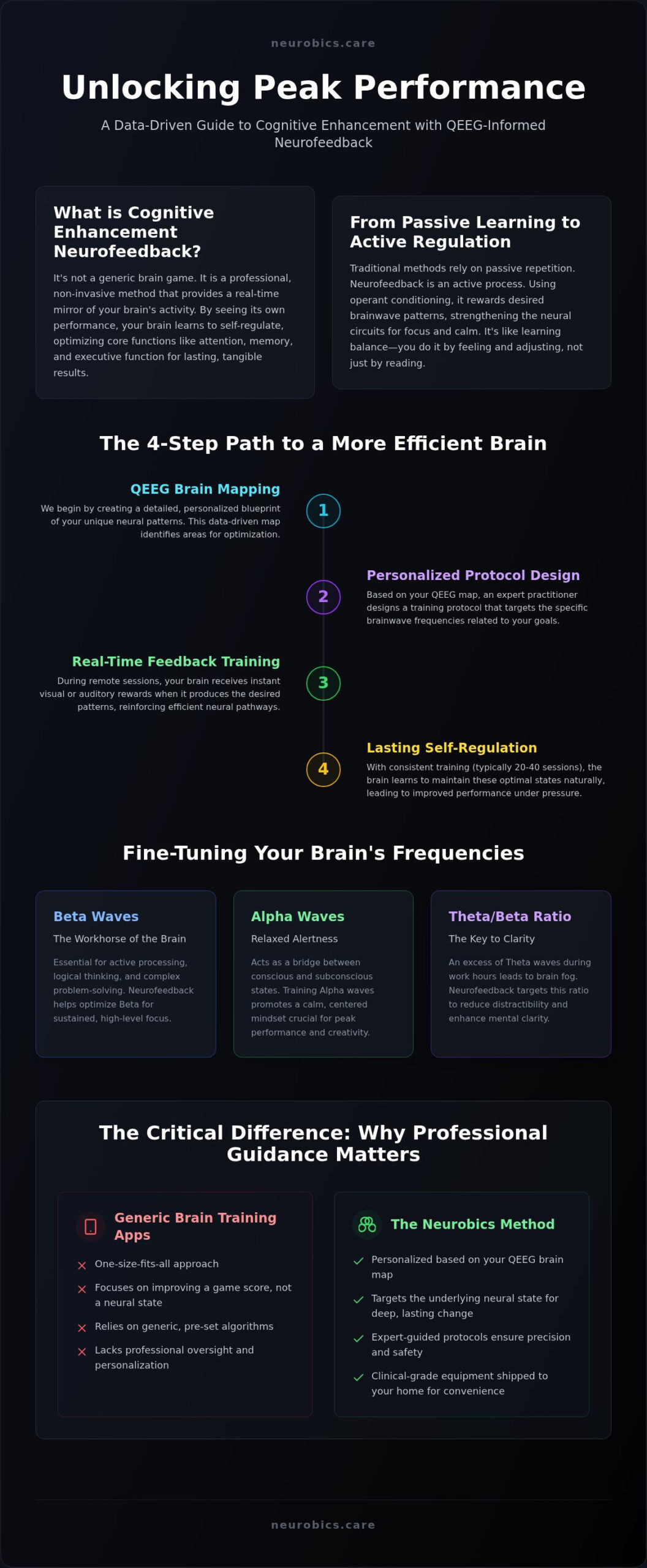
Cognitive enhancement is often misunderstood as a simple “boost” to intelligence or a temporary caffeine-like surge in energy. In reality, it represents the deliberate optimization of mental processes like attention, memory, and executive function. While many people associate “brain training” with mobile puzzles or memory games, cognitive enhancement neurofeedback operates on a much deeper physiological level. It’s a non-invasive method that acts as a real-time mirror for your brain activity. By providing immediate feedback on neural patterns, it allows the brain to see its own performance and adjust accordingly.
Unlike generic brain-training games that focus on improving your score in a specific digital task, professional neurofeedback focuses on the underlying neural state. To understand What is Neurofeedback, one must look at the mechanism of self-regulation. The goal isn’t just to “do better” at a game; it’s to train the nervous system to remain in an optimal state of calm focus or high-speed processing, regardless of the external environment. This creates a more resilient brain that doesn’t just work harder, but works more efficiently.
The Shift from Passive Learning to Active Regulation
Traditional learning is often a passive endeavor. You read a book or listen to a lecture, hoping your brain absorbs the information through repetition. Direct brain training is fundamentally different because it utilizes operant conditioning to shape brain wave patterns. When your brain produces a desired frequency associated with focus, it’s instantly rewarded with a visual or auditory cue. It’s much like learning to ride a bike. You can’t learn balance by reading a manual. You have to feel the micro-adjustments as you tip one way or the other. Neurofeedback provides those micro-adjustments for your neural circuits, creating a feedback loop that strengthens the brain’s ability to find its own balance.
This emphasis on active cognitive development is also a cornerstone of early education; for example, Meridian Private Primary School utilizes a bilingual environment to challenge and strengthen executive function from a young age, laying the groundwork for the neural efficiency discussed here.
Why 2026 is the Era of Remote Clinical Excellence
We’ve entered an era where clinical-grade technology is no longer confined to a practitioner’s office. As of 2026, the growth of at-home neurofeedback has transformed how we approach mental performance. This shift allows for more frequent training, which is crucial since a typical course requires 20 to 40 sessions to achieve lasting results. However, the surge in consumer headbands has also highlighted a significant gap in care. Professional remote training, like the model we use at Neurobics, bridges this gap by shipping medical-grade hardware to your home while maintaining expert oversight. It’s the precision of a clinic with the convenience of your living room. This human-led approach ensures that your training is always based on your unique data rather than a generic algorithm.
The Neuroscience of Mental Performance and Brain Waves
The brain communicates through rhythmic electrical pulses known as brain waves. When we discuss cognitive enhancement neurofeedback, we’re essentially talking about fine-tuning these rhythms to match your specific mental goals. Each frequency range serves a distinct purpose in your daily life. For instance, Alpha waves facilitate a state of relaxed alertness, often acting as the bridge between your conscious and subconscious mind. Beta waves are the workhorses of the brain, essential for active processing, logical thinking, and complex problem-solving. Conversely, Theta waves appear during deep relaxation or creativity, but an excess during work hours often manifests as the persistent brain fog that many high-performers struggle to overcome.
Peak performance isn’t characterized by the dominance of a single wave, but by the sophisticated relationship between them. A high-functioning brain exhibits what scientists call “neural efficiency.” This means the brain achieves complex tasks with minimal metabolic effort, avoiding the “overheating” that leads to burnout. By targeting specific ratios, such as the balance between Theta and Beta waves, we can encourage the brain to enter a state of effortless flow. This mainstream health perspective explains the process and benefits of neurofeedback in a way that highlights how these subtle adjustments lead to tangible mental clarity and improved quality of life.
Executive Function and the Prefrontal Cortex
The prefrontal cortex acts as the CEO of your brain. It manages high-level decision-making, impulse control, and sustained focus. In high-stress environments, this “top-down” control often weakens, leaving you feeling reactive rather than proactive. Protocols used in cognitive enhancement neurofeedback specifically target the prefrontal cortex to strengthen these executive networks. By training the brain to maintain a stable Beta rhythm in this area, you’re essentially building the “muscle” required to stay focused on a single task while ignoring the digital distractions that compete for your attention.
Neuroplasticity: Rewiring the Brain for Success
Our brains aren’t fixed or static. Neuroplasticity is the inherent ability of the nervous system to reorganize its structure and functions in response to consistent, targeted training. When you engage in repeated sessions, your brain begins to consolidate these new, more efficient pathways through a process called long-term potentiation. In 2026, we define neuroplasticity as the measurable capacity of neural networks to optimize their connectivity through data-driven feedback loops. This isn’t a temporary “mental boost”; it’s a fundamental shift in how your brain handles information and regulates its own energy. If you’re curious about how your unique brain wave patterns influence your daily productivity, you might consider starting with a professional brain measurement to see where your specific strengths lie.
QEEG Brain Mapping: The Blueprint for Enhancement
While understanding the general function of brain waves is helpful, real progress requires a look at your unique neural architecture. Quantitative EEG (QEEG) acts as the essential blueprint for this journey. It’s a sophisticated assessment that records your brain’s electrical activity at multiple sites simultaneously and compares it to a database of healthy individuals. This process allows us to see exactly where your brain might be over-performing or struggling. Effective cognitive enhancement neurofeedback isn’t a guessing game; it’s a data-driven strategy tailored to your specific needs.
A major weakness of many generic training methods is the “one-size-fits-all” approach. If your brain already produces high levels of Beta waves, adding more could lead to increased tension rather than better focus. QEEG identifies these nuances. It reveals areas of over-activity, often linked to stress, or under-activity, which is frequently linked to brain fog. Recent neurofeedback for cognitive enhancement research shows that targeting these specific individual deviations is what leads to significant, long-term improvements in mental performance. At Neurobics, we use these maps to ensure your training is always focused on the areas that will yield the greatest impact.
Visualizing Cognitive Strengths and Bottlenecks
When you receive a QEEG report, you aren’t just looking at numbers. You’re seeing a visual representation of your brain’s topography. These “brain maps” use color-coded scales to show how your neural activity compares to the norm. For example, a red area might indicate a bottleneck where high-frequency activity is causing mental fatigue. A blue area might show where slow-wave activity is hindering your processing speed. Understanding these patterns is the first step in our At-Home QEEG Brain Mapping: Clinical Precision from Your Living Room service, which brings diagnostic clarity directly to your doorstep.
The Importance of Professional Interpretation
In an era of automated apps, it’s tempting to rely on AI for interpretation. However, brain data is incredibly complex. An algorithm can spot a pattern, but it can’t understand the context of your lifestyle, professional goals, or personal history. Professional neurofeedback requires a human expert to translate these maps into a viable training protocol. At Neurobics, our practitioners bring over 15 years of expertise to every assessment. We don’t just hand you a report; we guide you through what those colors mean for your daily life. This human-led approach ensures that your journey toward self-regulation is safe, methodical, and genuinely effective.
Core Benefits: Focus, Memory, and Stress Resilience
The bridge between neural data and daily performance is where the true value of cognitive enhancement neurofeedback becomes apparent. While the science of brain waves is fascinating, most seekers of this technology are looking for a practical impact on their focus and memory. One of the most sought-after benefits is the ability to access the “flow state” more reliably. This state isn’t just about working harder; it’s about a specific synchronization of neural activity where the brain operates at its most efficient ratio. By rewarding the brain for entering these states, we help it learn the pathway back to deep focus, even when external distractions are high.
Memory and executive function also rely heavily on your nervous system’s baseline level of arousal. Think of your working memory as a mental workspace. If your brain is constantly scanning for threats or managing stress, that workspace becomes cluttered, leaving very little cognitive “bandwidth” for complex problem-solving. True cognitive enhancement requires high-level emotional regulation as a prerequisite for intellectual performance. When the brain is calm and self-regulated, it can allocate more resources to intellectual tasks, resulting in sharper recall and more fluid decision-making.
Breaking Through Brain Fog and Burnout
Chronic stress often acts as a cognitive hijacker. It forces the brain into a survival mode that prioritizes immediate reactions over long-term planning. This often leads to the mental “freeze” many professionals experience when they’re overwhelmed by a mounting workload. To better understand how this happens on a neural level, you can explore our guide on Understanding ADHD Paralysis: The Neuroscience of the Freeze Response. By training the nervous system to return to a state of calm, we can clear the fog and restore the mental clarity needed to maintain productivity under pressure.
Sustaining Cognitive Gains Long-Term
One of the most common questions we receive is whether these improvements disappear once training stops. Because neurofeedback relies on operant conditioning, the brain is essentially learning a new skill. Much like learning to ride a bike, once the neural pathways are established, the brain tends to maintain these more efficient habits long after the program ends. Industry research indicates that a typical course requires 20 to 40 sessions to achieve lasting results. While some clients feel subtle shifts in their sleep or mood within the first few weeks, the deep, structural changes that support long-term cognitive resilience usually consolidate over three to four months of consistent training.
If you’re ready to see how professional guidance can help you reclaim your mental bandwidth, you can reach out to our team to discuss your specific goals and start your journey toward better self-regulation.
How to Begin Professional Remote Neurofeedback
Transitioning from understanding the science to practical application is often where the most significant hurdles lie. Historically, accessing high-quality cognitive enhancement neurofeedback meant frequent commutes to a specialized clinic, often disrupting the very productivity you were trying to improve. In 2026, the model has shifted toward remote clinical excellence. This doesn’t mean a DIY approach with a consumer headband; instead, it involves bringing the full clinical infrastructure into your home. The process is designed to be seamless, ensuring that professional-grade hardware and expert practitioner oversight are the pillars of your training.
The journey begins with shipping medical-grade EEG equipment directly to your door. Unlike low-cost consumer devices, this hardware provides the high-fidelity data required for a true QEEG brain map. Once the equipment arrives, you’ll perform an assisted at-home brain measurement under the guidance of our experts. This data becomes the foundation for your personalized protocol. Throughout the program, you aren’t left to train alone. Weekly live sessions and expert check-ins ensure that your progress is monitored and your protocols are adjusted in real-time based on your brain’s evolving performance.
The Neurobics Remote Training Model
Our model bridges the gap between clinical precision and the convenience of your own environment. After the initial intake and at-home QEEG process, you’ll enter a structured training phase. These aren’t just automated exercises; they are live, remote-assisted sessions where a practitioner monitors your neural activity. This ensures that every minute spent training is optimized for your specific cognitive goals. For a deeper look at the logistics, you can read our At-Home Neurofeedback: The Complete Guide to Professional Remote Brain Training in 2026. This collaborative approach allows us to maintain the highest standards of care while you remain in the comfort of your living room.
Taking the Next Step Toward Mental Clarity
Prioritizing your brain health is a long-term investment in your quality of life. Whether you’re looking to recover from burnout or reach a new level of professional focus, a structured path is essential. At Neurobics, we offer 4-week or 12-week structured programs depending on the depth of change you wish to achieve. These programs are built on 15 years of practitioner expertise, ensuring that your path to self-regulation is methodical and grounded in evidence. If you’re ready to move beyond generic apps and embrace a data-driven approach to your mental performance, we invite you to contact Neurobics for a consultation. We’re here to partner with you on the journey toward a more resilient, focused, and efficient brain.
Refining Your Mental Edge with Data-Driven Precision
Mental performance isn’t a fixed trait; it’s a dynamic state you can influence through consistent, data-driven training. By moving beyond generic digital puzzles and focusing on the physiological foundations of your brain waves, you’re choosing a path of lasting self-regulation. We’ve explored how QEEG brain mapping provides the necessary blueprint to address your unique cognitive bottlenecks, ensuring every session is targeted toward your specific goals rather than a generic average.
Neurobics brings over 15 years of practitioner expertise directly to your home. We ship clinical-grade equipment to your door and design personalized QEEG-informed protocols that evolve as your brain performance improves. This professional remote model ensures you don’t have to sacrifice clinical precision for the convenience of your daily schedule. Investing in cognitive enhancement neurofeedback is about more than just immediate focus; it’s about building a resilient nervous system that thrives under pressure and maintains its efficiency long-term.
While neurofeedback optimizes the brain’s electrical patterns, maintaining the physical health of your spine is another vital component of nervous system resilience; to explore how gentle spinal alignment supports these goals, visit Chiropractic Lifestyle Family Practice P.C..
Ready to transform your mental bandwidth? You can book a consultation to start your cognitive enhancement journey and discover what your brain is truly capable of achieving. Your journey toward a sharper, more efficient mind is a methodical process, and we’re here to guide you every step of the way.
Frequently Asked Questions
Is neurofeedback for cognitive enhancement permanent?
Results from cognitive enhancement neurofeedback are generally long-lasting because the process relies on operant conditioning, which is a form of skill learning. Much like learning to ride a bicycle, once your brain establishes these more efficient neural pathways, it tends to maintain them. While periodic sessions can be helpful after major life stressors, the foundational improvements in self-regulation and focus typically remain stable over time.
How many sessions are typically needed to see cognitive improvements?
Most individuals require between 20 and 40 sessions to achieve consolidated, lasting changes in mental performance. While you might notice subtle shifts in your sleep quality or stress resilience within the first 10 sessions, the structural changes needed for peak executive function usually take three to four months of consistent training to fully stabilize. This timeline allows the brain to deeply integrate its new, more efficient habits.
Is neurofeedback safe for healthy adults looking for performance gains?
Neurofeedback is a non-invasive and safe method for healthy adults who wish to optimize their mental clarity. It doesn’t involve sending electrical currents into the brain; it simply acts as a mirror, showing your brain its own activity in real-time. Because the training is guided by your unique biological data and supervised by experienced practitioners, the process is gentle and carries minimal risk compared to pharmacological options.
How does remote neurofeedback compare to in-office treatments?
Professional remote neurofeedback provides the same clinical precision as in-office treatments when it’s supported by medical-grade hardware and expert oversight. The primary difference is the convenience of training in your own environment. At Neurobics, we ship professional equipment to your door and conduct live, remote-assisted sessions, ensuring you receive high-level care without the need for frequent commutes to a physical clinic.
Do I need a medical diagnosis to start cognitive enhancement training?
You don’t need a medical diagnosis to begin cognitive enhancement neurofeedback. While the technology is frequently used to address clinical conditions, many high-achieving professionals use it specifically for mental optimization and resilience. Our process begins with a comprehensive QEEG assessment to understand your unique brain patterns, allowing us to create a personalized training plan focused entirely on your performance goals.
Can neurofeedback help with age-related cognitive decline?
Neurofeedback is an effective tool for addressing age-related cognitive decline by leveraging the brain’s inherent neuroplasticity. Training helps improve processing speed and working memory by encouraging more efficient neural communication across different brain regions. It serves as a proactive, science-backed approach to maintaining executive function and mental sharpness as the nervous system ages, helping you stay productive and engaged.
What is the difference between neurofeedback and meditation apps?
Meditation apps offer a general, one-size-fits-all approach to relaxation, while neurofeedback is a data-driven, targeted intervention. While meditation is a helpful daily practice, neurofeedback uses your real-time EEG data to address specific neural imbalances identified in your brain map. It’s the difference between following a general wellness routine and engaging in a personalized training protocol designed for your specific neural architecture.
Is the equipment used for home training professional-grade?
The equipment shipped for home training is professional-grade and identical to the hardware used in high-end clinical settings. Neurobics prioritizes medical-grade EEG sensors over low-fidelity consumer headbands to ensure the highest data accuracy. This clinical-grade precision is essential for our practitioners to make the subtle, expert-led protocol adjustments that lead to genuine improvements in focus, memory, and emotional regulation.
