


The most expensive path to mental clarity isn’t always the high-end clinic visit; it’s often the “affordable” DIY headset that fails to deliver lasting results. It’s natural to feel a sense of sticker shock when comparing the costs of at home neurofeedback vs in clinic programs for the first time. When you’re already struggling with time poverty, the thought of commuting to a specialist several times a week can feel like an impossible addition to an already packed schedule.
At Neurobics, we believe that professional brain training should fit your life, not complicate it. This article provides a clear framework to help you evaluate the clinical outcomes and long term ROI of different training models. We’ll explore how qEEG-informed protocols and Dutch clinical expertise can provide a permanent solution to focus and stress issues. By the end, you’ll have the confidence to choose a path that delivers medical-grade results through remote care, ensuring your investment leads to genuine neural change and a more regulated nervous system.
Key Takeaways
- Understand why neurofeedback functions as a “CapEx” investment in your brain’s architecture rather than a recurring “OpEx” cost like medication.
- Discover why a qEEG brain map is the essential roadmap that protects your investment by removing clinical guesswork and shortening the training path.
- Compare the logistical and financial differences between at home neurofeedback vs in clinic care to find a model that fits your professional schedule.
- Learn how to quantify the real-world ROI of better focus and sleep, including the elimination of the hidden “ADHD Tax” on your productivity.
- Identify the specific equipment and oversight requirements that ensure remote training matches the clinical depth of a traditional office setting.
Understanding the Cost of Neurofeedback: Price vs. Value
Many people approach brain training with the same mindset they use for a gym membership or a prescription. They expect a monthly fee that continues as long as they want the benefit. However, neurofeedback is fundamentally different. It’s a process of biological learning, similar to learning how to ride a bicycle or swim. Once the brain acquires the skill of self-regulation, it doesn’t simply “forget” it when the sessions end. This distinction is vital when weighing the options of at home neurofeedback vs in clinic programs.
The initial investment often triggers a sense of hesitation, but understanding the underlying components provides necessary context. You aren’t just paying for the use of a headset. A professional program involves intensive clinical labor. Specialists must analyze complex EEG data to identify specific patterns in your brain’s electrical activity. This data then forms a personalized protocol. At Neurobics, we use medical-grade hardware that captures signals with a precision consumer “wellness” devices can’t match. You’re also investing in professional accountability; weekly adjustments by an expert ensure you don’t plateau and that your training remains aligned with your evolving neural state.
What are you actually paying for?
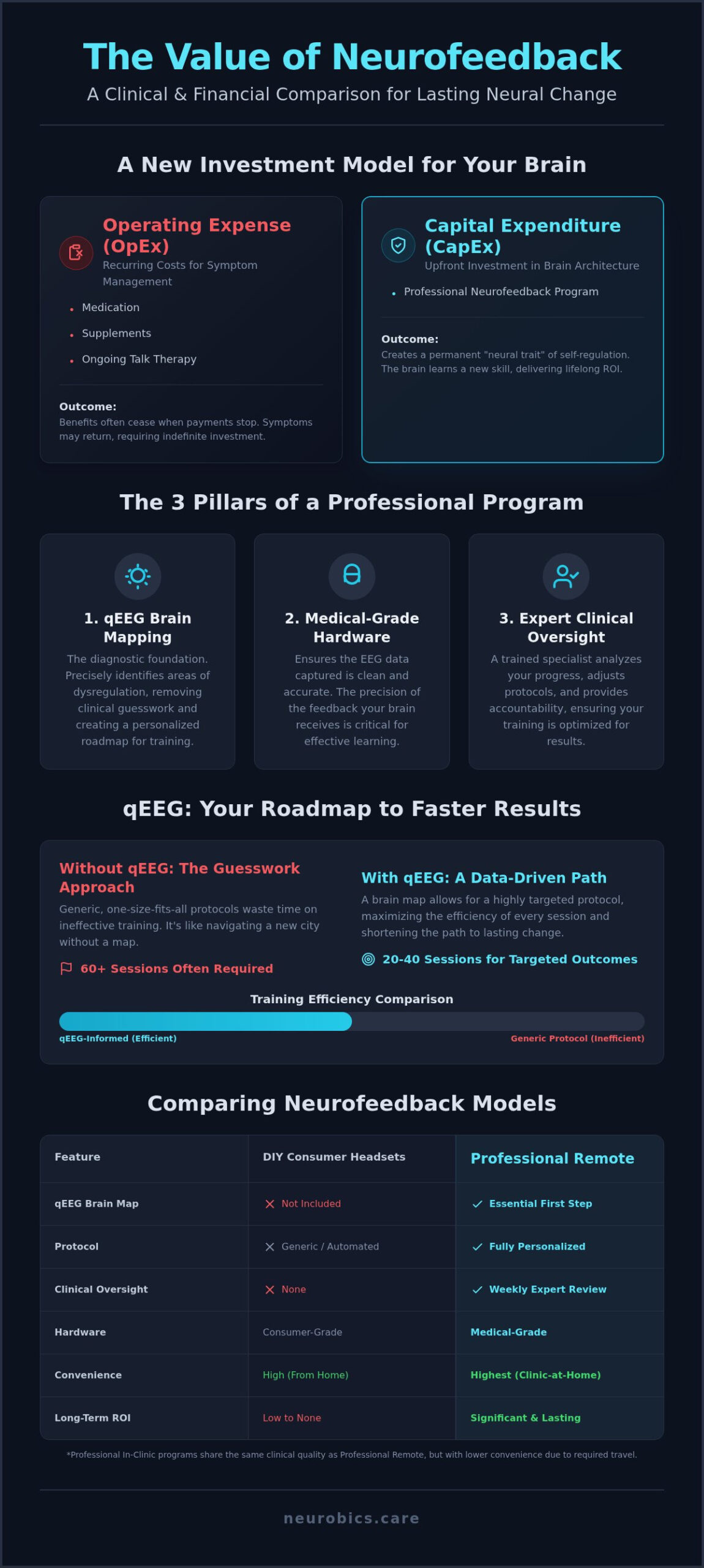
When you look at the quote for a professional program, you’re seeing the cost of three distinct pillars. First is the initial brain mapping, which acts as the diagnostic foundation. Second is the medical-grade hardware rental, which ensures the data being fed back to your brain is accurate. Finally, and most importantly, is the clinical oversight. Analyzing EEG data requires years of training. Without this expert guidance, a headset is just a piece of plastic. Professional support ensures that every minute you spend training is optimized for your specific nervous system needs.
Neurofeedback as a ‘CapEx’ for your brain
In financial terms, most mental health supports are “OpEx,” or operating expenses. Medication and ongoing talk therapy require recurring payments to maintain their effects. If you stop the subscription, the symptoms often return. Neurofeedback functions as “CapEx,” or a capital expenditure. It’s a front-loaded investment in your brain’s physical architecture.
By completing a structured program of 20 to 40 sessions, you help your brain develop a “neural trait.” This is a permanent shift in how your nervous system handles stress or maintains focus. While the upfront cost might seem higher than a few months of therapy, the long-term ROI is significant. You’re solving the root cause of dysregulation rather than managing symptoms indefinitely. When you compare at home neurofeedback vs in clinic through this lens, the value becomes clear: you’re purchasing a permanent upgrade to your mental capacity, not just a temporary reprieve.
The Science of ROI: Why qEEG-Informed Training is Essential
The true return on investment in brain training isn’t found in the hardware itself. It’s found in the data that drives it. Training your brain without a qEEG (Quantitative EEG) map is like trying to navigate a new city without GPS. You might eventually find your destination, but you’ll waste significant time and energy along the way. When evaluating at home neurofeedback vs in clinic options, the most critical question isn’t where the training occurs, but whether your protocol is based on a precise measurement of your unique neural patterns.
A qEEG removes the guesswork that often plagues DIY or unguided tools. It identifies the exact areas of dysregulation, allowing for a highly targeted approach. This clinical precision leads to faster results. Instead of a generic protocol that might take 60 sessions to show progress, a qEEG-informed plan often achieves the same outcomes in 20 to 40 sessions. This efficiency directly impacts your ROI by reducing the total time required to see a permanent shift in your mental state. You can learn more about how we bring this level of detail to your home in our guide on At-Home QEEG Brain Mapping: Clinical Precision from Your Living Room.
Personalization: The key to efficacy
A personalized protocol targets specific neural patterns at their source. For someone struggling with ADHD, the map might show an excess of slow-wave activity in the frontal lobe. For another person experiencing burnout, the pattern might look entirely different. A professional practitioner doesn’t just set a program and walk away. They monitor your weekly progress and adjust your “training load.” This oversight prevents overtraining and ensures that the challenge level is always in the optimal “sweet spot” for neural growth. This is the difference between a generic wellness app and a clinical intervention.
The ‘Safety Net’ of Professional Oversight
DIY tools often lack the safety net that a clinical expert provides. Without oversight, it’s possible to inadvertently train patterns that increase anxiety or cause brain fatigue. At Neurobics, our work is grounded in 15 years of clinical experience and adheres to the rigorous standards of the Dutch Healthcare Federation (NFG). Part of this quality assurance is the “Oral Report.” This is a deep-dive session where we translate your brain map into plain English, helping you understand your unique strengths and challenges. This level of insight ensures your training is not only effective but also safe for your specific nervous system. If you have questions about how a map could clarify your own symptoms, feel free to speak with a specialist about your specific goals.
Comparing the Models: Clinic vs. Professional Remote vs. DIY
Choosing between at home neurofeedback vs in clinic care often feels like a trade-off between clinical depth and personal freedom. While the goal is the same, the logistical reality of each model impacts how effectively your brain can actually learn. To make an informed choice, you must look beyond the initial quote and evaluate the long term sustainability of the training schedule. If a program is too rigid to follow, the biological changes simply won’t take root.
| Feature | In-Clinic Model | Professional Remote (Neurobics) | Consumer DIY Apps |
|---|---|---|---|
| Clinical Depth | High; practitioner led | High; qEEG-informed & expert led | Low; generic protocols |
| Convenience | Low; requires commuting | High; train on your schedule | High; portable |
| Equipment Quality | Clinical Grade | Clinical Grade (Rental included) | Consumer Grade (‘Toys’) |
| Total Investment | High; variable per session | Predictable; fixed program fee | Low upfront; high time waste |
One of the most significant hidden hurdles of the clinic model is the “time tax.” A typical 45 minute session often requires two hours of total time when you factor in traffic, parking, and preparation. When the clinical recommendation is three sessions per week, you’re looking at a six hour weekly commitment. For many professionals and parents, this leads to missed appointments and inconsistent training, which stalls progress. The professional remote model solves this by using a rental system. This allows you to access high-end clinical technology without the five-thousand-dollar purchase price, ensuring you have the right tools in your living room exactly when you need them.
The Clinic Model: Premium but rigid
Traditional clinics carry high overheads, including office rent and administrative staff, which are naturally reflected in their session fees. While the environment is professional, the rigidity can be a barrier to neuroplasticity. Brain training is most effective when done consistently. If your schedule only allows for one clinic visit a week due to work pressure, you won’t reach the “tipping point” where new neural habits become permanent. You can explore a deeper breakdown of these industry standards in our guide to Neurofeedback Therapy Cost in 2026: A Guide to Value and Outcomes.
The Remote Professional Model: The ‘Goldilocks’ solution
Neurobics provides the “middle way” by combining Dutch clinical expertise with the flexibility of home training. Training in your natural environment actually improves the “transfer” of skills. Your brain learns to find a state of calm or focus in the very place where you usually feel stressed or distracted. By offering fixed-term 4-week or 12-week programs, we provide a predictable investment structure. You gain access to world-class practitioners regardless of your geographic location, ensuring that the distance between you and expert care is never a barrier to your progress. This is particularly valuable for international professionals who can learn more about Prague Integration to help navigate the logistics of settling into a new city.
Measuring the Real-World Worth: Focus, Sleep, and the ADHD Tax
When considering at home neurofeedback vs in clinic programs, the conversation usually centers on the initial price. However, the true value of brain training is found in the “invisible” gains that appear in your bank account and calendar weeks after the training ends. For many of our clients, the primary return on investment isn’t just a better qEEG report; it’s the elimination of the daily friction that drains their energy and income.
This reduction in daily friction often involves combining internal self-regulation with external efficiency; for instance, using specialized platforms for ניהול ועד בית (building management) illustrates how automating administrative tasks can help preserve the cognitive energy gained through neurofeedback.
Consider the impact of sleep. Gaining just one extra hour of deep sleep per night can fundamentally change your next-day cognitive capacity. Research indicates that sleep-deprived brains operate at a level of impairment similar to alcohol intoxication, making errors more likely and decision-making slower. By regulating the nervous system to transition into rest more effectively, you’re essentially buying back hours of peak productivity that were previously lost to brain fog and fatigue.
Burnout prevention offers perhaps the most dramatic ROI. The cost of a proactive 12 week neurofeedback program is a fraction of the financial devastation caused by a six month medical leave. Staying in the workforce with a resilient nervous system is far more cost-effective than attempting to rebuild a career after a total collapse. This proactive approach is a hallmark of the Dutch clinical model we use at Neurobics, where we focus on building the capacity for long term stability rather than temporary relief.
The ROI of Executive Function
Many high-performing professionals struggle with a specific type of cognitive stall. If you’ve ever found yourself unable to start a critical task despite knowing the consequences, you’ve likely experienced ADHD paralysis. This “freeze” response is a neurological event, not a character flaw. The “ADHD Tax” is the cumulative financial and emotional cost of impulsivity, forgotten deadlines, and lost items that neurofeedback mitigates by strengthening the brain’s internal braking system through self-regulation. By improving executive function, you stop paying this tax and start reclaiming your control over high-stakes environments where emotional stability is your greatest asset.
Nervous System Resilience as Health Insurance
Think of neurofeedback as a form of “health insurance” for your future self. Most people wait for a crisis before seeking help, which leads to reactive crisis management. Proactive nervous system regulation builds a buffer against the stressors of modern life. This has profound effects on your personal life. When you’re no longer stuck in a state of “fight or flight,” your capacity for patience and presence as a parent or partner increases. These improvements in relationship quality are intangible but represent a significant part of the program’s worth. If you’re ready to see how these changes could manifest in your daily life, you can book an intake session to discuss your specific goals with our team.
Is Neurobics the Right Investment for Your Brain?
Deciding between at home neurofeedback vs in clinic care ultimately comes down to finding a partner who values clinical precision as much as you value your time. At Neurobics, we bridge this gap by offering the depth of a traditional clinic with the flexibility of a remote program. With over 15 years of clinical experience and registration with the Dutch Healthcare Federation (NFG), our approach ensures that your training is supervised by experts who understand the nuances of the human nervous system.
We offer different paths based on your specific goals. Our 4-week “Neurofeedback @Home” program serves as an intensive reset, ideal for those experiencing acute stress or wanting to test the efficacy of the protocols. For those seeking the “clinical sweet spot” for permanent neural change, our 12-week comprehensive training provides the necessary duration for new habits to become lasting traits. We also offer an annual subscription model for long-term optimization, which includes a free device to support your ongoing growth. Before you begin, consider this readiness checklist to ensure you’re positioned for success:
- Consistency: Can you dedicate 30 minutes, three times a week, to your training sessions?
- Precision: Are you willing to start with a qEEG brain map to ensure your protocol is evidence-based?
- Perspective: Are you looking for a permanent shift in self-regulation rather than a temporary “quick fix”?
- Environment: Do you have a quiet space at home where you can train without distractions?
Our commitment to evidence-based outcomes
We prioritize qEEG mapping over “one-size-fits-all” headsets because your brain deserves a roadmap as unique as your fingerprint. Our Dutch clinical roots mean we adhere to high standards of quality and transparency. We manage all equipment logistics from our centers in the Netherlands to ensure you receive medical-grade hardware ready for use. Whether you are working with our team from Dubai, Groningen, or anywhere else globally, you receive the same level of expert support and weekly data analysis to keep your progress on track.
For those in the UAE, Paramount Shift provides professional hypnotherapy services in Dubai, focusing on personal transformation and emotional well-being to complement your neural training.
Taking the next step
The first step toward a more regulated life is understanding your brain’s current patterns. We invite you to book an intake assessment where we can visualize your neural activity together and discuss how a personalized protocol can address your specific challenges with focus, sleep, or stress. This initial consultation is the foundation of your investment, providing the clarity needed to move forward with confidence. Please Contact Neurobics for a personalized clinical consultation to explore which program best aligns with your goals for better brain health.
Investing in a Future of Cognitive Clarity
Choosing to develop your brain’s capacity for self-regulation is one of the most significant investments you can make for your long-term well-being. By moving beyond temporary symptom management and focusing on the physical architecture of your brain, you’re building a foundation of resilience that lasts. The decision between at home neurofeedback vs in clinic care no longer requires a compromise between clinical depth and personal convenience. You can access medical-grade technology and 15+ years of clinical expertise from the comfort of your own living room.
Our qEEG-informed protocols and Dutch clinical oversight ensure that every session you complete is a purposeful step toward your goals. Whether you’re looking to eliminate the “ADHD tax” or recover from burnout, the path to a more regulated nervous system is accessible and evidence-based. You don’t have to navigate this journey alone; expert guidance is available to help you interpret your brain’s unique roadmap and optimize your results.
Book a clinical intake and start your personalized brain training journey
Your brain possesses an incredible ability to adapt and grow. With the right tools and professional support, a calmer and more focused life is well within your reach.
Frequently Asked Questions
How many sessions are typically required before I see a return on my investment?
Most individuals begin to notice substantive shifts in self-regulation within 20 to 40 sessions. This range is considered the clinical “sweet spot” for conditions like ADHD or chronic stress regulation. At Neurobics, we often recommend a 12-week program to ensure these changes move from temporary states to permanent neural traits. While some feel a “reset” after 4 weeks, the longer duration provides the necessary reinforcement for lasting results.
Is neurofeedback covered by health insurance in 2026?
Insurance coverage for neurofeedback remains inconsistent as of 2026 and varies significantly depending on your provider and specific diagnosis. While some EU insurance trends show a gradual move toward reimbursement for remote mental health tools, most clients currently pay out-of-pocket. It’s always advisable to contact your insurance provider directly to check if they offer partial reimbursement for NFG-registered practitioners or biofeedback services.
Can I use my HSA or FSA funds to pay for remote neurofeedback training?
Yes, Health Savings Account (HSA) and Flexible Spending Account (FSA) funds are typically eligible for neurofeedback programs. Since these services are often classified as biofeedback or neurological training, many international clients use these tax-advantaged accounts to manage their investment. We recommend keeping your clinical intake notes and receipts as documentation for your account administrator to ensure a smooth approval process.
What happens if I stop training; will the results disappear over time?
Unlike medication, the benefits of neurofeedback don’t vanish when the training stops. The process is a form of skill acquisition where your brain learns new ways to self-regulate. Once these pathways are established through 20 to 40 sessions, they become a permanent part of your neural architecture. It’s similar to learning to ride a bike; your brain retains the ability to find that balanced state even after long breaks.
How does the cost of at-home training compare to traditional in-clinic therapy?
When evaluating at home neurofeedback vs in clinic options, professional remote training is generally more cost-effective. While clinic sessions often range from $100 to $300 each, remote programs eliminate the high overhead of physical office space and the hidden costs of travel. By using a rental model for medical-grade equipment, you gain the same clinical depth as an in-office visit without the logistical friction of commuting three times a week.
Is it worth buying a cheap $200 neurofeedback headset for DIY use?
A consumer-grade headset is rarely a substitute for professional brain training if you’re seeking clinical outcomes. These devices often use only one or two sensors and lack the precision of a 19-channel EEG system used for qEEG mapping. Training without a professional protocol is essentially “guessing” with your brainwaves. For issues like ADHD or burnout, the investment in expert-led care ensures you’re targeting the right patterns safely and effectively.
What is the difference in cost between a basic intake and a full qEEG brain map?
A basic intake is typically a diagnostic discussion, whereas a qEEG brain map is a comprehensive data-gathering process. Industry-wide, a professional qEEG map can cost between $300 and $1,000 because it requires specialized equipment and expert analysis. While the intake sets the stage, the qEEG provides the actual roadmap. This data is what allows us to design a protocol that is tailored specifically to your nervous system.
Does Neurobics offer payment plans or subscriptions to manage the investment?
We provide several ways to manage the cost of your training, including an annual subscription model. For those who want a focused intervention, we offer “Neurofeedback @Home for 4 Weeks” with prepayment options. The subscription model is particularly popular for clients seeking long-term optimization, as it often includes the use of our medical-grade hardware. This flexibility allows you to choose a pace and investment level that matches your personal health journey.
