


The most advanced brain mapping technology available today is only as effective as the quality of the data it captures. Most people don’t realize that their morning routine can significantly impact the electrical noise their brain produces during a scan. If you’re wondering how to prepare for a qeeg brain map, you’re already taking the most important step toward a successful neurofeedback journey. It’s completely normal to feel a mix of curiosity and concern about how factors like your sleep or medication might influence the final report.
At Neurobics, we believe that clinical precision starts long before the sensors are placed on your head. We’ve designed this guide to help you cultivate the ideal internal and external environment for your measurement, ensuring your neurofeedback protocol is built on a foundation of clear, valid data. You’ll learn exactly how to manage your schedule, diet, and surroundings to eliminate interference and reveal your brain’s true signature. By following this simple checklist, you can move forward with the confidence that your results are an accurate reflection of your unique mental landscape.
Key Takeaways
- Learn how to minimize “biological noise” so your brain’s natural electrical signature can be recorded with clinical precision.
- Discover exactly how to prepare for a qeeg brain map by managing sleep and substance intake to ensure your baseline data isn’t artificially skewed.
- Understand the technical reasons why specific hair care routines are essential for maintaining a high-quality sensor connection during your measurement.
- Get practical tips for setting up a quiet, interference-free space for your at-home QEEG session to achieve professional-grade results.
- See how accurate preparation directly influences the creation of your personalized, remote-assisted neurofeedback protocol.
Understanding the QEEG: Why Preparation is the Key to Accuracy
Think of a standard EEG as a tool for spotting immediate medical crises, such as seizures or structural damage. In contrast, Quantitative electroencephalography (QEEG) functions more like a sophisticated weather map of your mind. It takes the raw electrical data and processes it into a visual representation of how different brain regions communicate. This map reveals patterns of dysregulation that might explain your experience with focus, sleep, or chronic stress. Because the analysis is so sensitive, learning how to prepare for a qeeg brain map is the first step toward a successful intervention. Without proper preparation, the data becomes cluttered with “artifacts,” which are biological distractions that obscure your actual brainwaves.
High-quality data is essential because it forms the baseline for your personalized neurofeedback protocol. If the initial recording is “noisy,” the resulting training plan might target patterns that aren’t actually yours. Understanding how to prepare for a qeeg brain map allows you to minimize these errors before they happen. At Neurobics, we prioritize clinical precision because we know that the most effective training begins with an undistorted view of your neural landscape. This clarity ensures that every minute you spend in training is focused on the actual needs of your nervous system.
Signal vs. Noise: The Science of Preparation
When we record your brain activity, we’re searching for the “signal,” which is the rhythmic firing of your neurons. However, EEG sensors are incredibly sensitive and pick up “noise” from various non-brain sources. Clenching your jaw, squinting, or even subtle eye movements produce electrical spikes that are significantly stronger than your brainwaves. In the context of EEG, the signal-to-noise ratio refers to the strength of the desired neural information compared to the unwanted background interference. While our practitioners use advanced software to filter out some of these artifacts, the most reliable data comes from a calm, physically relaxed state where the noise is minimized at the source.
What a QEEG Measures (and What it Doesn’t)
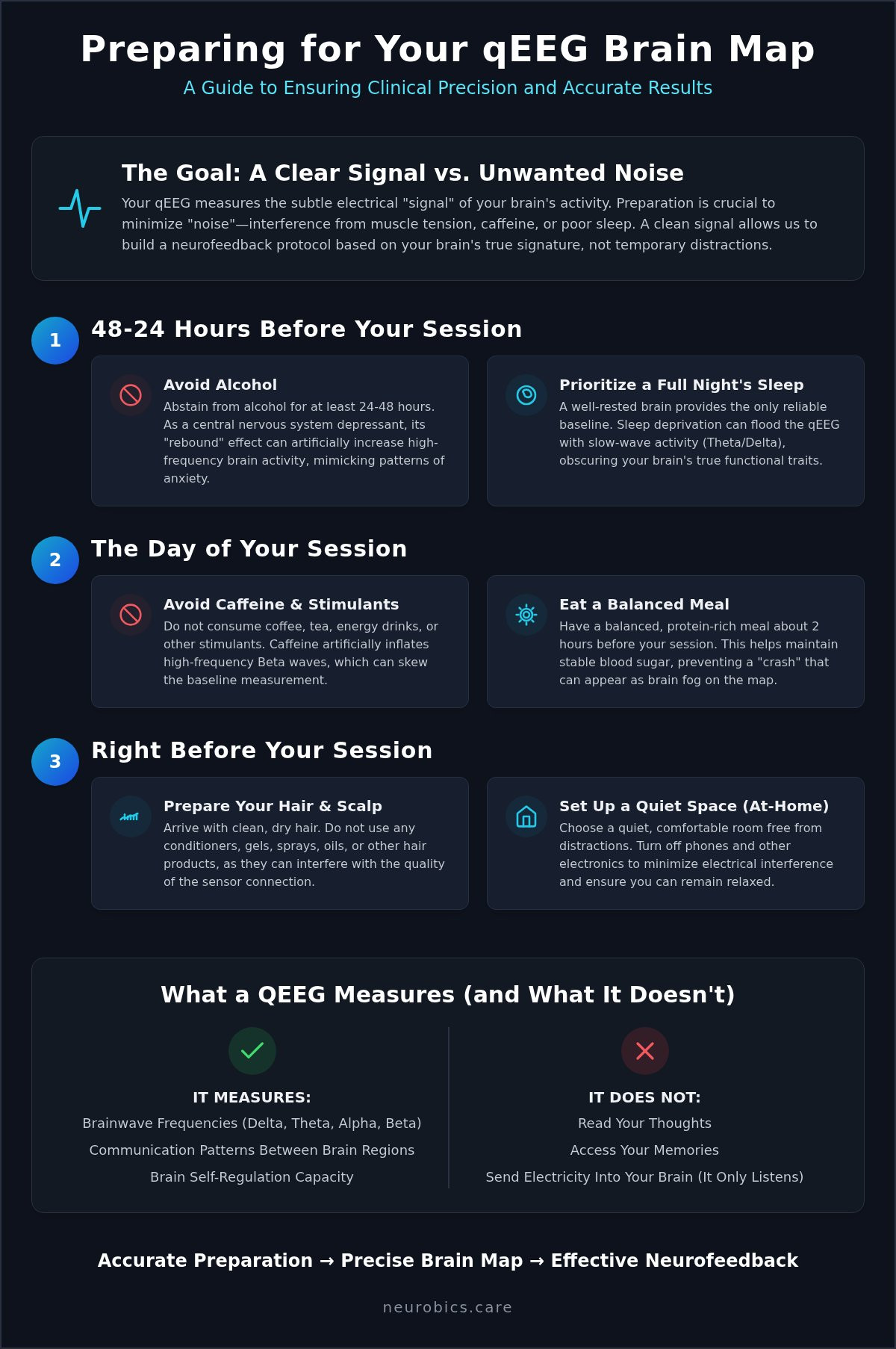
Your brain map visualizes the distribution of different frequencies, including Delta, Theta, Alpha, and Beta waves. These patterns show us where your brain might be working too hard or not hard enough to maintain a state of balance. It’s helpful to remember that this procedure is entirely non-invasive. The sensors act like tiny microphones that only “listen” to your brain’s natural activity; they don’t send electricity into your body. Contrary to popular myths, a QEEG cannot read your thoughts, memories, or secrets. It simply provides an objective look at your brain’s self-regulation capacity, which is the foundation for understanding What is Neurofeedback? and how it can help you reach your goals.
Biological Readiness: Managing Sleep, Diet, and Substances
To capture an accurate “weather map” of your neural activity, we need to see your brain in its natural, resting state. This means your internal biochemistry should be as neutral as possible. The most significant factor in this preparation is the 24-hour sleep rule. A well-rested brain provides the only reliable baseline for clinical analysis. If you’re significantly sleep-deprived, your QEEG will likely show an overabundance of slow-wave activity, such as Theta or Delta waves. This “drowsiness” signature can obscure the very patterns we’re trying to identify, making it difficult to distinguish between a temporary state of fatigue and your brain’s actual functional traits.
Dietary choices and hydration also play a quiet but vital role. Your brain is approximately 75% water, and even mild dehydration can affect the conductivity and voltage of the signals we record. Similarly, blood sugar stability is essential. A “crash” during your session can look like brain fog or low-energy processing on the map. We suggest eating a balanced, protein-rich meal about two hours before your appointment. It’s also important to avoid alcohol for at least 24 to 48 hours. Alcohol is a central nervous system depressant, but as it leaves your system, the brain often experiences a “rebound” effect. This manifests as excessive high-frequency Beta activity, which can incorrectly suggest a state of chronic anxiety or hyper-vigilance.
The Caffeine and Stimulant Protocol
Caffeine is one of the most common disruptors of QEEG accuracy. By blocking adenosine receptors, caffeine artificially inflates high-frequency Beta waves and suppresses the calming Alpha waves that help us understand your relaxation capacity. When considering how to prepare for a qeeg brain map, we recommend avoiding all stimulants, including coffee, tea, and energy drinks, for 6 to 12 hours before your session. If you’re a daily caffeine user, don’t stop abruptly days in advance; a withdrawal headache can cause muscle tension that creates its own electrical interference. Simply skip your morning cup if your appointment is early, or stick to the 12-hour window for afternoon sessions.
Medications and Supplements: A Critical Conversation
Safety and clinical integrity are our highest priorities. You should never stop taking any prescribed medication without the direct supervision of your physician. Instead, the goal is to document your current regimen so we can interpret your results accurately. Many substances alter brainwave patterns in predictable ways. For example, benzodiazepines typically increase fast-wave activity, while stimulants used for ADHD often shift the ratio between Theta and Beta waves. Even natural supplements like Melatonin, Valerian root, or high-dose CBD can linger in your system and influence the results. If you have questions about your specific supplements, you can contact our practitioners to discuss your preparation. Following standard clinical advice on how to prepare for an EEG ensures that your data is interpreted within the correct context of your unique biology.
Physical Hygiene: Preparing Your Scalp and Hair
While your internal state provides the signal, your scalp and hair provide the physical gateway for our sensors. Achieving clinical precision requires a low-resistance connection between the scalp and the recording equipment. When you’re planning how to prepare for a qeeg brain map, hair hygiene is often the most overlooked technical requirement. It isn’t about aesthetics; it’s about electrical conductivity. Natural skin oils, hair sprays, and leave-in conditioners create a resistive barrier that blocks the tiny micro-volt signals your brain emits. While this preparation is for a one-time scan, those interested in ongoing professional scalp analysis can visit 諾貝爾活髮科研中心 (Nobel Hair). When these oils mix with the specialized conductive paste we use, it can cause a chemical interaction that increases impedance, resulting in a fuzzy or unusable recording.
Comfort is equally important during the 60 to 90 minutes of your session. We recommend wearing loose, comfortable clothing that doesn’t require frequent adjustment. If you’re constantly shifting because of a tight collar or itchy fabric, those muscle movements will appear as artifacts on your map, complicating the analysis. At Neurobics, we want you to feel as relaxed as possible so your brain can settle into its natural resting state without physical distractions.
The Perfect Hair Prep Checklist
To ensure the best possible connection, follow these steps on the morning of your measurement:
- Wash your hair thoroughly: Use a simple clarifying shampoo. Avoid “2-in-1” products or those containing heavy moisturizers and oils.
- The No-Product Rule: Do not use any conditioners, gels, waxes, or hairsprays after washing. Your hair should be “squeaky clean.”
- Dry hair only: Ensure your hair is completely dry before the session starts. Damp hair can cause electrical “bridging” between sensors, which ruins the data.
- Scalp accessibility: For those with braids or specific hair textures, the scalp must be accessible at the standard sensor sites. If you have questions about your specific style, please contact us for guidance.
Contact Lenses and Accessories
We generally suggest wearing glasses instead of contact lenses for the duration of the scan. Contacts can cause eye dryness, leading to increased blinking. Every time you blink, the muscles around your eyes generate a large electrical spike that can drown out the brainwaves we’re trying to measure. Additionally, please remove any metallic hair clips, large earrings, or necklaces, as metal near the sensors can occasionally introduce environmental hum. You should also prepare for “EEG hair.” While the conductive paste we use is water-soluble and harmless, your hair will be messy immediately following the session, so you might want to bring a hat or plan to wash your hair again afterward.
Setting the Stage: Preparing for an At-Home QEEG Measurement
Capturing clinical-grade data outside of a traditional lab setting is one of the most significant advancements in modern neurofeedback. Choosing at-home QEEG brain mapping offers a distinct advantage: we record your brainwaves in the environment where you actually live, work, and rest. This often results in a more authentic baseline, as it removes the subtle stress of traveling to a clinic. However, because your home isn’t a shielded laboratory, your preparation plays a vital role in ensuring the data remains “clean” and free from environmental interference.
When you’re deciding how to prepare for a qeeg brain map at home, the first step is selecting the right room. You need a space that is far away from large appliances like refrigerators, washing machines, or air conditioning units. These devices create a constant electromagnetic field that can bleed into the sensitive sensors as a rhythmic “hum.” Even a smartphone charging on a nearby table can introduce unwanted noise. We recommend finding a room with minimal electrical clutter to ensure the signal we capture is purely your own.
Your physical posture during the recording is another critical factor. We often suggest an upright, comfortable chair that allows your feet to rest flat on the floor. If your neck isn’t properly supported, the small muscles at the base of your skull will stay engaged to keep your head steady. This muscle tension, known as EMG artifact, is much “louder” than your brainwaves and can obscure the data. By choosing a chair that promotes relaxation without slouching, you help us see past the physical noise and focus on your neural patterns. It’s also helpful to inform anyone in your household that you’ll need 60 to 90 minutes of undisturbed time. A sudden knock on the door or a pet jumping into your lap can cause a spike in your brain activity that requires us to restart the segment.
Electrical Noise and EMF Considerations
To maintain a high signal-to-noise ratio, stay at least three to five feet away from wall outlets and power strips during the recording. A stable internet connection is equally important, as it allows your Neurobics practitioner to monitor the data quality in real-time and provide immediate feedback. We look for “electrical silence” in the room, which means turning off unnecessary electronics and ensuring your laptop is running on battery power rather than being plugged into a wall during the actual measurement.
Mental Preparation and Relaxation
The recording consists of segments where you’ll keep your eyes open, followed by segments with your eyes closed. In both cases, the goal is to remain as still as possible. Avoid “internalizing” your thoughts or solving complex problems; instead, aim for a state of quiet, observational awareness. You should enter the session in a state of quiet alertness, where your body is heavy and relaxed but your mind remains wakeful and observant. If you’re ready to begin your journey toward better self-regulation, you can book your initial intake with our team today.
Next Steps: From Brain Map to Neurofeedback Training
Once the recording is complete, the raw electrical data is processed and compared against clinical databases to create your unique brain map. This isn’t just a collection of charts; it’s the foundational blueprint for your entire training process. At Neurobics, we translate these complex patterns into a clear oral report. During this session, you’ll learn exactly what your brainwave distribution says about your current capacity for focus, your stress resilience, and your sleep quality. This objective insight often provides a profound sense of relief, as it validates your internal experiences with physiological evidence—data that a neuroscience change management consultant can also utilize to help leaders and teams navigate complex organizational changes.
Your results then guide the creation of a structured program, typically spanning 4 or 12 weeks. Because you followed the steps on how to prepare for a qeeg brain map correctly, the resulting protocol is built on high-fidelity data. This allows us to target specific areas of dysregulation with surgical precision. This is the natural transition into remote neurofeedback training, where you use the same clinical-grade insights to train your brain from the comfort of your own home.
Personalized Protocol Design
The primary advantage of QEEG-informed care is that it moves away from “one-size-fits-all” approaches. Every brain is different, and a protocol that helps one person with focus might be over-stimulating for someone else. By grounding our training in your specific QEEG data, we ensure that every session is optimized for your nervous system’s unique needs. This personalized approach is supported by our practitioners throughout your remote training journey, providing a level of professional oversight that DIY apps simply cannot match. We also use follow-up maps at key intervals to track your progress and refine your protocol, ensuring your training evolves alongside your brain’s development.
Booking Your Assessment
Taking the first step toward better mental performance and regulation starts with a clinical assessment. When you’re ready to schedule your intake, ensure you have a quiet space and a stable internet connection for the initial consultation. During this intake, we’ll review your goals and confirm that you understand how to prepare for a qeeg brain map to get the most out of your session. Whether you choose an at-home measurement or an in-office visit, our team is here to guide you through every technical and biological detail. You don’t have to navigate this process alone. If you’re ready to discover what your brainwaves reveal about your potential, please contact Neurobics to book your QEEG assessment and begin your journey toward lasting self-regulation.
Your Path to Neural Clarity
A high-quality brain map is more than just a recording; it’s a partnership between your preparation and our clinical expertise. By following the guidelines on how to prepare for a qeeg brain map, you eliminate the artifacts that obscure your true neural signature. This allows our practitioners to design a neurofeedback protocol that is as unique as your own fingerprint. The accuracy of your initial measurement determines the success of your training.
At Neurobics, we bring over 15 years of experience and professional registration with the Dutch Healthcare Federation (NFG) directly into your home. Our expert-guided remote measurements ensure you receive the same level of care as you would in a traditional clinic. Ready to visualize your brain’s activity? Book your QEEG intake assessment with Neurobics today. We look forward to helping you unlock a more balanced and resilient version of yourself.
Frequently Asked Questions
Can I take my ADHD medication before a QEEG brain map?
You should continue taking your prescribed ADHD medication unless your physician specifically instructs you otherwise. When learning how to prepare for a qeeg brain map, it’s vital to disclose your medication schedule to your practitioner during your intake. We can perform the scan while you’re on your medication to see its effect, or “off” to see your baseline, but this decision must always be made in coordination with your prescribing doctor.
Does a QEEG brain mapping procedure hurt?
The QEEG procedure is entirely painless and non-invasive. The sensors placed on your scalp act as passive listeners, similar to a thermometer or a stethoscope; they do not emit any electrical current into your body. You might feel a slight coolness from the conductive gel used to secure the sensors, but the process is comfortable and often feels quite relaxing for most clients.
How long does a typical brain mapping session take?
A typical session lasts between 60 and 90 minutes from start to finish. While the actual recording of your brainwaves usually takes about 10 to 20 minutes, the remaining time is used for precise sensor placement, ensuring high-quality signal connections, and cleaning the conductive paste from your hair afterward. We prioritize taking this time to ensure every recording meets our clinical standards.
Should I avoid caffeine on the day of my brain map?
Yes, you should avoid caffeine for at least 6 to 12 hours before your appointment to ensure the most accurate results. Stimulants like coffee and energy drinks artificially increase high-frequency Beta waves and suppress Alpha activity. This can lead to a map that looks more anxious or “busy” than your brain actually is in its natural, resting state.
What happens if I blink too much during the EEG recording?
Excessive blinking creates electrical spikes called artifacts that can obscure your actual brainwaves. If you blink too often during the “eyes open” segment, your practitioner may ask you to pause and relax your eyes or might need to record that specific segment again. This is why we suggest wearing glasses instead of contact lenses to reduce eye dryness and the urge to blink during the measurement.
Is an at-home QEEG as accurate as one done in a clinic?
An at-home QEEG is just as accurate as a clinic-based scan when performed with clinical-grade equipment and professional supervision. Neurobics uses remote-assisted protocols to ensure your home environment meets the necessary technical standards for a valid recording. This allows us to capture high-fidelity data in the setting where your brain naturally operates every day.
Do I need to wash my hair specifically for the appointment?
Yes, you must wash your hair with a simple clarifying shampoo on the morning of your session. When considering how to prepare for a qeeg brain map, remember to avoid all conditioners, gels, hairsprays, or oils after washing. These products create a resistive layer on the scalp that prevents the sensors from making the clear, low-impedance connection required for clinical precision.
Can I have a brain map if I am feeling sick or have a cold?
It’s generally best to reschedule your brain map if you have a fever, a heavy cold, or the flu. Illness and the body’s immune response can significantly alter your brainwave patterns, often increasing slow-wave activity like Delta or Theta. Waiting until you’re fully recovered ensures that your map represents your true functional baseline rather than a temporary state of systemic sickness.
