


What if the key to managing your ADHD wasn’t found in a checklist of symptoms, but in a visual map of your own unique neural activity? For many, the journey toward focus feels like a series of generic labels and treatments that don’t quite fit their personal experience. You likely understand the exhaustion of executive dysfunction and the paralysis of a long to-do list, yet traveling to a specialized clinic often feels like an impossible hurdle. Accessing professional qeeg brain mapping for adhd uk shouldn’t require a stressful commute when you are already struggling with daily overwhelm.
We agree that a standard diagnosis often leaves you with more questions than answers. At Neurobics, we provide a clinical-grade, at-home assessment that transforms “black box” symptoms into a clear, visual blueprint for regulation. This article explores how professional brain mapping identifies your specific patterns of dysregulation to create a personalized neurofeedback plan. You’ll learn how this objective data allows for targeted support and lasting change, all while remaining in the comfort of your own home with the guidance of expert practitioners.
Key Takeaways
- Understand how functional mapping differs from structural scans by visualizing your brain’s real-time activity and processing patterns.
- Discover how professional qeeg brain mapping for adhd uk can be conducted from your own living room, bypassing the logistical challenges of clinic-based care.
- Learn how to identify the specific neural sources of executive dysfunction, sensory overload, and the “brain fog” often associated with ADHD.
- Explore how Neurobics uses your unique brain map to create a personalized blueprint for regulation rather than relying on generic labels.
- Get a clear overview of the at-home process, including what to expect during your intake and how clinical-grade equipment is shipped directly to you.
What is QEEG Brain Mapping for ADHD?
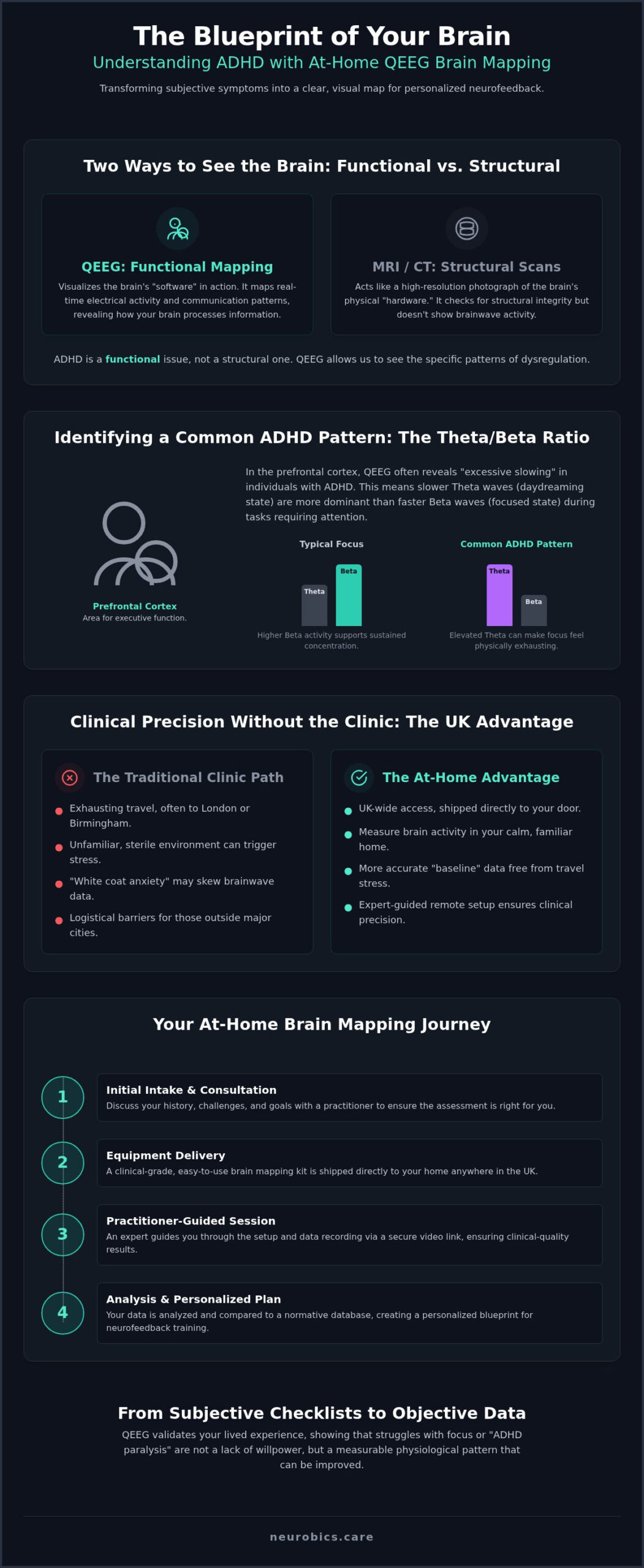
Quantitative electroencephalography (QEEG) is a sophisticated analysis of the brain’s electrical activity. Unlike a standard clinical EEG, which primarily looks for abnormalities like epilepsy, QEEG uses digital technology to quantify brainwave patterns across the entire scalp. It creates a functional “map” of how your brain processes information in real time. For individuals exploring qeeg brain mapping for adhd uk, this technology offers a way to see the invisible rhythms that govern focus and impulse control.
It’s helpful to distinguish this process from structural imaging. An MRI or CT scan is like a high-resolution photograph of the brain’s physical structure; it tells us if the “hardware” is intact. QEEG, however, acts as a recording of the brain’s “software” in action. ADHD is rarely a structural issue. It’s a functional one, rooted in how different regions of the brain communicate and regulate their energy levels. By capturing this activity, we establish a baseline that allows us to measure your progress objectively as you move through neurofeedback training.
How QEEG Identifies ADHD Patterns
In the prefrontal cortex, the area responsible for executive function, we often see specific markers associated with ADHD. The most common is an elevated Theta/Beta ratio. Theta waves are slow, typically associated with daydreaming or light sleep, while Beta waves are faster and linked to active focus. When there’s “excessive slowing” in the frontal lobes during tasks that require attention, the brain essentially stays in a semi-dreaming state. This makes sustained concentration feel physically exhausting.
Neurobics compares your individual data against a normative database of thousands of age-matched peers. This comparison reveals where your brain activity deviates from the statistical average. These deviations provide the clinical blueprint we need to design your training. We don’t guess which areas to train; we use the data to see exactly where your nervous system needs support to reach a state of better regulation.
Objective Data vs. Subjective Checklists
Most people arrive at an ADHD diagnosis through subjective checklists and retrospective interviews. While these tools are foundational, they rely on memory and self-perception, which can be frustratingly vague. Data provides a different kind of relief. Seeing “ADHD paralysis” or sensory overload represented as a specific cluster of activity validates your lived experience. It proves that your struggle with focus isn’t a lack of willpower; it’s a physiological pattern that can be worked with and improved.
QEEG is a non-invasive tool used to identify specific neural patterns for the purpose of designing personalized regulation protocols.
The UK Advantage: Professional At-Home Brain Mapping
For many individuals in Britain, accessing specialized neurological services often means a long, exhausting trip to a major metropolitan hub. Most traditional clinics offering qeeg brain mapping for adhd uk are concentrated in London or Birmingham, creating a significant barrier for those living in rural areas or across the borders in Scotland, Wales, and Northern Ireland. This logistical hurdle is particularly difficult for families managing ADHD, where long travel times and unfamiliar environments can trigger sensory overload and dysregulation before the assessment even begins. The stress of a four-hour train journey can fundamentally alter the very brainwave patterns we are trying to measure.
Neurobics removes these geographic constraints by bringing clinical-grade technology directly to your living room. We ship the same high-standard equipment used in top-tier clinics directly to your door, ensuring that your brain activity is measured in the environment where you actually live and work. This is vital because a calm, familiar setting often produces more accurate results than a sterile clinic. In your own home, your nervous system is more likely to reflect its “baseline” state, free from the ‘white coat’ anxiety that frequently skews data in medical settings.
Clinical Precision Without the Clinic
A common concern with remote care is whether the signal quality remains high without a technician physically present. We address this through practitioner-supervised setups. During your scheduled session, a Neurobics expert guides you through the process via a secure video link, monitoring the sensor connections in real time to ensure every data point is captured with clinical precision. This collaborative approach allows us to maintain the highest standards of data integrity while you remain in your most comfortable chair. You don’t need to be a tech expert; you just need to be in a space where you feel at ease.
UK-Wide Accessibility
Our service is designed to support the routine-heavy needs of ADHD families from Cornwall to the Highlands. By eliminating the need for travel, we ensure that your assessment fits into your existing schedule rather than disrupting it. While the NICE guidelines for ADHD focus on the standard clinical and psychosocial diagnostic pathway, adding objective data through at-home mapping provides a deeper layer of understanding for your personal regulation plan. This accessibility is a game changer for those who have previously felt excluded from advanced neurofeedback care due to distance or mobility issues.
If you’re ready to see how your brain functions in its natural environment, you can reach out to our team to discuss the next steps for your professional at-home assessment.
Understanding the ADHD Brain Map: What the Data Reveals
A brain map isn’t just a collection of colorful charts; it’s a window into the “top-down” control system that governs your daily life. When we perform qeeg brain mapping for adhd uk, we’re looking at how the prefrontal cortex manages attention, impulses, and energy levels. For many, the data reveals a “low-arousal” state where the brain struggles to shift into the higher gears required for focus. This explains why “brain fog” isn’t usually a lack of sleep, but a specific neural pattern where slow-wave activity dominates the areas meant for sharp, analytical thinking.
Different ADHD subtypes present distinct signatures on a map. Inattentive patterns often show excessive Theta waves in the frontal lobes, creating a sense of being perpetually “unplugged” or daydreamy. Conversely, the hyperactive-impulsive expression might show high-frequency Beta activity, indicating a nervous system that’s constantly over-revved and unable to filter sensory input. This leads to sensory overload, where every sound or light feels intrusive because the brain’s internal gatekeeper is physically overwhelmed.
Brainwaves and ADHD Paralysis
One of the most validating aspects of mapping is seeing the physical source of executive dysfunction. We often find high Alpha or Theta waves in the motor cortex, which can trigger a “freeze” response when you’re faced with complex tasks. This is the biological basis for ADHD paralysis. It’s not a failure of character or willpower; it’s a state where your brain is stuck in a low-arousal gear, making it physically difficult to initiate movement or decisions. You can explore this further by understanding the neuroscience of ADHD paralysis and how these patterns manifest in your daily routine.
The “Fingerprint” of Focus
We also look at the individual Alpha peak frequency (iAPF), which acts like a neural “clock speed.” A slower iAPF often predicts a lower capacity for sustained focus and slower information processing. Beyond focus, qeeg brain mapping for adhd uk helps us identify comorbid patterns, such as the high-beta signatures found in anxiety or the specific rhythms associated with chronic sleep disruption. It’s a way to see the “fingerprint” of your unique nervous system. While QEEG doesn’t provide a medical diagnosis of ADHD, it maps the unique neurological expression of your symptoms to provide the clarity needed for a personalized regulation plan.
This map also sheds light on emotional volatility. When the frontal regions aren’t providing enough “top-down” inhibition, the limbic system, your emotional center, can take over too easily. This results in the rapid mood shifts and rejection sensitivity that many people with ADHD experience but struggle to explain. By visualizing these connections, we move away from blame and toward a methodical plan for building internal balance.
How to Get Started with Brain Mapping in the UK
The journey toward better regulation begins with a comprehensive intake assessment. This isn’t just a clinical interview; it’s a deep dive into your personal history, daily challenges with executive function, and specific goals for your training. Once we understand your context, Neurobics ships a professional-grade measurement kit directly to your UK address. This kit includes a high-density EEG cap, sensors, and the necessary amplifiers to capture raw brainwave data with clinical precision from your own home.
The measurement session itself is conducted under the live supervision of a practitioner via a secure video link. You’ll participate in two primary protocols: an “eyes open” session to capture active processing and an “eyes closed” session to measure your brain’s resting state. This dual approach provides a complete picture of your nervous system’s flexibility. After the data is processed, you’ll meet with your practitioner for an oral report. This is where the abstract maps become a clear narrative, explaining your symptoms through the lens of your unique neural activity and establishing the baseline for your 4-week or 12-week program.
Preparing for Your QEEG Session
For a successful measurement of qeeg brain mapping for adhd uk, simple preparation makes a significant difference. We recommend getting a full night’s rest and maintaining your typical caffeine intake to ensure we capture your standard daily baseline. During the session, we capture data from 19 specific points on the scalp. Expert guidance is essential here because the brain’s electrical signals are incredibly faint. A practitioner helps identify and remove “artifacts,” which are non-brain signals caused by eye blinks, jaw clenching, or muscle tension that can easily distort results if not professionally managed.
From Mapping to Neurofeedback Training
The data from your map serves as the foundation for your personalized training program. Unlike generic apps that use a one-size-fits-all approach, Neurobics uses your QEEG results to set specific “reward” frequencies. This means the training is tailored to encourage the exact brainwave patterns your nervous system needs to reach a state of balance. Whether you’re working on focus or emotional regulation, your protocol is built on objective evidence rather than guesswork. You can explore our neurofeedback for ADHD guide to see how this data translates into active training sessions.
The transition from mapping to training is a collaborative process. We don’t just hand you a report and leave; we guide you through the initial sessions to ensure you feel confident using the equipment and understanding your progress. If you’re ready to move beyond subjective checklists and see the data behind your focus, you can book your initial intake assessment with our expert team today.
Why Choose Neurobics for Your ADHD Journey?
Neurobics stands apart because of our 15-year history of practitioner expertise in the field of brain health and regulation. We’ve refined our approach to ensure that every client receives “QEEG-informed” care, which is a commitment to never training blindly. Without a map, neurofeedback is often reduced to trial and error. By using professional qeeg brain mapping for adhd uk, we ensure that every session is targeted toward your specific neural needs, providing a level of precision that generic apps simply cannot match.
Our fully remote model isn’t just about convenience; it’s about providing high-level clinical support wherever you are located. Many providers in the UK require in-person visits that can be disruptive to the very routines people with ADHD work so hard to maintain. We’ve bridged this gap by combining clinical-grade equipment with ongoing expert supervision. This approach prioritizes your long-term self-regulation and quality of life rather than just providing a one-off report that gathers dust.
Expert-Led Remote Support
We believe that technology is most effective when it’s paired with human expertise and empathy. This is why our programs include weekly live sessions with your practitioner. These meetings allow us to monitor your progress in real time and adjust your protocols as your nervous system begins to shift and settle. You aren’t just buying a device or a measurement; you’re entering a partnership with a Dutch-registered professional practice that values your individual progress.
Working with an international practice like Neurobics provides a level of depth and authority that newer, local services often lack. We adhere to strict professional standards through our NFG and RBCZ registrations, ensuring that your data is handled with care and your training is grounded in years of clinical observation. When you invest in qeeg brain mapping for adhd uk through our remote service, you’re gaining more than just data; you’re gaining a roadmap for meaningful change. This continuous support helps you stay consistent, which is often the biggest hurdle for individuals with ADHD.
Your Path to Self-Regulation
Choosing to map your brain is a vital step toward moving beyond the limitations of a generic ADHD label. It allows you to see your challenges as functional patterns that can be influenced through methodical work. When you finally understand the physiological “why” behind your focus struggles or emotional volatility, the path to improvement becomes much clearer. Brain mapping builds a bridge from frustration to a more focused, calm, and predictable future.
Our goal is to empower you with the tools for self-regulation that last long after your 4-week or 12-week program ends. By training your nervous system to find its way back to balance, you develop a resilient foundation for managing stress and maintaining focus in your daily life. If you’re ready to start this journey with a team that values precision, empathy, and evidence-based care, you can contact our team today to learn more about our remote assessment options.
Mapping Your Path to Lasting Regulation
Moving beyond a generic ADHD label requires more than just subjective checklists; it demands a clear understanding of your brain’s unique functional patterns. By choosing qeeg brain mapping for adhd uk, you gain a clinical blueprint that transforms abstract symptoms into actionable data. This objective approach allows for the design of personalized neurofeedback protocols that target the root of your executive dysfunction and sensory overload from the comfort of your home.
With over 15 years of clinical experience, Neurobics provides a bridge between advanced technology and human-centered care. As an NFG and RBCZ registered practice, we offer specialized ADHD support across the UK, ensuring you’re never training blindly. Our remote model combines the precision of a clinic with the convenience your routine requires, guiding you toward a future of improved focus and internal balance.
If you’re ready to see the data behind your focus and start a personalized plan for regulation, we invite you to Book Your Remote ADHD Assessment with Neurobics. You don’t have to navigate this journey alone; expert support is just a conversation away.
Frequently Asked Questions
Is QEEG brain mapping a valid way to diagnose ADHD in the UK?
QEEG is not a tool for medical diagnosis in the UK. While it provides objective data on brain function, a formal ADHD diagnosis must follow the clinical and psychosocial pathways outlined by NICE guidelines. Neurobics uses qeeg brain mapping for adhd uk as a functional assessment to design personalized neurofeedback protocols. This data validates your lived experience by showing how your nervous system regulates itself, but it doesn’t replace a psychiatric evaluation; however, many adults seeking a formal clinical pathway find that online ADHD diagnosis and treatment provides the necessary medical support alongside their functional mapping results.
The cost for an at-home QEEG assessment depends on several factors, including your geographic location and the complexity of the oral report provided. While we provide clinical services, families often explore Subscription-based SaaS Fees for career discovery platforms like Future Me, Answered when seeking additional educational support for their children. Because Neurobics ships clinical-grade equipment directly to your door and provides live practitioner supervision, the fee covers both the logistics and the professional analysis. We focus on providing a clinical gold standard for remote care, ensuring the investment leads to a clear path for regulation rather than just a standalone report.
You cannot perform a clinical-grade QEEG scan without professional supervision. Capturing accurate brainwave data requires precise sensor placement and real-time monitoring to remove artifacts like muscle tension or eye blinks. Neurobics provides remote assisted neurofeedback, where a practitioner guides you through every step via video link. This ensures the data is clean and reliable, which is impossible to achieve with unguided, DIY consumer devices or simple self-help apps.
What is the difference between a standard EEG and a QEEG?
A standard EEG is typically used in medical settings to detect structural issues or conditions like epilepsy. In contrast, a QEEG uses sophisticated digital processing to quantify the power and distribution of brainwaves across 19 different points. By comparing your results against a normative database, we can see how your brain’s software is functioning. This functional map is what allows us to identify the specific neural signatures associated with your unique ADHD symptoms and challenges.
How long does it take to get my ADHD brain map results?
After your measurement session is complete, the data undergoes professional analysis and comparison against normative databases. You’ll then attend an oral report session with a Neurobics practitioner to review the findings. This process generally takes about one to two weeks from the time of your recording. During this session, your practitioner explains the visual maps in plain English and discusses how these patterns correlate with your daily challenges and goals for training.
Is QEEG brain mapping safe for children with ADHD?
Yes, QEEG brain mapping is entirely safe and non-invasive for children. The sensors only record the natural electrical activity produced by the brain; they don’t send any electrical current or stimulation into the body. For children with ADHD, the at-home model is particularly beneficial because it allows them to remain in a familiar, comfortable environment. This reduces the anxiety often associated with clinic visits, leading to more accurate and representative brainwave data for the assessment.
Will I need to stop ADHD medication before my QEEG mapping session?
In most cases, we recommend maintaining your typical medication routine before your qeeg brain mapping for adhd uk session. Our goal is to capture your brain’s activity in its standard daily state, which includes any support you currently use. However, this is a nuanced decision that depends on your specific goals. You should discuss your current medications during your initial intake assessment so your practitioner can interpret the data within the correct physiological context.
How many neurofeedback sessions will I need after my mapping?
Neurofeedback is a process of learning, and like any new skill, it requires consistent practice. Most individuals begin with a structured 4-week or 12-week program to establish a strong foundation for self-regulation. The exact number of sessions depends on your unique brain map and how quickly your nervous system responds to the training. We use periodic progress tracking to monitor your shifts and adjust your personalized protocols to ensure you’re reaching your specific regulation goals.
