


Imagine spending ninety minutes navigating the Central Line for a forty-minute appointment, only to repeat the journey again next week. For many seeking neurofeedback for adhd london, this exhausting commute is often the price of clinical expertise. You’ve likely tried the simple brain training apps that promise focus but lack the depth of a professional protocol. It’s frustrating to feel stuck between the rigid schedule of a Harley Street clinic and the inconsistency of a DIY approach that doesn’t quite meet your needs.
We believe that high-level support shouldn’t depend on your proximity to Central London. Based in the Netherlands, Neurobics brings over fifteen years of practitioner experience directly to your home through remote, qEEG-informed training. This article explains how you can access personalized protocols and expert guidance without the travel stress. We’ll walk through the process of using your own brain data to build a foundation for better self-regulation, ensuring you have the tools for improved focus and emotional balance in a way that fits your actual life.
Key Takeaways
- Learn how remote neurofeedback for adhd london provides a professional alternative to clinic visits, removing the stress of travel without compromising on expert clinical support.
- Understand why a personalized qEEG brain measurement is the foundation of effective training, allowing for protocols that target your specific brain patterns rather than a generic approach.
- Discover how Neurobics ships professional-grade equipment directly to your home, bridging the gap between clinical expertise and the comfort of your own environment.
- Explore the structured path to improved self-regulation through expert-led weekly sessions, ensuring you’re never training alone despite being at home.
- Find out how fifteen years of practitioner experience can support your ADHD journey through a flexible, evidence-aware training model that fits your daily routine.
Navigating ADHD Support in London: Why Neurofeedback is Trending in 2026
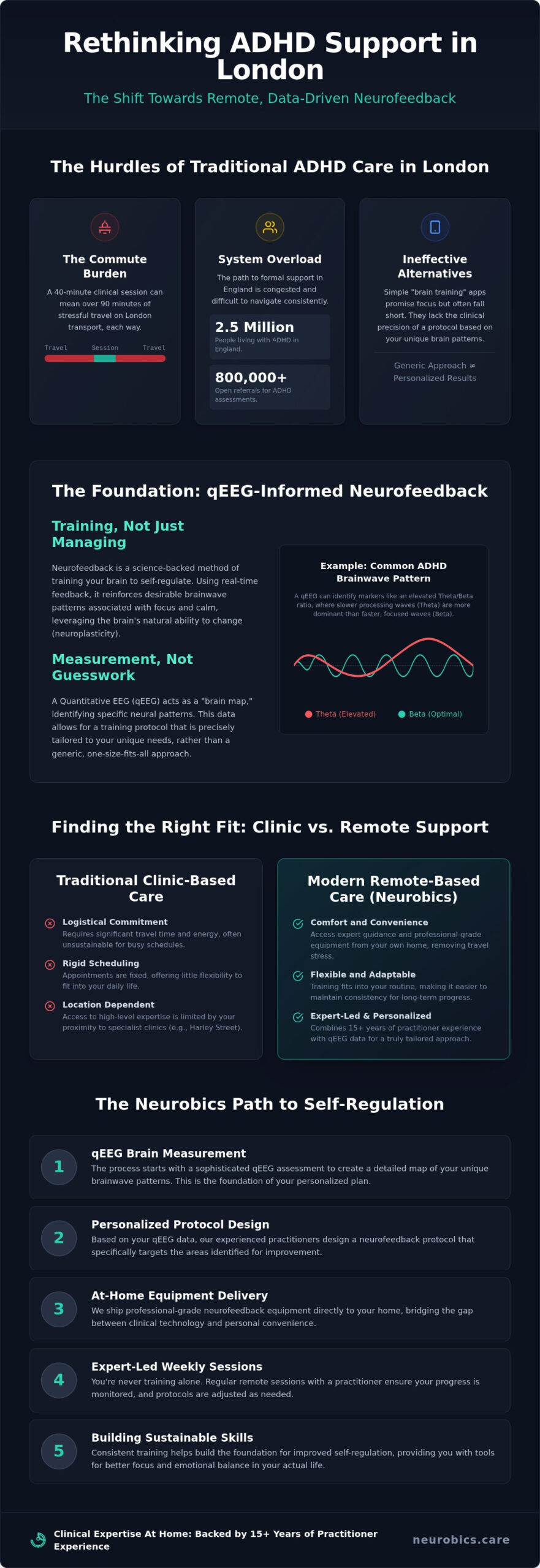
London’s pace is relentless, and for those managing ADHD, the search for effective, non-pharmacological support has reached a critical point. By mid-2026, data indicates that nearly 2.5 million people in England are living with ADHD, yet the path to formal support remains congested. While medication is a common route, many Londoners are looking for ways to build sustainable, long-term self-regulation. This is where What is Neurofeedback? becomes a central question for those seeking alternative or complementary tools. It’s a method that doesn’t just manage symptoms but aims to train the nervous system for better stability.
The Challenge of Traditional ADHD Support in London
Wait times for assessments and follow-up care are a significant hurdle. In March 2026, there were over 800,000 open referrals for ADHD assessments in England. Even for those who have secured a diagnosis, finding consistent care in the capital is difficult. Private clinics in areas like Harley Street offer high standards, but they require a heavy logistical commitment. Spending hours on the Tube for a weekly session isn’t sustainable for busy professionals or parents managing tight schedules. Many people turn to “brain training” apps as a shortcut, but these generic tools often fall short. They lack the clinical precision needed for neurofeedback for adhd london to be truly effective because they don’t account for the unique brain patterns identified through professional qEEG mapping.
Neurofeedback as a Science-Backed Alternative
Neurofeedback offers a different approach by teaching the brain to recognize and adjust its own activity. It’s a method grounded in neuroplasticity. During a session, sensors monitor brainwave activity and provide real-time visual or auditory cues. When the brain reaches a focused state, it’s rewarded with a clear screen or sound. Neurofeedback is essentially a form of operant conditioning for brain waves, where the brain learns to repeat desirable patterns through consistent reinforcement. This isn’t a quick fix. It’s a process of building mental capacity over time.
Neurobics integrates this scientific foundation with the convenience of modern technology. We move the expertise of the clinic into your living room. By using qEEG-informed protocols, we ensure the training isn’t a guessing game but a targeted plan based on your actual brain data. This shift toward remote, expert-led training allows you to prioritize your development without the burnout of a London commute. It’s a way to bridge the gap between high-end clinical care and the practicalities of daily life. If you’re ready to see how this fits your routine, you can contact us to discuss your specific needs.
How QEEG-Informed Neurofeedback Specifically Targets ADHD Patterns
Effective neurofeedback for adhd london starts with measurement, not guesswork. While generic brain training might offer broad relaxation, clinical-grade support requires a map of the individual’s neural landscape. This is achieved through a Quantitative EEG (qEEG), a sophisticated assessment that records brainwave activity across multiple sites. By comparing this data to a normative database, practitioners can identify specific markers associated with distractibility, impulsivity, and emotional regulation. This level of precision is what makes neurofeedback for adhd london a viable option for those who have found little success with generic apps.
Visualizing the ADHD Brain: The QEEG Map
One of the most common markers observed in ADHD is an elevated Theta/Beta ratio. Theta waves are often associated with daydreaming or drowsiness, while Beta waves represent active processing and focus. When the ratio is skewed, the brain may feel “under-aroused,” making it difficult to maintain attention on mundane tasks. However, every brain is unique. Some individuals might show different signatures, such as excessive Alpha activity in the frontal lobes or specific patterns of fast-wave activity that contribute to restlessness.
A King’s College London research review highlights the importance of rigorous methodology in this field, suggesting that outcomes are most reliable when protocols are precisely tailored. At Neurobics, we use this data to move beyond a one-size-fits-all model. Instead of a general protocol, we build a structured plan that targets the specific areas of your prefrontal cortex that need the most support. This data-driven approach moves the process from “guessing” to “measuring,” providing a clear baseline for your development.
The Science of Self-Regulation
The goal of these sessions is to leverage neuroplasticity, the brain’s natural ability to reorganize itself by forming new neural connections. Through repeated training, the brain learns to shift out of inefficient states and sustain the patterns necessary for executive function. It’s similar to physical therapy for the mind; you’re strengthening the pathways of attention through consistent, rewarded practice. QEEG-informed care ensures the training is ‘biologically relevant’ to the individual.
By focusing on your specific brain signature, we ensure that every minute of training is working toward your unique goals for focus and internal balance. This evidence-aware approach is designed to help you build lasting habits of regulation that persist long after the training ends. If you’d like to see how a personalized map could change your approach to focus, you can discuss your goals with our team today to learn more about our remote assessment process.
Clinic vs. Remote Training: Finding the Right ADHD Support in London
Choosing the right environment for neurofeedback for adhd london is a strategic decision that impacts both your results and your daily quality of life. For a long time, the only way to access clinical-grade training was through high-end clinics in Central London or Harley Street. However, as we move through 2026, the landscape has shifted. It’s no longer a binary choice between an expensive in-person visit and a basic, unsupervised mobile app. A middle ground has emerged: the remote clinical model.
Evaluating the Clinic Experience
The traditional clinic model offers a controlled, quiet space and the immediate presence of a technician. For some, this structure is helpful. But in a city as busy as London, this benefit often comes at a high logistical cost. The time spent navigating the Underground or sitting in traffic adds a layer of stress that can be counterproductive to nervous system regulation. When you factor in the session fees and travel time, the total investment is substantial. You can find a deeper breakdown of these factors in our guide to Neurofeedback Therapy Cost. For many professionals and families, the friction of the commute eventually leads to missed sessions, which slows down the progress of the training.
The Remote Assisted Model: Best of Both Worlds
Remote assisted neurofeedback is fundamentally different from “DIY” brain training. It isn’t a standalone device you use in isolation; it’s a clinical service delivered in your home. Neurobics bridges this gap by shipping professional-grade equipment directly to your door in London and providing the same level of expert oversight you’d find in person. By 2026, remote technology has advanced to the point where data quality is indistinguishable from clinic-based measurements, ensuring your training is always based on accurate brain activity.
- Frequency: Training 3 or 4 times a week is far easier when you don’t have to leave your house.
- Expert Support: Weekly live sessions with practitioners ensure your protocol stays on track.
- Consistency: Removing the travel barrier makes it much more likely that you’ll complete your full training plan.
This model allows you to maintain clinical standards while integrating the training into your actual life. You get the benefit of fifteen years of practitioner expertise without the burnout of the London commute. It’s a way to prioritize your focus and emotional regulation on your own terms. If you’re wondering how this model might fit into your specific routine, you can reach out to us for a detailed discussion about your needs.
The Path to Self-Regulation: Starting Your ADHD Journey in London
Embarking on a training program for neurofeedback for adhd london shouldn’t feel like an additional burden on your schedule. Our process is designed to bridge the distance between our Dutch clinical expertise and your home in the UK, ensuring that every step is methodical and supportive. The journey begins with a comprehensive intake session where we discuss your history, current challenges with focus, and your specific goals for regulation. This initial conversation ensures that the training we build is aligned with the practical realities of your daily life, whether you’re navigating a demanding corporate role in the City or supporting a child’s educational development.
The London QEEG Process: Clinical Precision at Home
For many, the most significant barrier to starting is the assumption that brain mapping requires a trip to a physical clinic. We’ve refined our logistics to ensure that residents in London receive the same level of diagnostic precision from their own living rooms. After your intake, we ship a specialized sensor cap and the necessary hardware directly to your address. During a live, guided video session, our practitioners walk you through the setup to ensure the signal quality meets our clinical standards. This At-Home QEEG Brain Mapping session is the cornerstone of your program, providing the raw data needed to identify the unique neural signatures of your ADHD.
Consistent Support and Live Sessions
Once your brain map is analyzed, we ship your personalized training equipment and launch your program. Whether you choose our 4-week intensive or the 12-week comprehensive track, you’re never training in isolation. Weekly live sessions with a neurofeedback expert are built into the process. These meetings are crucial for reviewing your progress and making micro-adjustments to your protocol based on how your brain is responding. It’s during these sessions that we translate the data into real-world wins. For example, a professional might report a newfound ability to stay engaged during long afternoon meetings without the usual mental fog, or a student might find the transition between subjects feels less jarring. To support your productivity outside of training, you can visit Timeqube to discover visual timers that help maintain focus during meetings and study sessions.
At Neurobics, we’ve spent over fifteen years refining a methodology that bridges the gap between scientific precision and personal well-being. While our practice is rooted in the Netherlands, our specialized remote model allows us to bring this depth of experience to those seeking neurofeedback for adhd london. We understand that the capital’s fast-paced environment demands a high level of cognitive resilience. Our goal is to provide you with the same clinical standards you’d expect from a high-end physical clinic, delivered with the flexibility that a modern London lifestyle requires.
Our training isn’t a one-off intervention but a structured journey toward better self-regulation. We offer 4-week and 12-week programs because we know that meaningful changes in neural pathways require consistent, guided practice. For those who choose our annual subscriptions, we include clinical-grade hardware as part of the service. This ensures you’re always training with professional equipment that meets our rigorous standards for data accuracy. It’s a comprehensive approach that prioritizes your progress over simple convenience.
Clinical Standards, Remote Delivery
The rise of automated “brain training” apps has created a misconception that neurofeedback can be managed by an algorithm alone. We take a different view. Every protocol we develop is human-led and evidence-aware. We believe that Neurofeedback for ADHD is most effective when a practitioner is involved to interpret the data and provide context to your experience. Your brain isn’t static; its needs change as you learn to regulate more effectively. By having an expert oversee your neurofeedback for adhd london, we ensure your training remains biologically relevant and safe throughout the entire process.
Next Steps for Your Brain Health
Starting your journey with Neurobics is a straightforward, supportive process. It begins with an intake assessment where we explore your history and what you hope to achieve. From there, we coordinate the delivery of your equipment and schedule your guided qEEG measurement. This isn’t just about addressing immediate challenges with focus or impulsivity. It’s an investment in the long-term health of your nervous system and your overall mental capacity. We view ourselves as your partners on this path, providing the tools and the expertise needed to help you build a more balanced, focused life.
If you’re ready to move beyond generic solutions and explore a professional, data-driven approach to your development, we’re ready to help. You can Contact us to discuss your ADHD training needs and learn more about how our remote clinical model can fit into your daily routine.
Building a Foundation for Lasting Focus in London
Accessing high-quality neurofeedback for adhd london no longer requires navigating the logistical hurdles of the city’s busiest districts. By choosing a remote clinical model, you integrate professional expertise directly into your daily routine. We’ve explored how qEEG-informed mapping replaces generic training with protocols tailored to your unique brain signature. This approach ensures every session is biologically relevant and supported by practitioners with over fifteen years of clinical experience. It’s about moving beyond symptom management toward building genuine mental capacity.
Neurobics provides the bridge between advanced technology and the human-led guidance necessary for meaningful growth. You don’t have to choose between clinical standards and convenience. Instead, you can develop better emotional balance and focus from the comfort of your own home. If you’re ready to start your journey toward improved self-regulation, we’re here to guide you through each step of the process with personalized care and expert oversight.
Book a remote intake assessment for your London home and discover how professional brain training can support your long-term goals.
Frequently Asked Questions
Is neurofeedback for ADHD effective when done remotely from London?
Yes, remote neurofeedback is highly effective because it uses the same clinical-grade hardware and qEEG-informed protocols as in-person sessions. The primary difference is the location. By removing the stress of the London commute, clients often find it easier to maintain the consistency required for neural change. Neurobics ensures effectiveness through weekly live sessions with experts who monitor your data and adjust your training plan in real time to suit your progress.
How long does it take to see improvements in ADHD symptoms with neurofeedback?
Most clients begin to notice subtle shifts in focus and emotional regulation within the first 10 to 15 sessions. However, neurofeedback is a process of building mental capacity rather than a quick fix. A typical program for neurofeedback for adhd london lasts between 12 and 20 weeks to ensure the new neural pathways are sufficiently strengthened. The pace of progress depends on individual brain patterns and the frequency of your training sessions.
Do I need a formal ADHD diagnosis to start neurofeedback in London?
No, a formal diagnosis isn’t a prerequisite for starting a neurofeedback program with Neurobics. Our approach is based on functional brain mapping rather than clinical labels. We use qEEG data to identify specific patterns of dysregulation, such as elevated Theta/Beta ratios, that correlate with your real-world challenges. This allows us to create a personalized training protocol focused on your unique goals for attention and nervous system balance without needing prior medical records.
What equipment is needed for at-home neurofeedback training?
We provide all the professional-grade hardware you need, including a high-quality EEG sensor cap and a dedicated training tablet. You don’t need to purchase standalone hardware yourself. Our annual subscriptions include the use of this clinical-grade equipment, which is shipped directly to your home in London. All you need is a stable internet connection for your weekly live sessions with our practitioners to ensure your setup is functioning correctly and your data is accurate.
Is neurofeedback a permanent solution for ADHD focus issues?
Neurofeedback aims to create lasting changes by leveraging neuroplasticity to strengthen neural pathways. While we don’t promise a “cure,” the goal is for the brain to learn new habits of self-regulation that persist after the training ends. Much like learning to ride a bicycle, once the brain acquires the skill of maintaining a focused state, it tends to retain that capacity. Some clients choose occasional “tune-up” sessions to maintain peak performance during stressful periods.
How does at-home QEEG brain mapping work for London clients?
We facilitate the brain mapping process by shipping a qEEG sensor kit to your London address and guiding you through the recording via a live video call. Our practitioners ensure the sensors are placed correctly to capture high-quality data. Once the recording is complete, we analyze the data against a normative database to build your personalized protocol. This remote-assisted model provides clinical precision without the need for a Harley Street visit or the associated travel time.
Can children in London use remote neurofeedback for ADHD?
Yes, children can benefit significantly from remote neurofeedback, provided they are old enough to sit relatively still for 20 to 30 minutes. It’s often an excellent option for families because it eliminates the travel stress that can be particularly taxing for children with ADHD. We tailor the training interface to be engaging and provide parents with the tools to support their child’s training sessions under our expert supervision, making it a sustainable part of the family routine.
What is the cost of a neurofeedback program for ADHD in London?
The cost of neurofeedback for adhd london varies based on the length and depth of the program. While we don’t list specific fees here, our remote clinical model is designed to provide better value than traditional in-person clinics by removing the overhead of central London office space. Our programs typically include the qEEG assessment, equipment use, and weekly practitioner support, offering a comprehensive alternative to the per-session costs found in many private Harley Street practices.
