


What if the reason your burnout hasn’t lifted with rest is because your nervous system has forgotten how to switch off? It’s a common frustration to feel like you’re doing everything right, yet that deep mental clarity remains out of reach. When traditional therapy doesn’t seem to address the biological root of your fatigue, a professional QEEG assessment Amsterdam provides the clarity you’ve been looking for.
We agree that mental well-being shouldn’t be a matter of trial and error. This article will show you how a clinical brain map provides the precise data needed to create a personalized, remote-first neurofeedback program tailored to your specific needs. We’ll explore how Neurobics uses these initial insights to build a bridge between clinical precision and the convenience of training from your own home. You’ll discover how a single visit to our Amsterdam location can unlock a structured path toward lasting cognitive balance and resilience.
Key Takeaways
- Understand how a professional QEEG assessment Amsterdam provides the essential biological blueprint needed to move beyond generic solutions and address the root causes of mental fatigue.
- Learn why a data-driven approach is superior to one-size-fits-all neurofeedback, ensuring your training protocol is specifically calibrated to your brain’s unique activity patterns.
- Discover the convenience of the Neurobics hybrid model, where a single clinical intake in Amsterdam enables high-quality remote neurofeedback sessions from the comfort of your home.
- Gain practical insights into the assessment process, including how to prepare for your recording session to ensure the highest data quality for your personalized plan.
- See how objective brain mapping serves as a foundation for long-term mental resilience, helping you regain focus and clarity through evidence-aware training.
QEEG Assessment: Why it’s Essential for Brain Health
A Quantitative electroencephalography (QEEG) is much more than a simple recording of electrical activity. While a standard medical EEG is primarily used in clinical hospital settings to detect structural issues like seizures or tumors, a QEEG assessment Amsterdam is designed to visualize how your brain actually processes information in real time. Think of it as a functional map rather than a still photograph. By analyzing the speed and rhythm of your brain waves, we can identify the biological blueprint behind your daily experiences. This shifts the focus from subjective symptom checklists to objective data, allowing us to see exactly where your nervous system might be stuck.
Identifying these patterns is the first step toward meaningful change. For example, someone struggling with chronic worry might show an overabundance of high-beta waves, which indicates a brain that’s constantly revving too high. Conversely, those dealing with focus issues or ADHD often exhibit a high theta/beta ratio, where slow-wave activity interferes with the brain’s ability to stay sharp and engaged. We don’t guess; we measure the specific electrical signatures that correlate with your mental state.
The Science of Brain Mapping: From Waves to Wisdom
Brain waves are categorized by their frequency, ranging from the deep, slow Delta waves of restorative sleep to the rapid Gamma waves associated with complex integration and problem-solving. Theta waves often appear during daydreaming or deep creativity, while Alpha represents a state of relaxed alertness. Beta waves are the workhorses of our waking life, though too much Beta can lead to feeling wired but tired. To make sense of these frequencies, we use normative databases to compare your results against a healthy peer group of the same age and gender. This comparison highlights specific areas for improvement and ensures your protocol is grounded in data. Neuroplasticity is the brain’s natural ability to reorganize its neural connections, which is the mechanism that allows QEEG-informed training to create lasting shifts in mental state.
Who Should Seek a QEEG Assessment in Amsterdam?
This assessment is particularly valuable for those who feel traditional rest isn’t curing their fatigue. In the fast-paced Amsterdam tech and financial sectors, many professionals face high-performance burnout where the brain loses its ability to down-regulate after a long day. It’s also an excellent tool for individuals experiencing “ADHD paralysis,” where the mental effort required to start a task feels insurmountable. For parents, this provides a non-invasive way to understand a child’s developmental regulation without relying solely on observation. If you are ready to see the data behind your mental state, you can contact us to schedule your initial intake and begin the process of regaining your mental clarity.
The Clinical Precision of QEEG-Informed Neurofeedback
Generic neurofeedback often relies on standardized protocols that assume every brain with a specific symptom should be trained the same way. This one-size-fits-all approach frequently leads to plateaus or inconsistent results because it ignores individual biological variance. By starting with a QEEG assessment Amsterdam, we eliminate the guesswork from the very beginning. We don’t just treat a label; we treat the unique electrical landscape of your nervous system. This precision is what allows us to build a program that actually resonates with your brain’s specific needs.
The interpretation of this data requires a high level of clinical expertise. Practitioner R.S. Verment, who brings over 15 years of experience to Neurobics, analyzes these complex maps to distinguish between meaningful neurological patterns and simple background noise. While consumer-grade headbands have popularized the idea of brain training, they lack the multi-channel precision required for clinical-grade work. Clinical QEEG equipment uses a full cap of sensors to monitor activity across the entire scalp, providing a high-resolution view that simple wearables cannot match. This evidence-based approach ensures that every session of your Remote Neurofeedback is grounded in rigorous science rather than trends. Just as software teams use FeedbackGraph to capture precise bug reports and feature requests to improve their products, clinical brain mapping captures the specific data needed to refine and optimize your cognitive health.
Visualizing Regulation: What Your Brain Map Reveals
A QEEG map uses color-coded visualizations to show which areas of your brain are “overactive” or “underactive” relative to a healthy peer group. Beyond just looking at individual locations, we analyze “coherence,” which describes how well different brain regions communicate and share information. Poor coherence can feel like a persistent mental fog or a lack of coordination in your thinking. In many cases, this fog is exacerbated by systemic issues; for example, Emagene Life highlights how chronic inflammation serves as a silent driver of cognitive fatigue and reduced clarity. By using these maps as a baseline, we can perform follow-up measurements to objectively track your progress and adjust your protocol as your brain learns to self-regulate more efficiently. It’s a dynamic process that evolves alongside your improvement.
Beyond Symptoms: Finding the Root Cause of Focus and Stress
Two people with the same ADHD diagnosis can have entirely different brain signatures. One might show an excess of slow-wave activity in the frontal lobe, while another might have a high-beta “busy brain” pattern that looks more like anxiety. This biological data is incredibly validating for our clients. It helps shift the narrative from a perceived character flaw to a visible, manageable physiological pattern, significantly reducing the stigma of mental health struggles. For those dealing with the specific “freeze” response often seen in neurodivergent individuals, understanding ADHD paralysis through a neurological lens is often the first step toward reclaiming control. If you’re ready to see what your own brain map reveals, you can book an initial intake with us to begin your journey toward lasting clarity.
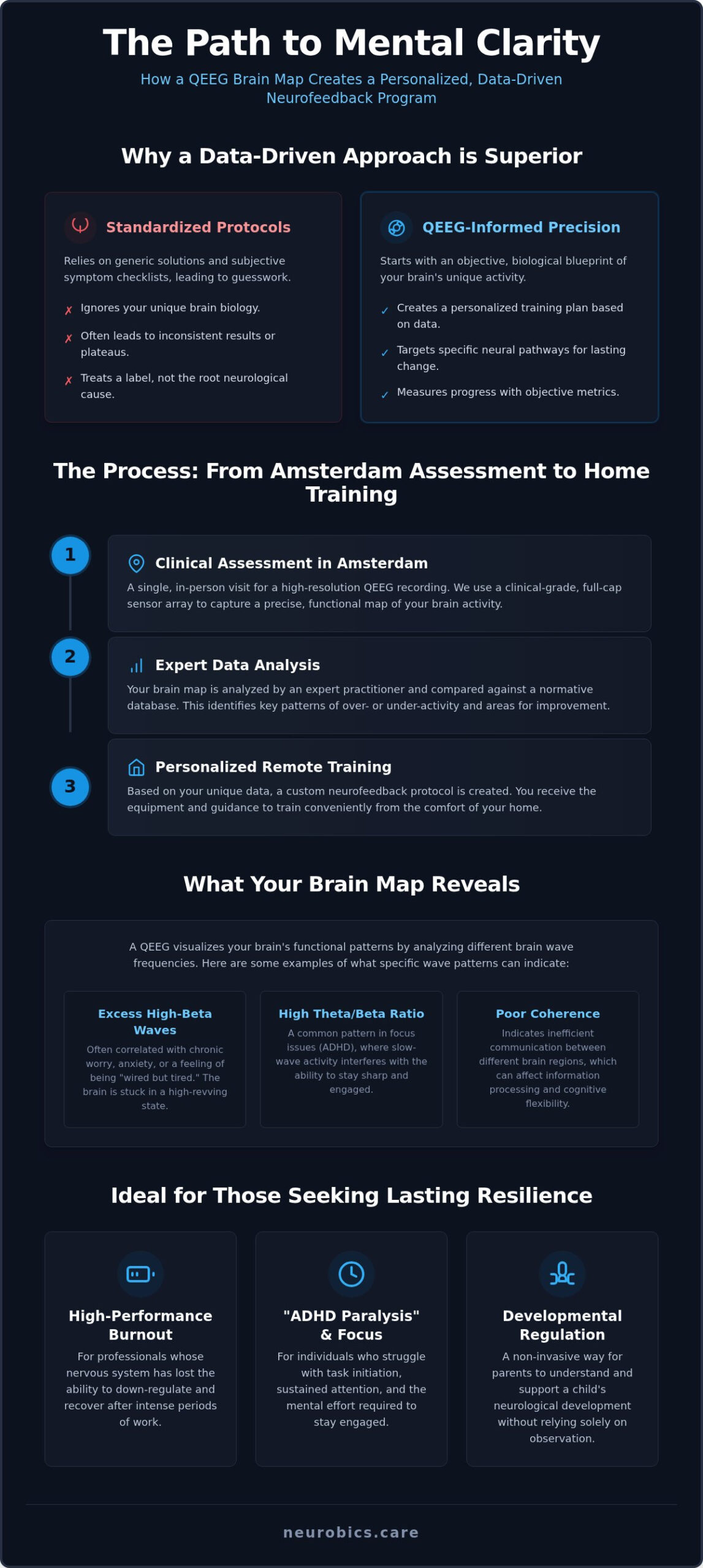
Assessment in Amsterdam, Training Anywhere: The Neurobics Hybrid Model
The biggest barrier to professional brain training is often the logistical burden of visiting a clinic multiple times a week. Traditional models require you to commute to a city center for every single session, which can be exhausting for those already dealing with burnout or focus issues. The Neurobics hybrid model solves this by combining the high-level accuracy of an in-person QEEG assessment Amsterdam with the flexibility of training from your own living room. We believe that professional-grade care should adapt to your life, not the other way around.
Your journey begins with a clinical intake in our Amsterdam office. This step is vital for data integrity. During this session, we use a specialized 19-channel cap to ensure perfect electrode placement and signal quality. This level of precision is difficult to achieve with DIY setups and forms the bedrock of your personalized training protocol. Once we have captured your brain’s unique activity patterns, the transition to Remote Neurofeedback is seamless. We ship the necessary clinical-grade equipment directly to your home, allowing you to begin your sessions without another trip to the city.
The Convenience of Remote Neurofeedback Training
Remote training doesn’t mean you are left to figure it out alone. Every program includes expert guidance to ensure you are meeting clinical standards during every session. You’ll work with a dedicated brain coach who monitors your progress through weekly live sessions, adjusting your protocols based on how your brain is responding in real time. For a deeper look at the technology and logistics involved, our At-Home Neurofeedback Guide provides a detailed breakdown of what to expect from professional remote training.
Global Support from a Dutch Foundation
While our Amsterdam office serves as the central hub for our European operations, our reach extends far beyond the Randstad. With over 15 years of practitioner experience, Neurobics has refined the process of supporting clients internationally. For those who truly cannot make the trip for a QEEG assessment Amsterdam, we also offer an at-home brain measurement option. This ensures that regardless of your location, you have access to the same evidence-aware care and technical support that has made our Dutch foundation a leader in the field. If you have questions about which assessment path is right for you, feel free to reach out to our team for a consultation.
Preparation and Results: Your QEEG Journey in the Netherlands
The day of your QEEG assessment Amsterdam is a focused, calm experience designed to capture the most accurate data possible. When you arrive, we start by placing a specialized 19-channel cap on your head. This cap contains sensors that simply listen to the electrical signals your brain is already producing; nothing is sent into your brain. The recording process itself usually takes about 20 to 30 minutes, during which you’ll spend time with your eyes both open and closed. It’s a quiet, non-invasive procedure that allows us to see how your nervous system functions in different states of rest and engagement.
To ensure the highest data quality, a few practical steps are necessary before your appointment. We ask that you wash your hair the morning of the session but avoid using any conditioners, oils, or styling products, as these can interfere with the sensor connection. It’s also helpful to have a normal night’s sleep and limit your caffeine intake for a few hours before the recording. While the “full QEEG” is the technical recording of your brain waves, the “intake” portion is where we discuss your history and goals. This combination ensures that the data we collect is grounded in your real-world experience.
Navigating Your Amsterdam Appointment
Our Amsterdam location is easily accessible, providing a professional and tranquil environment for your assessment. For residents in the Netherlands, it’s helpful to know that Neurobics is registered with the Dutch Healthcare Federation (NFG) and the RBCZ. While coverage for neurofeedback varies by provider, these registrations reflect our commitment to maintaining high clinical standards within the Dutch healthcare landscape. If you’re curious about the financial investment involved in professional training, you can find detailed information in our Neurofeedback Therapy Cost guide. Following the recording, we provide an oral report that translates complex graphs into actionable insights about your mental clarity and stress levels.
Interpreting Your Brain Map Report
The results of your assessment are presented as topographical “head maps.” These visualizations use colors to show where specific brain wave frequencies are outside the expected range. We use this data to build your personalized 4-week or 12-week training plan, targeting the specific areas that will help you achieve your goals. Your QEEG report is a living document used to guide every session, ensuring your training remains responsive to your brain’s evolving needs. This data-driven foundation is what makes our remote programs so effective. If you’re ready to see the blueprint of your own brain activity, you can schedule your Amsterdam assessment today to begin your journey.
The Neurobics Method: From Amsterdam Assessment to Mental Resilience
The journey toward mental clarity begins with objective data. A QEEG assessment Amsterdam is more than just a measurement; it is the non-negotiable first step in a process that transforms biological information into a roadmap for self-regulation. By capturing your brain’s unique rhythms in a clinical setting, we ensure that every subsequent session of your Remote Neurofeedback program is built on a foundation of absolute precision. We don’t believe in generic templates because your brain’s path to resilience is as individual as your fingerprint.
At Neurobics, our commitment to personalized care means that we stay with you throughout the entire process. The goal is not just to improve your numbers on a screen, but to foster lasting self-regulation that continues long after your formal training ends. By teaching your brain how to return to a state of balance, we help you build the internal resources needed to handle stress, focus, and emotional challenges with greater ease and confidence. This methodical approach ensures that the progress you make is sustainable for the long term.
A Personalized Path to Focus and Clarity
Whether you are managing the complexities of ADHD, navigating the persistent weight of anxiety, or recovering from high-performance burnout, QEEG-informed training provides a targeted way to address the underlying physiological patterns. Unlike DIY brain-training apps that offer a “one-size-fits-all” experience without clinical oversight, the Neurobics method relies on professional supervision and high-resolution data. This ensures that your training is safe, effective, and continuously adapted to your progress. Professional supervision is the key difference, as it allows for real-time adjustments that automated apps simply cannot provide. If you’re new to these concepts, reading our guide on what is neurofeedback can help you understand how this process supports long-term brain health.
Ready to Map Your Brain?
Choosing to invest in your brain health is a significant step toward a better quality of life. The Neurobics experience is designed to be premium and supportive, providing you with the expert tools and practitioner guidance needed to succeed. From your initial intake in our Amsterdam hub to your final remote session, we are partners in your growth. We invite you to move beyond simple symptom management and start building a more resilient mind today through a QEEG assessment Amsterdam.
If you’re ready to see the data behind your mental performance and begin a personalized program, we are here to help. You can Book your QEEG assessment in Amsterdam today or reach out to our team with any questions you may have about starting your journey. We look forward to supporting your path to mental clarity and lasting balance.
Take the First Step Toward a Resilient Mind
Understanding your brain’s unique electrical landscape is the key to moving past burnout and persistent focus issues. A professional QEEG assessment Amsterdam provides the clinical evidence needed to stop guessing and start training with precision. This data-driven approach ensures that your journey remains effective, whether you’re starting in our Amsterdam hub or transitioning to remote sessions from your own home. It’s a path designed to respect your time while prioritizing your mental health.
With over 15 years of practitioner expertise and professional registrations with the NFG and RBCZ, Neurobics combines high-level clinical standards with the flexibility of modern remote support. We don’t just offer technology; we provide a dedicated partnership focused on your long-term cognitive well-being. Ready to see what your own brain map reveals? Book Your QEEG Assessment in Amsterdam today and begin your personalized path to lasting mental clarity. Lasting change is possible when you have the right map to guide you.
Frequently Asked Questions
Is a QEEG assessment in Amsterdam covered by Dutch health insurance?
Neurofeedback is not covered by the mandatory Dutch Health Insurance Act (Zorgverzekeringswet). However, because Neurobics is registered with the NFG and RBCZ, some clients may receive partial reimbursement through their supplementary insurance package under “alternatieve geneeswijzen.” Every policy is different, so it’s best to check with your provider directly before booking your QEEG assessment Amsterdam to understand your specific coverage and potential reimbursements.
How long does a typical QEEG brain mapping session take?
A typical session at our Amsterdam hub lasts between 60 and 90 minutes. This timeframe includes the initial clinical intake conversation where we discuss your goals and history, followed by the 20 to 30 minute brain wave recording. We take the time to ensure the 19-channel sensor cap is fitted perfectly for high-quality data. You won’t feel rushed, as accuracy is our priority for building your personalized training protocol.
Do I need a referral from a GP to get a QEEG at Neurobics?
You don’t need a referral from a general practitioner (huisarts) to schedule an appointment at Neurobics. As a private practice, we allow clients to book directly to avoid the long waiting lists often found in the traditional Dutch mental healthcare system (GGZ). This direct access helps you begin your journey toward mental clarity and self-regulation much faster, providing a professional alternative for those seeking specialized, data-driven brain training.
Can I do the QEEG assessment at home if I can’t travel to Amsterdam?
Yes, we offer an at-home brain measurement option for individuals who cannot travel to our central office. While a QEEG assessment Amsterdam in person is often preferred for the highest level of practitioner-led precision, our remote measurement kits allow us to capture the necessary biological data from your own home. This ensures that even those living outside the Randstad or internationally can access a personalized, clinically informed neurofeedback program without logistical barriers.
Is the brain mapping process painful or invasive?
The brain mapping process is entirely non-invasive and painless. The sensors in the cap only “listen” to the natural electrical activity your brain is already producing; they don’t send any electricity or signals into your body. Most clients find the session quite relaxing, as you’ll simply be sitting quietly with your eyes open or closed for short intervals. It’s a gentle, passive way to gather deep insights into your nervous system.
How soon after the assessment can I start my remote neurofeedback training?
You can typically begin your Remote Neurofeedback training within one to two weeks after your initial assessment. Once we’ve analyzed your brain map and created your custom protocol, we ship the professional-grade equipment directly to your home. After the kit arrives, you’ll have a setup session with your brain coach to ensure everything is working correctly. This efficient transition allows you to maintain the momentum gained during your Amsterdam visit.
What is the difference between a standard EEG and a QEEG?
A standard EEG provides a raw recording of brain wave activity, often used by doctors to check for major issues like seizures. A QEEG, or “Quantitative” EEG, takes that raw data and processes it through sophisticated software to create a visual map. This allows us to compare your brain’s patterns against a normative database. It’s the difference between looking at a raw list of numbers and seeing a detailed, multi-colored weather map.
Can QEEG diagnose medical conditions like ADHD or epilepsy?
No, Neurobics does not provide medical diagnoses for conditions like ADHD, epilepsy, or clinical depression. Our work focuses on identifying functional patterns in brain activity that correlate with your symptoms, such as focus issues or stress. We use this biological data to create a training plan for self-regulation rather than labeling a condition. If you require a formal medical diagnosis, you should consult a psychiatrist or a specialized medical professional.
