


What if the reason you can’t sleep isn’t a lack of willpower or the wrong mattress, but simply a brain that has forgotten how to power down? It’s incredibly frustrating to spend your days in a persistent fog of fatigue only to find your mind racing the moment your head hits the pillow. You’ve likely tried the supplements, the blackout curtains, and the strict routines, yet that restorative rest remains out of reach. Neurofeedback for sleep improvement offers a different path by addressing the specific electrical patterns that keep your nervous system in a state of high alert.
We understand that dependence on sleep medication or the anxiety of another restless night can feel like an inescapable cycle. The good news is that your brain is remarkably adaptable and capable of learning new rhythms. By using qEEG-informed neurofeedback, we can identify the neurological root causes of your sleep disturbances. This process allows you to retrain your brain for deep, natural rest without the need for medication. In this guide, we’ll explore how professional nervous system regulation helps you fall asleep faster and reduce nighttime ruminations. You’ll discover how Neurobics uses clinical precision to help you reclaim the quiet, restorative nights you deserve.
Key Takeaways
- Understand how neurofeedback acts as operant conditioning, teaching your brain to naturally shift from a state of high alert to one of deep, restorative rest.
- Learn how SMR training through neurofeedback for sleep improvement stabilizes your brain’s internal clock to reduce nighttime wakefulness and fragmentation.
- Discover why qEEG brain mapping is essential for identifying your unique neurological patterns rather than relying on one-size-fits-all sleep apps.
- Explore the practical advantages of using clinical-grade equipment for remote neurofeedback in the comfort and privacy of your own home environment.
- See how Neurobics combines 15 years of expertise with remote professional guidance to ensure your brain training is safe, effective, and sustainable.
What is Neurofeedback for Sleep Improvement?
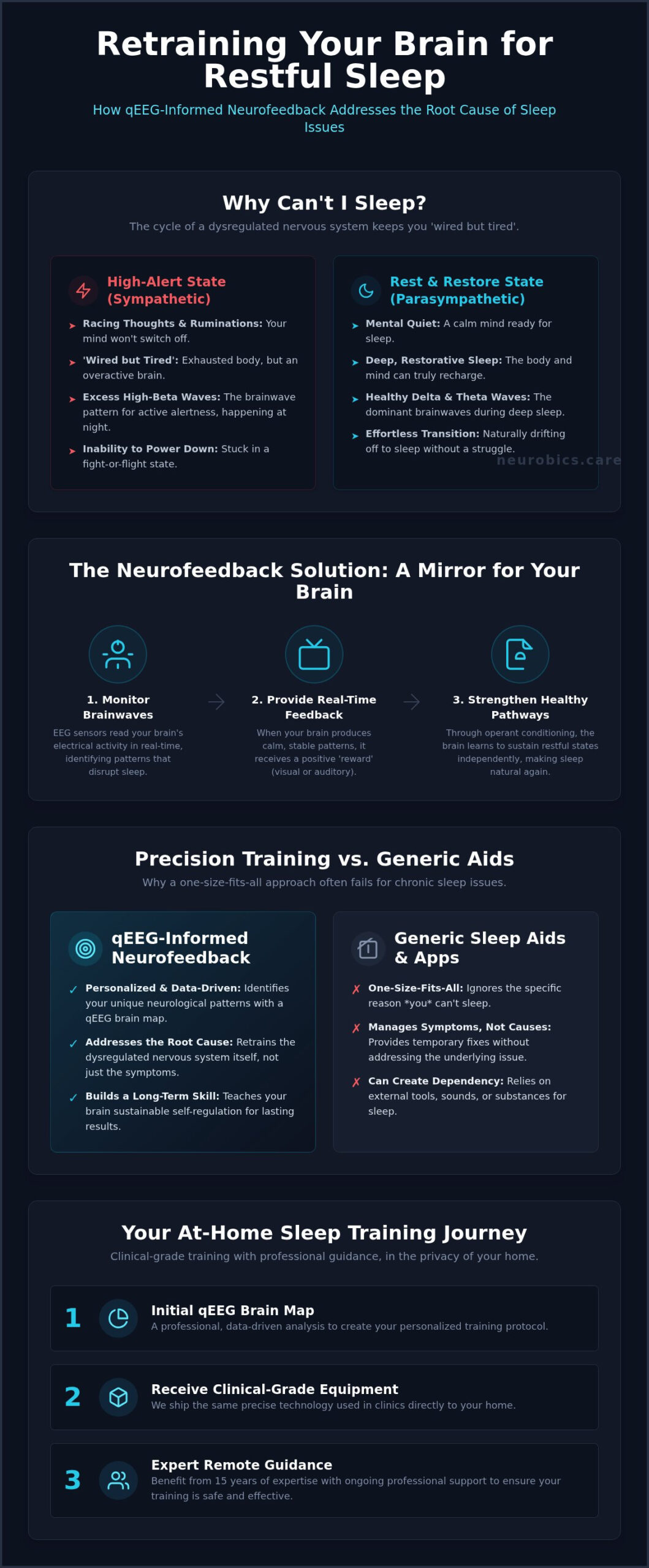
Neurofeedback for sleep improvement is a sophisticated method of retraining the central nervous system to find its way back to balance. Unlike passive interventions such as medication or white noise machines, this approach utilizes operant conditioning to teach the brain how to regulate its own states. To understand What is Neurofeedback?, it’s helpful to view it as a mirror for your brain’s electrical activity. By using EEG sensors placed on the scalp, the system monitors your brainwaves in real time. When your brain produces patterns associated with calm and stability, it receives a ‘reward’ in the form of visual or auditory feedback. Over time, your brain learns to sustain these healthy states independently. This makes the transition into sleep a natural process rather than a nightly struggle.
At Neurobics, we focus on brain-state regulation, which is the brain’s ability to shift gears from high-intensity alertness to a restful, restorative state. When this regulatory system is working correctly, you can move through your day with focus and then power down effortlessly at night. When it’s dysregulated, you might find yourself stuck in a loop of daytime fatigue and nighttime wakefulness.
The Science of Brainwave Regulation
Our brains operate on different frequencies depending on our level of activity. Beta waves are essential for daytime focus and alertness, while Delta and Theta waves dominate during deep sleep and relaxation. However, many people struggling with chronic sleep issues produce excessive ‘High Beta’ waves at night. This specific frequency is often the primary culprit for nighttime rumination and that ‘wired but tired’ feeling. Neuroplasticity is the brain’s ability to forge new sleep-friendly pathways, allowing it to move away from these high-stress patterns and toward restorative rhythms. Through consistent training, the brain becomes more efficient at producing the frequencies needed for high-quality rest.
Why Sleep Hygiene Isn’t Always Enough
Many clients come to us after trying every ‘sleep hygiene’ tip available. While dark rooms and avoiding screens are helpful, they often fail to fix a dysregulated nervous system. If your sympathetic nervous system is ‘stuck’ in a state of high alert, your body cannot effectively transition into the parasympathetic state required for rest. This is why you might feel exhausted but unable to drift off. Neurofeedback for sleep improvement serves as a tool to address this root neurological cause by teaching the brain how to down-regulate. Instead of just managing symptoms with temporary fixes, we’re helping the brain regain its natural capacity for self-regulation and long-term stability.
How Neurofeedback Retrains the Sleep-Wake Cycle
The core of neurofeedback for sleep improvement often involves training a specific frequency called the Sensorimotor Rhythm (SMR). This rhythm acts as a bridge between active alertness and deep rest. When we strengthen SMR, we’re essentially improving the brain’s ability to remain stable and undisturbed by external noise or internal stress. It’s a process of building a stronger sleep muscle that becomes more resilient with every session. By reinforcing this specific frequency, we help the brain develop a natural “standby” mode that is crucial for a smooth transition into slumber.
During a typical session, the brain receives real-time rewards whenever it hits these target frequencies. It’s a subtle but powerful way of learning. As detailed in this Forbes article on at-home sleep training methods, this feedback loop helps the brain recognize and repeat healthy patterns. This isn’t just about falling asleep; it’s about training the brain’s internal clock. By reinforcing daytime alertness and nighttime calm, neurofeedback helps align your circadian rhythm. This alignment supports the natural production of melatonin, making the transition to bed feel effortless rather than forced.
Targeting Nighttime Anxiety and Ruminations
One of the biggest hurdles to rest is hyperarousal, a state where the nervous system feels too unsafe to power down. This often manifests as a racing mind or physical tension the moment the lights go out. Neurofeedback helps lower this baseline of anxiety by training the brain to shift out of high-alert modes. For example, a person who spends hours rehearsing their to-do list in bed can learn to quiet that internal noise. Through training, the brain recognizes the onset of these ruminations and naturally pivots toward a more grounded state. This emotional regulation is a cornerstone of sustainable sleep health.
Improving Sleep Architecture and Deep Rest
Quality sleep isn’t just about the number of hours you spend in bed; it’s about the structure of those hours. Your brain needs to transition smoothly between REM and Deep Sleep cycles to truly recover. Dysregulated brains often struggle with these transitions, leading to fragmented sleep or feeling unrefreshed upon waking. Neurofeedback helps refine this sleep architecture by stabilizing the brain’s electrical activity. Over several weeks, these transitions become more efficient, allowing for longer periods of deep, restorative rest. If you’re ready to see how this approach can work for you, you can learn more about our personalized programs.
qEEG-Informed Training vs. Generic Sleep Aids
Achieving sustainable results with neurofeedback for sleep improvement requires more than just a device; it requires a roadmap. This is where the qEEG, or Quantitative EEG, becomes indispensable. While consumer-grade sleep apps often promise a quick fix, they usually apply a generic protocol to every user. This one-size-fits-all approach ignores the reality that your brain’s electrical signature is as unique as your fingerprint. Without a personalized map, there’s a genuine risk of over-training a frequency that’s already dominant, which can lead to increased agitation or poor results. At Neurobics, we use the qEEG as a blueprint to ensure your training is precisely targeted to your needs.
The Precision of qEEG Mapping
A qEEG identifies the specific type of dysregulation preventing you from resting. It can distinguish between an anxiety-driven sleep issue, characterized by excessive fast-wave activity, and an arousal-driven issue where the nervous system simply won’t down-regulate. We compare your brain’s activity against a normative database of healthy individuals to see exactly where your patterns diverge. This data-driven approach allows us to create a protocol that is both safe and effective. Professional interpretation of this map is critical. A trained practitioner can spot nuances in your brain’s data that an automated app would miss, ensuring you aren’t under-training the areas that need the most support.
Neurofeedback vs. Sleep Medication
Many people turn to sedatives as a first line of defense, but medication acts as a chemical override. It forces the brain into a state of unconsciousness without addressing the underlying rhythm of the sleep-wake cycle. In contrast, neurofeedback for sleep improvement focuses on organic learning. Instead of relying on an external substance to “knock you out,” you’re teaching your brain the skill of self-regulation. A common question we hear is whether you’ll be dependent on these sessions forever. Because neurofeedback relies on neuroplasticity, the changes are long-lasting. Once your brain learns these new, healthier pathways, it retains the ability to use them. You won’t have to worry about the grogginess, dependency, or long-term side effects associated with traditional sedatives.
By choosing a qEEG-informed approach, you’re investing in a solution that respects your individual biology. It’s a shift from temporary symptom management to building a foundation for lifelong sleep health.
The Practical Journey of At-Home Sleep Training
Training for better rest is most effective when it happens in the environment where you actually sleep. Traditional in-office visits often involve long commutes and clinical settings that can inadvertently trigger a stress response, counteracting the relaxation benefits of the session. By choosing neurofeedback for sleep improvement at home, you integrate the training into your personal space and daily rhythm. You’ll use clinical-grade sensors and a user-friendly interface that brings professional precision into your living room. While the training is remote, it’s never a solitary “do-it-yourself” project. A dedicated practitioner monitors your progress behind the scenes, ensuring your sensors are placed correctly and your protocols remain optimized for your evolving needs.
Step 1: The Initial qEEG Assessment
Your journey begins with an At-Home QEEG Brain Mapping session. We ship the necessary high-fidelity equipment directly to you, allowing you to record your brain’s activity in a relaxed state. This data provides a detailed look at the electrical patterns responsible for your sleep disturbances. Once the recording is finished, our experts analyze the results to design a protocol tailored specifically to your nervous system. This ensures that your training isn’t based on guesswork but on a clear, data-driven blueprint of your unique brain function.
Step 2: Starting Your Training Sessions
A typical session lasts between 20 and 40 minutes and is designed to be a calm, engaging experience. You might watch a movie or listen to audio that responds to your real-time brainwave activity. When your brain produces the target frequencies associated with calm and stability, the movie plays clearly. If your brain drifts into a “high-beta” or “wired” state, the screen might dim slightly. This immediate feedback loop is how your brain learns to stay in the “rest-ready” zone. Consistency is the most important factor for success. Training several times a week helps reinforce these new pathways until they become your brain’s new default setting.
Step 3: Tracking Real-World Improvements
Progress in neurofeedback for sleep improvement often starts with subtle shifts. You might notice you’re less reactive to daytime stressors or that the persistent “tired-but-wired” feeling in the evening begins to fade. You won’t have to navigate these changes alone; your Neurobics practitioner conducts weekly check-ins to review your session data and discuss your experience. As your brain becomes more resilient and your sleep architecture stabilizes, we refine the protocol to keep you moving toward your goals. This ongoing professional guidance is what transforms the technology into a sustainable solution for long-term health. If you’re ready to begin, you can reach out to our team today to discuss the best program for your needs.
Why Choose Professional Remote Neurofeedback for Sleep?
Neurobics stands at the intersection of clinical expertise and the evolving landscape of home-based care. With 15 years of operational history, we’ve refined our approach to neurofeedback for sleep improvement to ensure that every protocol is as precise as one found in a high-end clinic. Our mission is to provide you with the tools for self-regulation without the logistical burden of frequent travel. We bridge the gap between high-level technology and the restorative comfort of your own bedroom, making professional care accessible wherever you are.
Our international presence allows us to support clients across the globe, with specialized local support teams available in Europe and Dubai. We offer structured 4-week and 12-week programs designed to provide the consistency your brain needs to make lasting changes. These timeframes aren’t arbitrary; they’re based on the biological reality of how long it takes for the brain to consolidate new habits and rhythms. By committing to a structured program, you give your nervous system the time it needs to move from a state of hyperarousal to one of sustainable calm.
The Neurobics Approach: Expert-Guided Regulation
Trust is foundational when it comes to brain health. Neurobics is NFG and RBCZ registered, meaning our work meets rigorous professional standards for care and ethics. We recognize that sleep disturbances rarely exist in isolation. Often, they’re intertwined with other challenges like focus issues, anxiety, or internal restlessness. Our personalized protocols are designed to address the whole person, which is why we also specialize in Neurofeedback for ADHD. By looking at the broader picture of your neurological health, we help you build a more resilient and balanced nervous system that supports rest and focus alike.
Next Steps Toward Better Sleep
The path to better rest begins with understanding your current neurological state. We encourage every prospective client to start with a professional intake assessment. This initial conversation allows us to listen to your history, understand your specific sleep pains, and determine if neurofeedback for sleep improvement is the right fit for your lifestyle. It’s a collaborative process where your goals and our expertise meet.
From your first inquiry to your final training session, our team is there to guide you. Once you decide to move forward, we’ll coordinate the global delivery of your clinical-grade equipment and schedule your initial brain measurement. Achieving deep, restorative sleep is a journey of small, consistent steps. When you’re ready to take the first one, you can contact the Neurobics team for a personalized consultation. We’re here to help you navigate the process with clarity, empathy, and expert support.
Reclaim Your Natural Rhythms
Sleep is more than just a biological necessity; it’s a skill that your brain can relearn through consistent, targeted practice. By moving beyond temporary fixes and addressing the electrical dysregulation at the root of your restlessness, you create a foundation for lasting change. Neurofeedback for sleep improvement offers a path toward sustainable rest by utilizing your brain’s own neuroplasticity to shift from hyperarousal to calm. With our evidence-based protocols and clinical-grade equipment delivered directly to your door, you can begin this transformation in the comfort of your own home. Our NFG-registered practitioners provide the expert guidance needed to ensure your training is safe and precisely aligned with your unique qEEG map.
You don’t have to navigate the fog of daytime fatigue or the anxiety of a racing mind alone. We’re here to help you bridge the gap between advanced technology and the deep, restorative rest your body requires. Every session builds toward a more resilient nervous system and a more balanced life. Take the first step toward waking up feeling truly refreshed and restored by choosing a path that respects your individual biology.
Book your clinical brain mapping assessment for better sleep today
Frequently Asked Questions
How long does it take to see sleep improvements with neurofeedback?
Most clients begin to notice subtle shifts in their sleep quality within the first 10 to 15 sessions. While the initial feeling of being less “wired” happens early, significant neurofeedback for sleep improvement usually requires more time to consolidate. It’s a cumulative process where the brain gradually adopts these new rhythms as its default state. Consistency is key to ensuring these early gains turn into long-term habits.
Can neurofeedback help with chronic insomnia that has lasted for years?
Yes, neurofeedback is effective for long-standing sleep issues because it targets the underlying neurological patterns rather than just the symptoms. Even if you’ve struggled for decades, your brain retains the capacity for neuroplasticity. By identifying and retraining the hyperarousal patterns visible on your qEEG map, we can help your nervous system learn to power down. This process works regardless of how long the dysregulation has been present.
Is at-home neurofeedback as effective as in-clinic sessions?
At-home training is just as effective as in-clinic sessions when you use professional, clinical-grade equipment and expert oversight. Neurobics provides the same high-fidelity sensors used in top clinics, combined with remote guidance from experienced practitioners. Training in your own environment actually offers a unique advantage. It allows your brain to learn these new sleep-ready states in the exact location where you need them most, reinforcing the association between your home and rest.
Are there any side effects to training my brain for sleep?
Side effects are rare and generally mild, often manifesting as temporary fatigue or a slight headache after a session. These symptoms are similar to the mental tiredness you might feel after learning a complex new skill. Because we use personalized qEEG protocols, we can adjust the training to minimize discomfort. Having a practitioner monitor your progress ensures that the training remains within your brain’s comfort zone while still encouraging growth and regulation.
Do I need to stop my sleep medications before starting neurofeedback?
You don’t need to stop your medications to begin training, and you should never change your prescription without consulting your doctor. Neurofeedback works as a complementary approach that focuses on the brain’s self-regulation. As your brain becomes more efficient at entering sleep states naturally, you may find that you need less support. Any reduction in medication should be a gradual process managed by your medical provider in coordination with your progress.
How many sessions of neurofeedback are typically needed for sleep?
A standard program for lasting sleep regulation usually consists of 20 to 40 sessions. While early improvements are encouraging, this higher number of sessions is necessary to ensure the brain “locks in” the new patterns. Think of it like physical therapy for the brain. Short-term training might provide temporary relief, but completing a full course allows the neurological changes to become a permanent part of your brain’s architecture.
What happens if I stop neurofeedback-will my sleep problems return?
The benefits of neurofeedback for sleep improvement are typically long-lasting because the process involves actual learning. Once your brain masters the skill of shifting from alert to restful states, it doesn’t simply forget. It’s similar to learning to ride a bike; once the neural pathways are established, they remain accessible. While some clients choose occasional “tune-up” sessions during high-stress periods, the core improvements generally stay with you long after the program ends.
Can neurofeedback help with sleep apnea or restless leg syndrome?
Neurofeedback can help manage the brain’s response to these conditions, but it isn’t a direct treatment for physical issues like airway obstruction in apnea. For restless leg syndrome, training can help calm the overactive motor cortex and reduce the associated distress. While it doesn’t replace medical treatments for these conditions, it often improves overall sleep architecture and makes the nervous system more resilient to the disruptions they cause.
