


Nearly three in ten adults in Ireland now report feeling anxious or stressed more than half the time, yet many find themselves stuck on long waitlists or facing hours of commuting to clinics in Dublin or Cork. It’s frustrating to feel that your path to better sleep or improved focus is blocked by geography or a lack of specialized care in your local area. This is why at home neurofeedback ireland has become such a vital alternative for those seeking professional support without the travel. You might have looked into basic apps but felt skeptical about their “one size fits all” approach and lack of expert oversight.
You deserve a solution that’s both clinically grounded and respectful of your time. In this guide, you’ll discover how to access professional, QEEG-informed training that brings clinical expertise directly to your home. We’ll explain how Neurobics uses personalized brain mapping and weekly professional sessions to help you achieve better emotional regulation and mental clarity. We’ll also look at how a structured, expert-guided program fits into a busy lifestyle, ensuring your journey toward a calmer mind is supported by over 15 years of clinical experience. This approach provides the same rigor as an in-person clinic, helping you build a more resilient nervous system from any location in Ireland.
Key Takeaways
- Learn how remote training provides clinical-grade brain sessions from the comfort of your own home, bypassing long waitlists and travel to major cities.
- Understand the role of QEEG brain mapping in creating a personalized protocol that addresses your specific patterns of stress, sleep, or focus.
- Discover why at home neurofeedback ireland relies on professional-grade equipment and weekly expert guidance rather than unregulated DIY apps.
- Explore the 4-week structured journey with Neurobics, from the initial discovery call to receiving your hardware kit at any Irish address.
- Gain insights into how systematic brain training supports long-term self-regulation and mental resilience through evidence-aware methods.
What is At-Home Neurofeedback and How Does it Support the Irish Community?
Professional brain training has undergone a significant transformation in Ireland. Traditionally, accessing these services meant regular commutes to specialized centers in major hubs like Dublin or Cork. Today, at home neurofeedback ireland provides a way to receive clinical-grade care without the logistical burden of travel. This model uses the same high-standard hardware found in a practitioner’s office, but it’s delivered to your doorstep. It isn’t a “DIY” approach; instead, it is a remote-assisted process where experts guide you through every session using secure digital connections.
To understand the foundation of this work, it’s helpful to ask: What is Neurofeedback? At its core, it’s a non-invasive method that monitors brainwave activity and provides real-time feedback. This allows the brain to learn more efficient patterns of self-regulation. For the Irish community, where 29% of adults report feeling stressed or anxious more than half the time, having this technology available at home removes one of the biggest barriers to consistent care: accessibility.
The Evolution of Brain Training in Ireland
The history of neurofeedback in Ireland was once defined by its scarcity. Families in rural areas often had to choose between grueling weekly drives or going without support. However, recent advancements in EEG technology and the planned 2026 rollout of national remote health monitoring services by the HSE have signaled a broader shift toward telehealth. Modern systems now allow for lab-quality EEG monitoring in a living room. Neurobics bridges the gap between international expertise and local needs, ensuring that whether you’re in a busy Dublin office—where organizations often implement modern שילוט דיגיטלי לעסקים to improve communication—or a quiet village in Connemara, the quality of your training remains uncompromised.
Choosing at home neurofeedback ireland often comes down to the environment. Clinical settings can sometimes trigger a “clinic effect,” where the stress of an unfamiliar environment or a long commute alters a person’s baseline brain state. Training in a familiar, low-stress space allows for more accurate data and a more relaxed learning process. This is particularly beneficial for neurodivergent individuals or those with sensory sensitivities who might find a traditional clinic overstimulating.
Consistency is the final piece of the puzzle. Neuroplasticity, the brain’s ability to change and adapt, thrives on regular practice. When equipment is already in your home, it’s much easier to maintain a schedule that fits a busy lifestyle. This frequency leads to more stable progress in emotional regulation and focus, making the training a seamless part of your daily routine rather than an added chore.
The Science of Self-Regulation: Why QEEG-Informed Protocols Matter
Neurofeedback is more than a relaxation tool; it’s a sophisticated form of brain training grounded in operant conditioning. This process involves rewarding the brain when it produces desired wave frequencies, helping it learn more efficient ways to function. For those exploring at home neurofeedback ireland, it’s vital to distinguish between active learning and passive stimulation. While some systems simply provide a general stimulus, our approach requires the brain to do the work, leading to more durable changes in self-regulation. This is why professional oversight is so important; you aren’t just watching a screen, you’re teaching your nervous system a new set of skills.
The foundation of this training is the QEEG, or Quantitative Electroencephalogram. This serves as a clinical blueprint for your nervous system. The Science of Neurofeedback highlights how these maps allow practitioners to move away from guesswork and toward precision. By measuring electrical activity across the scalp, we can see exactly where the brain is over-performing or struggling to keep up. This data is what makes the difference between a generic “brain app” and a clinical program.
What a QEEG Brain Map Reveals
A brain map identifies the relative power of different frequencies across the cortex. Delta and theta waves are slower, often dominant during sleep or deep relaxation. If these are too high during the day, it can manifest as brain fog or focus issues often seen in ADHD. Conversely, alpha and beta waves relate to calm alertness and high-level processing. An imbalance here might explain why someone feels constantly wired but tired. By utilizing At-Home QEEG Brain Mapping: Clinical Precision from Your Living Room, we connect these internal patterns to your real-world experience, providing clarity on why certain mental states feel so difficult to shift.
Personalised Protocols vs. Generic Feedback
Generic systems often treat every brain the same way, which can lead to plateaued progress or even increased irritability. Your brain is unique and needs a specific exercise plan that targets the right areas. At Neurobics, we don’t just ship equipment and leave you to figure it out. Our practitioners review your data and adjust your training parameters remotely. This ensures that your at home neurofeedback ireland program evolves as your brain does, maintaining the right level of challenge. This level of expert oversight provides a safety net and a clear path toward meaningful improvement. If you’re ready to see what a personalized map could reveal about your own brain health, you’re welcome to reach out for a discovery call.
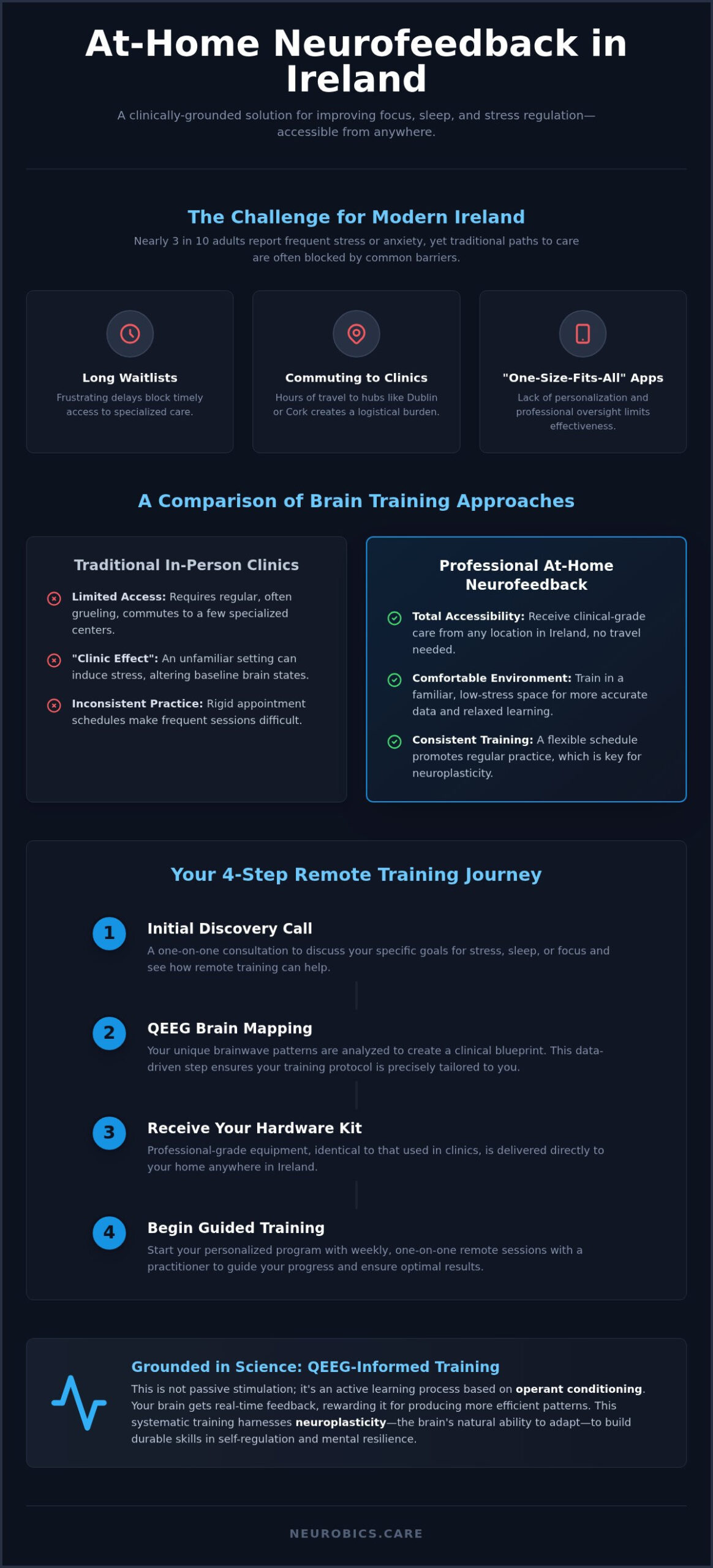
Comparing Local Irish Clinics vs. Professional Remote Neurofeedback
Choosing between a brick-and-mortar clinic and at home neurofeedback ireland involves more than just location. It’s a choice about the intensity and sustainability of your training. A standard course often requires 20 to 40 sessions to see lasting changes in brain patterns. In a traditional clinic setting, this means committing to one or two visits per week. For many, this timeline is stretched thin by the realities of Irish traffic or long-distance travel from counties like Galway or Kerry. Commuting twice weekly for months is a significant hurdle that often leads to dropped sessions and slower progress.
The efficacy of this work is recognized by Professional Neurofeedback Organizations like the ISNR, which emphasize that the quality of the hardware and the protocol matters most, not the physical location of the practitioner. Remote models allow for a much higher frequency of training. While a clinic visit might happen twice a week, having professional hardware at home allows for three to five sessions weekly. This increased frequency often leads to faster consolidation of new neural patterns, making the most of the brain’s natural neuroplasticity. At Neurobics, we prioritize this consistency because it’s the foundation of long-term change.
Logistics and Convenience for Irish Families
Commuting to Dublin or Cork for an hour-long session often turns into a three-hour ordeal. For a family managing a child’s focus or a professional dealing with burnout, this added stress can be counterproductive. Home training allows you to integrate sessions into your existing routine, perhaps after school or before a workday starts. It also means training in the very environment where you need those self-regulation skills most. Whether you are in a home office or a quiet bedroom, the brain learns to regulate itself in the context of your real life rather than in a clinical, sterile room.
Cost and Value Comparison
When evaluating the financial aspect, the per-session cost of in-clinic care can add up quickly. Most Dublin clinics charge between €120 and €150 per hour. Over a 20-session program, the investment becomes substantial. In contrast, the rental model used in at home neurofeedback ireland provides a flat monthly rate that often includes high-frequency sessions. You can explore a detailed breakdown in our guide on Neurofeedback Therapy Cost in 2026. This shift from paying per hour to paying for a program typically results in more training hours for every Euro spent. While Irish health insurance providers are still catching up with remote healthcare trends, many clients find the time saved on petrol and parking makes the home model the more economical choice long-term.
Your 4-Step Journey to Remote Brain Training with Neurobics
Embarking on a journey toward better mental clarity shouldn’t feel like a technical challenge. We’ve refined our process to ensure that at home neurofeedback ireland is as seamless as possible, combining clinical rigor with personalized, human-led support. The path begins with an initial consultation where we listen to your history and define your specific goals, whether that’s managing burnout, improving sleep quality, or addressing long-standing focus issues. This discovery phase ensures the training is tailored to your life from the very first day.
Following our initial talk, we ship professional-grade EEG equipment directly to your Irish address. This hardware allows for an at-home QEEG brain measurement, which captures the raw data needed to build your clinical blueprint. Once your brain map is recorded, Neurobics experts translate these complex patterns into a personalized protocol designed specifically for your nervous system. Finally, you move into the active training phase, typically structured in 4-week or 12-week blocks. You’ll engage in regular sessions at your own pace, supported by weekly live check-ins to ensure your progress is steady and your protocols are adjusted as your brain learns to self-regulate.
Receiving and Setting Up Your Equipment
When your kit arrives, you’ll find clinical-grade EEG sensors and a user-friendly training interface designed for home use. We understand that many of our clients don’t have a background in neuroscience or technology, so we’ve made the setup remarkably simple. You don’t need to be a technical expert to get started. Our team provides a scheduled “tech-check” via video call to walk you through the placement of sensors and ensure the signal quality is optimal. This step is crucial for maintaining the same level of precision you’d expect in a physical clinic, all from the comfort of your own living room.
The Role of Your Remote Practitioner
Success in brain training isn’t just about the hardware; it’s about the partnership between you and your practitioner. Your guide reviews your data after every session to monitor how your nervous system is responding. During your weekly live check-ins, we discuss your real-world experiences and adjust the training parameters accordingly. This level of oversight is particularly vital for those seeking Neurofeedback for ADHD, where subtle shifts in regulation require careful, professional calibration. By keeping the experience human-led, we ensure you feel supported throughout the entire process. If you’re ready to begin this structured path, you can book an intake today to explore how we can support your unique goals.
Getting Started: Investing in Your Brain Health in Ireland
With nearly one in ten people in Ireland experiencing depression and waitlists for mental health services often stretching into months, taking control of your cognitive health is a proactive necessity. The shift toward at home neurofeedback ireland offers a bridge between clinical expertise and the practicalities of a busy life. It is a logical evolution for a country moving toward remote health monitoring. By choosing a remote-assisted model, you’re not just bypassing the commute to a clinic; you’re choosing a path that prioritizes consistency and expert oversight over the limitations of generic, unsupervised apps.
Investing in your brain health requires a shift in perspective. It’s about moving from a reactive stance to a proactive one. Neurobics provides the tools and the professional guidance to make this transition possible. While the technology is advanced, our goal is to keep the experience human-centered and grounded in your real-world progress. We believe that lasting change comes from a methodical, supported approach to nervous system regulation rather than a “quick fix” that lacks clinical depth.
Is Remote Neurofeedback Right for You?
Determining if this program fits your needs is an important first step. Success with at home neurofeedback ireland depends on a few practical factors. You’ll need a stable internet connection for our weekly live support sessions and a quiet space where you can focus for about 30 to 45 minutes a few times a week. This program is particularly beneficial for individuals managing ADHD patterns, chronic stress, or sleep disruptions who need a structured, expert-led program that doesn’t disrupt their work or family life. If you’re still curious about the technical foundations of how we train the brain, you can explore What is Neurofeedback? A Comprehensive Guide for a deeper look at the science of self-regulation.
Take the First Step Toward Regulation
The journey toward a more resilient mind begins with a single, no-obligation conversation. To get started, you can book an intake assessment specifically designed for our Irish clients. During this discovery call, we’ll discuss your goals and explain how the QEEG-informed process works. It’s helpful to have a brief history of your symptoms and what you’ve tried in the past ready for our discussion. This allows us to ensure that our program is the right fit for your unique situation. We invite you to contact our team today to schedule your initial consultation. Taking this step is an investment in your long-term wellbeing and a commitment to a calmer, more focused future.
Empowering Your Cognitive Resilience
The landscape of mental wellness in Ireland is shifting toward more accessible, clinically rigorous solutions. By choosing at home neurofeedback ireland, you’re opting for a path that respects both your time and your brain’s unique needs. We’ve explored how QEEG-informed protocols provide a clear blueprint for progress, moving beyond the limitations of generic apps or the logistical stress of frequent clinic commutes. This modern approach ensures that professional care is no longer dictated by your proximity to a major city.
Our team brings over 15 years of clinical experience to every session, ensuring your training is always human-led and data-driven. We provide professional equipment shipped directly to any Irish address, allowing you to build a more regulated nervous system within the rhythm of your daily life. These personalized protocols are designed to evolve with you, providing a stable foundation for long-term brain health and emotional balance.
If you’re ready to explore what a personalized brain map could reveal about your cognitive patterns, we invite you to take the next step. You can Book Your Remote Neurofeedback Intake Assessment to discuss your specific goals with our experts. Your journey toward better focus, sleep, and clarity starts with a single, supportive conversation. We look forward to helping you reach your full potential.
Frequently Asked Questions
Is at-home neurofeedback as effective as in-clinic sessions in Ireland?
Professional at-home training is just as effective because the hardware and QEEG-informed protocols are identical to those used in a clinic. The primary difference is the location. By using at home neurofeedback ireland, you can actually train more frequently, which often leads to faster consolidation of new brain patterns. Success depends on using clinical-grade sensors and having expert oversight rather than the physical setting of the session.
How long does a typical neurofeedback program last?
Most clients see the best results with a program lasting between 12 and 20 weeks. At Neurobics, we structure our training in 4-week or 12-week blocks. A typical course involves 20 to 40 sessions in total. Because you have the equipment at home, you can complete these sessions more consistently than with clinic visits, allowing your brain to stabilize new self-regulation skills over a shorter calendar period.
Do I need a medical diagnosis for ADHD to start training?
You don’t need a formal medical diagnosis to begin training with us. We focus on training brainwave patterns and improving self-regulation rather than providing clinical labels. Our QEEG brain map identifies specific areas of dysregulation related to focus or stress. While many of our clients do have a diagnosis like ADHD, our goal is to support your functional brain health through evidence-aware training rather than medical intervention.
What equipment is required, and do I have to buy it?
We provide all the necessary clinical-grade EEG sensors and the specialized training interface. You don’t need to purchase any expensive hardware yourself. Neurobics uses a rental model where we ship the professional kit directly to your address in Ireland. This ensures you have access to the highest quality technology without a large upfront investment, and we handle all the technical maintenance and updates remotely.
Is neurofeedback safe for children, and at what age can they start?
Initial shifts in sleep quality or emotional regulation are often noticed within the first 10 to 15 sessions. However, long-term stability usually requires 20 to 40 sessions to ensure the brain fully integrates these new patterns. Every individual responds differently based on their unique QEEG map. Consistency is the most important factor in seeing these improvements translate into your daily life and long-term mental resilience.
Can I do neurofeedback while taking medication for anxiety or ADHD?
Yes, you can safely participate in at home neurofeedback ireland while taking prescribed medications. Neurofeedback is a learning process for the brain and doesn’t interfere with chemical interventions. We ask that you keep us informed about your medication schedule so our practitioners can accurately interpret your brain map data. As your self-regulation improves, any changes to your medication should always be managed directly by your prescribing physician.
What kind of support will I receive from Neurobics during my home sessions?
You receive comprehensive, expert-led support throughout your entire journey. This includes an initial tech-check to ensure your equipment is set up correctly and weekly live sessions with a practitioner who has over 15 years of experience. We review your session data remotely to adjust your protocols as your brain evolves. You are never left to figure it out alone; our team is a constant partner in your training.
