


What if your anxiety isn’t just an abstract feeling, but a visible, measurable rhythm in your brain that can be mapped and understood? For many, the most exhausting part of chronic worry is the feeling that it’s all in their head without any physical proof to point to. By utilizing brain mapping for anxiety patterns, we move past subjective descriptions and look directly at the physiological evidence of your distress. A 2026 poll by the American Psychiatric Association found that 48% of adults are feeling more anxious than they did just a year ago, yet the standard of care often remains a one-size-fits-all model.
We agree that your mental health journey deserves more than guesswork. You need to see the “why” behind your symptoms to truly address them. This is why qEEG technology is so transformative. It identifies your unique neural signature and provides a specific blueprint for personalized remote neurofeedback training. In this article, we’ll explore how Neurobics uses objective data to validate your experience and build a personalized plan for long-term nervous system regulation.
Key Takeaways
- Learn why qEEG is considered the gold standard for identifying the physiological roots of your symptoms rather than relying on subjective labels or guesswork.
- Explore the four most common brain mapping for anxiety patterns, such as the “Busy Brain” signature, to understand how your brain specifically processes stress.
- Discover how Neurobics brings clinical-grade technology into your living room to perform a professional brain measurement in a natural, resting state.
- Understand how a personalized protocol uses your unique data to reward calm brainwave states while inhibiting the overactive rhythms that drive tension.
- Find out why consistent, expert-guided remote training offers a more effective path to long-term nervous system regulation than generic self-help apps.
What is Brain Mapping for Anxiety Patterns?
When you struggle with persistent worry, it often feels as though your mind is running a race you didn’t sign up for. Traditional approaches usually rely on describing these feelings to a professional, but this subjective process can be imprecise. Brain mapping changes the conversation by providing a functional map of your brain’s activity. At Neurobics, we use a Quantitative Electroencephalogram (qEEG) to capture this data, offering a window into how your brain actually functions in real-time. It’s often considered the gold standard for identifying the physiological roots of distress because it moves beyond what you feel and looks at what your brain is doing.
It’s helpful to distinguish between structural and functional imaging. An MRI or CT scan is like a high-resolution photograph of your brain’s physical structure, showing the “hardware” to ensure everything is physically intact. In contrast, brain mapping for anxiety patterns is more like a video of the “software” in action. It measures the electrical communication between neurons, allowing us to see where the system is overactive or struggling to find balance. This objective data is the foundation for effective neurofeedback therapy, as it identifies exactly which areas of the brain require support.
The Science of Neural Signatures
Anxiety isn’t a single, monolithic state. It’s a collection of diverse neural signatures that vary significantly from person to person. Your brain’s electrical activity reflects its internal state of regulation through different brainwave frequencies. A qEEG is a non-invasive measurement of brainwave distribution that identifies these specific signatures. By comparing your data to a database of healthy brain function, we can see the unique “neural fingerprint” of your anxiety. This scientific approach helps us understand if your brain is stuck in a high-arousal state or if it lacks the natural “brakes” needed to calm down after a stressful event.
Why Symptoms Alone Aren’t Enough
Two people can walk into a clinic both complaining of racing thoughts and a tight chest, yet their brains might look entirely different under a lens. One might show an excess of fast-wave activity in the frontal lobes, while the other might have a deficiency in calming alpha waves. Relying on symptoms alone often leads to a frustrating cycle of trial-and-error with medications or generic treatments. By using brain mapping for anxiety patterns, we identify the specific nervous system loops maintaining your discomfort. This precision reduces the time spent on ineffective strategies and allows for a personalized plan. If you’re ready to stop guessing and start measuring, you can contact us to learn more about our at-home mapping process.
4 Common Brain Mapping Patterns in Anxiety
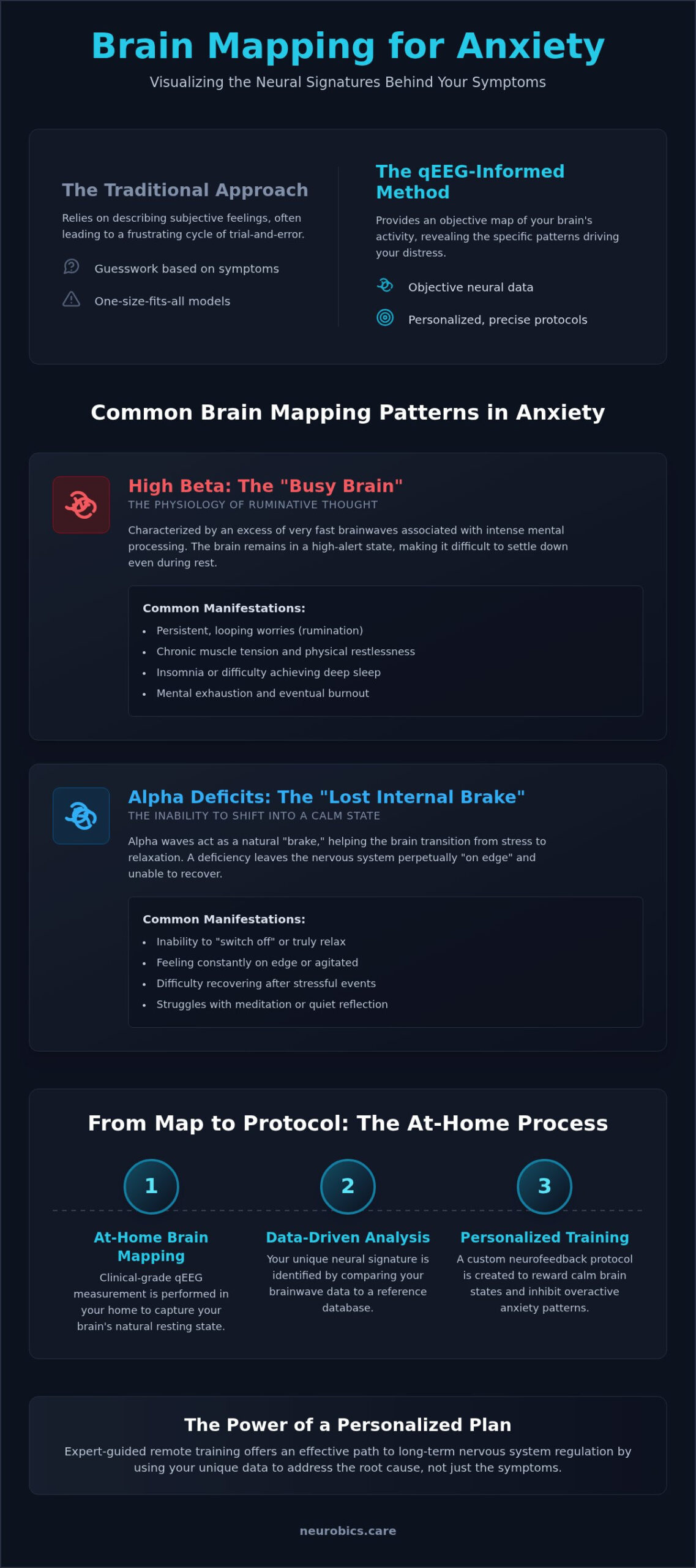
While every individual’s neural signature is unique, brain mapping for anxiety patterns often reveals recurring themes in how the brain processes stress. These patterns aren’t just abstract data; they correlate directly with how you experience the world, from the physical tension in your shoulders to the racing thoughts that keep you awake at night. Addressing this mind-body connection often involves both brain-based training and structural care; for instance, specialized practices like Restore Chiropractic Center focus on upper cervical alignment to help reduce physical stress on the nervous system. By identifying these specific signatures, we can move away from general labels and toward a precise understanding of your nervous system’s current state.
High Beta: The Physiology of Ruminative Thought
Alpha Deficits: The Loss of the ‘Internal Brake’
Alpha waves are the brain’s natural way of transitioning into a state of relaxed alertness. They act as an internal brake, helping you shift gears from a busy workday into a calm evening. In many brain mapping for anxiety patterns, we see a significant deficiency of Alpha waves, particularly in the posterior regions of the brain. When your brain lacks these calming waves, you might feel as though you’ve lost the ability to truly relax. This state makes it difficult to recover from stress, leaving your nervous system perpetually “on edge.” Understanding this deficit is a core part of What is Neurofeedback? because it shows us exactly which rhythms we need to encourage to restore balance.
Another common pattern involves overactivity in the limbic system and the cingulate cortex, often referred to as the “Emotional Loop.” This pattern is frequently seen in individuals who struggle with emotional reactivity or feeling “stuck” in certain moods. Finally, connectivity issues can occur when different brain regions fail to communicate efficiently. If the front and back of the brain aren’t synchronized, it can lead to a sense of fragmentation and difficulty focusing. If you recognize these patterns in your own life, you can contact us to see how a personalized map could provide the clarity you’ve been seeking.
The QEEG Process: Professional Precision at Home
Many people assume that high-level neurological assessments require multiple trips to a sterile clinic or hospital. Neurobics changes this dynamic by bringing clinical-grade technology directly to you. We ship professional-grade equipment to your door, allowing you to conduct an at-home brain measurement with clinical precision. This setup uses a 19-sensor cap to record the electrical activity across your entire scalp, capturing a comprehensive picture of how your brain functions. It’s a sophisticated process, yet we’ve designed it to be accessible and stress-free.
A critical advantage of this approach is the ability to record in a “resting state” within your own environment. When you’re in a clinic, the stress of travel and unfamiliar surroundings can skew the data, often making anxiety patterns look more intense or different than they are in your daily life. By measuring your brain while you’re relaxed on your own sofa, we get a more accurate baseline of your brain mapping for anxiety patterns. This authentic data is essential for building a training protocol that actually works for your real-world experience.
Preparing for Your At-Home Brain Scan
Achieving a high-quality signal is straightforward with the right guidance. We provide clear instructions on simple steps, like ensuring your hair is clean and free of products, to help the sensors maintain a strong connection. Recording in your natural environment doesn’t just offer comfort; it provides realistic data that reflects your true neural state. This process is the foundation of our At-Home QEEG Brain Mapping service, ensuring that the protocol we build for you is based on the most reliable information possible.
From Raw Data to the Visual Map
Once the recording is complete, our expert practitioners take over. They transform the complex electrical signals into intuitive, color-coded “head maps.” These maps visually represent where your brainwave activity deviates from a normative database of healthy individuals. For instance, areas showing excess High Beta might appear in bright red, while Alpha deficiencies might show up in cool blues. These visual markers make it easy to see exactly where your nervous system is struggling to regulate itself.
Once we have completed the brain mapping for anxiety patterns, the transition from raw data to a functional training protocol begins. The QEEG map serves as a literal blueprint for your remote neurofeedback sessions. We use this information to set specific “thresholds” in the training software. When your brain produces the desired brainwaves, which we call the “rewards,” the system provides positive feedback, such as a clear video or a pleasant tone. Conversely, when the system detects an excess of the fast, anxious waves identified in your map, the feedback fades. This process of “inhibiting” overactive rhythms and “enhancing” calming ones helps the brain find a more regulated state through repetition.
This level of personalization is what makes Neurobics’ remote training both safer and more effective than generic “brain training” applications. Generic tools often apply the same standard exercises to every user, which can be counterproductive if they accidentally encourage a pattern your brain already has too much of. By using your unique neural signature, we ensure the training is always moving your nervous system toward a state of balance rather than just adding more stimulation. It’s a precise approach that respects the complexity of your individual brain chemistry.
Tailoring the Training to Your Signature
For instance, if your map shows high-arousal patterns in the right frontal lobe, we might target that specific area to improve emotional regulation and reduce reactivity. This is similar to how we approach other neurodevelopmental signatures; you can read more about Neurofeedback for ADHD to see how different signatures require entirely different protocols. Our experts review your progress weekly, adjusting these thresholds as your brain becomes more adept at self-regulation. This human-led oversight ensures that the protocol evolves alongside your improvement.
Measuring Progress Against the Baseline
We don’t just rely on how you feel to determine success; we use objective data to track your journey. After a block of training, we can perform follow-up maps to visualize how the brain has reorganized itself compared to your initial baseline. This shift from simply “coping with anxiety” to actually “regulating the nervous system” is made possible by neuroplasticity. Neurofeedback is essentially a learning process for the brain, where it discovers how to maintain a calm state even when external stressors arise. Over time, these new neural pathways become the brain’s “new normal,” leading to lasting changes in how you experience stress. If you’re ready to see how a personalized protocol can support your mental clarity, get in touch with our team to discuss your options.
Why Expert-Guided Remote Training is the Next Step
Transitioning from a diagnostic map to active training is the most rewarding part of the process. While many traditional clinics require you to commute several times a week, Neurobics provides a more supportive model through remote neurofeedback. This allows for consistent, high-frequency training in the environment where you actually experience your symptoms. For someone dealing with chronic worry, the stress of navigating traffic or sitting in a waiting room can often negate the benefits of a session. By training at home, you maintain a regulated state from start to finish, allowing the brain to integrate new patterns more effectively.
Our programs are structured to provide the depth of care you need for lasting change. We offer foundational 4-week training blocks and more comprehensive 12-week programs, both of which are built entirely on your unique brain mapping for anxiety patterns. This isn’t a “set it and forget it” system. We combine 15 years of practitioner experience with clinical-grade hardware to ensure your protocol is adjusted as your brain learns to self-regulate. This human-led approach ensures that technology serves your specific needs rather than following a generic algorithm.
The Convenience of Remote Professional Support
Your Journey Toward Lasting Calm
The ultimate goal is to turn self-regulation into a life-long skill. By understanding your brain mapping for anxiety patterns, you’ve already moved from the frustration of subjective symptoms to the clarity of objective solutions. Every training session builds on the last, strengthening the neural pathways that support a calm, focused mind. This process begins with a professional assessment that serves as the foundation for everything that follows. If you’re ready to move beyond temporary fixes and discover your brain’s unique signature, contact Neurobics to schedule your home-based intake and begin your path toward a more regulated nervous system.
Your Path to a More Regulated Nervous System
Understanding your mental health shouldn’t be a matter of guesswork or endless trial and error. By utilizing brain mapping for anxiety patterns, you gain the objective clarity needed to stop simply managing symptoms and start addressing their physiological roots. This transition from subjective feelings to measurable data is the first step toward reclaiming your sense of calm and mental clarity. It’s about moving toward a state of self-regulation that feels natural and sustainable.
At Neurobics, we combine professional QEEG hardware delivered to your door with expert-led protocols based on 15 years of clinical experience. As a provider registered with the Dutch Healthcare Federation (NFG), we prioritize clinical precision and human-centered care in every remote session. You don’t have to navigate this journey alone. Our practitioners are with you at every step, ensuring your training protocol evolves as your brain learns to find its balance.
If you’re ready to see the unique signature of your own brain and build a personalized plan for lasting change, we invite you to take the next step. Book Your Professional At-Home Brain Mapping Assessment today. Better mental performance and a quieter mind are within your reach through methodical, science-backed training.
Frequently Asked Questions
What is brain mapping for anxiety, and how does it differ from an MRI?
Brain mapping for anxiety is a functional assessment using qEEG to measure electrical activity, whereas an MRI creates a structural image of the brain’s physical anatomy. While an MRI ensures there are no physical abnormalities, brain mapping for anxiety patterns identifies how your brainwaves communicate in real-time. It’s the difference between looking at a photograph of a computer and watching the software run to see where it might be glitching.
Can a QEEG brain map diagnose a specific anxiety disorder?
A qEEG brain map is not a medical diagnosis for conditions like Generalized Anxiety Disorder. Instead, it provides a functional assessment of your nervous system’s regulation. At Neurobics, we use this data to identify the neural signatures that correlate with your symptoms. This objective information helps us create a personalized training protocol rather than labeling your condition. It’s a tool for understanding your brain’s unique performance and self-regulation capacity.
Is brain mapping for anxiety patterns safe and non-invasive?
Yes, the process is entirely safe and non-invasive because the sensors only record electrical signals naturally produced by your brain. The 19-sensor cap doesn’t send any electricity or stimulation into your body; it acts like a thermometer that reads your temperature without changing it. This makes it a comfortable choice for individuals of all ages who want to understand their brain’s activity without the stress of invasive procedures.
How much does a professional at-home brain mapping session cost?
The cost of a professional brain map varies depending on the comprehensiveness of the report and the level of expert interpretation provided. Generally, industry rates in 2026 for a high-quality qEEG assessment range between $300 and $2,000. At Neurobics, our at-home service includes the shipment of clinical-grade equipment and a detailed oral report from a practitioner with 15 years of experience, ensuring you receive professional precision without the overhead of clinic visits.
How long does it take to see changes in my anxiety patterns after mapping?
Brain mapping is the initial blueprint; the actual changes occur through the subsequent neurofeedback training. Most individuals begin to notice subtle shifts in their regulation after 10 to 15 sessions. However, lasting changes in neural pathways typically require a commitment of 20 to 40 sessions. This duration allows the brain to consolidate new habits through neuroplasticity, moving from temporary relief to a more permanently regulated state of being through consistent practice.
Do I need to stop taking my anxiety medication before a brain mapping session?
You shouldn’t stop or change any prescribed medication before your session without consulting your doctor. It’s helpful to inform your Neurobics practitioner about any medications you’re taking, as they can influence brainwave patterns. We record your brain in its current state, which includes the effects of your medication. This ensures the training protocol we develop is relevant to your actual daily physiological experience and supports your current health plan without disruption.
What happens if my brain map shows ‘normal’ activity but I still feel anxious?
A “normal” result simply means your brain activity falls within a statistical average, but it doesn’t invalidate your experience. Anxiety can stem from subtle connectivity issues or specific sensitivities that a broad normative comparison might miss. Our experts look beyond simple averages to find the specific nuances in your measurement. We focus on how your brain functions relative to your personal goals for focus, sleep, and emotional regulation.
Can brain mapping help with anxiety-related sleep problems or ADHD?
Yes, brain mapping is highly effective at identifying the neural signatures shared by anxiety, sleep disturbances, and ADHD. For example, the same High Beta overactivity that drives ruminative thoughts often prevents the brain from transitioning into deep sleep. By identifying these overlapping patterns, we can create a protocol that addresses multiple symptoms simultaneously. This holistic view of your nervous system’s regulation helps improve overall quality of life rather than just targeting one issue. To explore how functional medicine and brain mapping work together to address underlying chronic symptoms, you can discover O’Keefe Matz Functional Health Clinic.
