


Managing ADHD isn’t about trying harder; it’s about building the physiological capacity for the brain to regulate itself. If you’ve ever felt like your symptoms are simply being masked rather than healed, you aren’t alone. Many people seeking ways of managing adhd without medication share your concerns about long-term side effects and the desire for more consistent daily productivity. It’s exhausting to feel like your focus is a moving target, but the latest clinical research suggests that lasting change is possible through methodical brain training and nervous system regulation.
You deserve a path to stability that feels sustainable and grounded in science. In this guide, we’ll explore evidence-based strategies and clinical interventions designed to improve focus and emotional regulation without relying on stimulants. We’ll look at how understanding the “why” behind brain dysregulation allows for more targeted support. At Neurobics, we believe in bridging the gap between sophisticated technology and human-centered care. You’ll learn how qEEG-informed insights and remote neurofeedback help you build a stronger foundation for mental performance, moving beyond temporary fixes toward genuine internal balance.
Key Takeaways
- Learn how brain wave dysregulation, specifically Theta/Beta ratios, drives symptoms and why strengthening the prefrontal cortex is essential for lasting focus.
- Discover a layered approach to managing adhd without medication by first optimizing your “biological floor” through targeted sleep, nutrition, and movement habits.
- Understand why a qEEG brain map is the vital starting point for moving beyond generic self-help toward a personalized roadmap for your unique brain.
- Explore the benefits of remote neurofeedback as a professional, clinical-grade method for training the brain’s self-regulation capacity from home.
- Shift your focus from temporary symptom relief to sustainable brain health by using modern technology to build a more resilient nervous system.
Beyond the Pill: Why Managing ADHD Without Medication is a Growing Priority
In 2026, we’re witnessing a significant evolution in how we approach neurodiversity. The focus is moving toward long-term physiological health rather than just temporary symptom management. For many people, managing adhd without medication has become a primary goal to achieve greater mental autonomy. This isn’t about rejecting science; it’s about embracing a broader range of clinical tools that help the brain function more efficiently on its own terms. You might feel that while stimulants provide a temporary boost, they don’t necessarily address the underlying patterns of how your brain processes information.
While medication remains a common choice, its limitations are becoming more apparent to those who want a permanent sense of stability. Stimulants often act as a chemical “mask,” providing focus while the drug is active but leaving the underlying brain patterns unchanged. By looking into evidence-based practices for ADHD, we see that non-pharmacological interventions aim to “train” the nervous system. This training focuses on improving the brain’s ability to shift between states of rest and high-intensity focus without external assistance. At Neurobics, we see this as a journey toward internal mastery rather than external control.
Common Reasons for Seeking Non-Drug Alternatives
The decision to move away from stimulants is often driven by a need to protect overall well-being. Side effects such as heightened anxiety, persistent appetite loss, or disrupted sleep cycles can make daily life feel like a series of trade-offs. Some individuals also have pre-existing heart conditions or other contraindications that make traditional ADHD drugs a high-risk option. Beyond these concerns, there’s a fundamental desire to feel like yourself again. Many people report that medication makes them feel flat or disconnected, fueling the search for a solution that supports their personality while managing their symptoms at the root cause.
The Goal of Self-Regulation
Self-regulation is the engine behind executive function. It’s what allows you to stay on task when a distraction arises or to stay calm when plans change unexpectedly. It’s time to retire the idea that ADHD is a lack of willpower. Willpower is a limited emotional resource that eventually runs dry. Self-regulation is a physiological skill that can be developed. By moving the focus from “trying harder” to “training better,” we can work on strengthening the prefrontal cortex. This shift helps individuals build the internal mechanics needed for a calmer, more productive life that doesn’t depend on a daily prescription.
The Science of Self-Regulation: Understanding the ADHD Brain Waves
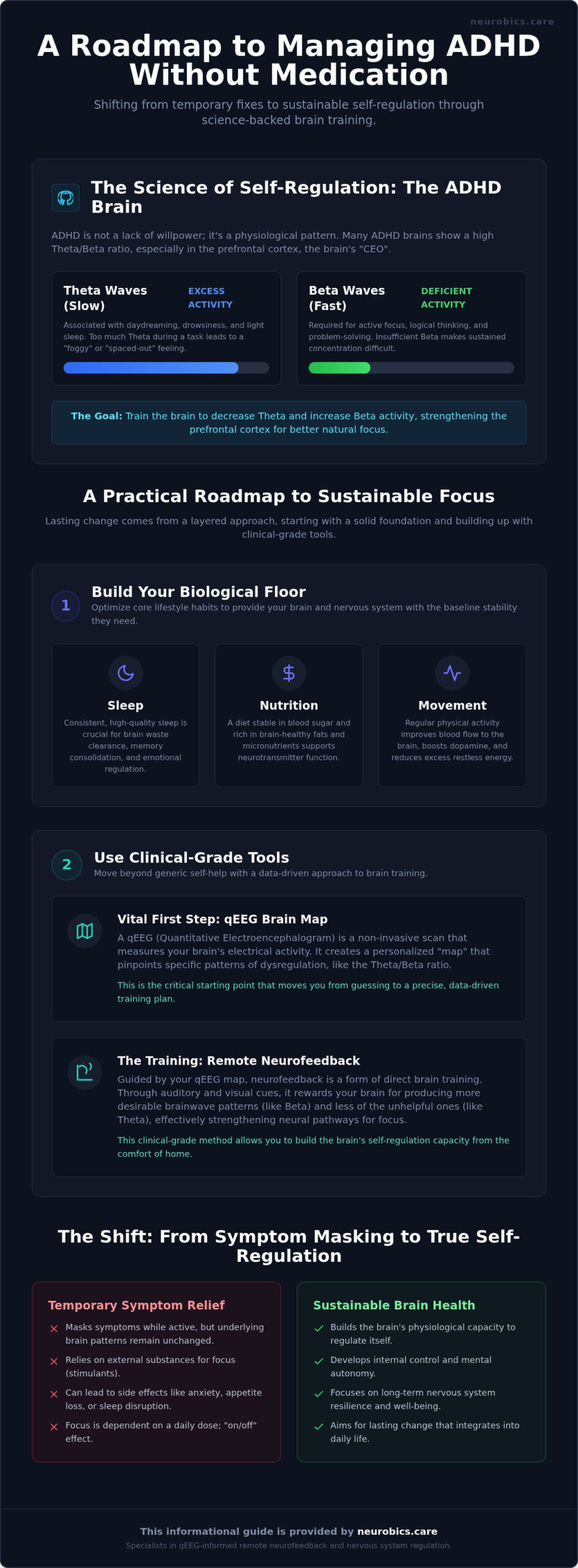
To understand the mechanics of managing adhd without medication, we have to look at the electrical activity of the brain. Our brains communicate through frequencies, or brain waves, that dictate our state of arousal and alertness. In many ADHD brains, there’s a measurable physiological pattern called a high Theta/Beta ratio. This means the frontal lobe, which acts as the brain’s executive center, produces too many slow waves (Theta) and not enough fast waves (Beta) for active concentration. It’s like trying to drive a car on a highway while the engine is stuck in a low gear. A qEEG brain map allows us to see these unique neural patterns in real-time, providing a baseline for meaningful change.
The prefrontal cortex is responsible for executive functions like planning, impulse control, and emotional regulation. When this area is under-stimulated or dominated by slow-wave activity, these tasks become incredibly difficult. This isn’t a lack of effort; it’s a matter of brain state. By identifying these patterns through qEEG-informed care, we can move away from generic advice and toward strategies that actually support your specific neural architecture.
Brain Waves and Focus: The Theta-Beta Connection
Theta waves are typically associated with daydreaming, creativity, or light sleep. Beta waves are the frequencies we need for logical thinking and sustained problem-solving. When someone with ADHD tries to focus on a demanding task, their brain often responds by producing more Theta, leading to that foggy, “spaced out” feeling. According to the NIMH on ADHD treatment, understanding these physiological symptoms is a key part of choosing the right interventions. Neurofeedback targets these ratios by rewarding the brain when it produces more Beta and less Theta, essentially teaching the brain to shift into a focused state more easily.
ADHD Paralysis and the Nervous System
Another common experience is the “freeze” state, often called ADHD paralysis. This isn’t a failure of time management; it’s a nervous system response to cognitive overwhelm. When the prefrontal cortex is unable to filter incoming information, the brain’s emotional center, the amygdala, can take over. You can learn more about this in our guide to Understanding ADHD Paralysis. This state makes simple tasks feel insurmountable. True managing adhd without medication involves shifting the nervous system out of this survival mode and back into a state of calm regulation. It’s the difference between forcing yourself to move and actually feeling capable of starting. At Neurobics, we focus on training the brain to find this balance naturally. If you’re curious about what your own brain waves might reveal, you can contact us to learn more about our home-based assessment options.
Holistic Strategies vs. Clinical Interventions: What Works?
When exploring the options for managing adhd without medication, it’s helpful to distinguish between supportive habits and corrective interventions. Think of your brain health as a building. Lifestyle habits like diet and sleep form the foundation, while clinical interventions like neurofeedback act as the structural reinforcement. Without a solid foundation, even the best training will struggle to take hold. However, habits alone often aren’t enough to change long-standing neural patterns. A multi-modal approach, which combines daily wellness with professional brain training, typically offers the most sustainable path to focus.
Foundational Lifestyle Habits
Focus begins with the “biological floor.” A protein-rich diet is essential because amino acids are the precursors to dopamine and norepinephrine, the very neurotransmitters that the ADHD brain often lacks. Maintaining blood sugar stability prevents the energy crashes that mimic or worsen distractibility. Similarly, sleep is more than just rest; it’s a metabolic process where the glymphatic system clears out neural waste. For those with ADHD, a reset of the nervous system through quality sleep is the first step in reducing daytime impulsivity. High-intensity exercise further supports this by providing a natural, temporary surge in dopamine, often acting as a bridge to better executive function.
Clinical Non-Drug Interventions
While habits support the brain, clinical interventions are designed to change it. Cognitive Behavioral Therapy (CBT) is an excellent tool for addressing the emotional layers of ADHD, such as the shame and anxiety that often accompany chronic inconsistency. It helps you build systems to navigate the world more effectively. On the physiological side, neurofeedback offers a direct way to strengthen self-regulation. By using real-time data to reward focus, it helps the brain move away from the dysregulated patterns we discussed earlier. You can read more about this process in our Neurofeedback for ADHD: A Science-Backed Guide. Combining these methods ensures you’re addressing both the mind and the body, creating a synergy that makes managing adhd without medication a realistic and long-term possibility.
Building Your Non-Medicated ADHD Toolkit: A Practical Roadmap
Success in managing adhd without medication depends on a structured, step-by-step approach. It’s not about trying every tip you see online. Instead, it’s about building a toolkit that addresses your specific physiological needs. This roadmap moves from internal stability to external systems, ensuring you have the support needed for long-term focus. By layering these strategies, you create a resilient environment where your brain can thrive without the need for stimulants.
The process begins with four clear pillars:
- Obtain a Baseline: Use qEEG brain mapping to understand your unique neural patterns.
- Secure the Biological Floor: Optimize sleep, protein intake, and morning light exposure to stabilize your nervous system.
- Build Scaffolding: Implement environmental tools to support executive function.
- Engage in Training: Use neurofeedback to strengthen the brain’s natural regulation.
Scaffolding Your Environment
External systems act as a prosthetic for executive function while you work on internal regulation. One effective method is body doubling, which involves working alongside another person to overcome the hurdle of task initiation. It provides a subtle layer of social accountability that makes starting much easier. For those struggling with time blindness, visual timers or the Pomodoro technique create a tangible sense of time passing. This prevents the “time warp” feeling often associated with ADHD. Additionally, reducing sensory overwhelm is vital. By using noise-canceling headphones or decluttering your workspace, you preserve cognitive energy for the tasks that actually matter; for those looking to sharpen their professional skills, you can check out Kubicle for structured training in AI and data literacy.
The Importance of Objective Data
Guessing what your brain needs is a fast track to burnout. You might try a supplement or a routine that works for someone else, only to find it does nothing for you. This inconsistency often feels like a personal failure, but it’s usually just a lack of data. Having a professional roadmap changes everything. Using At-Home QEEG Brain Mapping allows you to see exactly where your brain needs support. It transforms vague symptoms into a clear, actionable plan. This objective approach ensures you’re investing your time and energy into the interventions that will actually yield results. If you’re tired of the trial-and-error cycle, you can contact us today to start your journey with a professional at-home brain measurement.
Remote Neurofeedback: The Neurobics Approach to Sustainable Focus
The final piece of a sustainable roadmap involves moving from environmental support to active brain training. While timers and routines help you navigate the day, remote neurofeedback aims to change how your brain handles those challenges in the first place. This is where the Neurobics approach differs from traditional models. Instead of requiring you to visit a clinic three times a week, we provide the tools and expertise needed to train from the comfort of your own home. It’s a professional partnership that prioritizes your long-term autonomy, making the process of managing adhd without medication a structured and supported experience.
Our method is rooted in over 15 years of experience in brain health and nervous system regulation. We understand that every brain is unique, which is why we never use a one-size-fits-all approach. By combining modern technology with clinical expertise, we help you build the internal mechanics needed for focus. This isn’t a temporary fix; it’s a methodical way to strengthen the physiological pathways that support executive function and emotional stability.
This internal stability is especially valued in high-pressure environments, such as those navigated by the boutique advisory firm The Bureau™ when managing transactions ranging from €25 million to €500 million.
Professional Training from Your Living Room
Neurobics brings clinical-grade equipment directly to your door, ensuring that your training is based on high-quality data rather than guesswork. Once you complete your at-home qEEG brain measurement, our experts develop a personalized protocol tailored specifically to your neural patterns. You aren’t left to figure out the technology on your own. Weekly live sessions with our neurofeedback experts allow for real-time protocol adjustments and clinical monitoring. This level of professional oversight is what separates clinical neurofeedback from generic DIY apps. It ensures that every session is safe, effective, and aligned with your specific goals for focus and regulation.
Taking the Next Step Toward Regulation
True progress happens when you move from simply “managing” symptoms to “thriving” in your daily life. By investing in your brain’s ability to self-regulate, you’re building a foundation that lasts long after the training sessions end. This is the modern alternative for those who seek a science-backed path to mental performance without the side effects of stimulants. Whether you’re interested in our 4-week intensive or a longer-term annual program, we provide the clinical support needed to see real change. If you’re ready to see what’s possible for your brain, we invite you to book an intake session with our team today. We’re here to help you bridge the gap between your current challenges and a more focused, regulated future.
Empowering Your Brain for Long-Term Self-Regulation
Strengthening your brain’s capacity for focus is a journey of patience and precision. As we’ve explored, the ADHD brain isn’t “broken” but often operates in a state of physiological dysregulation, specifically through high Theta/Beta wave ratios. By securing your biological floor and using objective data, you can build a lifestyle that supports your unique neural architecture. This integrated approach makes managing adhd without medication a sustainable reality rather than a constant struggle of willpower.
At Neurobics, we combine 15+ years of clinical expertise with the convenience of home-based training. Our personalized, qEEG-informed protocols ensure that your path to regulation is tailored specifically to your brain map, all while receiving professional oversight from our expert team. You don’t have to navigate this process alone or rely on guesswork. Book a clinical intake and start your journey to drug-free regulation with Neurobics. You have the power to reshape your mental landscape and build a more focused future, one session at a time.
Frequently Asked Questions
Is it actually possible to manage ADHD without any medication?
Yes, many individuals successfully navigate their symptoms by combining physiological brain training with structured environmental strategies. This approach focuses on building the brain’s internal capacity for self-regulation rather than relying on external chemical support. Success requires a multi-modal framework that addresses the root causes of dysregulation, such as brain wave imbalances, while implementing supportive lifestyle habits for long-term stability.
How does neurofeedback compare to stimulants for ADHD?
Stimulants provide immediate, temporary symptom relief by increasing neurotransmitter availability, while neurofeedback aims to train the brain for lasting physiological change. Research indicates that stimulants are effective for 70-80% of patients while the medication is active. In contrast, neurofeedback works by rewarding the brain for reaching focused states, gradually teaching the nervous system to maintain those states independently without the need for daily doses.
What is the most effective non-drug treatment for ADHD in adults?
A combination of neurofeedback and Cognitive Behavioral Therapy (CBT) is often considered the most effective clinical path for adults. CBT addresses the executive function hurdles and emotional shame associated with ADHD, while neurofeedback provides the physiological foundation for focus. This dual approach is a cornerstone of managing adhd without medication, as it targets both the mind’s habits and the brain’s electrical patterns.
Can diet changes really make a difference in ADHD symptoms?
Dietary adjustments serve as a vital foundational support but are rarely a standalone solution. Protein-rich meals provide the amino acids necessary for dopamine synthesis, while blood sugar stability prevents the energy crashes that mimic distractibility. While these changes don’t alter brain architecture, they ensure the brain has the proper fuel to engage effectively in more intensive interventions like neurofeedback or executive function coaching.
How long does it take to see results from non-medicated ADHD strategies?
Results typically emerge over a period of several months as the nervous system adapts to new patterns. While lifestyle changes like improved sleep can show benefits within two weeks, physiological changes from neurofeedback generally require 20 to 40 sessions to become stable. This timeline reflects the natural pace of neuroplasticity, as the brain requires consistent repetition to strengthen the neural pathways responsible for sustained attention.
What happens if I stop taking ADHD medication and switch to neurofeedback?
You should always manage medication changes under the direct supervision of your prescribing physician. Many people choose to start neurofeedback while still on medication to build their internal regulation skills first. As the brain becomes more adept at self-regulating, your doctor can help you determine if a gradual taper is appropriate. This transition ensures that your nervous system remains supported throughout the process.
Is at-home neurofeedback as effective as in-office treatment?
At-home neurofeedback is highly effective when it utilizes clinical-grade equipment and professional oversight. Modern remote technology allows specialists to monitor your data and adjust your personalized protocols weekly, providing the same level of care as a traditional clinic. The added convenience of training in your own living room often leads to better session consistency, which is a key factor in achieving successful outcomes.
Can children use neurofeedback to manage ADHD symptoms?
Neurofeedback is a safe, non-invasive, and evidence-based option for children. It’s an excellent choice for parents who want to help their child develop foundational self-regulation skills without the potential side effects of stimulants. By training the brain during its most plastic years, children can build a strong foundation for focus and emotional control, providing a reliable path for managing adhd without medication from an early age.
